Support WBUR
Essay
These books help tell the story of my life
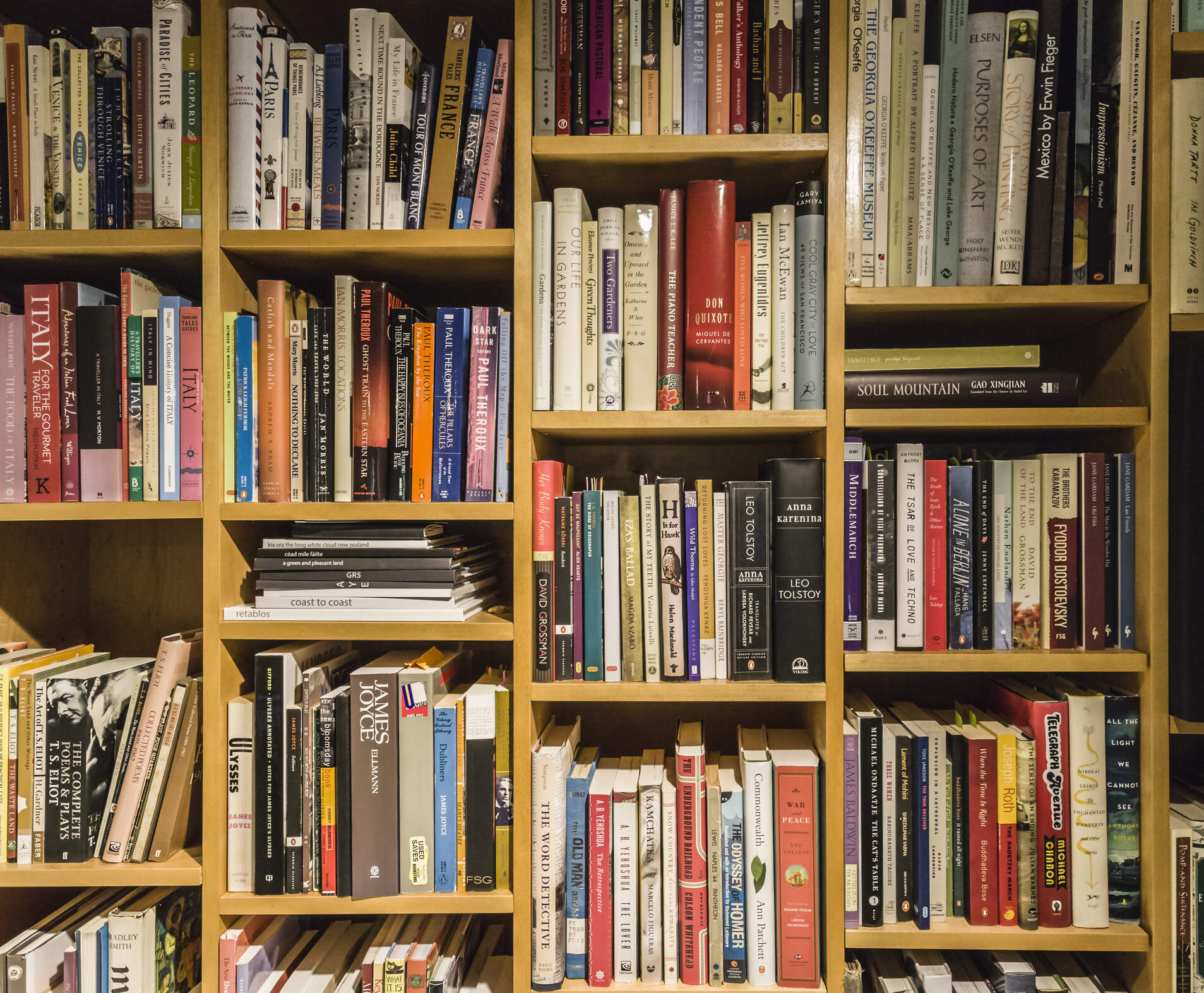
When my husband and I told friends that we were planning to move to a smaller place, they needed no explanation. Given our age, the number of stairs it took to get to our front door and a garage driveway that turned into a ski slope in icy weather, they nodded and said things like, “Yeah, we’ve been thinking about downsizing,” or “My kids have been nagging me to do that, too.”
But everyone followed up with the same question, “Are you going to have room for all your books?”
Jim and I have always had a lot of books. We’ve filled floor-to-ceiling shelves in living rooms, bedroom-offices, hallways and one nominally finished basement. Many of these books — though by no means all — have been read, with titles that testify to our individual and shared interests.
Our new place would accommodate a lot of our books, but about a third had to go. Shelf by shelf, book by book, I asked myself:
Will you ever reread this novel? No, probably not.
Would it be an insult to the dear friend who pressed this chapbook of middling poems into your hands? No.
Should you save this book for research on an article you didn’t write in the last century? No.
Wouldn’t you be relieved to get rid of the five hardcovers you bought for a project you abandoned years ago? Yes.
No books were destroyed in the process of winnowing. All were re-homed: some to friends and libraries, but most to More Than Words, a Boston-area non-profit social enterprise that employs and supports young people. (If you have more than eight boxes of books to donate, they’ll pick them up.)
Filling bookcases in the new place turned out to be a table of contents of my life as a reader and writer.
There are several shelves about Judaism and Jewish life that informed and enriched my own practice and the books I wrote about contemporary Jewish life.
I held onto the Complete Works of Shakespeare — the GOAT of human literature — and a few books that help me understand them.
There aren’t as many novels as you might expect on my new shelves, but a few that have kept me company for decades remain. The oldest is a hardcover copy of “One-Hundred Years of Solitude” by Gabriel García Márquez, which I bought the summer I graduated from high school — the year it was published in English. It remains the most vivid, sexy and confusing novel I’ve ever read, and reread.
I donated most of the poetry but kept several favorites and keep a few of them (Mary Oliver, Leonard Cohen, Billy Collins) beside my bed. Because poetry requires me to slow down and eases me into sleep.
I kept a lot of books by and about women: history, sociology, fiction, humor, biography and autobiography: “Women and Power” by Mary Beard, “Pride and Prejudice” by Jane Austen, “Savage Beauty: The Life of Edna St. Vincent Millay” by Nancy Mitford.
Also books about Boston (I’m a fan.) And American art.
While packing up the last of my collection, I discovered duplicates of three books: one of each pair was in good shape, the other was an unreadable wreck of cracked bindings, brittle paper, and in one case, 68 missing pages.
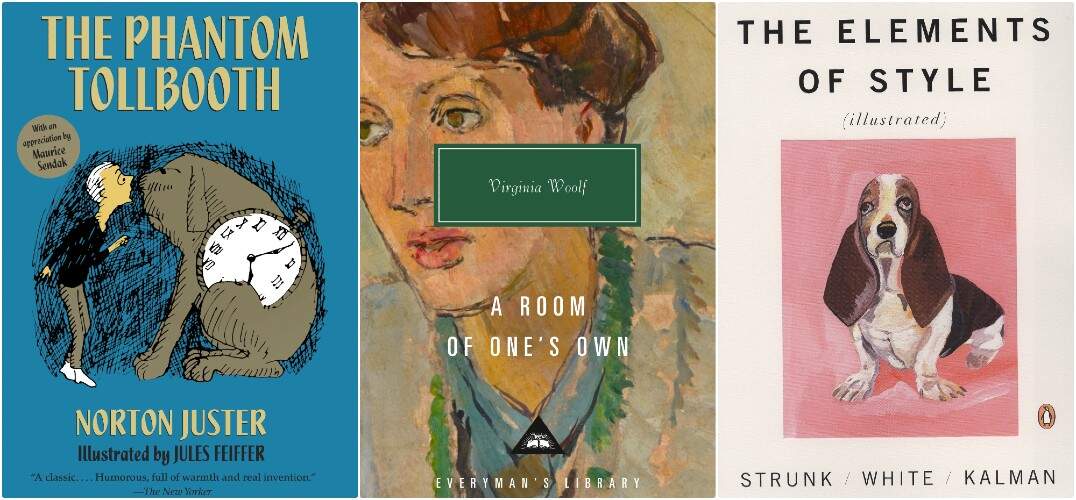
I got “The Elements of Style” as an undergraduate on the advice of my beloved English professor, Harry Martin. The book started out as a pamphlet written by William B. Strunk, professor of English at Cornell University, who distributed it for free to his students in 1920. The second edition was published as a book 35 years later, revised and introduced by one of Strunk’s former students — E.B. White, author of “Charlotte’s Web” — and has been in print ever since.
It’s a slender, no-nonsense volume that practically barks common sense in its insistence on clarity, simplicity and brevity. “Omit Needless Words” may be Strunk and White’s best-known admonishment, and it’s been my writing North Star ever since.
My duplicate copy is an illustrated version, published in 2006. It’s the only grammar book ever to land on a best-seller list, largely thanks to 57 colorful, whimsical and sometimes sly illustrations by Maira Kalman, a painter and prolific author.
I also own two copies of “A Room of One’s Own” by Virgina Woolf, which was assigned to me in a graduate school course on women’s literature. The book, based on lectures Woolf delivered at two women’s colleges in the 1920s, is a classic feminist text. While not all of Woolf’s observations have aged well, her explanation for absence of great literature written by women was revelatory: It had nothing to do with a lack of innate talent or ability, and everything to do with the fact girls were denied education and the all-consuming demands of family life left women no time to gather their thoughts, much less put them on paper.
Woolf made her point by conjuring a sister for Shakespeare — a young woman blessed with the same intelligence and passion for the stage as her brother. But having the talent, ambition and courage that made him Shakespeare would have doomed her to misery and death at an early age.
In another chapter, Woolf invents a contemporary novel in which, “Chloe liked Olivia.” And then it struck me what an immense change was there: Chloe liked Olivia perhaps for the first time in literature.
I owe a debt of gratitude to Shakespeare’s sister and the friendship between Chloe and Olivia, which watered the seed of an idea I had for a novel about a little-known, silent biblical woman.
There aren’t as many novels as you might expect on my new shelves, but a few that have kept me company for decades remain.
And then, there’s “The Phantom Tollbooth” written by Norton Juster with illustrations by Jules Feiffer, a Pulitzer Prize-winning editorial cartoonist. I was 10 years old when it was published in 1961, and my battered copy — missing the first 68 pages — has been with me since junior high school.
It’s a children’s book written from a grown-up point of view about a spoiled brat named Milo who is surrounded by all the toys and books a kid could want, but is bored by everything. One afternoon, Milo finds two mysterious packages in his room which open to reveal a child-sized car, a genuine tollbooth (“easily constructed”), a book of rules and regulations, and a map: “For use by those who have never traveled in the Lands Beyond,” which are filled with silliness, beauty, and life lessons served with a side of wry.
In 1996, my husband and I borrowed a recording of “The Phantom Tollbooth” from the library to entertain our 11-year-old daughter on the drive from Boston to Washington D.C. to participate in “The March on Washington for Our Children,” to protest cuts to federal programs that benefitted poor children.
We were enchanted by the story, sad when it ended, consoled by Milo’s transformation from spoiled brat to a curious boy who would never be bored — or waste time — again.
I had no intention of rereading “The Phantom Tollbooth” from cover to cover when I found the battered copy on my shelves. But once I started, I recalled the grown-up feeling I had as a kid: getting the jokes and puns and agreeing with its lessons about the benefits of paying attention to the wonders and curiosities right in front of me, and the pitfalls of inattention and arrogance.
I’ve given away at least one third of my personal library, and there have been moments I’ve regretted letting go of some. But then I remember that I have access to all those books and pretty much anything else I might want to read, and not only because I have a good internet connection and an e-reader.
I have access to wonderful public libraries, which is where I have found the most subtle and creative of all search engines: They are called librarians.