Support WBUR
Cog's Weekly Newsletter
The serendipity of Little Free Libraries
Editor's Note: This essay appeared in Cognoscenti's newsletter of ideas and opinions, delivered weekly on Sundays. To become a subscriber, sign up here.
I don’t remember when I first happened upon a Little Free Library, but I remember my most recent encounter with one. A friend had asked me if I’d ever read Chanel Miller’s 2019 memoir, “Know My Name,” a New York Times bestseller. I hadn’t. She urged me to. That was that, until a few days later, when I passed a Little Free Library. I peeked inside — as I always do — and spotted a copy of the book. “Look what was in the little library at the beach!” I texted my friend. “OMG,” she replied. “You must read it! It’s a sign.”
It’s that serendipity, that unexpected joy, that has, at least in part, fueled the Little Free Library (or LFL) phenomenon.
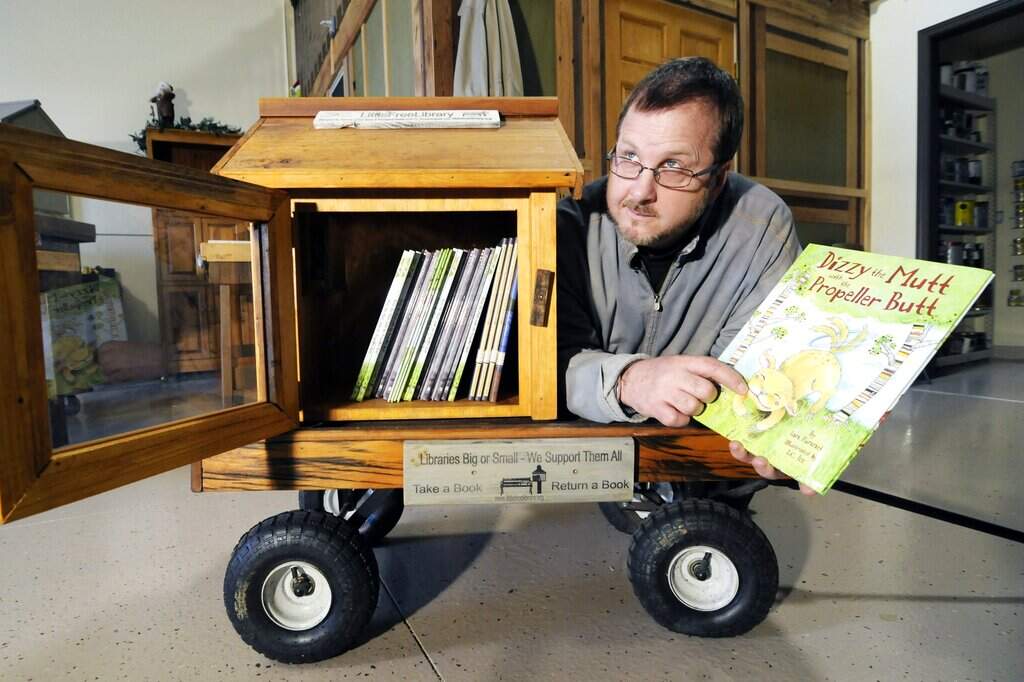
The movement began roughly 15 years ago in Wisconsin. LFL’s late founder, Todd Bol, got the idea when he was renovating his garage and couldn’t bring himself to throw out the beautiful old wooden door on the structure. He decided to use it to create a monument of sorts to his mother, who had been a teacher and tutor.
He made a 2-foot-by-2-foot schoolhouse, stuck it in his front yard and filled it with his mother’s old books. For a while, nothing much happened. But when neighbors came to his garage sale a year later, they were enchanted with the mini library. The idea caught on. More LFLs started to spring up. In 2012, Bol and his friend and business partner, Rick Brooks, registered LFL as a nonprofit organization.
Inspired by the Gilded Age philanthropist Andrew Carnegie, who established 2,509 libraries in his lifetime, Bol set a goal of building 2,510 LFLs. He surpassed that goal in two years. At the time of his death in 2018, there were more than 75,000 LFLs around the globe. Today, the number tops 200,000. And that humble nonprofit Bol and Brooks started boasts a staff of 18.
The organization’s tagline is “Take a book. Share a book.” But no one’s keeping score. You can take a cookbook, an autobiography and two novels without donating a single title. Or you can deposit your high schooler’s once beloved “Magic Tree House” boxed set in a local LFL and walk away empty-handed.
I’ve probably only taken three books from LFLs in the past decade, but I always stop at each one I pass to see what’s inside. The literary voyeur in me just can’t resist. Is that book there because the person who donated it didn’t like it? Or did they love it so much that they wanted everyone to have a copy? Did the previous owner of that out-of-print title not realize how valuable it was when they donated it?
Until I edited Meaghan Shields’ essay about her LFL this week, it never occurred to me that the “stewards” of LFLs curate the content of these libraries —that they rotate the stock to keep it from going stale, that they track trends and notice what “sells” (contemporary fiction) and what doesn’t (business books). Neither did it ever occur to me that LFLs are controversial.
Many homeowner’s associations, which seem to prioritize conformity over community, prohibit LFLs. And then there are the Reddit confessions, Facebook threads and NextDoor screeds about people removing secular novels to fill LFLs with bibles and vigilante visitors who take away books they don’t approve of so no one can read them.
And while it’s true that the LFL nonprofit charges a fee to register little libraries and sells DIY library “kits” for as much as $479.95, it also donates libraries and books to Title 1 schools and underserved communities. Residents with HOAs have found ways to amend bylaws to allow little libraries. And the NYT ethicist, who responded to one would-be book banner, has encouraged LFL fans to “think outside your own box.”
In the end, I find it hard to argue with the logic that easier access to books means more people will read more. And I find it incredibly easy to identify with Bol, who saw building a little free library as “a spiritual gesture.”
Books are my all-time favorite gift to give because they’re so personal. Accordingly, books are a big part of the Cooper family holiday tradition. Yesterday, for St. Nicholas Day, my young filmmaker son got “Uncool” by Cameron Crowe. I gave my daughter, who is applying to graduate school to study public health, “Dopesick.” And my history major son received “1929.” But if one of them eventually ends up in an LFL, I’m OK with that, too.
Follow Cognoscenti on Facebook and Instagram. And sign up for our weekly newsletter.