Support WBUR
Essay
My taekwondo community is like family
My friend Eriko lives in Tokyo, but I see her every Monday. On my computer screen she stands in an outdoor park, wearing her dobok — her taekwondo uniform. Behind her, shadows from bare trees stretch over the patchy lawn. In Japan, it’s 6:30 Tuesday morning. Here, in my basement outside of Boston, it is 5:30 Monday evening. Eriko waves to me across time and space.
We have one month until we perform in Seoul, South Korea, at a Hanmadang, a taekwondo festival, put on by Grandmaster Kim of our school. Actually, make that schools — plural. His legacy reaches across the U.S., China, Korea, Singapore, Ireland, Malaysia and, in fact, the entire global taekwondo community. Every few years he invites students to showcase their skills at an international gathering.
On Zoom, Eriko jumps and twirls —impressive, given the weight of her running shoes and the uneven ground. We try to synchronize our movements across the stuttering internet connection. In Seoul, we’ll perform with our friend Zach, who lives in Tel Aviv, Mr. Song, an instructor from our Quincy branch, and another student in Korea. We’ve been drilling remotely for six months across our patchwork of time zones. We never practice all together — and never all in person — yet we hope to perform in perfect unison. Honestly, I’m not sure we can pull it off, especially that jump and twirl.
Grandmaster Kim has listed us on the exhibition schedule as “long-term members,” but I joke that we’re the “alter kakers” a Yiddish term for old farts. At 68, I suspect I’m the most “alter” of all. When I tell people I practice taekwondo, they assume I mean tai-chi, no doubt picturing slow, graceful movements, not the martial art developed by General Choi for the Korean Army in the 1950s.
Twenty years ago I took my daughter to try a taekwondo class. She was 12 then, and we were trying to find her sport. “It’ll be fun!” I said, not expecting to fall in love myself.
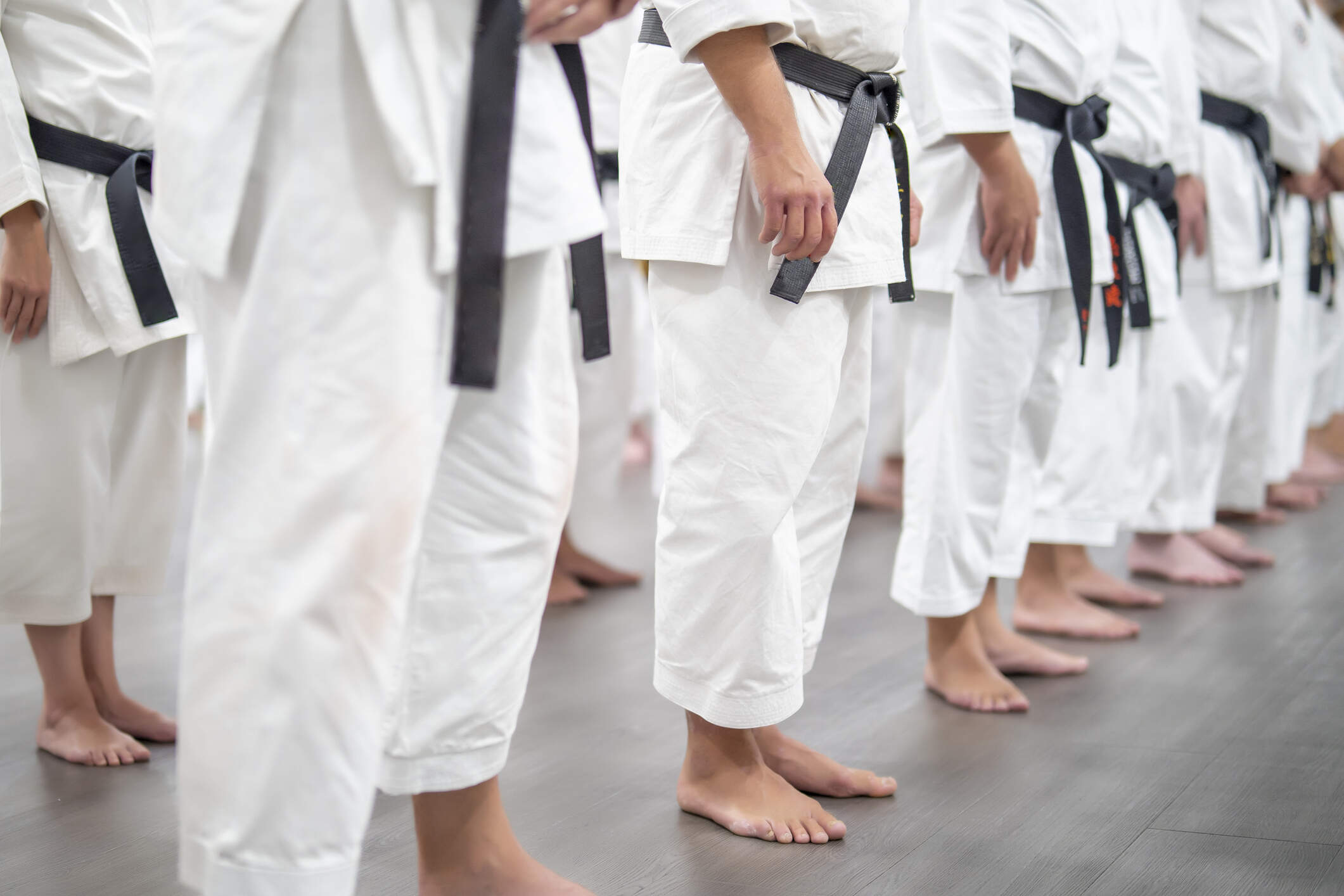
Soon, the thrill of smacking something as hard as I could, the heavy bags dancing from impact, the adrenaline of stepping into the sparring ring, unleashed a need I didn’t realize I had. What has kept me practicing for 20 years — what helped me earn a black belt — can be summed up by the graceful banners hanging in the dojang, which display our school tenets:
Improvement of mind and body. Every day there’s more for me to learn: new forms, the nuance of a punch, how to summon more power in my kicks. Five days a week, I challenge myself to do better.
Ethical self-conduct. I think of this as the no-jerks policy. Our differing opinions and beliefs don’t matter here. Only that we treat each other kindly. Along the way, respect blossoms.
Unity among members. This one’s my favorite — though I like to say community in my interpretation of “members.” We help each other. Every black belt — really, each of us — is expected to guide a lower ranked person with gentle correction and encouragement. Lift your kick higher. Position your arm like this. Try again, faster. Harder.
While disciplines like tai-chi or yoga may channel inner focus, taekwondo demands that you pay close attention to the other person, reading their face and movements, understanding their patterns of behavior. Maybe that’s why I’ve met chaplains, nurses, surgeons, dancers and therapists at the dojang; professionals like Eriko (who coaches the elderly), attuned to others’ needs.
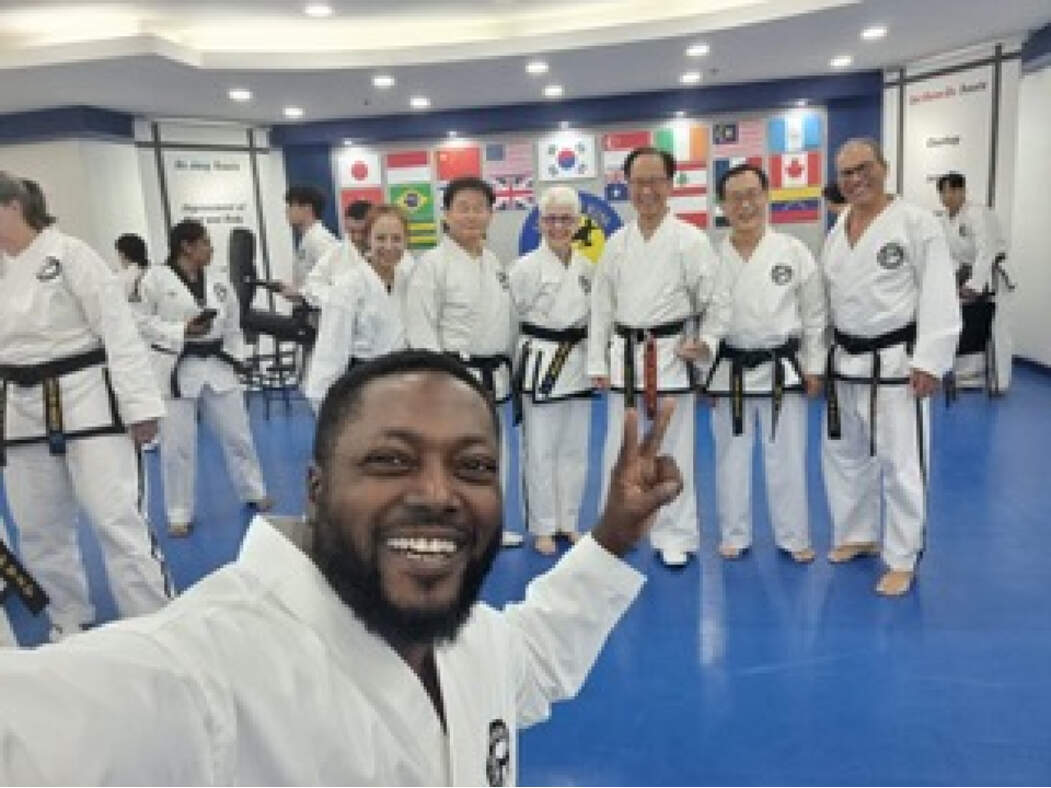
The Hanmadang was scheduled a week before Thanksgiving. In the Seoul hotel lobby, I spot Eriko, her dark puffy coat and red flannel scarf a beacon, and Zach, with his brown satchel and wide grin. “Linda!” It’s been years since we’ve been together. The miles vanish as we hug. Eriko pulls gifts out of her cloth handbag: tissues and ginger lozenges for my lingering sniffles, handwoven rings for my daughter and me. I give them both small boxes of chocolates. We go in search of the other long-term members, to arrange practice times and align our movements. We want to make the grandmaster proud.
On the day of the Hanmadang, in a light-filled room with sky blue floors, I feel the electricity: the harnessed energy and nerves of hundreds of students. Groups from nine schools take their spotlight in turn. We watch our colleagues leap over crouched bodies, pulverize concrete blocks, grapple and kick in tightly choreographed formations. We howl at the theatrics of the team from Ireland, admire the power moves of students from Seattle, the precision of Korea, the acrobatics of Singapore and Shanghai, and the mastery of the schools from Boston.
Finally, we “alter kakers’” take the stage. Grandmaster Kim calls out Joon-be! We assume ready stance, legs together, hands pressed in front. Shi-jak! Begin.
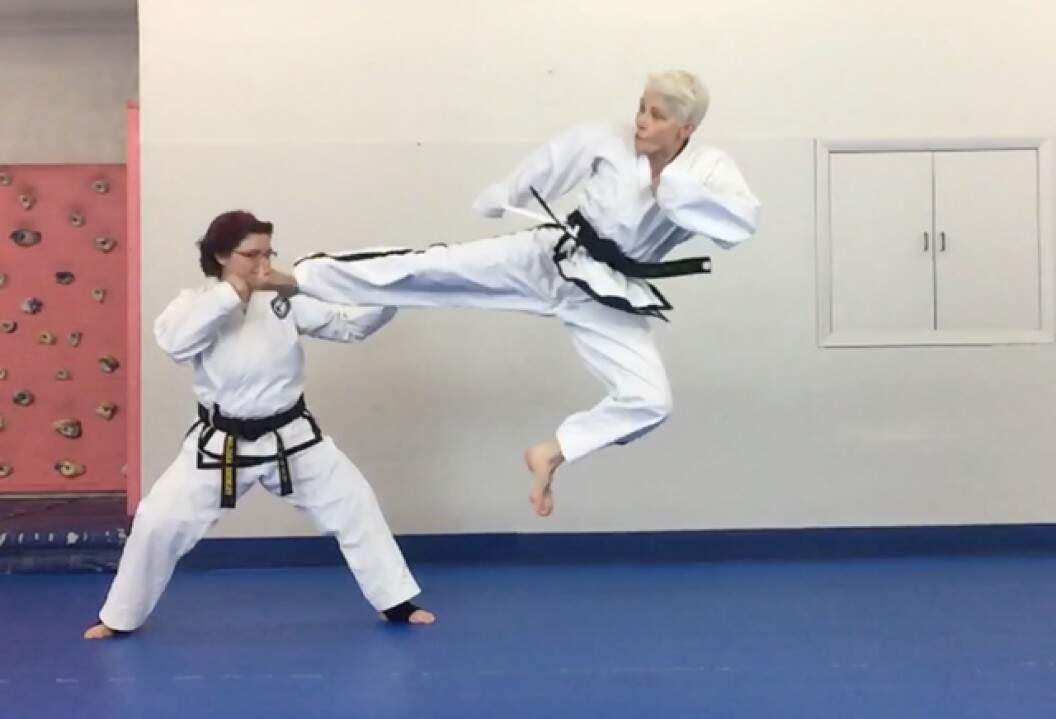
My mind goes blank. My body takes over. As I jump and twirl, I sense my friends are airborne as well and hear our feet softly hit the padding in unison. Our uniforms snap with each punch. In mere minutes it’s over. Somehow, we did it. Together. Grandmaster Kim nods, with approval I hope. Quietly, I tell myself, I can do better.
I expected a lot of feelings, coming to Seoul for the Hanmadang: pride, excitement, delight. But I had not expected to be moved to tears as I sat and watched others perform. Perhaps it was seeing so many of us, from so many corners of the globe, invest our whole selves in a shared experience.
Afterwards we crowd the dojang, taking pictures, chattering through translation apps, gestures, and smiles; conversations with few common words and yet deep understanding.
A young Korean woman bows to me and says, “You inspire!” I laugh. “Only ‘cause I’m old.”
She presses her hand against her heart. Taekwondo is a village that wraps around us like an embrace. This is why our practice touches so many lives and why, when we gather on Zoom or in person, arriving with different beliefs, families and cultures, we all speak a common global language: Friendship.