Support WBUR
Cog's Weekly Newsletter
Racket sports are hot. I finally get it
Editor's Note: This essay appeared in Cognoscenti's newsletter of ideas and opinions, delivered weekly on Sundays. To become a subscriber, sign up here.
Every summer for the last four summers, I’ve attended something called “family camp.” I’d never heard of the term before it became part of my life. But basically, you go to camp with your family: sleep in a cabin, eat meals in the mess hall, swim in the lake, go for a hike, roast marshmallows, try your hand at arts and crafts, lounge in Adirondack chairs. This sort of rustic getaway isn’t for everybody, but I’ve loved it. It’s great fun and so relaxing – and I don’t have to think about what to cook or clean or do laundry for a whole week! Heaven.
It just so happens that my family camp experience coincided with the recent pickleball craze. In 2021, some 5 million people played pickleball; by 2024, it was nearly 20 million. Derek Thompson wrote that “it might be the fastest-growing sport in modern American history.”
Family camp attendees (the adults, not the kids) got so into pickle that camp directors decided to organize a double-elimination tournament. They assigned partners – to make for more evenly matched teams – and posted the brackets to the wall in the mess hall. We got match updates during meals. The final rounds drew a decent-sized crowd, and the winners got their names inscribed on a plaque. I have a buddy who went too hard and threw his back out for a week. I shrieked strings of obscenities after accidentally stepping into “the kitchen” (IYKYK).
Is it slightly ridiculous for a group of middle-aged adults to be so hyped up about a vacation-week pickleball tournament? Possibly. Fine, yes.
But in fairness to me and my comrades, our regular lives don't include much physical competition with other people (the WBUR softball team aside, of course). I was an athlete growing up, and I miss the clarity that comes from winning and losing. But in normal life, it’s taboo to try to openly beat others. I have to compromise, be nice, interpret, read between the lines.
At last month’s Olympics, professional freeskier Eileen Gu said something about the relationship between sports and confidence that’s stuck with me: “In terms of trusting yourself, the power of sport is unparalleled because it is evidence over affirmation. You don’t tell yourself ‘Oh, I can handle the pressure. ‘Oh, I’m so great.’ You do it, time and again.”
Maybe that evidence, even more than the competition, is what I crave. There are so few areas in adulthood where my input can come even reasonably close to predicting the output. Words are squishy, people are complicated, my kids exist to push my boundaries. But sports — sports never lie to you. Thus, it should come as zero surprise that when given the opportunity to try my hand at another racket sport this winter, I took it.
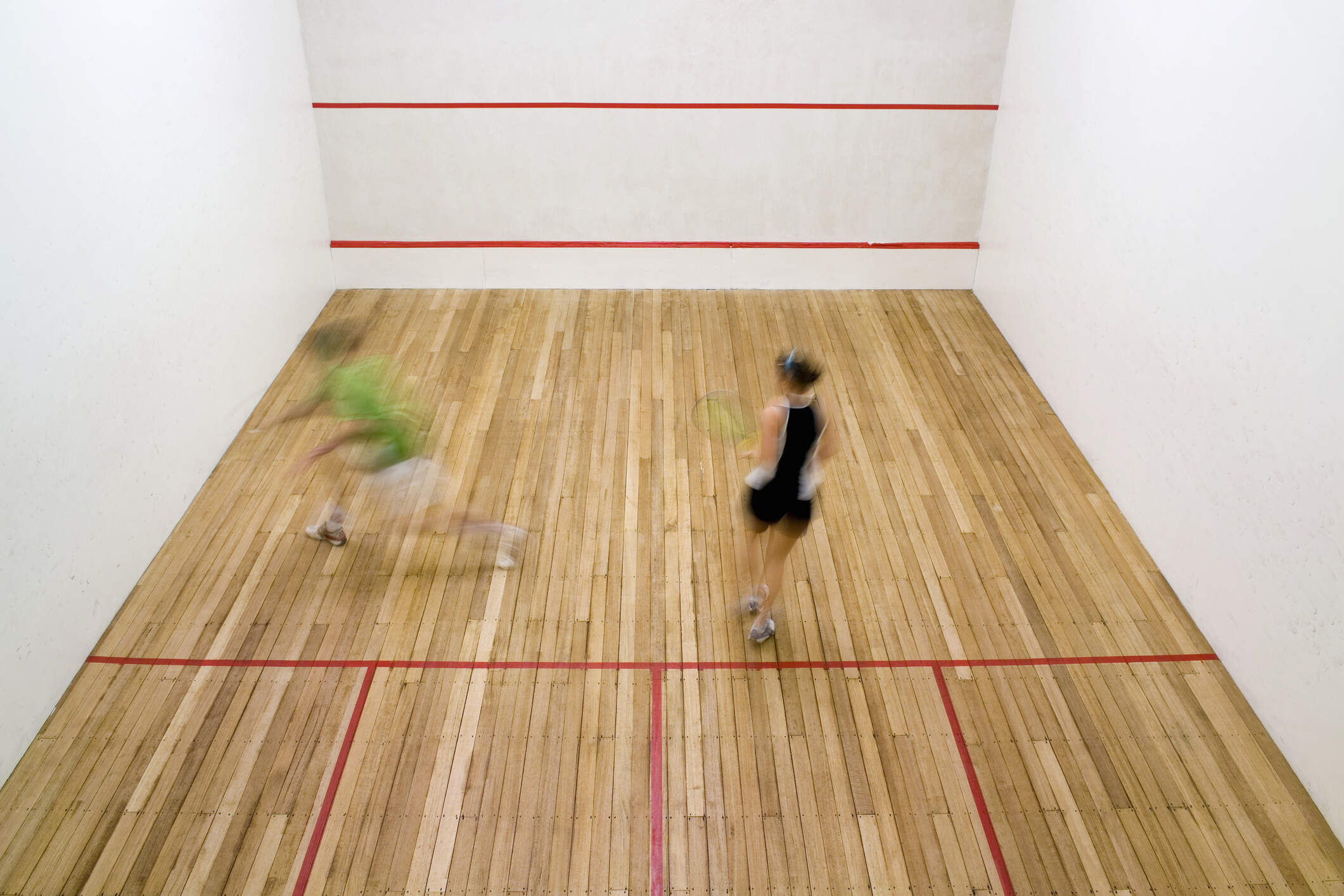
Until very recently, I believed squash was the provenance of old white men — the stuff of hair-slicked Wall Street bros and the Doonesbury comic strip. (I may have been confusing squash with racquetball, but you see my point.) When a friend invited me to play, I thought sure, sure: I’ll wear those silly goggles and do my best impression of Ben Stiller in “Dodgeball.” I didn’t think I was squash material.
Then we arrived at this little squash club in Acton, housed in an unremarkable building in an industrial park abutting the Assabet River. It was not fancy. Honestly, the narrow, concrete hallways had an old-timey prison feel. The women’s locker room is bare bones — slightly musty, but pleasant, like a middle school gymnasium.
My friend, who is also a beginner, loaned me some gear and offered up a few instructions on the rules of the game. Then we went for it. Whacking the tiny rubber ball, ripping a backhand, sprinting for a drop shot — all of it was so much fun.
Back in the locker room after our hour on court, a veritable Greek chorus of older women (all in their 60s, 70s and 80s) sang the sport’s praises. They said they played every morning for an hour and invited us to attend a women’s weekly skills clinic. They were so welcoming, so kind. An 84-year-old, the best player in the bunch, wore brightly colored high-tops in a kid’s size because her feet are so small. To be clear: I am decades younger, and she would destroy me in a match.
What was this place? I wondered. And who are these women? What’s it take to play squash into your 70s (and 80s)? I didn’t realize this could be a thing.
We went back the next week, and the week after that. Just playing. Then, a different friend invited me to join him for an hour-long private lesson. This friend is very into squash. He’d play six times a week if life allowed and has a collection of squash books that his wife jokes is so large it can be measured in linear feet.
Our instructor, a lovely Irish pro, ran us through a series of drills. I learned a proper grip. Where to stand. How to hit the ball straight. How to hit a boast (where the ball hits another wall before hitting the front wall). How to hit a serve. How to hit the ball off the back wall. How to volley.
I still can't do any of these things consistently and I have zero strategy beyond see the ball, hit the ball. But I suppose there's the potential both of those things could change, if I work at it?
I've learned that good squash players don’t run very much, because they can put the ball precisely where they want it to go — they get their opponents racing around the court. I, unsurprisingly, ran a lot: side to side, front to back. By the end of the lesson, I was a red-faced, sweaty mess. But I was smiling. I didn’t need to be affirmed for my effort. There was clear evidence of it in my wobbly legs and sweat-soaked t-shirt.
I can't wait to play again.