Support WBUR
Essay
Finding running again in midlife helped me find my people, too
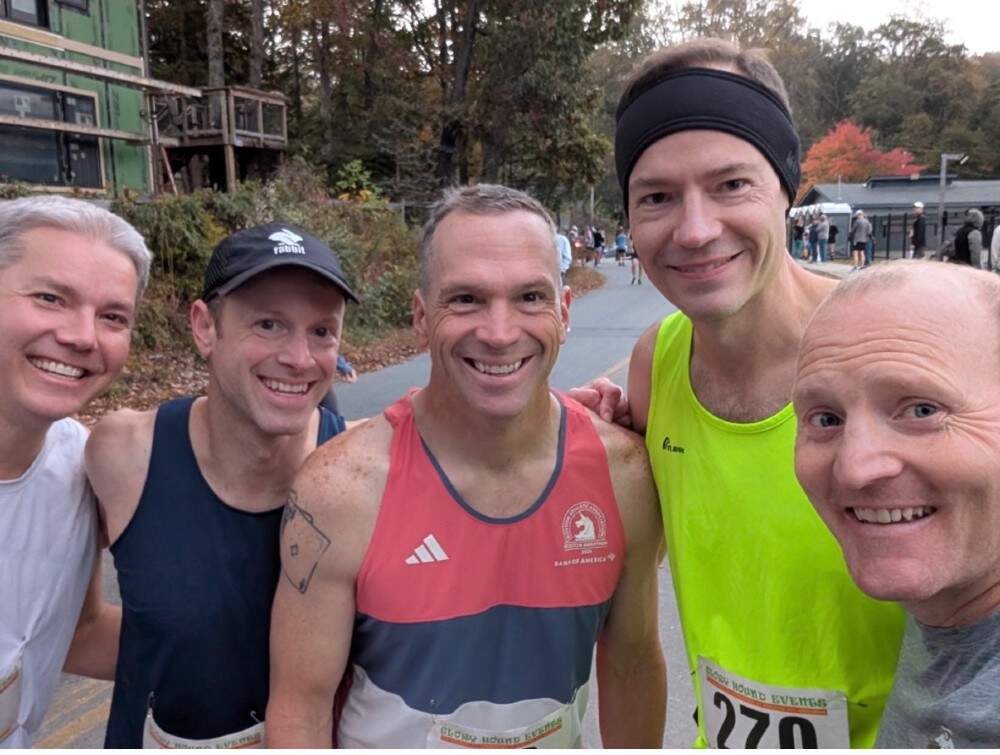
One fall afternoon, three years ago, I stood near a trail by my son’s cross country practice, stretching longer than I needed to. Two dads I had met a few times, Matt and Daniel, were heading out for a run. I lingered just enough to make myself visible.
“Seven miles,” Daniel said. “Want to join us?”
I said yes immediately. I had not run more than five miles in nearly a decade. I talked too much at first, trying to sound relaxed. Near the end, Daniel warned me about a sneaky incline. When we hit it, I briefly considered pretending to tie my shoe just to catch my breath. I did not. I focused on staying upright and keeping pace.
That night, when the run posted to Strava, another dad I barely knew commented, “That looks like fun. Hope I can join you guys next time.” His name was Derek. We did not know it then, but that comment marked the beginning of what would become our own unofficial team.
I had always thought of running as an individual sport, a place to measure myself against a watch. But by midlife I was slower, and the old definition of success no longer fit. I thought I was coming back to running for fitness. I didn't realize what I was missing was a team. I watched as, after years of soccer, my son tried cross country in middle school and found his place and his people. Through him, I found mine too.
Our kids ran together on the same club team, which meant we were at the same practices two or three times a week. Their long runs became ours. We checked in before races and after, with congratulations or quiet support, depending on how the day went.
I watched as, after years of soccer, my son tried cross country in middle school and found his place and his people. Through him, I found mine too.
Near the end of that first season, Derek invited me to join a four man relay with him, Matt and Daniel for the “Frosty Fifty.” We carried a baton, shouted encouragement and celebrated together at the finish. Afterwards, we went for burgers and beers. It was not a celebration like our youth: It was four grown men groaning as we tried to stand up, then taking the big step down out of Derek’s truck, knees protesting and quads already tight, laughing at how ridiculous it felt. Without needing to say it out loud, I already belonged. I had not realized how lonely I had become — until I wasn’t.
Later, when I ran my first marathon, one of my favorite memories happened the night before, standing in a hotel bathroom with Daniel while we practiced drinking water on the run. He showed me how to pinch the paper cups just right.
“You’re not pinching hard enough,” he said.
We went through cup after cup until the trash overflowed. I would have been embarrassed doing this with almost anyone else, but Daniel just laughed — never at me, always with me.
I qualified for the Boston Marathon the next day. As I walked through the finish area, my first thought was not about the time but that I could not wait to tell my friends. I found Daniel first. Before I could ask how he was, he hugged me and said, “You did it. And I grabbed extra beer tickets for you.” His Achilles had been bothering him for months, and his race had not gone well. And still, he wanted to celebrate me.
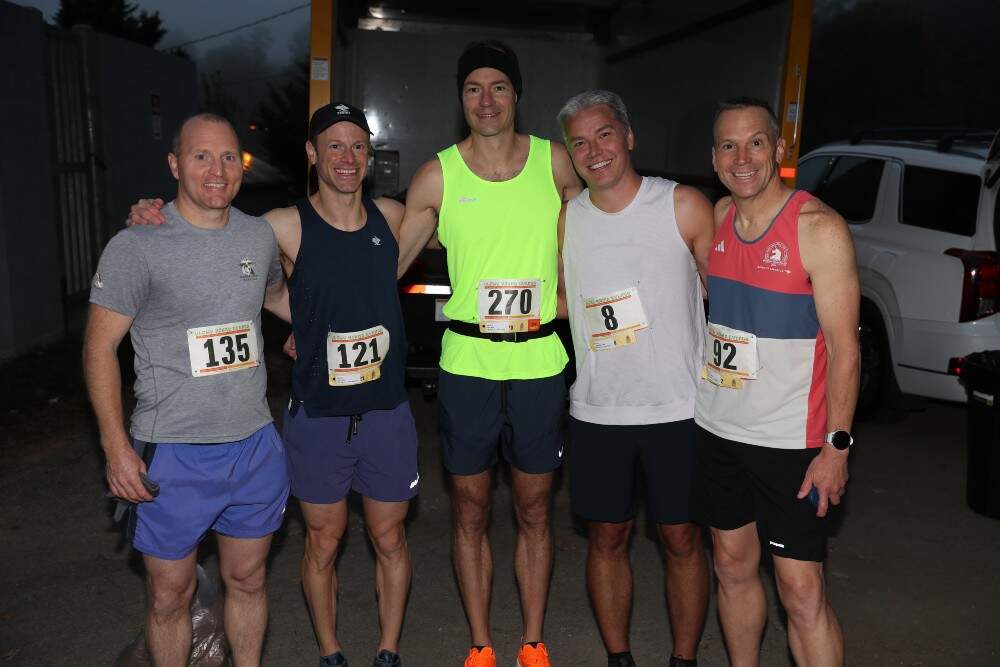
That moment stayed with me. Being a good teammate does not mean pretending disappointment does not exist. It means making room for it — and still choosing to celebrate someone else’s success. I’ve tried to pass that lesson along to my son. After a disappointing race, he wanted to leave immediately. I told him he could take a moment for himself, but after that, he had to go back out and cheer for his teammates. We stood near the finish, clapping until we began to lose our voices. I was not trying to teach him how to win. I was trying to show him how to belong.
Then I got injured. At physical therapy, the therapist was direct: Best case, I would be out for four to six weeks. I nodded, thanked him, and walked to my car. I sat there without turning the key. The tears came before I fully understood why. It was not just the running I feared losing. It was the rhythm and the easy familiarity of showing up together. But even when I could not run, the group checked in with outrage over Garmin scores, questions about my son’s races and an invitation to meet for the post run beer anyway.
As our kids aged out of the club team and scattered to different high schools, the built-in structure faded, and we saw less of one another. So I sent a message. It said simply: “I am starting a weekly Tuesday night run. Easy pace. Then a beer. Come when you can.”
The hearts started to appear, then the replies. “Great idea.” “I am in.” “That works for me.” The following week, we were all together again.
I used to measure success alone. Now I know, it is built in shared miles, quiet encouragement and choosing to be there for one another.
I grew up in Massachusetts and watched the Boston Marathon every year near the top of Heartbreak Hill. Back then, I thought the story was about toughness. Now I think it is about being seen, the simple miracle of people showing up for one another.
This April, I return as the one being cheered for, grateful for the team that got me back to that hill in the first place. They'll be there with me after, in the group text and on the next Tuesday run, long after the finish line stops mattering.