Support WBUR
Commentary
We need to practice talking to people we disagree with. Here’s how
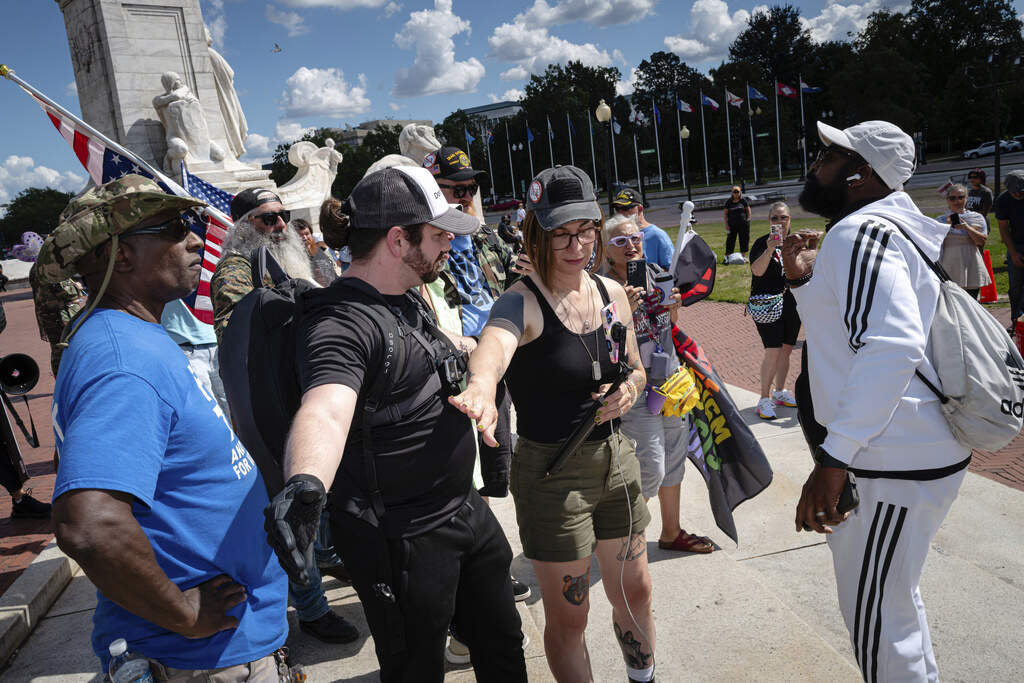
We avoid certain relatives. We change the subject when politics comes up at work. We scroll past posts from friends we’ve known for decades rather than risk a conversation that might cost us the relationship. Americans have forgotten how to talk to each other about challenging topics like politics.
Pew Research shared new survey results in February showing that more than half of American adults have stopped talking about politics with someone because of something that person said. The American Psychiatric Association found last year that nearly 1 in 5 Americans are now estranged from a family member over political disagreements — and that the same share have started skipping family events altogether to avoid the tension.
We have stopped practicing one of the most fundamental human skills: talking to people we disagree with.
The cost is real. The American Psychological Association’s most recent Stress in America survey found that 62% of adults say societal division is a significant source of stress in their lives, and that roughly half of Americans report feeling isolated, left out and lacking companionship. This isn’t just a political problem. It has become a loneliness crisis. A public health issue. And it’s showing up at work, too: In a recent report from the Society of Human Resources Management (sHRM), almost half of workers pointed to political disagreements as the number-one driver of workplace incivility.
None of this is inevitable. But reversing it requires something most of us don’t remember how to do well.
I’ve spent my career as a mediator sitting across from people who are convinced the other side will never understand them. What I’ve learned, again and again, is that they’re usually wrong. Not because their differences aren’t real. They often are. But because most conflict, including political conflict, is less about irreconcilable values and more about the inability to feel heard. When people genuinely feel heard, something shifts. The temperature drops. Conversation becomes possible.
So how do we start?
The first step is the hardest: Resist the urge to persuade. Most of us enter political conversations as lawyers making a case, not as people trying to understand. We ask questions designed to poke holes. We wait for the other person to finish so we can respond. We measure success by whether anyone changed their mind — and declare failure when they don’t. This approach almost never works, and it leaves both people feeling worse than when they started.
Instead, try listening to understand rather than to agree. After the other person speaks, reflect back what you heard — in your own words, without editorial comment. Do this not to signal that you agree, but to demonstrate that you actually understood them. Start your response with “What I’m hearing is …” or “It sounds like you’re saying ....” Mediators use this technique all the time to help people feel heard without signaling agreement. This single act of acknowledgment is more disarming than any argument you could make.
It also helps to look for shared values before engaging on policy. More often than we might think, people across the political spectrum share the same core concerns: safety, fairness, opportunity, community. Policy disagreements are real, but they’re usually arguments about how to get somewhere, not whether the destination matters. Take, for example, conversations about immigration. Often, the value of safety is seen as a dividing line, but safety can also be treated as a shared value. While one side might express safety concerns surrounding crime by undocumented individuals, the other might focus on safety concerns that cause those individuals to leave their home countries. This starting point — acknowledging a joint concern about safety — can open the door to a more constructive conversation focused on policy and priorities.
Data creates defensiveness. Stories create connection.
And when you do share your own perspective, make it personal. Abstract policy arguments rarely move people. But a real experience — an anecdote about something that happened to you or someone you love — tends to open people up in a way that talking points cannot. Personal stories can inform the conversation, so ask for them: How has this issue impacted you personally? Can you tell me more about why you feel connected to this perspective? Data creates defensiveness. Stories create connection.
Perhaps most importantly: model the tone you want to receive. People mirror the energy of the person they’re speaking with. When you approach a hard conversation with calm and genuine curiosity, you create the conditions for the other person to respond in kind. Push to convince someone they’re wrong, and you’re more likely to harden their position than change it. The goal is not to win. The goal is to stay in the relationship. Imagine a conversation with a longtime friend who holds an opposing view about vaccinating their children. Judgment or persuasion can lead to your friend hardening, or freezing, their stance — and potentially losing the friendship. Instead, ask them about their health concerns. Show them you want to learn more about the nuance of their views. These questions, based in curiosity, provide warmth and can lead to a thawing effect in both the disagreement and the friendship.
None of this is easy. Some conversations carry too much history, too much accumulated hurt, for two people to navigate alone. That’s not a failure. It’s a signal. Knowing when to ask for help, whether from a trusted third party, a counselor, or a trained mediator, is itself a skill. It is a sign of commitment to the relationship, not a retreat from it.
The American Psychological Association found something striking in its 2024 research: 4 in 5 Americans, regardless of political affiliation, say it is important to maintain relationships with people who don’t share their values. We want to stay connected. We just don’t always know how.
That’s the part we can work on: The willingness to sit across from someone who sees the world differently and choose curiosity over contempt. To ask one more question before making one more argument. To remember that the person in front of you is more than their political views, and so are you.
For those dissatisfied with the vitriol and sharpness of our political discourse, change can only start with each of us. When we listen to understand and build connection based on values rather than to win arguments, we become part of the solution.
We haven’t forgotten how to disagree. We’ve forgotten how to do it without losing each other. It’s a skill. And like any skill, it can be relearned.