Support WBUR
Essay
After a shooting, the weight of silence
This winter, my 10th grader stage managed her high school’s production of “Lockdown,” a short play by Douglas Craven. When the lights come up, the audience sees a group of students during a lockdown drill. Or is it? The entirety of the play takes place in one classroom — a teacher leaves to check on a student who runs out of the room, we hear ominous footsteps in the hallway, tensions build among those left behind. When the lights go out at the end of the show we still don’t know if it was a drill, or if the threat was real.
I was at Trader Joe’s in Cambridge on Monday afternoon when I overheard a cashier say something to his colleague about a shooter. I couldn’t catch the full scope of their conversation, but my antennae went up — the New Yorker in me on full alert.
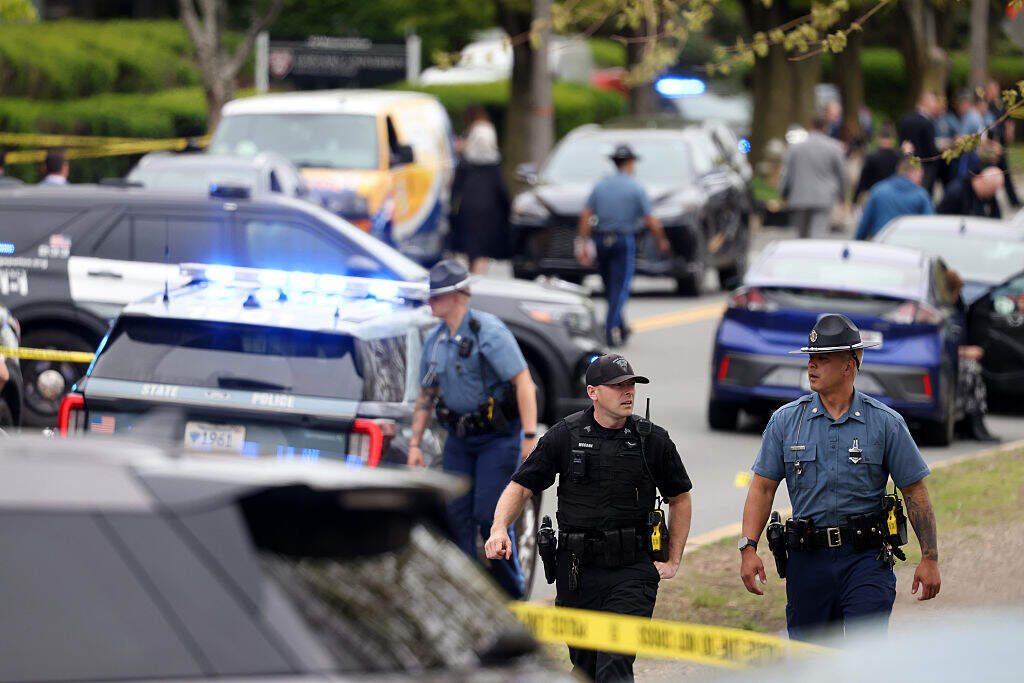
As I pulled out of the parking lot onto Memorial Drive, I was immediately met with a wall of police cars, blue lights ablaze, who forced me to turn right. One of the police cruisers followed behind me, closing down the street as we went. I was last in the line of cars allowed to take that route for the rest of the day.
I went to bed on Monday fine. Okay. And troubled yet again by the lack of an infrastructure for collective care in these moments.
Had I not stopped for spinach, I might have been on Memorial Drive when the gunman opened fire (my usual time commuting home to Cambridge from work in Longwood). I may have had to choose between fleeing or hiding under my car.
After I turned right, with the police car behind me, I called my friend who lives very close to where the shooting occurred. It was too early for news outlets to have picked up the story, but Reddit and X helped us piece together what was happening. Her children were still on “secure-and-hold” at a public school in the neighborhood (a distinction I later learned is for threats outside the school, versus “lockdown” which signals an immediate internal threat). Eventually local news would tell us that the shooter had been apprehended, but my friend would still text, “they should cut the helicopters, it’s freaking everyone out.”
Middlesex District Attorney Marian Ryan opened her press conference, by playing audio from the scene: gunshots in rapid succession for 40 seconds straight. At the end, sirens can be heard moving ever closer. Ryan said:
Sometimes these situations can seem impersonal. What you just heard was Memorial Drive in Cambridge at 1:30 on Monday afternoon. I would venture to guess that there is no one in this room who hasn’t had occasion to travel along that stretch of Memorial Drive. Particularly on a beautiful day like today.
While naming the charges the DA’s office plans to bring against the alleged shooter, Ryan added, “this, in the city of Cambridge, a relatively safe and certainly a vibrant community … what happened today cannot stand.”
And while I don’t disagree that such events are unacceptable, what I hear echoing behind her words is a familiar and troublesome trope that such violence is and should be an anomaly in “safe” places like Cambridge. Just as I’ve heard parents at my daughter’s private school say they wouldn’t want their kids in certain “unsafe” neighborhoods across the river, though their classmates live in those very places.
I am not recovering from bullet wounds. Instead, the images from Monday will be added to the carousel that spins through my consciousness as I run and drive that section of Memorial Drive daily.
I am already a worst-case-scenario person, who can’t always shut out the gruesome “what ifs” each time I say goodbye to loved ones. I was a high school senior in April 1999, when two boys — exactly my age — killed 13 and gunned down 23 more at Columbine High School. Each time I’m in a movie theater, as the lights dim, there’s still a few seconds where I think about Aurora, Colorado —12 moviegoers murdered in the summer of 2012, as I was nursing my second child. I know it is a privilege for these to be fleeting, albeit ever-present, thoughts, when there are people who live with the constant threat of gun (and other) violence.
What hit me hard as I went to bed Monday night is how few people I heard from that day. I’ve lost count of the “just checking in, you all good there?” texts I’ve sent to friends after seeing alerts on my phone. Perhaps the news of what happened on Memorial Drive didn’t make it into my friends’ algorithms?
One college friend, who now lives in D.C. did text me Monday afternoon, “Checking on you and the wonderful crew. Please let us know y’all are safe.” That’s it. At an event at a Cambridge bookstore that evening, not a single person brought up the shooting, though we were less than a mile from the scene. My kids had no questions, only blank expressions, when their father and I told them about the shooting.
What is this generation internalizing as they are released from yet another secure-and-hold? What do they no longer see as worth a reaction?
“None of us are free, until all of us are free.” Variations of this quote have been attributed to Emma Lazarus, Fannie Lou Hamer and Maya Angelou. This is what I keep coming back to. Because while I am not a victim of Monday’s shooting in many senses of that word, what is also true, is that we all are. If we become callous to this violence, or worse if we think we have bought our way into places immune from it, we overlook the crucial ways in which we are all — whether to Boston across the river, or to Iran across the globe — interconnected. If we distance ourselves from every other life into which a gun has entered, especially those who live under the daily and unrelenting spectre of violence, we are complicit.
I went to bed on Monday fine. Okay. And troubled yet again by the lack of an infrastructure for collective care in these moments. Each morning since I’ve felt the weight of that silence. Each day we wake up and, just like in “Lockdown,” as the lights fade, we hold our breath. We don’t know if today’s a drill, or if it will be the real thing.