Support WBUR
Essay
In Attleboro, a forest grows — and so does hope
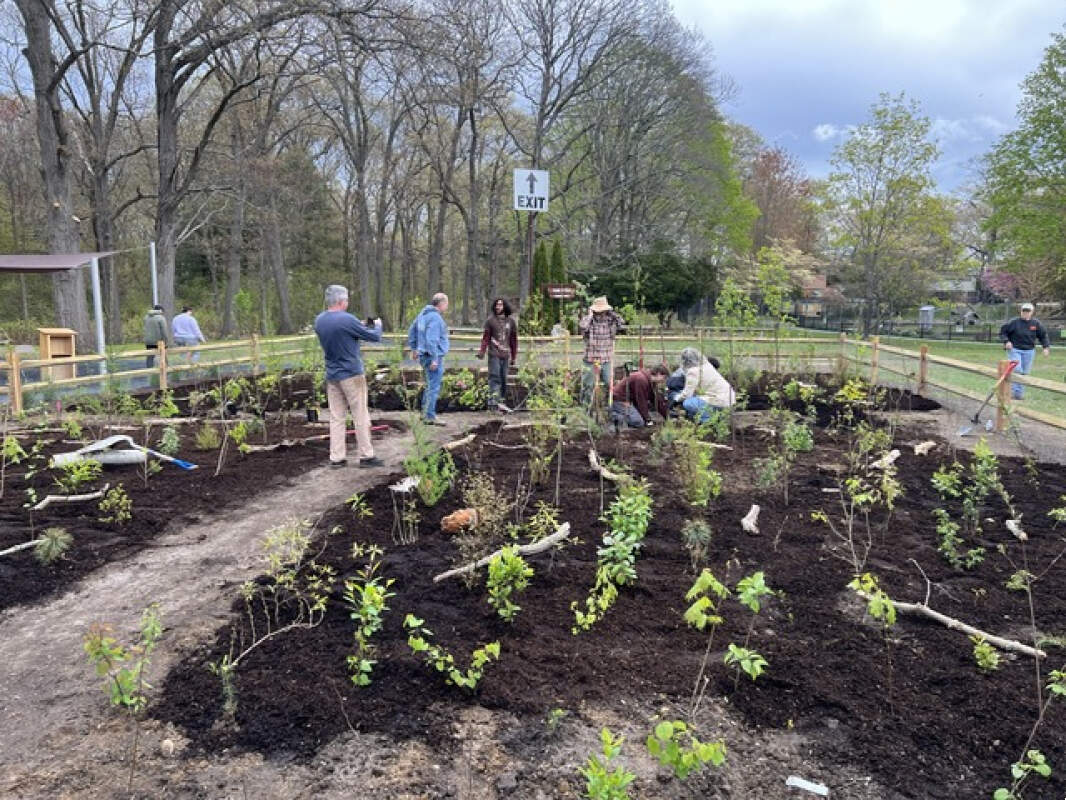
On a recent weekend in Attleboro, I watched a forest begin.
It didn’t look like much at first — just a small, 2,000-square-foot plot and a steady stream of volunteers carrying shovels and saplings, their roots soaked in compost tea. By the end of two days, more than 150 people had planted 550 native trees and shrubs from 50 different species. This little forest, a “pocket forest,” had a higher diversity of native trees and shrubs planted closer together than any other forest in Attleboro.
This project began as an idea in 2023. After a series of storms dropped a whopping 10 inches of rain that September, I worried about extensive stormwater and flood damage. Attleboro’s conservation officer, Nick Wyllie, recognized that a faster-growing forest could build inches of soil in a year: six inches of soil, with its carbohydrate-rich dirt and organisms, could hold 10 inches of water. Wyllie proposed the pocket forest as an educational demonstration forest by the high school. I was tasked with raising the necessary funds, working with the high school and finding as many native trees and shrubs as possible.
The project followed the Miyawaki method, developed by Japanese botanist Akira Miyawaki. His work was based on a simple observation: organisms that collaborate will thrive more than those that compete. Plant a greater diversity of tree species, including both field trees and mature forest trees, close together as saplings.
That idea challenges conventional wisdom about how people think about forests.
We tend to picture trees as individuals competing for space and light. But beneath the soil, a different story unfolds. Trees are connected through vast networks of fungi and microorganisms, exchanging nutrients, water and carbon. Each tree species brings its own galaxy of bacteria that respond to messages from plant cells and make available to all their products, including fixed nitrogen and enzymes that thicken cell walls. Each contributes something different, and together they form a system that is more resilient than any single tree could be on its own.
The Miyawaki method calls for planting trees more densely and with greater diversity than would otherwise occur; this naturally accelerates the formation of these underground networks. What might take decades in a conventional forest can begin within a few years. The data suggests that Miyawaki forests grow 10 times faster and become self-sufficient after just two to three years of maintenance.
Above ground, the changes follow quickly. A dense canopy helps retain moisture and block drying winds. The forest floor stays cooler and more humid, supporting the life in the soil that, in turn, supports the trees. Over time, the ground itself changes — becoming looser, richer and better able to absorb water.
That last point is especially relevant here in Massachusetts.
Rainfall hasn’t changed dramatically in recent decades, but the way our land handles it has. Compacted soils, pavement and development mean that water is less able to soak into the ground. Instead, it runs off roads and rooftops, carrying pollutants into rivers and coastal waters and contributing to flooding. At the same time, less water is stored in the soil, leaving landscapes more vulnerable during dry periods.
During the Attleboro planting, students tested nearby soils and found that water infiltration was almost nonexistent in some areas. That’s not a natural condition — it’s the result of how we’ve shaped the land.
The pocket forest offers a different possibility. As it grows, its roots will open the soil and help it hold more water. The trees will cool the surrounding area through shade and transpiration. Wildlife will return. Air quality will improve. Over time, a small patch of land will begin to function more like a healthy ecosystem again.
None of that would happen automatically.
Every step reflected an understanding that building a forest is as much about relationships as it is about trees.
What struck me most about the weekend project was not just the method but the people. High school students worked alongside college volunteers and local residents. Saplings were carefully dug from nearby woods, their roots kept intact with native soil. Compost tea was used to support microbial life, and logs rich with fungi were placed among the plantings. Every step reflected an understanding that building a forest is as much about relationships as it is about trees.
That feels like an important lesson at a time when climate change can seem overwhelming in scale.
We often look for solutions in large systems — new technologies, major infrastructure projects, sweeping policy changes. Those are necessary. But they can also feel distant from everyday life.
Projects like this operate on a different scale. They are small, local and tangible. My favorite Miyawaki forest is in East Cambridge at Greene-Rose Heritage Park. It sits on the footprint of an administrative building where a friend once worked. Now it serves as a rest area for migratory birds along the flyway to Mount Auburn Cemetery in West Cambridge.
A 2,000-square-foot forest will not solve climate change. But it can store water, cool a neighborhood, support biodiversity and reconnect people to the land. And when efforts like this are repeated across communities, their impact begins to add up.
Just as important, they invite participation. They turn climate response from something abstract into something people can see, touch and build together.
By the end of the weekend, the Attleboro site no longer looked like an empty plot. It looked like the beginning of something — not just a forest, but a way of thinking differently about how we live with the natural systems around us.
In learning how to rebuild a forest, we may also be learning how to rebuild our relationship with the land — and with each other.
Subscribe to Cog's weekly newsletter. Essays on friendship, love, loss, parenting, politics and more, from Boston's NPR.