Support WBUR
Commentary
Pope Leo sees beauty in 'wasting time together'
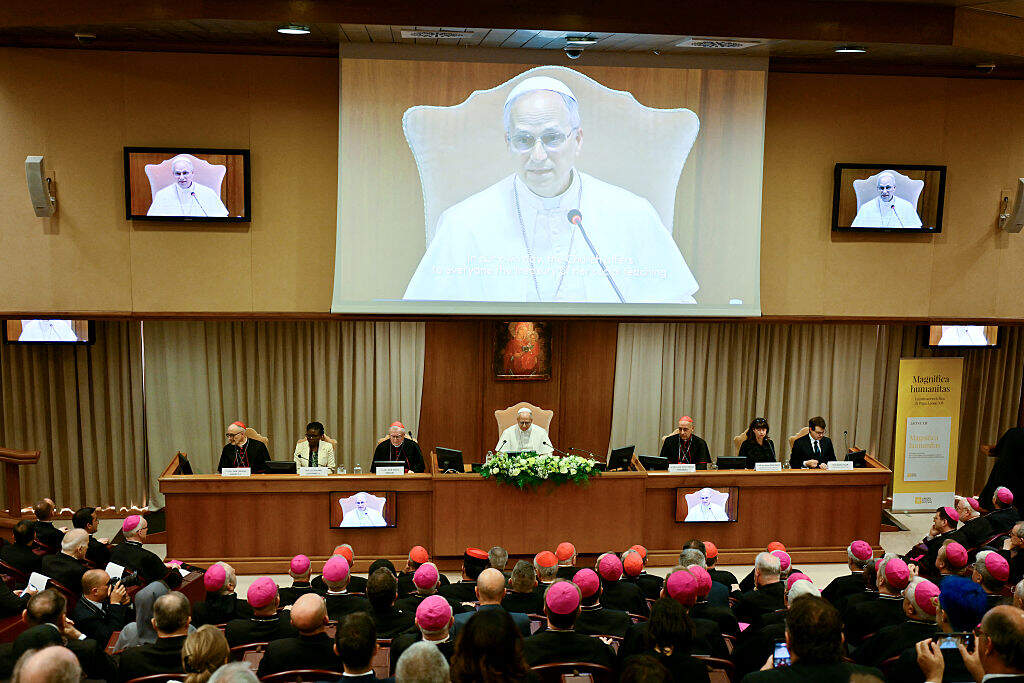
When Cardinal Robert Prevost was elected Pope in May 2025 and took the name Leo, most in-the-know experts took this as a sign that the new pontiff intended to honor Pope Leo XIII.
Best known for his 1891 encyclical “Rerum Novarum or Of Revolutionary Change,” Pope Leo XIII ushered in the modern era of Catholic social teaching by addressing the rights of workers, the needs of the poor and the dignity of the individual. In that landmark encyclical, the Church committed to be a voice of justice for the poor and called on the faithful to stand up to the seemingly inexorable forces present at the dawn of the Industrial Age: greed, unfettered capitalism and dehumanizing automation.
In Pope Leo’s “Magnifica Humanitas,” signed on May 15, 2026, exactly 135 years after “Rerum Novarum” was released, Pope Leo XIV addresses the artificial intelligence (AI) revolution — a moment not unlike the one his predecessor faced — where rapid and unregulated technological innovation, combined with concentrated wealth, power and greed, could work in concert to destabilize large swaths of humanity. The document offers a strong and compelling moral framework for how to address the opportunities of AI and the dangers of dehumanization and commodification in a world where data-driven decision-making can often trump human judgement, relationships and love.
Like “Rerum Novarum,” “Magnifca Humanitas” offers a compelling moral framework for how to address the promise and the peril of AI.
Though Pope Leo XIV was careful to draw the intellectual throughline of Catholic social thought from “Rerum Novarum” through the Second Vatican Council, and on to the writings of his recent predecessors St. John Paul II, Pope Benedict XVI and Pope Francis, I was more struck by the discontinuity between the writing of Pope Leo XIII and Pope Leo XIV.
In a moment where authoritarian voices are gaining traction globally and where polarization and disconnection are on the rise, Pope Leo XIV departs starkly from the writings of his 19th century namesake. Where “Rerum Novarum” is centered from a place of papal authority — the Magisterium or teaching authority of the Church revealing God’s truth to the world — “Magnifica Humanitas” does not. In the opening paragraphs, Leo says, in no uncertain terms that, “We wish to engage in dialogue with all men and women of our time.”
Where “Rerum Novarum” never uses the words “dialogue” or “negotiation” at any point, the new encyclical urges dialogue 36 times, with 12 additional references to the centrality of negotiation for human flourishing.
While commentators focus (with good reason) on the substance of Leo’s moral and policy framework for the use of AI, I am thunderstruck by the process by which he argues that he, the Church and indeed all humanity can best move us toward a “civilization of love” and therefore advance the common good.
The call to dialogue — to listen to the voices of the people of God beyond the bishops themselves — is not unique to this pontiff. It signals clearly Leo’s intention to build upon Pope Francis’ call for listening and a “culture of encounter” in the Church, articulated perhaps most clearly in Francis’s 2020 encyclical “Fratelli Tutti.”
In asking for God’s wisdom, Leo explicitly calls for a “shared discernment process” — not an angel in a dream or a secret vision — to guide him. And Leo follows this “shared discernment” by contrasting biblical images to point the Church in a new direction.
In the first example, Leo examines the story of the Tower of Babel where efforts to build a tower toward heaven forced uniformity and conformity, eliminating diversity. That eschewed listening and resulted in disaster. He contrasts this example with the Book of Nehemiah where, in order to rebuild Jerusalem from ruins, Nehemiah gathered people from all families, “listened to their concerns” and “did not impose solutions from above.”
As a Catholic — and as someone who believes that welcoming conflict and disagreement produces better results than using power to minimize or squelch dissent — “Magnifica Humanitas” is groundbreaking for the process of discernment, even more than for the substance of that discernment.
Even more exciting, Leo is not acting as a facilitator or mediator. He offers a strong and powerful argument in the document about the values and priorities that must guide leaders as they harness the promises of AI. But even as Leo puts forth his own view, he reminds us that it is formed with input from opinions and perspectives that may differ from his own.
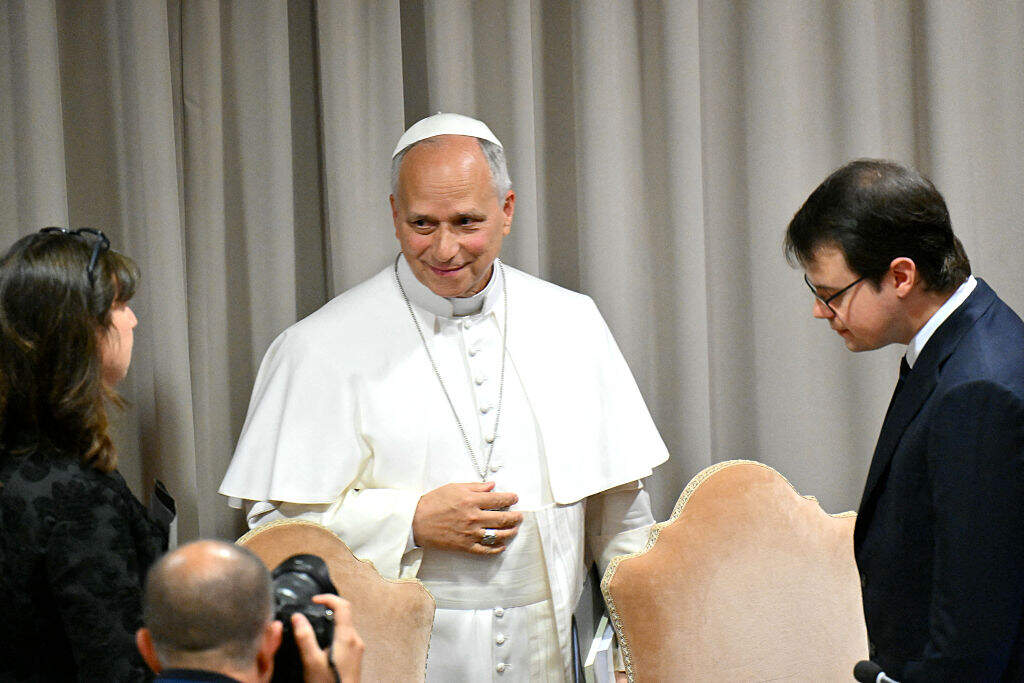
"Magnifica Humanitas" ends where it begins. In the final paragraphs, Leo tells us that “dialogue is the primary means of co-existence between people and nations.”
AI, Leo writes, is not capable of human dialogue — or of embodied conversations. And this reality is what distinguishes the tremendous power and value it can bring from the truly unique magnificence of what it means to be human.
Indeed, in paragraph 220, he celebrates the beauty of “wasting time together.” We live in a polarized world. It’s easy to avoid disagreement, stereotype the other and decry any conversation that doesn’t lead to a “solution” as a “waste of time.” Leo’s invitation toward “wasting time together” could not be more relevant, timely and encouraging. Through genuine good-faith encounters, we find communion and peace, which Leo differentiates from unanimity and homogenization.
At the Monday morning Vatican event where the Pope formally presented “Magnifica Humanitas” to the world, the pontiff seated Anthropic co-founder Christopher Olah three seats down from him on the dais. The presence of someone whose views on AI may differ widely from the pontiff’s himself is, itself, an enfleshed example of the underlying message of “Magnifca Humanitas”: When we dialogue and listen to each other across lines of disagreement and difference, when we even take the time to “waste time” with each other on activities that do not contribute to problem-solving or economic production of value, we discover the deepest learning of all — the learning that helps build a civilization of love, not power; the learning that prioritizes human dignity and freedom.
That’s learning that not even the most advanced AI model can offer.