Support WBUR
The truth about seagulls, the internet's most hated bird
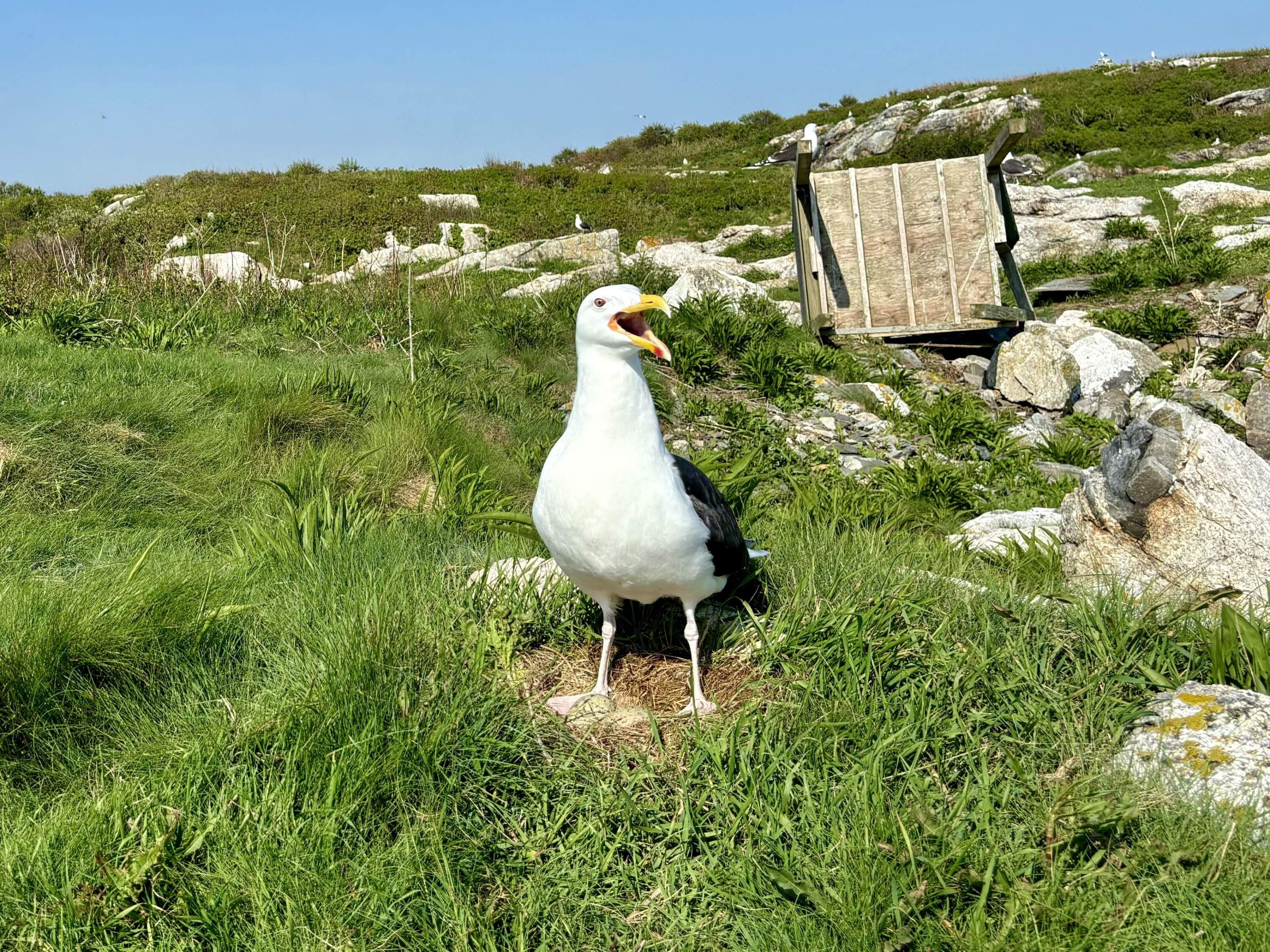
Gulls are not beloved creatures. Consult social media, where they are deemed relentless, dirty pests who steal our food and crowd our beaches. As one TikTok user puts it, "Seagulls are the worst animals to ever exist."
Such hatred overlooks truths about this intelligent, charismatic animal, and it is masking a big problem: While gulls may seem like they are everywhere, many species are dying.
Endless Thread goes on a journey to reconsider the seagull.
Show notes:
- The Gulls of Appledore
- The Virus Plus+ Lab (University of Massachusetts, Boston)
- Roof-top nesting Herring Gulls (University of New England)
- Shoals Marine Lab (University of New Hampshire)
Photo essay:
Welcome to Appledore Island, seven miles off the coast of southern Maine. We'll take you on a quick visual tour to pair with our episode.

First, we meet a bird. This one is a great black-backed gull, the focus of the Gulls of Appledore research project. Great black-backeds are the largest species of gull, once nicknamed the "tyrant Gull" by John James Audubon. (He was not a fan.)


It is May — nesting season — and hundreds of nests across the island are full of eggs. Typically, great black-backed lay up to three eggs. They tend to be dotted and olive-hued, just like the chicks yet to be born.
The process of banding gulls begins with finding the right nests. Here, researchers Jonathan Dain and Shailee Shah approach a family of great black-backeds.
The birds do not appear to be pleased. They may show displeasure in many ways. Minor agitation may warrant a "kek kek," a curious chattering call that sounds like a Muppet laughing.
More displeasure may lead to grass pulling (why grass pulling is an act of aggression is highly debated) or swooping. In the accompanying photo, Dain and Shah hold sticks above their heads, not to swat at the birds — unadvisable — but because gulls will often attack the highest point of any unwelcome guest.
The researchers are looking for an unbanded bird. Once a bird is selected, the banding begins.
Next, an elegant trap is set. The cube-shaped trap, made of wire mesh and iron rods, is laid over an unoccupied nest. One side is propped up on a stick. When a bird enters the trap and settles on the nest, the stick is pulled.


Once the gull is caught, they are safely transported to a group or researchers who will draw blood and take other measurements. Importantly, they will also attach two bands, a metal federal band and a black plastic band, unique to the Appledore project.
The blood that is drawn is used in collaboration with the University of Massachusetts, Boston, where another group of researchers is studying avian influenza.
In 2022, that lab found that a great black-backed gull may carried that year's deadly strain to North America. The flu devastated wild bird populations, including gulls.
A separate study showed that, worldwide, great black-backed gull populations have fallen by half in three decades.
Bird flu is only one part of a tangled problem. Other factors include overfishing and climate change, which increases the likelihood of harmful algal blooms and upsets prey distribution.
There are other factors. From 2012 to 2019, the Department of Agriculture authorized the take of 130,000 gulls and several hundred thousand eggs, according to one study. And gull abuse is not uncommon in urban areas, and it proliferates online.
But hope for the birds remains. The Gulls of Appledore team are making sure of it.

Finally, after the birds are banded, the researchers go "resighting," meaning they search for birds banded in previous years. This helps the team keep track of the population and understand individual and family behavior.
When the birds are not nesting, they may wander, particularly the juveniles. Because of the bands, the Appledore team has logged gulls as far as Texas and Mexico.
Maybe they'll visit you, too.