Support WBUR
Neurologist struggles with mom's Alzheimer's diagnosis
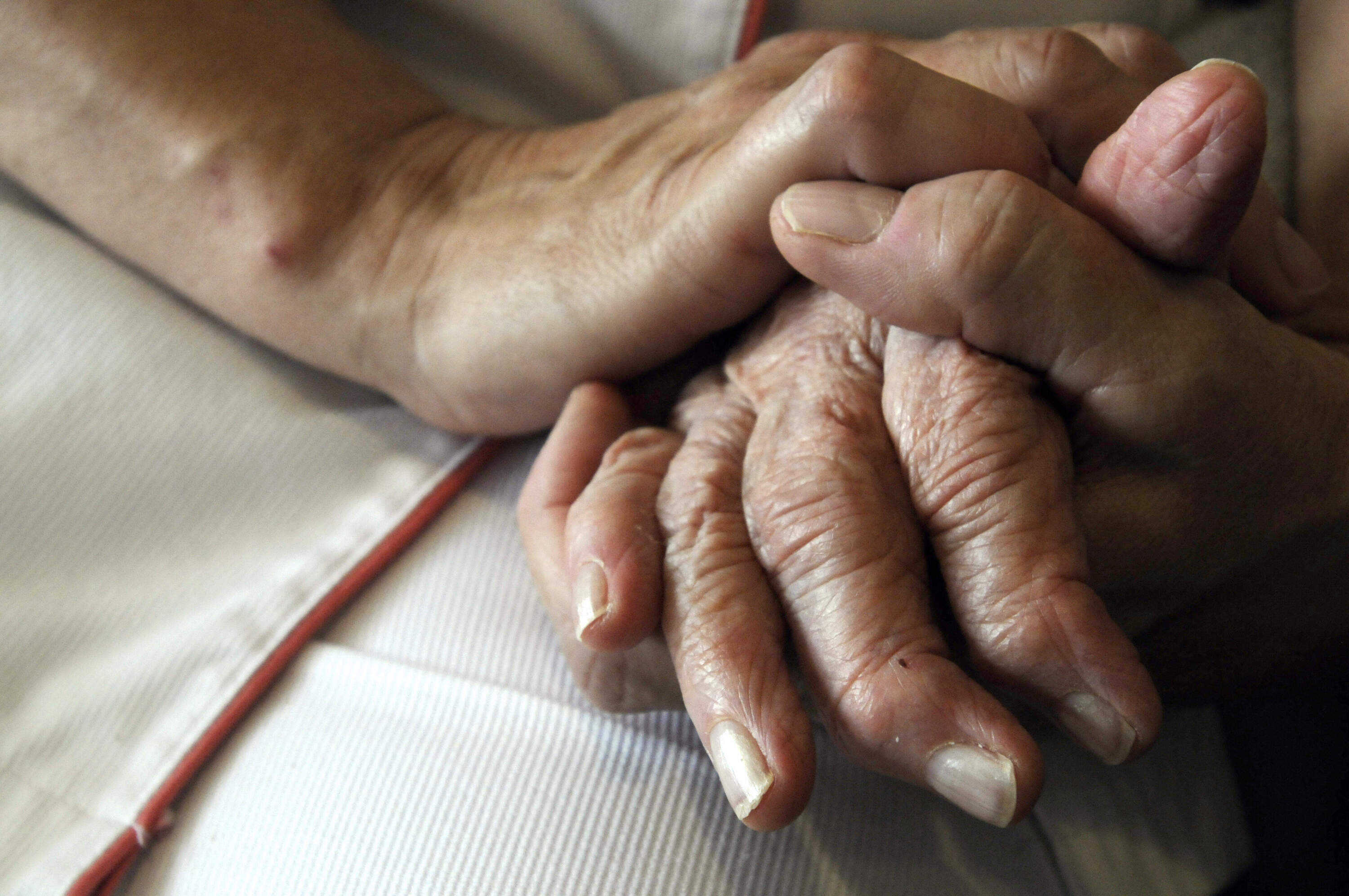
Dr. Adeline Goss is grappling with the best way to treat her mother's Alzheimer's disease. New drugs offer some hope of slowing the disease's progression, but they come with potentially serious side effects, cost a lot of money and don't offer a cure.
When her mother began treatment with one of the recently approved but controversial new drugs, Goss wasn't sure what to think. In an essay in the Boston Globe, the associate chief of neurology at Highland Hospital in Oakland, California explains how the disease is impacting her family.
“I'm just trying to savor every moment I have with her,” Goss says, “and appreciate what she offers to the world still and all the good ways that she's changing as well as the ways that can cause sadness.”
7 questions with Dr. Adeline Goss
How did you and your family first start to notice that change in your mom?
“I think it's a pretty typical story, repetitive questioning, a little bit of spaciness, not just silly things, but not remembering more important parts of our lives. The beginning of this disease can often be really ambiguous and drawn out. So there was a long, long chapter lasting years of not knowing if this was the beginning of Alzheimer's or something more routine and reversible, but then kind of reality set in.”
Your mom was a very well-regarded doctor. How did she respond to, not only what was going on, but to the diagnosis in the end?
“Her relationship to the diagnosis has changed over time. But I think initially she approached it like she's approached, approached her own medical issues in the past and medical problems of her patients. And she was very thorough. She brought herself to the best medical centers she could and sought out the best neurologists and the best testing and she tried to seek out any clinical trials that were available. There weren't any for her. And then just eagerly awaited any news of any treatment that could possibly slow down the disease or reverse the disease. And that also took many years to reach even a little glimmer of hope”
In this essay for the Boston Globe, you grapple with her treatment. You say she was waiting for some possibility to slow this disease down and she got it because there's this new drug that could stave off the worst effects of Alzheimer's, maybe for a few months. And there's also a pretty big risk with this drug. There's brain swelling and bleeding that could happen. It's very expensive. What have you been thinking about that as a neurologist? What we should all be thinking about this new opportunity?
“As you mentioned, this is not a straightforward medication. It would be easy to describe it as a burdensome medication. The one I'm talking about is called Lecanumab, but listeners may be familiar with Denanumab, which is the other FDA-approved infusion medication for Alzheimer's approved just in July. But both of these medications, they're quite similar and they're regular frequent infusions in an infusion center.
“So in the case of Leucanomab, which my mom is taking, it's every other week going to an infusion center and getting this drug, which means somebody driving her and sitting with her. And then as you mentioned, the treatment itself carries risks. So there's about a fifth of people who receive this medication will have some brain swelling or brain hemorrhage, which can be dangerous.
“And then the benefits of the treatment. are modest. They don't reverse the disease. People who take these drugs don't feel better or start thinking better. Their Alzheimer's just progresses more slowly. And that's imperceptible. There's no way to compare oneself on the medication to oneself off the medication.
“And so it's really a bit of a leap of faith that maybe this type of drug can buy a few more months. It's in the cognitive state that a person was in, but there's no way to prove it. And so I think for all of those reasons, the decision to take it or not is extremely personal.”
When this drug was presented as an option for your mom, did your reaction as a daughter differ from, say, your reaction as a neurologist and a doctor?
“I think that the possibility of risk, of course, feels different when the risk would be assumed by someone I love. So that's, I think, the part that is most frightening and heaviest to carry, just wondering if tomorrow could be the day that she develops a complication from this medication.
“But I think the other element is knowing my mother. who was a great optimist in her science and a real fighter for her patients. And so the way she sees this medication is different from how I might see it for myself. She doesn't feel resigned with her Alzheimer's. She wants to make every incremental change she can to try to slow the disease down. That is different, I think, for most patients.
“I think there's one other thing I should mention that we didn't list before, but this is an extremely expensive medication. And that's another factor. I mean, realistically, this medication is not available for the great majority of patients because they wouldn't be able to afford the out-of-pocket costs. I work at a county hospital and that's just something that, yeah, none of my patients are currently receiving at my hospital. So that's a realistic barrier as well.”
How did you find such beautiful words to describe something so terrible?
“I don't know. I mean, there's just this feeling with Alzheimer's. I just sit with this all the time and it changes so slowly. And I think that grieving my mom, It's just this creeping, slow process where I come to realizations very, very slowly over time.
“So someone pointed out that reading that they were struck by how different it sounds than I think what is often described in Alzheimer's of people fading into darkness. It does feel different than that. My mom remains a very light and positive presence. She's there. Fading into darkness doesn't quite describe that.”
Did your mom play a role in becoming the doctor you are today?
“She certainly did. My mom was a physician activist. She felt every single one of her patients and I should say worked in what was initially a very hopeless area of medicine. She focused on hepatitis C, which was It's mostly incurable when she started her career and she helped to drive that field forward to a place where many people are cured of that virus.
“And so I think like me in the field that I chose, she dealt a lot with caring about people and then seeing them die. I think she just connected first to the person in front of her, and then unlike me, she was very much a scientist and thinking also about novel compounds and clinical trials and leading all of that. So yeah, I think I did absorb some of that. I hope I absorbed some of that.”
What do you hope for your mom, this disease and yourself?
“I hope that over time that we have treatments that we can all agree are more powerful and effective and treatments that can actually reverse the slow of Alzheimer's or be given early enough that people take quite a long time to develop the disease at all.
“In the moment I feel hopeful about my ability and her ability to savor life, to appreciate life, to enjoy subtle shifts in who she is. I write in the piece about how incredibly present she is now. I write about how she can sit on the floor with my young son and just play and play and play with minutes passing. And she's not looking at her phone or getting up and checking something. She's fully in the moment. She's not in the past and she's not anticipating the future. She's right there.
“And so my hope is that I can overcome whatever gaze I have as a physician to focus on the pathology and focus on what's wrong. And instead just delight in everything she still is. I don't want to forget that she's still here. Even as we gradually lose someone, we just have to bring ourselves to the present moment and be with them and expand every moment with them. And so that's my hope for us as a family, is that we can do that and try to focus on what's good.”
This interview has been lightly edited for clarity.
Editor’s note: Host Peter O’Dowd previously worked with Adeline Goss at Wyoming Public Radio.
Peter O'Dowd produced and edited this interview for broadcast with Micaela Rodriguez. Allison Hagan adapted it for the web.
This segment aired on August 12, 2024.