Support WBUR
Oceans and their role in climate change are at the center of the new book 'Category Five'
Oceans cover more than 70% of the Earth, play a key role in the climate, drive weather patterns and absorb a vast amount of carbon dioxide.
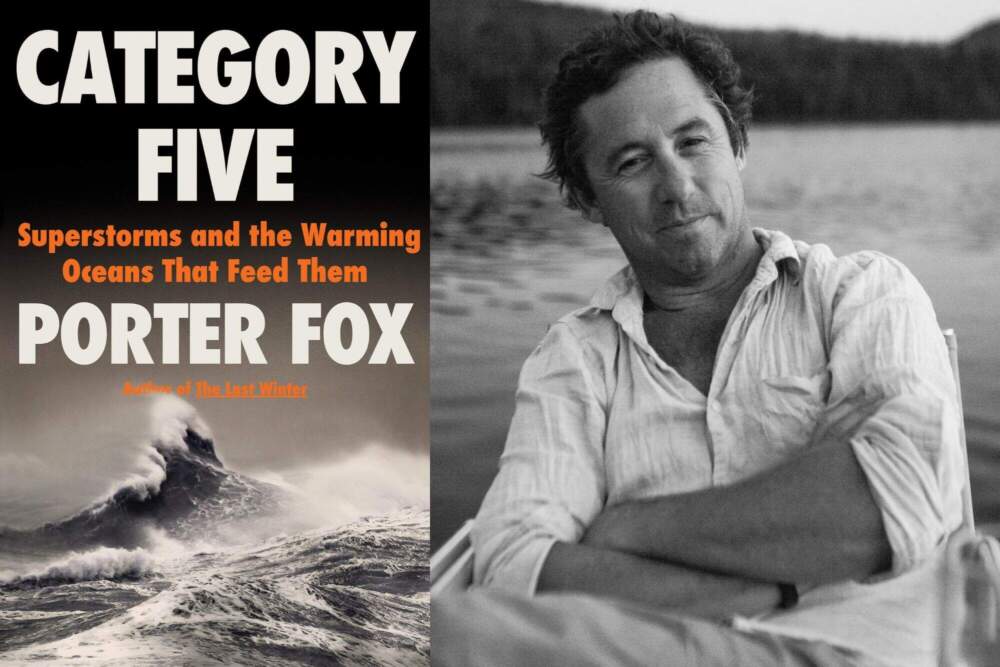
But oceans are warming along with the rest of the planet. Those warmer waters fuel more powerful hurricanes. The warming ocean’s impact on climate disasters is the topic of author Porter Fox’s new book "Category Five: Superstorms and the Warming Oceans that Feed Them.”
In his research for the book, Fox talks with people who’ve sailed during these massive storms.
“The wind accelerates to almost like a blunt force that can bend steel and break boats,” Fox says. “Just the waves themselves carry so much force that it's completely terrifying to sail into.”
Fox says he used to sail off the coast of Maine when he was younger. Though the waves weren’t as strong as those produced by a mega hurricane, Fox says the force of the ocean was terrifying then too.
Being out on the water runs in Fox’s family; his father was a boat builder before he died. Fox’s remembrance of his father plays out in the book too, who he credits as his connection to this world of storm sailors.
“I found one of the ships he had built back in the [1980s], but I really didn't have a lot of knowledge or preparation of storm sailing techniques or predicting storms and weather,” Fox says. “I was going to take my family out, so I wanted to learn about that. And that's how I met some of these storm sailors that I write about.”
Book excerpt: 'Category Five: Superstorms and the Warming Oceans that Feed Them'
By Porter Fox
The wind filled in around North Point, and I hoisted both sails with no reef for the first time the entire trip. It felt good to have some power as the Whistler hit six knots on a reach due east. In half an hour, it touched seven knots. I was making such good time, it was tempting to leave the sails as is; then I remembered the old adage: reef early, reef often. So I put on my harness and shuffled to the bow. I could feel the wind pushing the boat and watched bluegreen water peel off the stern. It was going to get windy again; I knew it. And I didn’t want to be overpowered. I tied in the first reef, then put one in the mizzen as well.
The boat continued at seven knots, but it felt more in control with the reefs tied in. Cuttyhunk, site of an old British colony, emerged from the fog. There was nothing on the windswept island but brown sand and bramble and a few boulders lying on the beach. I had been following an invisible line toward Woods Hole for six hours. A straight line on the sea is a line through time. My father had been gone for fifteen years, but right then it seemed like a day. He was on Whistler I with me, watching the sails and looking out for squalls. My grandfather was there too, along with all the ill-tempered old men who taught me how to sail, how to tie a bowline and a sheepshank, and whose boats I washed, drove, and maintained for years. They were perfectly happy to not be freezing on a thirty-eightdegree day in Buzzards Bay, and they might have been happier still that I turned out to be an all right sailor.
I hadn’t touched land in five days; I wasn’t sure I missed it. The sun dropped to the west and lit up the ocean like a house fire. Golden light lingered on the low, sandy hills of Cuttyhunk, Nashawena, and Pasque Islands. The sun dropped on a line, and a metallic golden hue reflected off the sails, the islands, the little wake peeling off the stern. It looked like a scene from an old movie, a sepia film with actors who were long dead. The characters may have been dead, but the story was alive. The plot followed water and the evolution of humankind. It followed our families too, and so it was about life on the sea. I loved this film; I could watch it over and over. I’d never tire of it. It enveloped the horizon, the peninsula, the mainland, and all that land behind, where people sit in chairs and cars and stir cocktails on their patios, then wake at three in the morning to wonder what this is all about.
I was starting to understand. I saw my parents in the movie and my brother and sister and all the people who had died and who were young and strong when I was little. Those people made me think a certain way, like how a painting or a sculpture inspires you. They were permanent objects of knowledge and strength. They had always been there. I grew up among them, thinking that they would always be around. This is the fallacy of childhood: the belief that things never change.
The old yellow captain’s house where I grew up in Southwest Harbor is owned by someone else now. The peeling paint on the porch balusters, the maple tree with the swing, the boat shop in the backyard, are all gone. They were a theater set that I walked onto unknowingly. But of course that’s wrong. That’s not how it goes. History is not a scene. It is entropy, tearing everything down as quickly as it appears. I smelled seaweed and saw miles of sand crushed by the waves, wind, rocks, and glaciers. I remembered the shores I grew up on, tidal pools, overturning rocks with friends to search for crabs, building forts in the tidelands. I was entering the movie now, slipping out of the living and into history. You can do this on the sea. I spotted the yellow iris of a goldeneye flying past Packet Rock. The contrail of a jet soaring overhead fell in line with the sun and cast a long black stripe on the water directly toward my destination. Waves grew in the cut between the Elizabeth Islands and the mainland, the incoming tide building the swell as wind surged through the slot. I wasn’t looking at the weather now; I didn’t care anymore. I had given myself over completely and wasn’t sure if I ever wanted this trip to end. I had found something that had been dormant for a long time. I’d found a way to kill old fear, to sit still for eight, ten, twelve hours at a time, to think bigger thoughts than you can summon on land.
A low growl rumbled beneath the cockpit as Whistler I hit seven knots. There was auburn in the islands now. And a trace of green. There were pines as well, and not much else in this barren, windswept place. Rhode Island appeared as a series of low hills to the north. It was hard to imagine Hurricane Bob raging through these waters, ripping trees out by their roots, pushing a fifteen-foot wall of water toward the cobblestone streets of Providence. It was remarkable to imagine a storm that started over John Kretschmer’s head in the Bahamas spinning a thousand miles up the East Coast into these waters. It was harder still to think of the storm of the future that would ravage the northeastern seaboard.
I saw the finish line an hour later. The brick and clapboard buildings of the Woods Hole Oceanographic Institute stood out on Penzance Peninsula. Antennae, satellite dishes, and PVC venting pipes jutted from laboratory buildings nestled in the little New England village. Around them, cedar-shingled beachside homes, shuttered for winter, crowded the shoreline. I kept sailing east. I’d reserved a mooring in a small harbor a few miles away. The mouth of Quissett Harbor faces northwest, protecting it from storms blowing up the bay. I started the engine, trimmed the sails, and turned hard to starboard around Gansett Point. The harbor was laced with ledges. The water was flat calm but the wind still howled. I doused the sails for the last time and motored the rest of the way.
The marina owner, Weatherly Dorris, had told me to tie up to mooring number sixty-three. She said that they had just started installing moorings for the summer season and that there were only a few boats in the harbor. Many of them were tiny Herreshoff 12½ racing sailboats. The deep keel and wide beam looked roomy and fast. I motored past a few on the dock, then glided up to my mooring.
It took an hour to put the boat away. I hauled out the sail covers, washed the decks, coiled sheets, and launched the dinghy. It was surreal catching an Uber from the boatyard to downtown Woods Hole. Everything seemed fast, even the cheeseburger and beer that a friendly waitress delivered to my seat at the bar. The bar was called Landfall. It seemed an appropriate end to the journey. A quote from Joseph Conrad was printed on the paper place mat:
In all the devious tracings the course of a sailing-ship leaves upon the white paper of a chart she is always aiming for that one little spot — maybe a small island in the ocean, a single headland upon the long coast of a continent, a lighthouse on a bluff, or simply the peaked form of a mountain like an antheap afloat upon the waters. But if you have sighted it on the expected bearing, then that Landfall is good. Fogs, snowstorms, gales thick with clouds and rain — those are the enemies of good Landfalls.
Excerpted from "Category Five" by Porter Fox. Copyright © 2024 by Porter Fox. Used with permission of Little, Brown and Company. New York, NY. All rights reserved.
Emiko Tamagawa produced and edited this interview for broadcast with Todd Mundt. Grace Griffin adapted it for the web.
This segment aired on September 23, 2024.