Support WBUR
Will the 'real' Dr. Martens please stand up? Examining the status of the iconic boot
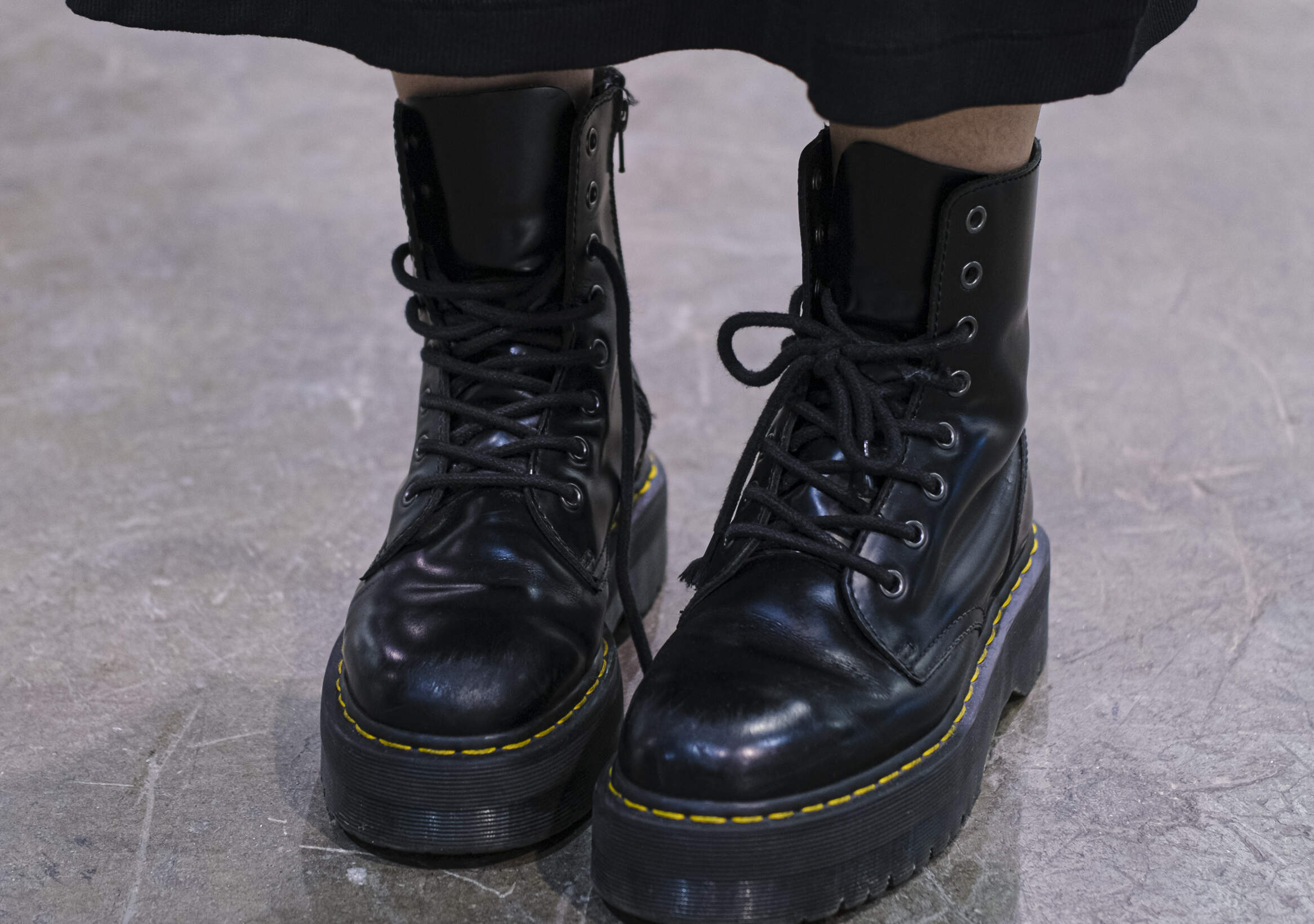
To true believers, the "real" Dr. Martens boots aren’t called Dr. Martens. They’re actually called Solovair.
New York Times fashion reporter Jacob Gallagher talks about the British boot factory that once produced Dr. Martens and lived on even after the shoe giant moved its production elsewhere.
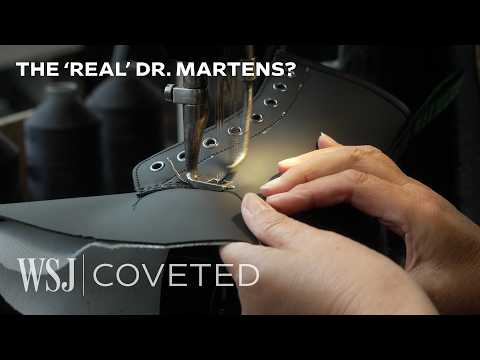
5 questions with Jacob Gallagher
How did the factory start making Dr. Martens?
"Northamptonshire is known as the cradle of British shoe manufacturing. That's really where, going back centuries, that's where shoes were produced in England for an extraordinarily long time, really up until globalized manufacturing takes off. But this is where shoes are produced in the UK.
“Somewhere around the 1950s Dr. Martens is established. And they have this novel concept to have an aerated sole. And they look around at factories and they hit on this factory that's been around for a very long time. This is NPS (Northamptonshire Productive Society), a shoe manufacturer that's been around since the late 1800s. And they, for a long time, produced Dr. Martens. They are known as Dr. Martens by Solovair which is the name that NPS hits on for making this product and for this manufacturing process. And so we have these two brands that sit in tandem. They're Dr. Martens by Solovair, and they exist in harmony for a while.
“Then, Dr. Martens makes a split that a lot of companies choose to make. They want to go big. They start producing overseas. They produce at a much greater volume. That's the Dr. Martens story. So the NPS factory looks around and thinks, “Well, maybe we can continue making these.” And they do. And they have. And under the Solovair name, they've made a shoe that to any of your listeners looks like a Dr. Martens without the yellow stitching. It looks like a work boot. It has all the kind of classic hallmarks. It's a pretty beefy shape. It's a little lustrous leather.
“To say that [Dr. Martens and Solovair] are cousins might even be underplaying it like they share much of the same DNA.”
How has Solovair survived, in an advanced economy when salaries and costs are high?
“We're talking about two extremely different scales. Dr. Martens is a mega-corporation that is producing at a really broad scale. Solovair is doing it in a much more craft, small way. I believe the figure is somewhere in the realm of just a few several thousand shoes per year. So it's really not churning them out at this incredible clip. And part of that is that these shoes take a really long time to produce. I believe the company says something around the range of 140 steps per shoe.
“But that appeals to a certain consumer: The fact that it does take all this handwork, that it does take all this time and effort to produce a pair of shoes. People like that. There's certainly a certain consumer base out there that is intrigued by [the process] and who are willing to pay for that. So they're kind of in this niche, I'd say, craft zone. They're the kind of farm-to-table equivalent of footwear.”
A lot of us buy a brand because we buy the story. And there's quite a story here. Is there a broader kind of fashion lesson here?
“Fashion brands take a lot of pains to puff up these stories, sometimes fabricate these stories a little bit. Solovair is a company that has the story authentically. It's been making shoes in this part of England since the 1880s.
“They have all rights to crow about this story in their heritage all they want. And you can't buy that. That is something that is just authentically ingrained in the tradition of this brand. And so that is invaluable for a company like Solovair. They're trying to play to people and saying, ‘Hey, we're made in England and we're made by all these local factory workers.’
“This is the way things used to be. And that really does land to a large number, I would say, of consumers not really in the fashion space as much as in what I would call like a clothing craft space. There's a similar effect we see in kind of the denim market where Levi's are mass-produced. But on the flipside, there's all these small Japanese brands that make denim kind of the old-fashioned way on ancient looms. And people are willing to pay hundreds, if not thousands, for those. And it's a similar effect also there.
How did Dr. Martens transform from a workboot to a fashion staple?
“This is just the classic fashion narrative that something that is created for a particular purpose, in this case, for people that are working in factories, working the land, or are working service on their feet all day need a hardy boot as well. They turn to Solovair and even, for a time, Solovair was making shoes for the military. So they had a function. And that function then became cool. It's this kind of magical switch that gets flipped. And to the public, they start thinking, ‘Okay, these have hardiness and these have comfort. These are, in this case, aggressive in look and all those aesthetic pieces land for a different culture base.’
“The Dr. Marten is an integral piece of punk fashion. It has been since about the 1970s. And that all happens because it's co-opting something that exists in one place and contorting it for a completely different kind of person. And that is where cool comes from.”
Does sharing the Solovair story ruin what makes the shoes special?

“There are no secrets in fashion. If you Google Solovair vs. Dr. Marten, you will be hit in the face with tens, if not hundreds of Reddit threads comparing the two shoes and hearing from a lot of people that have gone way deeper into the kind of insoles and I would say the heart of these shoes than I ever could, saying, ‘No, no, no. Solovairs are so much better than Dr. Martens. And here I'm going to tell you why.’ And trying to school everyone on why they're superior. When something is secret in fashion, because of the Internet, it never stays secret for that long.
“[Exposure] doesn't help or really, I don’t think, hurts them because they're saying “It's great that people can come to us, but in the end, we're doing our thing and we can't change that.”
“I never feel bad about exposing a story like this either, because this is one of those stories that they are running counter to the way a lot of fashion operates right now. And I think that they are worthy of attention and praise in a way, because they've been able to make a go at this and they have found a pathway in which they could they can continue to produce shoes in this area where shoe making was once integral to the local region. And now it's just a little bit less so. And then you have NPS and Solovair. They're doing their thing.”
A final fashion consumer question: What should you look for in a quality boot?
“You're looking for things like all leather, as opposed to a leather kind of poly or leather-plastic blend. And you should really be looking for that not just on the shell, the exterior of the boot, but also the inside of the boot, the insole. That's going to be a huge factor in terms of how comfortable it is and how it breaks down over time. Also make sure that the stitching looks right. Sometimes machine stitching can look too uniform or you can kind of tell by the width of it that it's just there to secure [the pieces]. And if anything frays, [the boot] is going to completely fall apart. Look for finer stitching and even look for stitching that looks like it's been done by hand. If it looks like it has imperfections, that might not be the worst thing in the world because it shows that it was someone's hand stitching, as opposed to a machine.”
Gabrielle Healy produced and edited this interview for broadcast with Micaela Rodriguez. Healy also adapted it for the web.
This segment aired on January 8, 2025.