Support WBUR
How Americans will remember Jimmy Carter
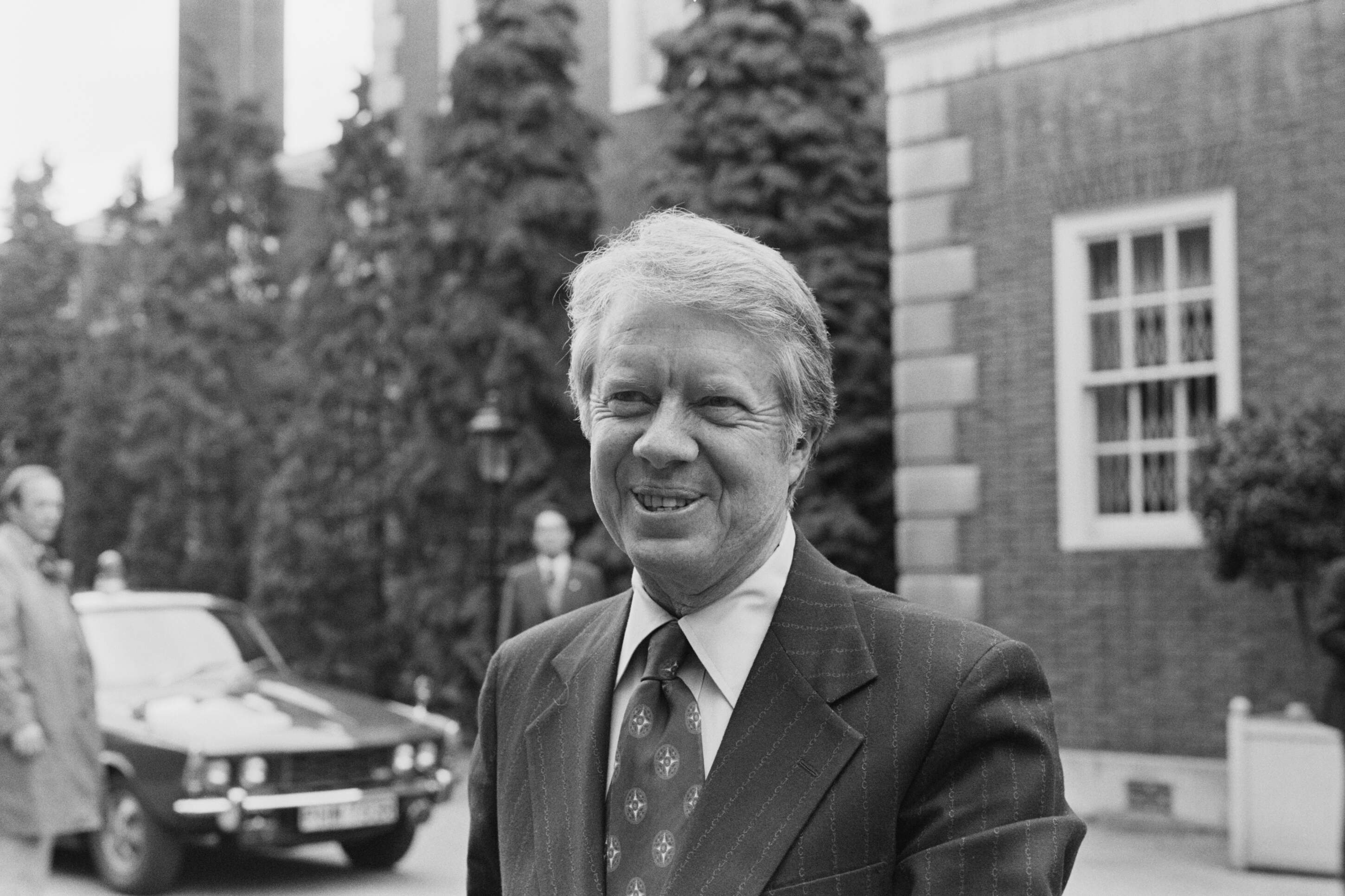
The nation paid its final respects on Thursday to former President Jimmy Carter, who died at 100 on Dec. 29.
After Carter lost his reelection in 1980, he went on to establish the Carter Center to promote human rights, monitored elections, worked to eradicate infectious diseases and promoted affordable housing through his work with Habitat for Humanity.
We asked listeners to share their Jimmy Carter stories, and here are a few of them:
Dana Walker Lindley of Louisville, KY
"President Carter called me on Jan. 14, 1980, at 10:15 p.m. My toddler son, Josh, was asleep in his crib. I was washing dishes in the kitchen sink. When the phone rang, I answered with soapy water dripping down my arms. The woman said, 'Please hold for the president of the United States.' I thought it was a joke. Then, the male voice said, 'This is Jimmy Carter,' and it was unmistakable. He thanked me for helping to organize a conference on nuclear weapons in my small Iowa town.
"Iowa’s churches had sent out an ecumenical call for parishioners to study 'blessed are the peacemakers.' Our little group had done all the usual things, book discussions, bible studies, etc., and became focused on the horrors of nuclear weapons. We wanted to share what we had learned with the community and decided to hold a symposium.
"We had no money. In a perfect example of 'if we build it, they will come,' we invited speakers to attend at their own expense. They agreed — a theologian, a U. S. senator, a peace expert and a military official from the Pentagon carrying a briefcase full of charts to explain the government’s position.
"Soon, the registration numbers exceeded the space in the church basement. We moved the event to the Simpson College auditorium. The Chicago Tribune showed up, as well as U. S. News and World Reports, garnering national attention, making Carter aware.
"Since then, I’ve wondered why the president called an anonymous young mom, and [I] think it’s because our little ragtag neighborhood group did the unexpected . We were not East Coast/West Coast 'radicals,' just concerned citizens. We got their attention, made them think, at least for a minute. It showed the power of the people functioning in a democracy as the nationwide 'nuclear freeze' movement gained momentum. In just a few years, it all gave way to President Reagan’s 'Star Wars' plans and we have plenty of [nukes] today, enough to destroy the world many times over.
"This call reflected President Carter’s character when this truly humble and gracious man spent time on his very long, busy day to say thank you. I never talked about this for years, who would believe me, until later, after his presidential daily schedule was posted online. There it was, a record of the call."
Mary Stodder of Brisbane, CA
"As an adventure after graduating from Vanderbilt, I got a job on the Delta Queen steamboat. Low and behold, when we were docked at Chester, Illinois, a tiny town on the Ohio River, four impeccably dressed [people] were ushered up on deck. I was to show them room 340, the largest room on the boat and right around the deck from the calliope.
"I could write more!
"But skipping ahead, the morning Jimmy Carter appeared from his room, the last far-away room on the sundeck, I saw a short man and two robust, tall secret service men on either side of him, one white, one Black. He walked down the deck toward me where I was busy at my maid closet, organizing towels and cleaners on my cart. I felt a bit nervous. He pleasantly said 'Hello, Mary' — having read my name tag — and I replied as per protocol learned only that week, 'Hello Mr. President.' Then he ambled on.
"I noted that he was only 5'8", my exact height, and was wearing Hush Puppies."
Donni Kennedy of Lincoln City, Oregon
"I remember Jimmy Carter with gratitude for submitting legislation in 1978 to extend and improve the budget for the Comprehensive Employment Training Act.
"Thanks to CETA, I could go to the unemployment office in Seattle and leaf through a fat binder of jobs that had never existed before. CETA funding made these jobs possible. In that fat binder, I found job description after job description written by idealists, experienced workers in the fields of social justice, public interest law, and the arts. Creative and committed people who saw that there were crying needs in the community, gaps in social services that needed filling and the possibility of solutions for people who had been falling through the cracks.
"Can you imagine?!!!
"I had no relevant experience to offer. I didn’t even have a college degree. I only knew I wanted to make a difference. I turned the pages in that binder at the unemployment office, marveling in joy and disbelief over the richness of offerings as I looked for a description that 'sounded most like me.'
"I ended up getting a job as a paralegal for an attorney who had pioneered legislation to create opportunities for developmentally disabled citizens. I was assigned to seek alternatives to incarceration for developmentally disabled people caught in the criminal justice system.
"Other CETA people hired on that project worked as community liaisons at community mental health centers that had opened up in a hurry to try to accommodate the hordes of people released from Western State Hospital when the laws around involuntary commitment changed and the mandate became to find the least restrictive alternative.
"My CETA contract as paralegal lasted a year, but launched me into the next ten years of my working life. I left criminal justice work after President Reagan got elected, which brought a shift in philosophy from rehabilitation to retribution. And social services — including alternatives to incarceration — evaporated in a matter of months.
"I was so lucky to be part of a generation of young people welcomed into meaningful well-paid employment right out of the gate. I don’t believe any generation of young workers since then has been received with such respect and appreciation.
"I think Jimmy Carter, more than any president in my lifetime, really put his money where his mouth was and devoted himself to making a difference to young people just starting out and people who had not been born into privilege."