Support WBUR
Composer Pinar Toprak reinvents the world of 'Avatar' in Grammy-nominated video game score
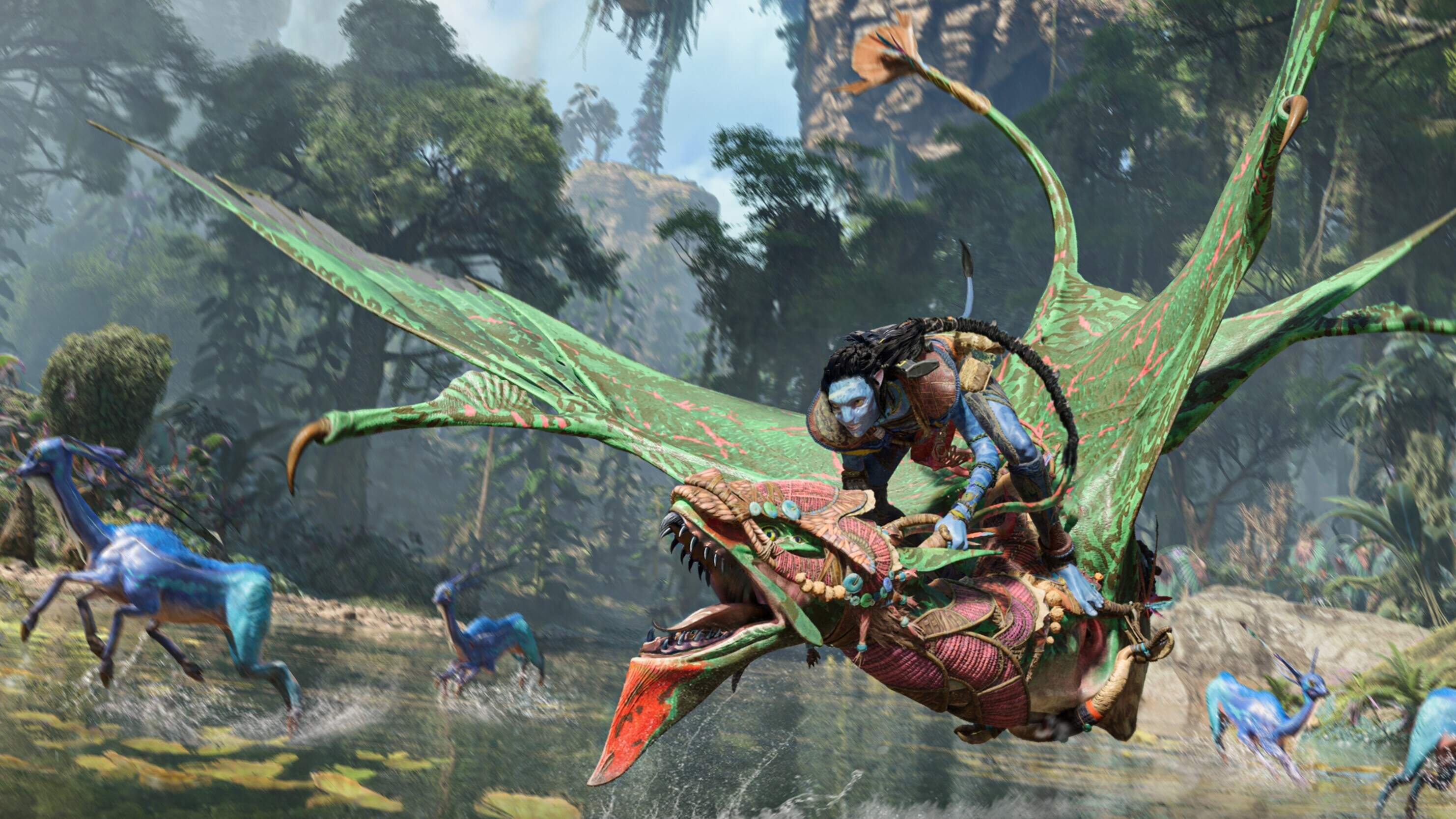
For the third year running, the Grammy Awards will honor video games this Sunday.
A spin-off from the blockbuster franchise, “Avatar: Frontiers of Pandora” is one of five nominees in the “Best Score Soundtrack for Video Games and Other Interactive Media” category.
“I have always been a huge ‘Avatar’ fan ever since the first film,” says composer Pinar Toprak. “I just loved the world that Jim Cameron created and I loved James Horner's score.”
A veteran TV and film composer, Toprak won the gig after sending a blind demo to game publisher Ubisoft. But despite her admiration for the late James Horner, her employer wouldn’t let her adapt any of his original music.
“The challenge was, how do you create something brand new while still keeping the DNA of the score?” mused Toprak. “In the film, you may be more limited to what the film's story is telling you — but in the game, we really went beyond the Avatar sound.”

The interactive score also had to react to the player’s actions over a vast virtual landscape. “It's really like writing a whole bunch of puzzle pieces,” explains Toprak. Then the game’s coders would program the music to fit different situations: “Once they have all the individual food groups, so to speak, they can say, ‘Okay, now here we will just the strings and percussion, or when we see the bad guys, let's put the big brass,’ for example.”

Toprak also says that the game’s fans have rallied around the soundtrack: “Unlike a film experience where most people might watch it once or twice — video game players, they play for hours every single day. In some cases, it defines their childhood or a certain time in their life.”
“It's funny, I even got some videos over the New Year's Eve,” says Toprak. “There are people that got together and actually went into the New Year with the music from our game — it just really touches people.”
3 Questions for Pinar Toprak
For people who don't know, Avatar is a science fiction parable about colonialism. And the Na'vi are the natives on this planet that humans who are the alien colonists come to essentially strip for its natural resources. How did you communicate that theme through music?
“In a way [the Na’vi] are more human than the humans. And we even have that in our score. The Na’vi music is a lot more human and emotional and connected to nature. And the music for RDA, the humans, is actually a lot more metallic and aggressive and electronic, and it sounds less human in a way.”
There's a sense of folk and world tradition in the Na’vi songs. Did you draw on world music traditions to tell the story?
“Absolutely. But you didn't want to be region-specific per se. But we used a lot of different soloists and different wind players and string players on top of the orchestra. Over the entire course of the recording, we've had over 200 musicians from all around the world that actually played on the score. And two different sets of choirs, two different sets of orchestras and so many different soloists.”

How do you make sure that you use the instruments, the traditions respectfully? Is that why you bring people from all over the world?
“It's ultimately the way I see music. I try not to get too brainy about it because ultimately it needs to be an emotional reaction, right? So in the way that we've approached everything, if it felt right, it was right, basically. And that was kind of how we approached a lot of it. And because of the sounds that James Horner had already put in place and the first film that created some openings for us, we knew kind of like whereabouts we could go. We went kind of way beyond it ultimately, but it gave us a good place to start.”
This segment aired on January 31, 2025.