Support WBUR
Arizona sheriff won't help with Trump's deportation blitz
President Trump ran on a platform of mass deportation. Now, in the early days of his second administration, he’s started laying out immigration and trade policies that put towns on the U.S.-Mexico border at ground zero for enforcement.
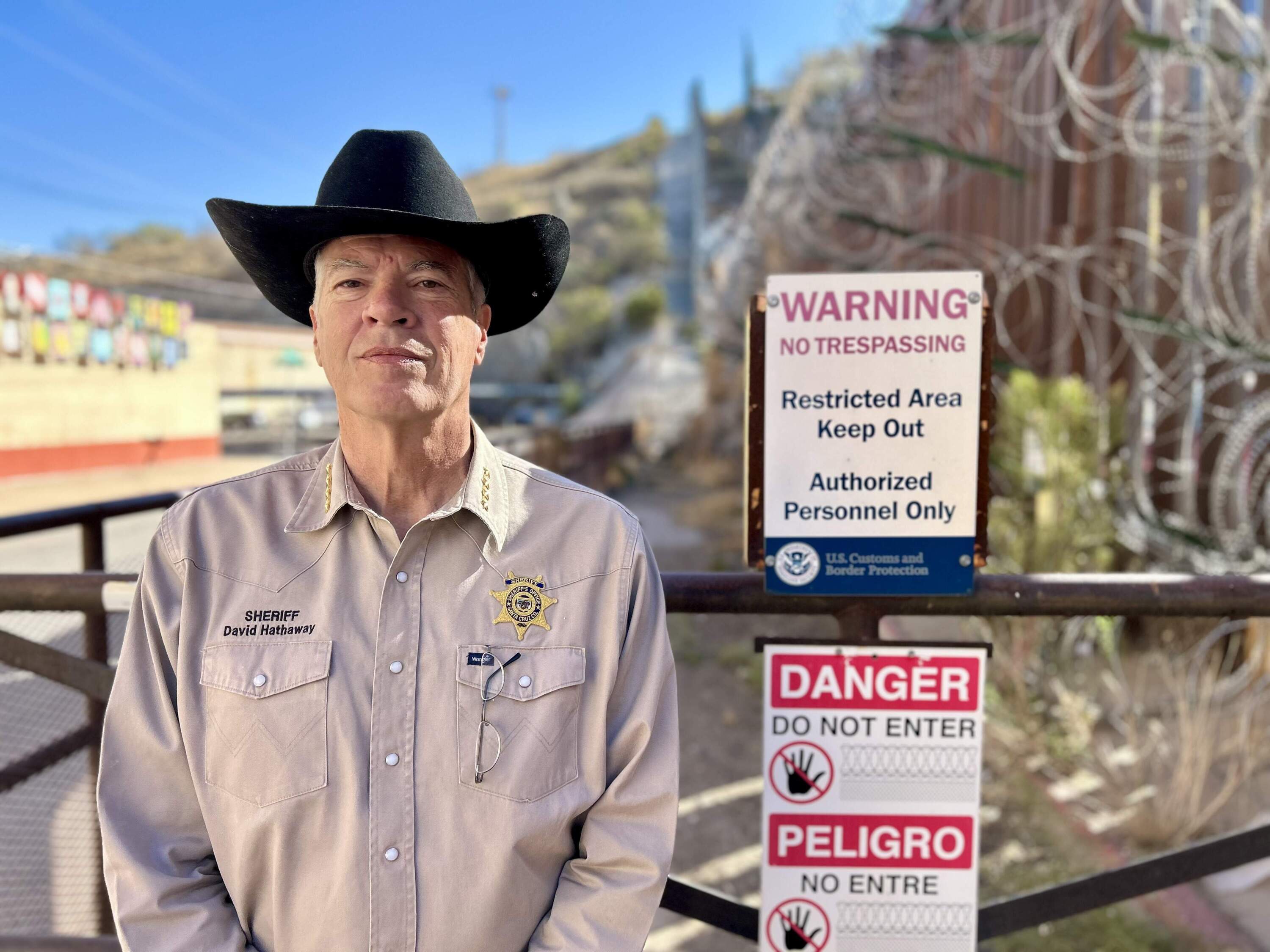
Nogales, Arizona, is one of those border towns. David Hathaway is a Democrat and the sheriff of Santa Cruz County, where Nogales is located. Hathaway’s family has lived in Arizona for generations, even before it was recognized as a U.S. state. He says that growing up, the border ‘wall’ was just a livestock fence.
Now, a steel wall towers over Nogales. Thanks to Trump's policies during his first administration, it's covered in razor-sharp barbed wire.
“ The optics of that fence, it makes it look like a war zone. And this is a very safe community, but it discourages people from coming here,” Hathaway says. “ My focus is not immigration or border concerns, and we don't have people coming across the fence here like you would think.”
5 questions with David Hathaway
Have you noticed a difference near the border since Trump reentered the White House?
“ No. People have their ears perked up to see if anything's gonna change.
“One thing we've heard about, 1,500 active-duty troops are gonna be sent to the border. Well, there's no indication yet where they're going. [We] haven't seen anything different here.”
Are the troops necessary?
“ No, these people are coming across to work. They're not coming here to commit crimes like Trump has been quoted as saying, ‘They're all coming here to rape, murder, sell drugs.’ It's just not the truth.
“What we need is a functional guest worker program. Like when I was a kid, my grandparents’ generation, there was a guest worker program where you could — if you needed a worker from Mexico, you couldn't find an American to do a job — there was a way to get a work permit and then it had to be returned within a certain amount of time or that person would never get a permit again.
“Congress needs to act and actually make it where these people can have legal pathways to come here to work. That's why they're coming. They're not coming here to commit a crime or go on welfare.
“That's not just anecdotally for me. If you look at the FBI statistics, a native-born American is three times as likely to commit a crime as a migrant. So these kinds of tropes, these meme comments you hear out there, it just doesn't fit reality.”
Mexico says it will also up its border security to try to curb the influx of fentanyl coming into the U.S. What do you make of that?
“ This isn't new. Trump did the same thing in his first administration. He threatened tariffs on Mexico and he says, ‘I'm going to build a wall. Mexico's going to pay for it. How are they going to pay for it? They're going to pay for it through tariffs,’ he said, ‘unless they do something significant to slow the flow of migrants and drugs on the border.’
“So what did Mexico do? In 2018, they sent thousands of troops — National Guard troops in Mexico — to the border. They're still there. They're now delaying the entry of Americans going into Mexico. Now we have long lines on the U.S. side of Americans going to Mexico because of what Trump did. He made more of a police state in Mexico in his first administration.
“So when he said the same thing this time, I told everybody, ‘he's going to pull those tariffs back at the last minute, swing in as the hero and save everybody from the tariffs that he was going to impose.’ Which is exactly what happened.”
What can be done to cut down on drugs coming over the border?
“ I was the head of a federal agency, the DEA here in this community, and I worked eight years in that career in South America and I saw the flow of drugs.
“The big complaint from the Latin American countries is that you're a consumer nation. If you weren't consuming these things, then there wouldn't be that issue.
“ I saw the failures of the drug war. You think that you're gonna get rid of a cartel head, and then somebody else will come in to replace them. It's just basic economics. If there's a demand, somebody will supply the demand.
“You wind up creating violent clashes between rival gangs and the police and people who sell drugs. We shouldn't just rush haphazard into that.”
In terms of mass deportations, what — if any — role will local leaders like yourself play in Trump’s plans?
“ Trump has been asked, ‘How are you going to do this?’ You don't have enough federal officers and you can't use the military because there's a law in the U.S. called the Posse Comitatus Act that says you cannot use the military as a police force. And he has said he will use state and local officials.
“We're not going to do that here because where we're standing right now the demographics are 95% Hispanic in Nogales, Arizona. So I'm not going to create that kind of tension between my community and law enforcement where they're afraid to call 911 if they hear an intruder at the back door of their house, because they think they're inviting a border patrol agent, an immigration officer.
“If they go through with these task forces where they make state and local officers into the equivalent of border patrol agents, then it creates that kind of tension between us and the community. So we won't be participating in that.
“But when you talk about building giant detention centers and using Guantanamo Bay, which was used in the past to hold people without charges, just indefinitely suspending habeas corpus. To see all that coming back again, it's just very negative that we're starting to look at this kind of racial profiling aspect again.”
Peter O'Dowd produced and edited this interview for broadcast with Todd Mundt. Grace Griffin adapted it for the web.
This segment aired on February 10, 2025.