Support WBUR
Peter Wolf recounts long music career in 'Waiting on the Moon'
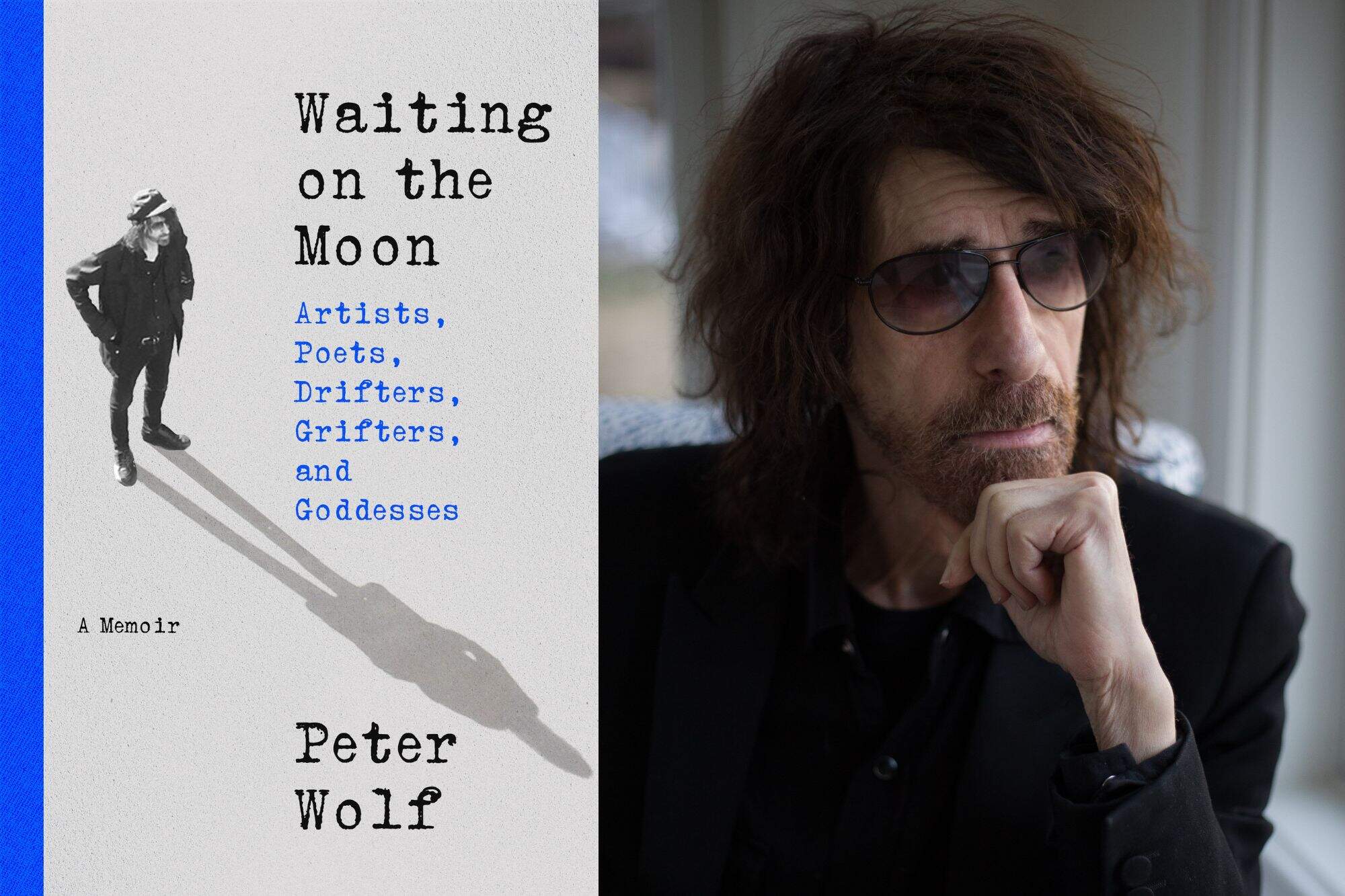
Peter Wolf is perhaps best known as the former frontman of The J. Geils Band. But that’s only a fraction of his story.
In his memoir “Waiting on the Moon: Artists, Poets, Drifters, Grifters, and Goddesses,” Wolf details his life story. Born in the Bronx in New York City, Wolf was dyslexic and a self-described ‘terrible student.’
When his father — who never had a formal education — went to sing with the Robert Shaw Chorale at Tanglewood, he left Wolf with a local artist to watch after him. That artist was Norman Rockwell.
Wolf got into the School of the Museum of Fine Arts in Boston for college, where his music and art career really opened up.
6 questions with Peter Wolf
When you were 10 years old, you went to a movie theater with your parents and met Marilyn Monroe. What was that like?
“ I noticed she was wearing house slippers and she had a fur coat on and underneath she was wearing a nightgown. As the movie progressed, she slowly gets very tired and I can feel her head slowly, slowly leaning towards my shoulder until she actually fell asleep on my shoulder.
“And so slowly I fell asleep, head on head, until this gentleman got up and said, ‘Darling, let's go. Quick, quick, quick; the lights are coming on.’ And everyone in the theater started screaming, ‘It's them! It's them! Arthur Miller and his beautiful wife.’”
How did you come to live with David Lynch?
“ I was actually sleeping on the river. I had no money. And so, there I am, looking in the hallway of the Boston Museum School of Fine Arts for a roommate. And I hear this voice going, ‘Are you looking for a place to stay?’
“I said, ‘Sure I am.’ And it turned out to be David Lynch.
“He locked me out of the apartment because I never had money to pay for the rent. I couldn't blame him.”
How did you meet Muddy Waters?
“ I was such a fan. I waited outside Club 47 and I saw Muddy, my idol. I said, ‘Mr. Waters, such an honor to have you. Welcome to Cambridge, Massachusetts.’
“Tthe electric window lowered down, and he goes ‘Thank you.’ And I said, ‘Can I do anything?’ And he said, ‘Yeah, see that equipment? Start helping us carry it.’ So I ended up underage, finding them alcohol for James Cotton and Otis Spann.
“ Muddy found my apartment as a mecca and I had all his records and all the blues records. We became friends from that point on.”
You were the one who broke the news about Martin Luther King Jr.’s assassination to Waters during one of his shows. What was that like?
“ The manager came up to me and said, ‘Martin Luther King had just been assassinated.’ I said ‘What?’ And so I walked up on the stage, Muddy was in the middle of a song, and I whispered.
“He just looked in shock. And he raised his hand, stopped the band, and said to the crowd, he said, ‘Young people, young people, please, listen to me. Terrible news: Martin Luther King has been shot. File out very slowly. Please get home safely.’
“He put his hands on my shoulders and said, ‘Little Wolf, that's what he called me, get home safe.’”
What was it like collaborating with Merle Haggard on ‘It's Too Late For Me’?
“ [Will Jennings and I] wrote this song. We finished the song, and I said, ‘Will, man, if we can get Merle Haggard to do a duet,’ and he said, ‘Good luck, buddy.”
“I idolized Merle Haggard. Now we did this when he was performing with Willie Nelson and Ray Price, and we recorded it out at Harbor Lights. I set up a studio, and when he came in to do his thing, his eyes closed. One take.
“ I do the first verse. When Merle comes in, it becomes heavenly right here.
“ I am just totally in awe, staring at him. Eyes closed. No lyrics needed. He had absorbed the song.”
You were the frontman of The J Geils Band, which ended with the band splintering and the other members asking you to leave. Do you think the band would ever reunite?
“ When we did the reunion tour, the same issues seemed to come up, so that really wasn't a future in that. And so I've just been sailing my ship alone.”
Robin Young produced and edited this interview for broadcast with Todd Mundt. Grace Griffin adapted it for the web.
Book excerpt: 'Waiting on the Moon'
By Peter Wolf
Prologue
There is a certain conceit involved in writing a memoir, taking on the assumption that one’s life is a story worth telling. Over the years I have found myself regaling others, either at intimate dinner parties, in backstage dressing rooms, or during concert performances, with stories of the fascinating range of people, both known and unknown, I have encountered throughout my life. “You should write a book” was often the response.
I made numerous starts. I tried writing longhand, dictating into a recorder, and even using my one-finger typing, but nothing seemed to provide me with any fulfillment. I just couldn’t seem to find my voice on the page. I didn’t want an “as told to” or “written with” book. But after I reread numerous autobiographies, novels, collections of short stories, and my favorite noir mysteries, curiously, they seemed to kick-start my one-finger typing. Finally, one chapter led to another… and another and another.
In Goodbye to Berlin, Christopher Isherwood wrote, “I am a camera with its shutter open.” With that goal in mind, I have remained as true to the events and encounters as my memory allows. In recounting the dialogue, I have tried to convey both the tone and essence of the conversations with as much accuracy as I can recall. While writing these chapters, I experienced both joy and sadness — the exaltation of rediscovery combined with the realization of the profound loss of the many people who played such important roles in my life.
In the past, I’ve read the acknowledgments pages of many books in which the authors thank their editors for helping shape the direction of their works. I thought it would be wise for me to pursue an editor of my own who could guide me, help me focus, and keep me from losing faith in completing this endeavor. After many referrals, there were several interesting leads, but surprisingly, I found what I was searching for not with a formal editor but with a friend, the painter Grace O’Connor, whose talents, vast interests, and enthusiasm for knowledge I greatly admire. During our friendship, we have enjoyed many lengthy conversations not only about painting but also about all the arts — and of course the many works of literature, each for our own reasons, we thought were worthwhile reading. It’s to her and her sister Nora I dedicate this book.
Excerpted from "Waiting on the Moon" by Peter Wolf (Little, Brown, March 11, 2025), Copyright © 2025 by Peter Wolf.
This segment aired on March 11, 2025.