Support WBUR
Tariffs against China threaten the booming board game industry

Board games have been booming. But the industry is starting to collapse under the weight of hefty tariffs against China, where most board games are produced.
“People are losing their jobs, publishers are already closing,” said Sam Bryant of Runaway Parade Games. “Containers full of games that were bound for the U.S. market are now sitting in warehouses in China.”
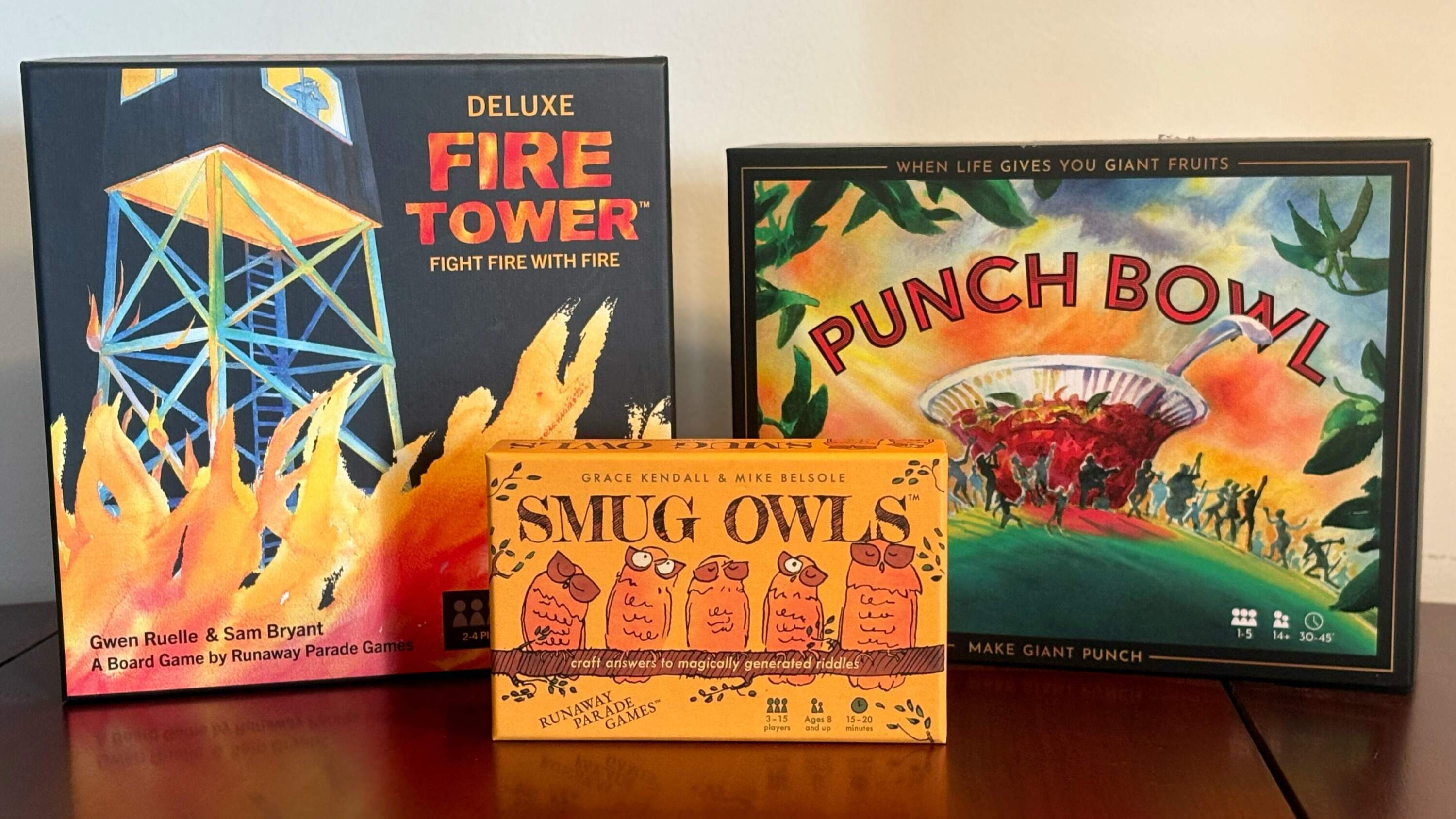
Bryant and co-owner Gwen Ruelle paused Chinese shipments of their game “Fire Tower” as tariffs against China climbed to 145%. They also delayed crowdfunding their next game, “Punch Bowl.”
“The uncertainty is one of the worst parts,” said Ruelle. “Not being able to make a new plan because the goalpost is always shifting and production takes a long time — it takes between four and six months to make a product.”
Ruelle and Bryant built their company on a lifelong, shared passion for the hobby.
“I have loved games since I was a kid — I was designing games out of rocks and sticks and whatever I could get my hands on,” said Ruelle. “I'm kind of in my dream job, where I get to make games for a living and spend a ton of time playing games as well.”
The recent industry contraction has discouraged her, not just as a designer, but as a fan. “I know of specific games that I was waiting to play that aren't going to be created now,” she said. “Hopefully we find another path forward or these tariffs change — but for now, I think we're just mourning the loss of this incredible era of board games.”
“A whole class of people who would have been the new designers are going to be wiped off the board and we won't see these new, unique ideas,” Bryant said. “And it will become kind of a stagnant industry and people will just have what they have.”
4 Questions for Sam Bryant and Gwen Ruelle
Why is your game, “Fire Tower,” manufactured inside of China?
Sam Bryant: “Honestly, it's the only place it can be manufactured at the moment. They have the expertise, the capacity to produce the orders our industry needs. For ‘Fire Tower,’ it has a whole bunch of acrylic fire crystals that we call Fire Gems, and China has the ability to make those pieces. The machines, the knowledge like that doesn't exist in the U.S.”
What does the China import tax of more than 100% mean for you? Can you pay the tariff and pass that cost onto the consumer?
Gwen Ruelle: “Unfortunately, I don't think we can at this point right now. Typically, a container of ‘Fire Tower’ costs about $100,000 to make. If we were to ship that from China, we would incur an additional $145,000 at port. So that would bring our total to $245,000. For a small business like that, just barely able to shell out that original manufacturing cost of 100,000, that would instantly bankrupt us.
“So we're looking at just one shipment ending our company and we're used to doing multiple of these per year. So if we were to pass the prices on to customers, unfortunately we couldn't just add that additional cost directly on. We'd have to multiply that out because as the game exchanges hands, it incurs percentage-based costs. So for example, Amazon takes a certain percentage as a referral fee or a retailer buys it at a certain percentage. So you can't just raise it by the cost of the tariff. You have to raise it even more. And we don't think people want to buy, ‘Fire Tower’ for maybe $60 when before could get it for $30. We still want to bring the product to everyone in the United States. It's been doing really well, better and better every year. But how we can move forward with these tariffs, we actually have no idea.”
So are you looking at production in other countries like Malaysia, India or Vietnam?
Bryant: “We definitely were scrambling at first looking at those other places. But then the second round of tariffs came in. We were also looking at Vietnam. A lot of Chinese factories are thinking of moving their production there as well. But then we saw I think it was 58% in Vietnam, which has now been paused and now is 10%. So if we print right now and then let's say Vietnam suddenly has 100% tariffs, we are stuck paying $100,000 that we didn't account for. We've also looked at Mexico, but the situation there is also fluid as well. So really at this point, we're just at a standstill. It's impossible with this chaotic nature of the tariffs to plan for the future at all.”
The justification for tariffs is to bring manufacturing back to the United States. Can you find a way to make games in America?
Bryant: “The big companies might be able to bring manufacturing back or invest in it. But for us, we're not experts in manufacturing or building factories or building infrastructure. We're really just a small business; two creatives who had an idea and were able to produce it. There is no way we could manufacture in this country at any time in the future that I can see. And even in some far-off future where it does happen, our company won't exist by the time that option is there.”
Ruelle: “And that's the case with almost everyone we know in our industry. The bigger staffs of a board game publishing company are often around ten. But most companies are running with, you know, one to five people. So none of us will be able to hold on long enough for a new factory to be built and to move our plans here, especially if these tariffs hold while we're waiting for that factory to come.”
James Perkins Mastromarino and produced and edited this interview for broadcast with Todd Mundt. Perkins-Mastromarino adapted it for the web.
This segment aired on April 17, 2025.