Support WBUR
A professor on Charlie Kirk's watchlist reflects on Kirk's death
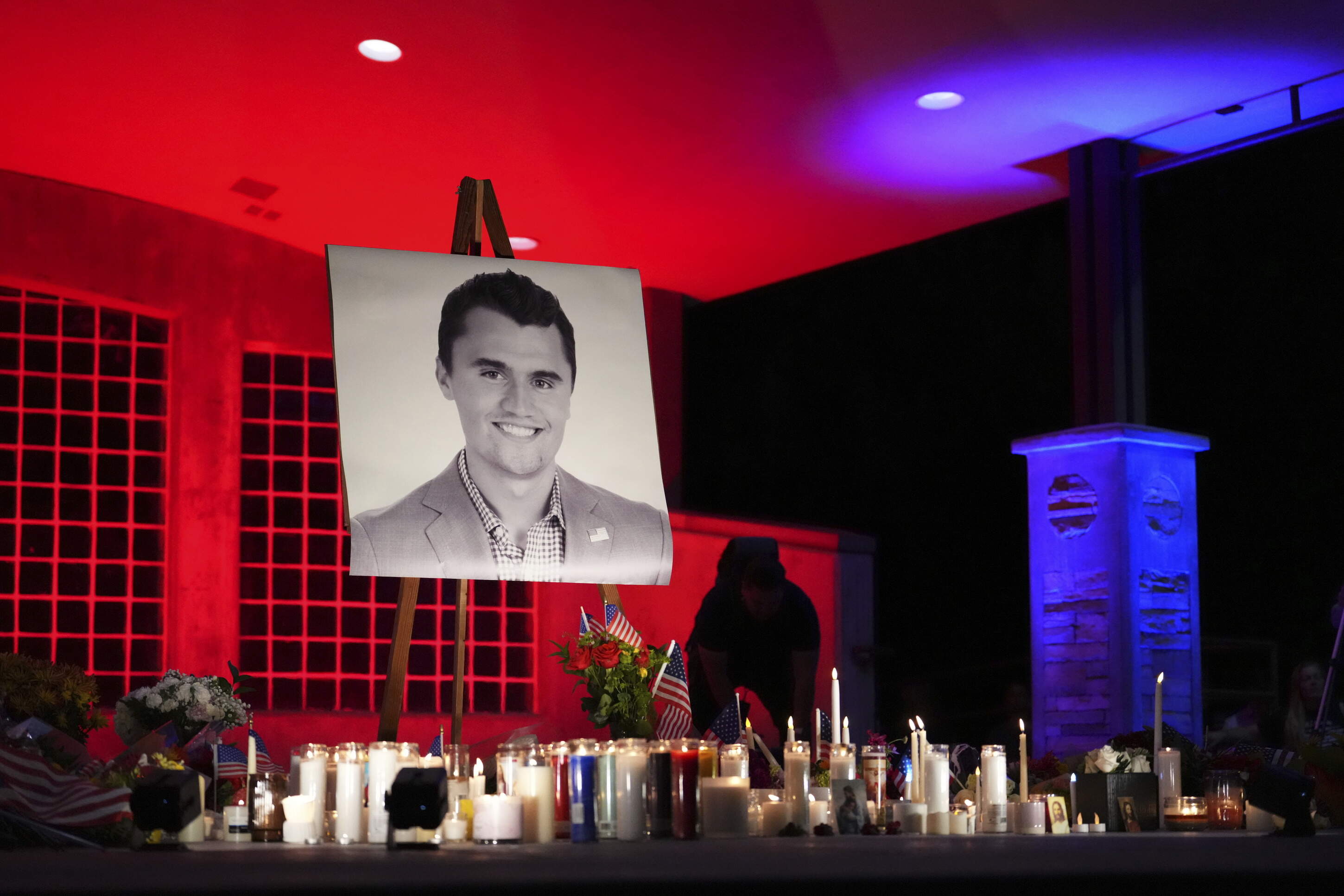
Charlie Kirk encouraged his followers to help “save America” by sending in names of college professors they considered to be on the "radical left." Kirk compiled those names on his Professor Watchlist, which he launched after the 2016 election.
Matthew Boedy, a professor of English at the University of North Georgia, has been on that list for years, and has spent time researching Charlie Kirk and his organization, Turning Point USA. Boedy says he is now worried that Kirk will be portrayed as a martyr.
"Martyrdom certainly honors the person, but it has a terrible track record," Boedy said in an interview with Here & Now's Sarah McCammon. "And that's why I suggest it's dangerous for our country, because in our country right now there are divides all over the place — in churches, in pews, in families — and so to have one side say martyrdom and one side, ‘I'm sorry for his death, but he's not a martyr,’ it really can ignite things in a terrible way.”
5 questions with Matthew Boedy
You were supposed to give a Sunday school presentation at your own First Baptist Church there in Gainesville this weekend about your research into Christian nationalism and Charlie Kirk. You decided to pivot in light of Kirk's death. What were you planning to say before you got the news and how is that changing?
"I did want to present to the class about Charlie Kirk and Turning Point's plan to save America for Jesus through taking back these seven areas of cultural influence, or Seven Mountains.
"So that was gonna be my focus, and to be honest with you, I have a few days before Sunday and I don't know what to say. I certainly don't want to talk about the strategy as much as I do want to talk about the bigger question of the relationship between Christianity and democracy. Many people are labeling Charlie Kirk a martyr, not just for free speech, but for his Christianity, and I think that will drive even more division, perhaps even more violence.”
You mentioned this idea of Seven Mountains, it's something you've spent a lot of time researching. It's a motif that appears in some Christian right circles. Can you just sort of summarize what that's about?
“That's a strategy for taking back America for Jesus. It points to seven areas. They want to put Christians in charge of these high places, government being one of them. So electing Christians over government, but also putting Christians leading these other areas: the mountain of entertainment, obviously, you don't elect people there, but putting Christian culture atop these other cultural institutions. Some people describe it as a theocracy, but it seems to be about having a Christian culture, and that's what Charlie Kirk often referred to implicitly when he was talking about Western civilization."
Your name is part of a list of professors that Kirk would have categorized as radical left wing and essentially portrayed you and others as discriminating against conservative students and advancing a leftist agenda in the classroom. How did you come to be on that list?
“Back in 2016, when I and many people had never heard of Turning Point, they went viral with this list of a conglomeration of articles and comments.
"I had written an op-ed for our local paper about a bill that was being debated in our state legislature, now a law, that allows concealed weapons, concealed firearms on college campuses. And to be honest with you, it was a short piece and I said, ‘guns chill debate,’ and I didn't think much of it. And six months later, Turning Point gathers all these materials and puts me on a list.
"And to be honest with you, many of my colleagues who are on that list — that list has grown to 700 to 800 people now — have faced way more harassment and terror than I have, but that's how I got on the list.”
How are you processing Kirk’s sudden and violent death?
“I did get choked up when I got the notification of his death. I first thought — I got a report earlier about him being shot — ‘my God, this could be bad.’ So getting choked up was about his widow and his children. I have two young children around the same age.
It was also being deeply sad about our nation. Again, to have someone assassinated in this fashion on a college campus is just tragic, and because I was targeted by Turning Point for writing an op-ed about gun violence and not having guns on campus, and for Charlie to be assassinated by a gun on campus is beyond ironic.
“My tears were for him and for his wife, but I think his death is a national moment, a line we have crossed, that is deeply sad."
You talked about how you're worried that portraying Charlie Kirk, not only as sort of a martyr for free speech, but as a martyr for his Christian faith, how that could be counterproductive. How do you, as a Christian, view that kind of language around this horrible incident?
"I think that it's difficult to align martyrdom with someone who was, I would say, shot for sharing his political beliefs. Certainly religious, and he tied those together in many ways, but, you know, it's kind of hard for me to use that label.
“But the reason that it's dangerous is because if we can see throughout the history of the church using martyrdom often rallies people to go after their enemies. And so martyrdom creates a legacy of really reinforcing people's beliefs and reinforcing their anger, reinforcing their desire for vengeance.
"Martyrdom certainly honors the person, but it has a terrible track record, and that's why I suggest it's dangerous for our country because in our country right now there are divides all over the place — in churches, in pews, in families — and so to have one side say martyrdom and one side, ‘I'm sorry for his death, but he's not a martyr,’ it really can ignite things in a terrible way.”
This interview was edited for clarity.
This segment aired on September 12, 2025.