Support WBUR
Tribal history and new evidence tell a different, fuller story of Sacagawea
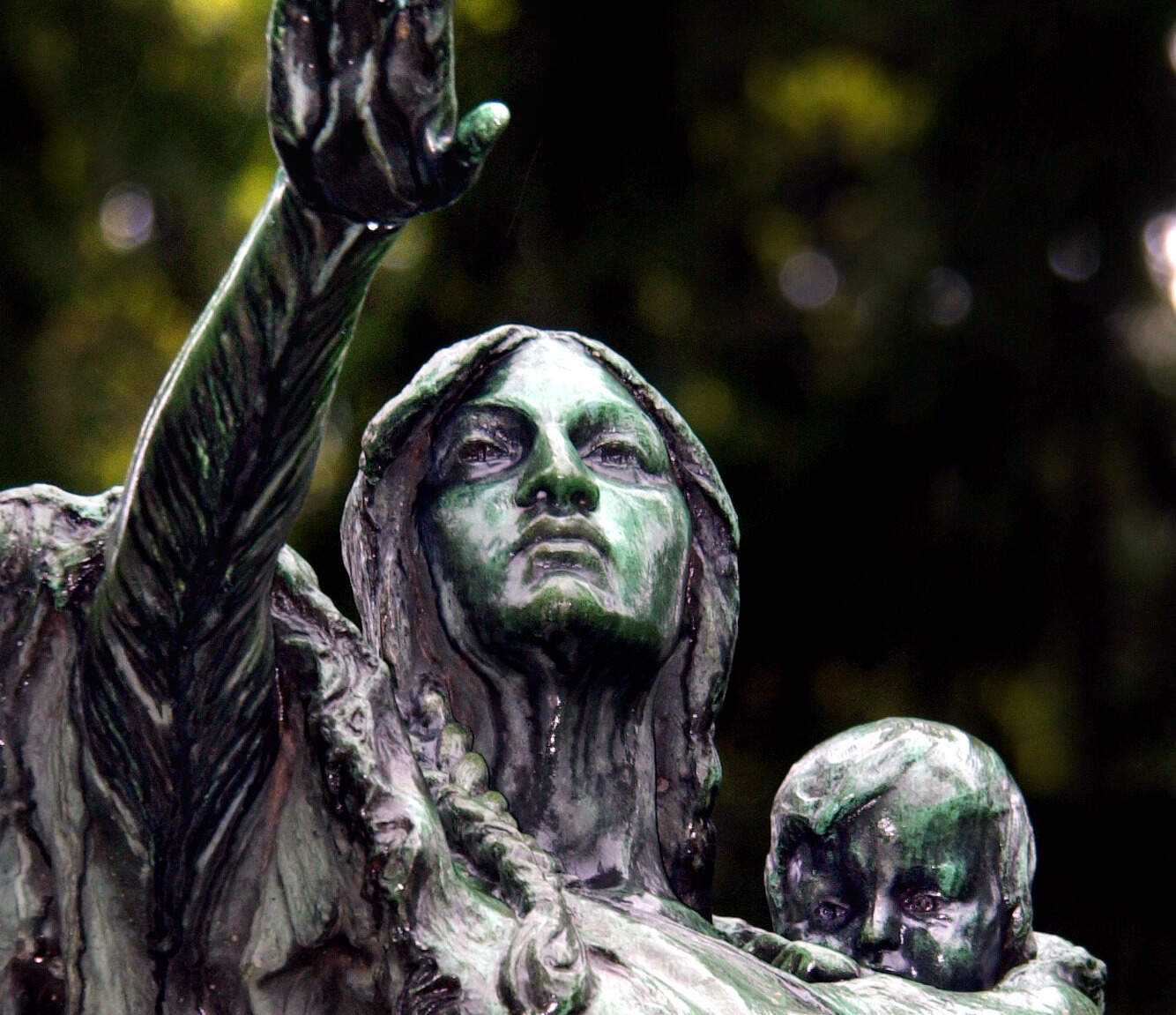
One of the foundational stories in American history is that of Lewis and Clark's two-year expedition that began in 1805, from Missouri to the Oregon coast and back, and the Native American teenager who accompanied them, named Sacagawea.
Her face is on the dollar coin. The country is dotted with statues of her. Most American kids learn about her from their history textbooks in school.
But is the story we've been told about her actually true? What’s been left out? The Hidatsa tribe has been leading an effort to correct the historical record and offer a fuller, different portrait of Sacagawea.
Christopher Cox wrote the article “The Mystery of Sacagawea” in the New York Times Magazine.
Speaking to Here & Now, the first thing Cox did was correct the pronunciation of her name. The way the Native American tribes say her name is sah-KAH-ga-way-ah.
6 questions with Christopher Cox
What is the traditional history most people have been told about Sacagawea?
“The revisions to the story start from the very beginning, with just how you even say her name. The standard history or version of her life — the one that we've learned from Lewis and Clark and their journals — is that they met her in what is now North Dakota, among the Hidatsa tribe.
“But she was not Hidatsa, according to Lewis and Clark. They said she was kidnapped by the tribe from the Shoshone, who live in the Rocky Mountains. When Lewis and Clark arrived into present-day North Dakota, they spent a winter there in a fort on the Missouri River. And while they were there, a French trader known as Toussaint Charbonneau approached them and said, ‘I know this country. I can speak several Native languages. You should hire me to go on your expedition.’ And Charbonneau brings along his wife, and that was Sacagawea.
“Lewis and Clark, for the longest time in their journals, they don't refer to her by name. They call her Charbonneau’s wife, and they call her the interpreter's wife, and it's only as she sort of becomes more important to the success of the expedition that they started using her proper name, but it takes a long time.
“So they end up bringing her along on the expedition all the way to Oregon, intending to use her as an interpreter among the Shoshone in the Rocky Mountains. They record the whole journey. They bring her back to North Dakota, and then she sort of disappears from history for a few years, but pops up again in a couple written accounts that have her dying in 1812. She was a teenager on the expedition, and she was in her twenties when she died, according to the standard histories. And that's it. That's her whole story. And the Hidatsa have a very different story that they want to tell.”
What is the story the Hidatsa tribe wants to tell about Sacagawea?
“Almost everything for her is sort of up for debate once you start considering alternate forms of evidence. So oral history is kept by these tribes, but also the Hidatsa tribe in particular has gone to great lengths to find other kinds of evidence. There's DNA evidence. There's other written records of her life. And the bottom line that they point toward are two strong claims.
“One is that she was born in North Dakota, that she's a member of Hidatsa tribe and has been since birth. And the other is that she did not die in 1812. In fact, she died in 1869, more than 50 years later. In 1812, she supposedly died of sickness. In their version in 1869, she died of a gunshot wound. She was killed by a Sioux raiding party. So it's a fairly significant change to her life story.”
Why does this alternate story about which tribe she was born in, and when and how she died, matter?
“It changes the meaning of her life. I mean, if her only importance and our only knowledge of her comes from the two years she happened to be living among Europeans, that's a very different life story for her than it would be if she lives 50 years longer.
“They have her having three more children than she had, according to standard histories. Lewis and Clark were there when her first child was born, Jean Baptiste Charbonneau, and others have her having three more. And those tribe members, those three children have multiple descendants among the current tribe, all who can trace their lineage back to her through them.”
Talk about the scholars of the oral histories who tried to publish a book on their findings and couldn’t find a publisher for a long time.
“They gathered their research, and they re-interviewed members of the tribe, elders, people with traditional knowledge of Sacagawea and her family, and they put it together in a book. And just a raft of evidence in this book, laid out for the reader to consider. And yeah, they had trouble finding a publisher, according to the tribe.
“Some of the places they approached said, ‘Oh, we've already published a book about Sacagawea. We can't publish another one that contradicts that.’ And so I think they very quickly discovered that it's incredibly hard to change a historical narrative once it's sort of been fixed in the public's mind.”
With President Trump’s Restoring Truth and Sanity to American History executive order, how does this story of Sacagawea fit into the debate over history unfolding now in America?
“The Hidatsa have recently come into some trouble trying to get their story out there because of this executive order. They've been in a long series of talks with the National Park Service, and their goal is not to rewrite the story entirely at federal facilities on the National Park Service's sites; they just want to, as a part of the story, present the debate, more or less.
“But they've heard recently from members of the Park Service that the hurdle to doing that has gotten higher because they need to figure out whether any changes like this would be in compliance with Trump's executive orders on American history. So it's a live debate in a live struggle that is continuing now.”
What stories did you hear when talking to the tribes that show who Sacagawea was and what her life was like?
“I read the book that the tribe put out, which is very thorough, but then I also went out to the reservation in North Dakota where many of the Hidatsa live now, and I interviewed tribal elders there. And between the two, you do get a much fuller, more human picture of Sacagawea.
“They talk about how when she was young, she would break up fights among her siblings, how she was athletic, and she was known to be a strong swimmer. She loved to swim. They talk about how in her 40s, she was a great gardener. And at one point, I was interviewing an elder tribe member, and he was telling me a story that I didn't immediately understand the import of, about a group of kids swimming in the Missouri River. And they would jump into the water and let the stream take them down, climb of the riverbank, and walk back up to where they started. But there's one girl who didn't do that. She chose to swim back up the river, she wouldn't walk on the riverbank. And then only at the end, he said, ‘That was Sacagawea.’”
This interview was edited for clarity.
Julia Corcoran produced and edited this segment for broadcast with Todd Mundt. Corcoran also produced it for the web.
This segment aired on September 26, 2025.