Support WBUR
How Americans used to get their weather from the post office
To mark the 250th anniversary of the United States, we’re cataloging 25 objects that define the country’s history.
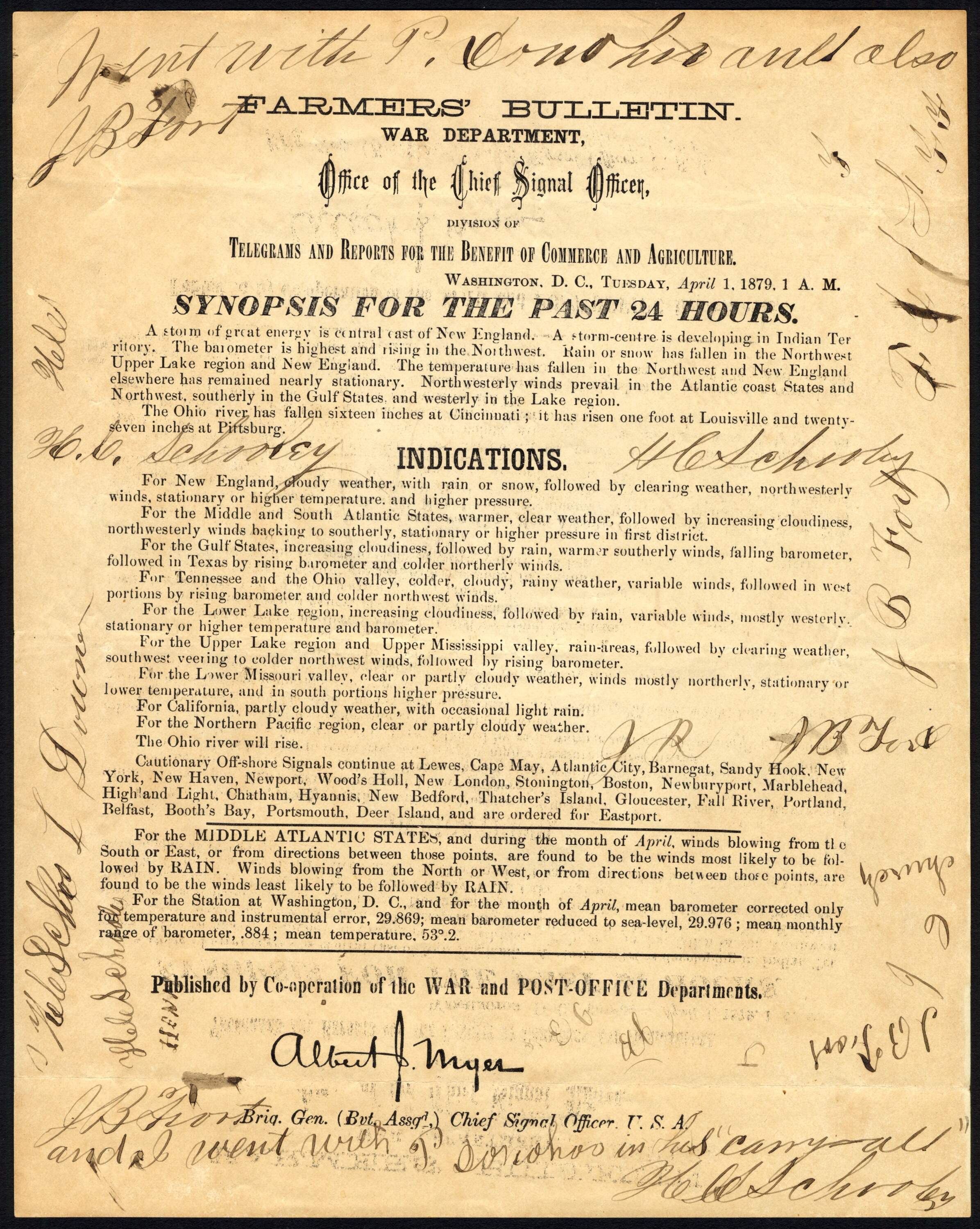
How did you check the weather this morning? Maybe you used an app, got a push update from your favorite meteorologist or tuned into your local public radio station. Back in the late 1800s and early 1900s, one of the best ways to get your forecast was through a Farmers’ Bulletin.
These papers were early versions of weather reports put together every evening except Sunday in Washington, D.C., and then sent out to thousands of community post offices throughout the country. These bulletins were information lifelines for rural America, and one of them from 1879 now sits in the Smithsonian National Postal Museum.
Curator Lynn Heidelbaugh explains how the Farmers' Bulletin system first developed and why it was so critical for a growing nation.
6 questions with Lynn Heidelbaugh
What was the inspiration for starting these Farmers’ Bulletins?
“Very early on in American history, you have folks like [former President] Thomas Jefferson who are taking daily weather recordings and trying to understand their natural world and systematize that practice. And then, when the first Secretary of the Smithsonian started in the 1840s, he set up a series of observational stations, 150 of them, with the help of volunteers and the army.
“They were studying various areas across the U.S. So by the time the post office department was involved, the Army was running a weather bureau and harnessing the new invention of telegraphs and the telegraph network to be able to get reports like these out.”
Where were these bulletins typically displayed?
“They were displayed at post offices. So this is one of the many services that the post office was doing in addition to the mail.
“At the time, most rural Americans were having to go to the post office to pick up their mail. It was often a daily or weekly kind of occurrence. They would be at their local post office, and it had the forecast and the synopsis of what happened the day before.”
What kinds of information would readers find on these bulletins?
“So it had information that was being reported by observers for the Army Signal Corps. And those were being telegraphed back by midnight every day except Sunday. And then this report was put together by 1 a.m. so that it could be delivered before sunrise. It could be anything about rain totals, the direction of the wind. It was much more about current conditions than a forecast.”
How did people collect and transmit the data that went into these reports?
“It was through a network of other observers with some basic but essential scientific equipment, like thermometers and barometers. And to economize, they were using ciphers. They were using coded words and numbers so that they wouldn’t spend too much money sending telegraphs.”
How important were bulletins like this in allowing the country to cohere as it grew?
“It's really tying the American and American experience together through the network of the post office department. The post office was a conduit of information. It’s where you went to find personal messages, messages from your government, your news, and notices coming in from your local governments.”
What do these bulletins tell us about our country during the late 1800s and early 1900s?
“It is one of those incremental ways that people were experimenting and trying to harness new inventions like the telegraph. Technologies like telephones eventually come in and speed up the type of information that’s being exchanged about weather. So the role of the post office fades with that.
“But at the core, the interest is still there. It’s about understanding our natural world and how it affects us: our commerce, our agriculture and our livelihoods.”
This interview was edited for clarity.
Will Walkey produced and edited this interview for broadcast with Catherine Welch. Walkey also produced it for the web.
This article was originally published on April 22, 2026.
This segment aired on April 22, 2026.