Support WBUR
‘I have to eat’: Arizonans adjust to huge cuts to food stamps
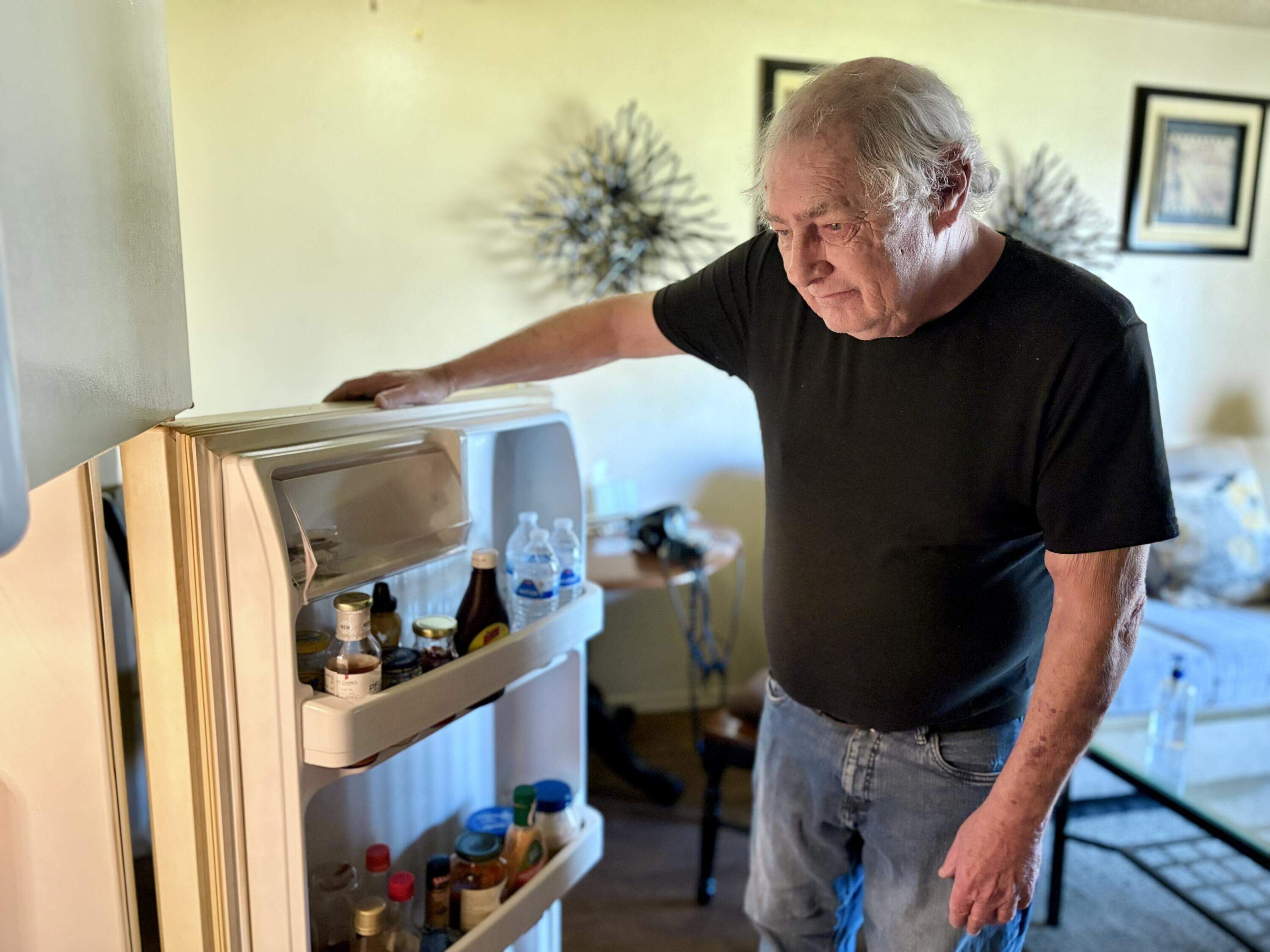
In February, Lee Rosen heard from the state of Arizona that his monthly food-assistance benefit had been terminated.
He felt the impact of losing his $260 stipend immediately.
“I’ve been stretching,” said the 69-year-old from Phoenix whose refrigerator is stocked with three eggs, a quart of milk and a few bottles of condiments. “I’ve never been like this in my life, but now I’m on a tight, tight budget.”
Rosen buys boxes of pasta on sale and rarely affords meat. Without a food stipend, he said it’s harder to get by on his monthly Social Security check.
“I need this card as a means of survival, basically,” he said, pointing to the empty EBT card on his kitchen table. “I have to eat.”
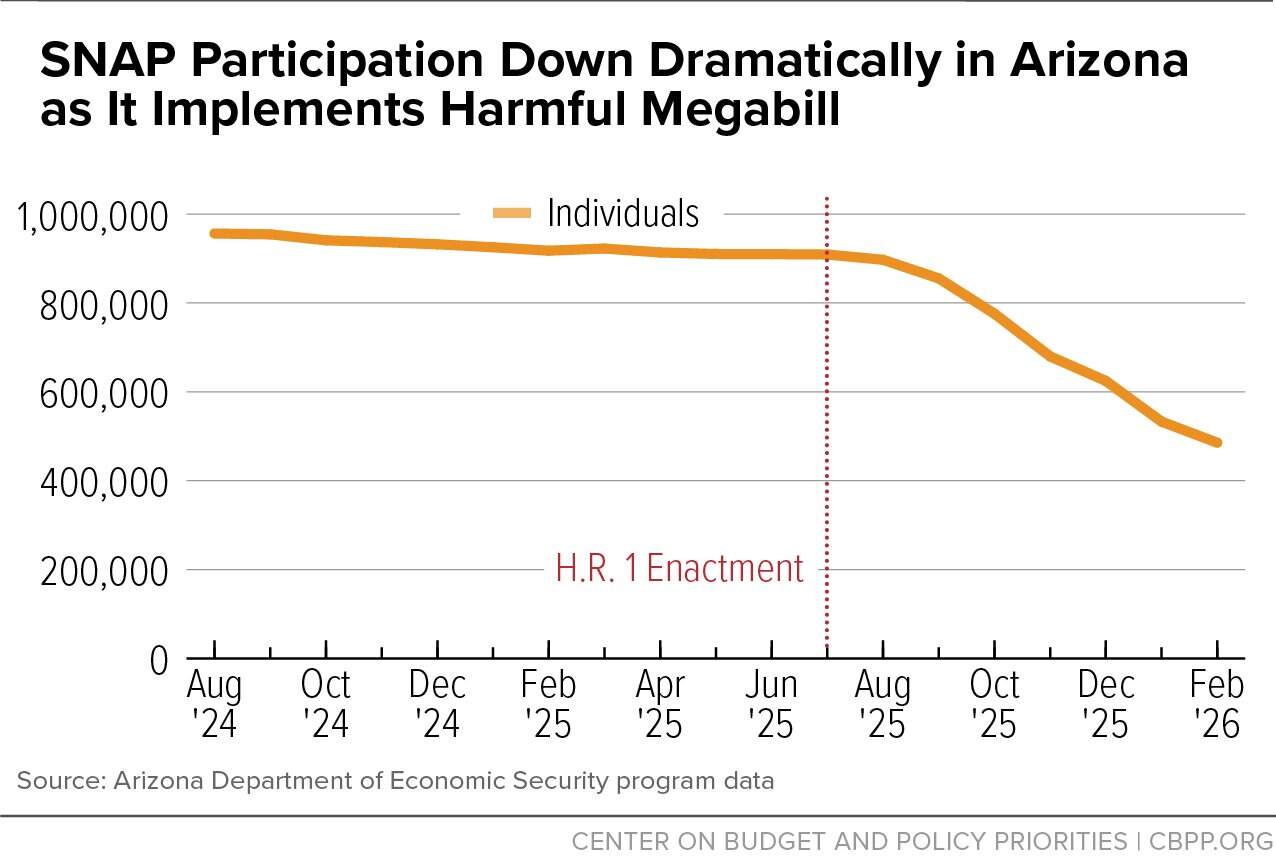
Rosen is one of nearly 460,000 people in Arizona who’ve been kicked off the Supplemental Nutrition Assistance Program, also known as SNAP or food stamps, since Congress passed a law last summer tightening the rules for eligibility. While the state’s program has shrunk by more than half, the purge is happening in states across the U.S., according to the Center on Budget and Policy Priorities.
“Since that law was enacted, we have seen a very significant decrease in the number of low-income people receiving SNAP nationwide, and no state has seen a steeper drop than Arizona,” said Katie Bergh, a senior policy analyst at the Center on Budget and Policy Priorities.
Across the U.S., more than 3 million people have lost benefits. Florida, Louisiana, Tennessee and Virginia have reported significant enrollment declines since July when Congress mandated new work requirements for certain groups of people.
The new law also demands that states begin sharing the cost of the program with the federal government.
“Those are very, very significant costs,” Bergh said, likely adding up to “hundreds of millions of dollars each year.”
How much a state is required to pay is based on how accurate its accounting is.
Mistakenly paying people too much — or too little — can affect what’s known as an error rate. As states rush to reduce those errors to avoid financial penalties, there’s new incentive to cut costs by any means necessary, Bergh said.
Data analysis from the Center on Budget and Policy Priorities. This graph appears on the CBPP website.
Arizona’s response
Rosen said he was kicked off SNAP in Arizona because he had $47 in undeclared income. To make ends meet, he got a job early this year at a discount retail store, but quit after one shift when he realized he couldn’t stand for hours at a time.
Rosen didn’t report his first and only paycheck to the state’s Department of Economic Security. He said whenever he tries to call the agency to see how he can get back onto the program, he’s stuck on hold for hours and never gets through.
His attempts to navigate the system have become “a total dead end,” he said.
Last summer, facing increased funding cuts from the federal government, Arizona slashed hundreds of jobs at the Department of Economic Security. People trying to apply for SNAP benefits — or appeal their case if they’ve been kicked off — report jammed phone lines and long waits at the agency’s offices.
Michael Wisehart, director of Arizona’s Department of Economic Security, said to reduce error rates, the agency has had to increase documentation requirements to prove eligibility. That has “led to significant backlogs,” in a system already hobbled by outdated technology, he said.
People unable to meet the documentation requirements could be kicked out of the program, even if they are still legally eligible.
“We are working feverishly, all hands on deck, with every resource we have available to us to mitigate backlogs and to help to simplify the process,” Wisehart said.
Gov. Katie Hobbs is asking for $48 million to shore up the food assistance program in next year’s budget. But the Democrat is at odds with the Republican-led legislature. She vetoed a Republican budget this week that would have added more restrictions to SNAP.
Republican Rep. Nick Kupper backs a provision in the Republican’s budget that would force Arizona to reduce its error rate even further.
“You’re wasting taxpayer dollars where they shouldn’t be going,” Kupper said. “If we have an error rate, I think, inherently, that’s waste.”
Food banks at 'capacity'
As the state works out more changes to the SNAP program, people are turning to food banks for help. United Food Bank in the Phoenix suburb of Mesa, Ariz., is “at capacity,” and reporting a 10- to 12% increase in food distribution each month, said Christopher Bodnar, director of agency network.

The demand is so high that, for the first time, food bank visits in Arizona are now outpacing the number of people who use SNAP in the state, officials said. With the cost of fuel approaching $5 a gallon in Phoenix, the pain is growing.
“It puts a lot of pressure,” said Bodnar. “We’re bringing more food in because we have to put more food out, and that’s pushing us at our capacity.”
Meanwhile, retiree Rosen finally got a little more capacity in his budget. A few hours after Here & Now asked DES about his case, Rosen got a phone call from the agency.
All of his benefits were reinstated.
“It gives me a lot of relief,” he said. “I can finally afford meat again.”
This segment aired on May 8, 2026.