Support WBUR
Mayor Wu 'conflicted' on eliminating MCAS as a graduation requirement
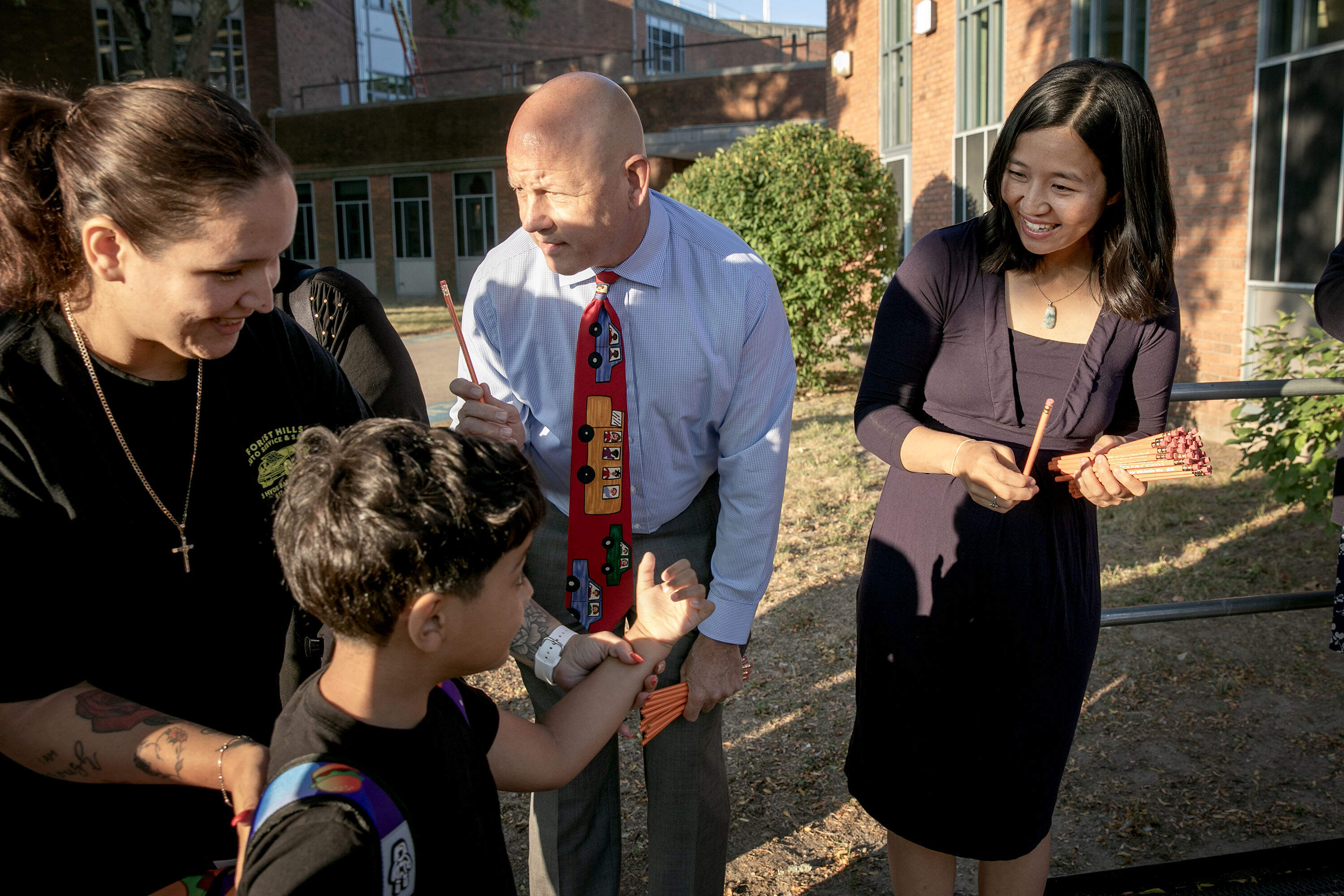
Boston students have only been back to school for a couple weeks, but Mayor Michelle Wu is already thinking about graduation requirements.
Voters will decide next month whether public school students across the state should have to pass the 10th grade MCAS exam in order to graduate high school. The mayor has yet to take a public stance on the measure.
But she has had to answer for the district's school bus arrival times. Only 35% off buses made it on time on Boston's first day of school. To get a first-hand experience, Wu rode a school bus last week that arrived six minutes after the bell.
To talk about all this, Boston Mayor Michelle Wu joined WBUR's Morning Edition host Tiziana Dearing.
Highlights from this interview have been lightly edited for clarity.
Interview Highlights
On whether she'll support the ballot question proposal to eliminate the MCAS as a graduation requirement:
"I am conflicted on the exact language of this ballot initiative. We need high standards for our schools. We need to be able to measure and hold ourselves accountable to how we are providing those opportunities for students. ... We also have seen in Boston the impacts of when there are a wide variety of needs and learning abilities and specific situations that make one single high stakes test not necessarily the most accurate judge of whether a student is fully prepared."
"We see that even though four-year graduation rates may be experiencing challenges or even decreasing across the country, in Boston, for example, we also measure measure five- and six-year graduation rates. And those numbers are actually up, which show that the specialized supports for alternative education and getting students back on track who may have experienced some disruption or additional challenges, those are working in Boston. And we need to have the infrastructure there to support all of those students from a wide spectrum of needs and to have the targeted solutions available for them."
On if she feels teachers are restricted in what they can teach by the test standards:
"My son is in fourth grade now, and so we remember the days where ... nothing else was happening except taking the MCAS and it was a big deal. And we got notes home, [saying] make sure your child's prepared, and it felt a little bit stressful to know that so much was going to happen with that.
"But it was also important to know that there was some way to measure what was happening across our district, as long as those standards weren't applied in a high stakes way to determine the fate of school funding, for example. They should be used as a diagnostic tool to point out areas where students or entire classrooms may need extra support."
On whether she'll announce her decisions on the ballot measures before the election:
"There's a difference between the decision that I make as an individual in the voting booth and deciding to publicly endorse a ballot initiative and ask others to make that same decision. So I have not yet decided on that front."
On what has caused buses to be delayed at the beginning of the school year:
"The first day of school is always complicated. It's always by far the lowest number that we see all year, and in previous years that has ranged anywhere from 41% on time to in the mid- or high-60% on time by the bell. And so we were even lower than the last several years with the implementation of some new technology as well as being twice as many routes. Nearly two-thirds of bus routes had address changes or new students added since the drivers have done those test runs.
"We've been running the same system with clipboards and paper routes printed for more than 30 years. This year, we've moved to a technology based system that for the very first time will let parents and families see exactly where their child is and exactly what the predicted pick up and drop off time is, as well as let the district know which students are actually riding the bus, which is information we didn't have before."
On where bus arrival times stand this week:
"The last couple days of data that we have show that we're back to sort of the standard on-time rates by this time in the school year. Friday was 84% on time, Monday was also 84% on time. That's where we were at this point in the last few years as well. The first couple of weeks always is a little bit of challenge as routes are being adjusted and traffic patterns are shifting for the fall."
On whether she thinks Boston can meet a state requirement for the district to get to 95% on-time bus arrivals:
"The district has never, ever in our history, hit 95%. We cannot find any examples of other districts that are even required to report publicly, much less hit these standards.
"And again, our real goal is 100% of students. But even as I was riding the bus, I see the real logistical challenges that pop up. There are things that are way outside Boston Public Schools purview that we need to be doing to improve transportation as well."
Correction: Mayor Michelle Wu incorrectly stated on air the ballot question seeking to remove the MCAS as a graduation requirement would create a commission to specify alternate academic standards for students. In fact, the ballot measure states an existing board — the state's Board of Elementary and Secondary Education — could potentially establish new standards. The post has been updated to reflect this.
This article was originally published on September 25, 2024.
This segment aired on September 25, 2024.