Support WBUR
Our Favorite Massachusetts Tiny Desk Entry
From the Mass. Tiny Desk: Nikhil Dasgupta reframes his story of chronic illness

There were nearly 250 entries from Massachusetts to this year's NPR Tiny Desk Contest. Five panelists — Alisa Amador, Noble, Scarlet Keys, Victoria Wasylak and Amelia Mason — were tasked with choosing a favorite. But it's hard to pick just one. So as we prepare to reveal the panel's top choice, we're highlighting entries that left an impact.
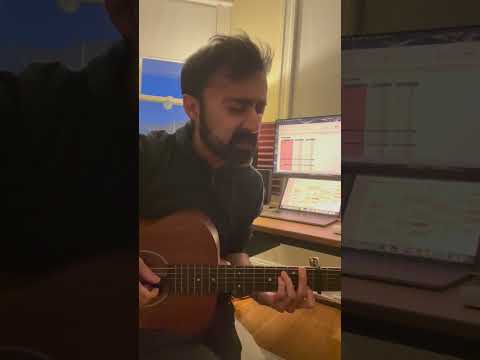
There was a time when Nikhil Dasgupta dreamed of becoming a rockstar.
Maybe he wouldn’t have admitted such a vast ambition. But his band, SnugHouse, was gaining traction in New England for its gentle, harmony-driven folk songs. Dasgupta thought they were headed somewhere.
“Like everyone who winds up doing music, I’ve always felt music deeply and wanted more than anything to be a part of that world,” he said in a recent interview over Zoom.
Then, one day in 2019, a window fell out of the frame in Dasgupta’s apartment and landed on his head. He was diagnosed with a concussion, which meant he couldn’t play music for a bit. The band went on hiatus while he recovered. But Dasgupta didn’t get better. Instead, he started developing new symptoms. It was hard to get a clear diagnosis — was it the head injury, or something else? Unable to work, he moved back home with his parents outside of Boston. SnugHouse disbanded. Dasgupta despaired of ever playing music professionally again.
“The idea that I couldn’t be a musician was devastating to me then,” Dasgupta said. “I was like, ‘The clock’s ticking, I’m getting older, and I’m going backwards instead of forwards.’”
“Heaven Knows” was one of the songs Dasgupta wrote during that period. It begins where a lot of songs do: with unrequited love. “I won’t spend another year in denial/ And you won’t change your mind,” Dasgupta sings, his wistful tone matched by the warble of his finger-picked guitar.
There’s an undercurrent of heat to “Heaven Knows,” which is determinedly unshowy. “Still I can’t help but love you like a forest fire,” goes one quietly apocalyptic lyric. As the song progresses, its perspective zooms out, from the interiority of heartbreak to a more existential point of view. “You can run the numbers/ A hundred thousand times,” Dasgupta sings. “It'll come for us all in the end.”
“Heaven Knows” doesn’t directly address Dasgupta’s illness. But he says it’s at the heart of the song.
“The way I was fixating on this relationship was a window into where my heart was at that time,” Dasgupta said. He came to believe that “helplessness is the heart of what's happening to me, not this relationship.”
In the first year of his illness, Dasgupta wrote a record’s worth of music, desperate to make meaning out of what he was going through. He remembered thinking at the time, “I'm going to write so many sad songs about how hard my life is and how miserable it is.”
But as his illness worsened, he began to reframe his experience. In the end, that was the only way he was able to get better.
“You have this story of, like, ‘I am going to be onstage playing music to thousands of people. I'm going to be successful,’” Dasgupta explained. “And then, when something happens — you get really sick, in my case — you try to make your reality meet that story, and you just can't connect them anymore. I think there's just so much suffering in that. I think, honestly, most of my suffering came from that, more than the physical symptoms.”
These days, Dasgupta, now 30, is feeling better. He lives on his own again and is able to work. He tries to tell himself a different story, one that’s not entirely tied to his identity as a musician.
“I really find so much value in the story being a really small one,” he said. “I have a daily life that's peaceful and fulfilling, and I have a lot of love in that life.”
Filming himself performing “Heaven Knows” was a way to dip his toes into playing music again. Putting himself out there for the sake of putting himself out there. Not telling any grand story. Just singing a song.