Support WBUR
The legacy of talk radio host David Brudnoy, 20 years on
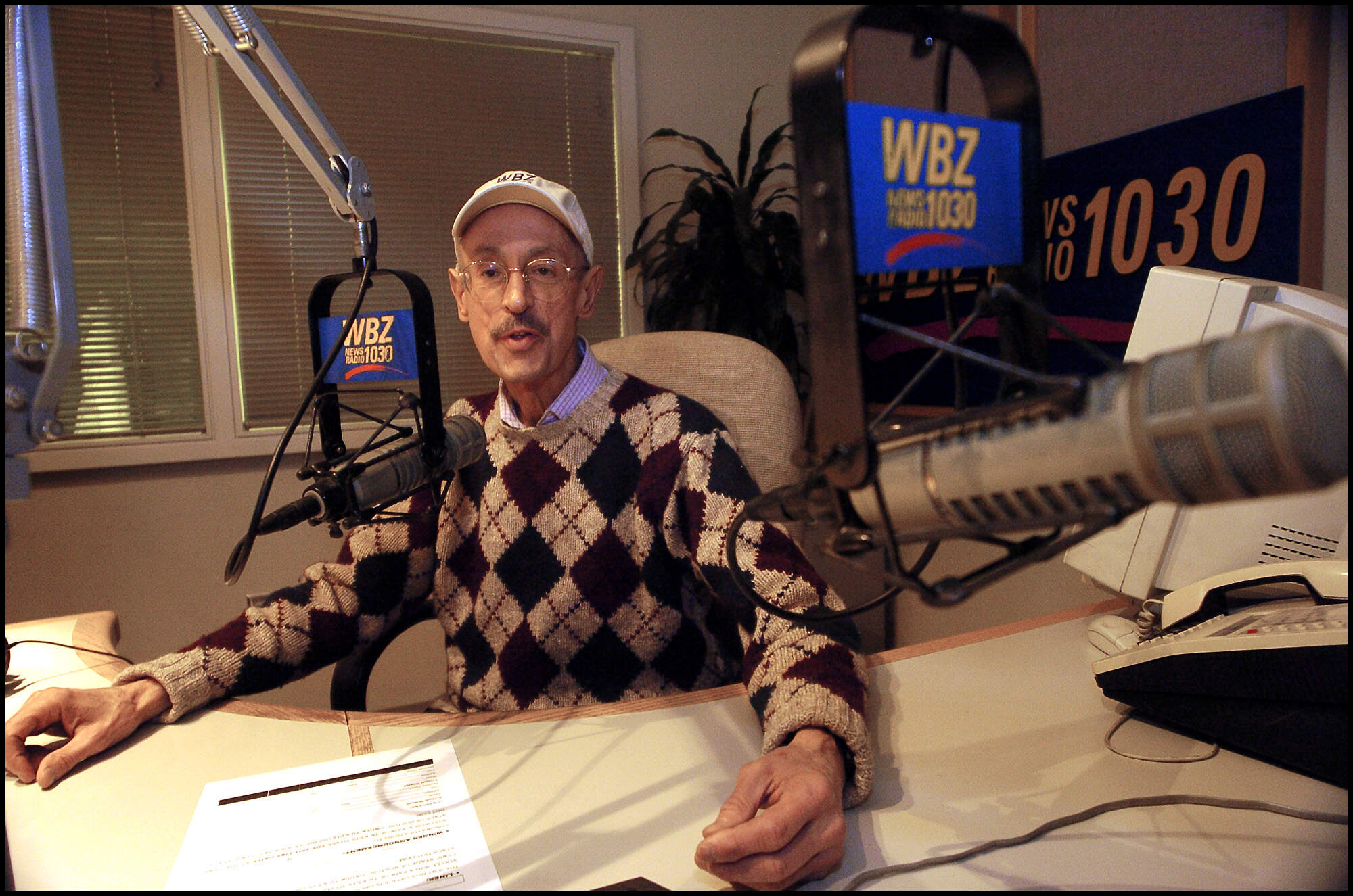
My friend David Brudnoy died 20 years ago, on Dec. 9, 2004. He was 64 years old.
Brudnoy was a Boston broadcasting legend, host of the city’s most popular nighttime talk show for decades. It may sound strange now that talk radio has become a cesspool of partisan harangues, but WBZ’s “The David Brudnoy Show” was an evening of eloquent, erudite conversation that appealed to listeners of all political persuasions and walks of life. Reaching “38 states and some of the finer provinces in Canada,” it was the only show beloved by both academics and cab drivers. I started listening to David when I was 11 years old. Even when I didn’t entirely understand what these adults were talking about, I was fascinated by the sophistication with which they spoke. It was like an entrée to a more thoughtful, grown-up world. A friend of mine once described the show as “all about how much f---ing fun it is to be smart.”
And there weren’t many people smarter than David Brudnoy. He’d graduated from Yale before getting a master’s from Harvard and then a second master’s and a doctorate from Brandeis. In addition to hosting the radio show five nights a week, the self-described workaholic was also a professor at Boston University and reviewed movies for the TAB newspapers. Brudnoy founded the Boston Society of Film Critics in 1981, and every few months he’d have his colleagues on for movie nights, devoting the final hour of the program to discussing current releases or the Academy Awards. One of these evenings was the first time I called into the show. I was 12 years old and furious that Brian De Palma’s “The Untouchables” hadn’t been nominated for Best Picture. (I still think it was robbed.)
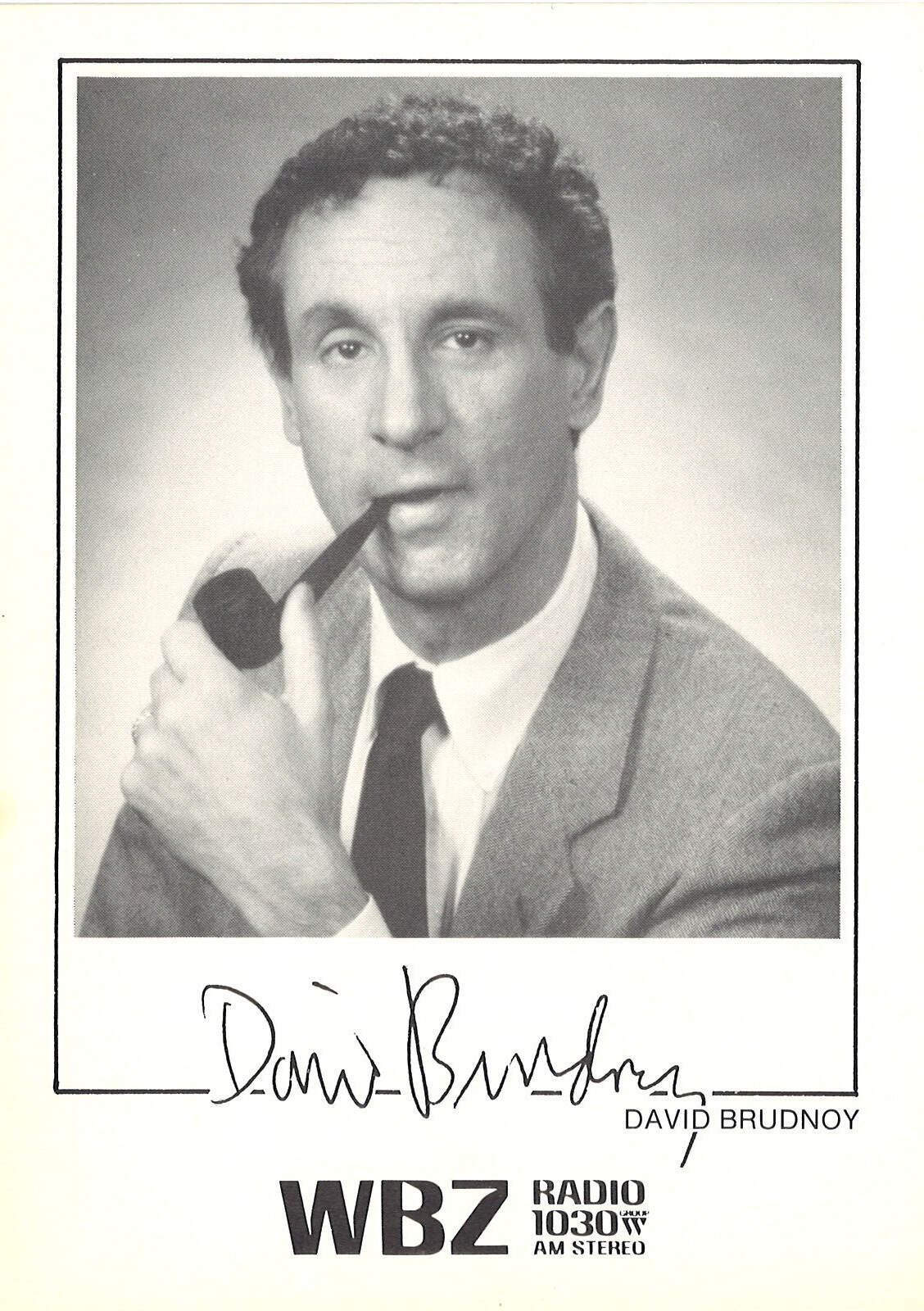
Brudnoy made national news after he spent nine days in a coma in 1994 with full-blown AIDS. Turns out he’d been hiding his diagnosis for years, secretly traveling for treatments to Washington, D.C., and paying medical expenses out of pocket to prevent a paper trail. He had been worried that it would end his career, or that he’d be pigeonholed as the gay conservative with AIDS. Instead, fans rallied around him and he came back to the airwaves more popular than ever. The struggles with his health and journey to self-acceptance were beautifully recounted in his 1996 memoir, “Life Is Not a Rehearsal.”
But I didn’t meet him until after all that.
I started reviewing movies professionally in 1999, when I was 24. I was living in the Boston area and writing for an alternative weekly in Philadelphia, filing my stories via email — a strange and exotic way of working that a lot of people couldn’t wrap their minds around at the time. As the critic for an out-of-town paper that nobody here had heard of, I was basically invisible — ineligible to even apply to the Boston Society and of zero use to local publicists, some of whom seemed to take perverse pleasure in reminding me how little I mattered. I had no idea what I was doing and no frame of reference for how to do it.
I was the youngest person at press screenings, which were held on weekday afternoons in the glorified shoeboxes of the Loews Copley Place Cinemas – a nadir of 1980s mall-bound multiplex construction boasting nine tiny auditoriums with screens the size of postage stamps. (It was the only movie theater I’ve ever encountered where the floors were raked in reverse, so that seats in the front rows were higher than those in the back.) It was a chilly, unfriendly atmosphere in those little rooms, especially for a clueless nobody like me. One of the very few people who reached out and tried to make this young writer feel welcome — to my surprise and delight — was David Brudnoy.
I don’t recall when exactly we started chatting, but I was gobsmacked when he said he’d add me to his friends and family email list for his weekly reviews if I would do the same for him. (This was how we writers used to share our work before social media.) David read and responded to every review I ever sent him — sometimes just a sentence or two, sometimes a disagreement that could go back and forth all day, and our friendship grew from there. I would walk with him after the screenings, across the bridge connecting Copley Place to the Prudential Center and we’d part ways when we reached his apartment at the Vendome on Comm. Ave. This was blocks and blocks out of my way — sometimes my car would still be at Copley — but I loved talking to him and wanted to keep the conversation going.
The thing that made Brudnoy’s show so special, and his friendship even more so, was his curiosity. He wanted to hear what you thought, and he had a natural host’s ability to make whoever he was speaking with feel like they were the most important person on the planet. David didn’t need to win arguments — he was so brilliant he could have done so in his sleep, there was no sporting interest for him in that. What he wanted was to understand other ideas, to learn why people felt the way that they did, especially if it was a difference of ideology or opinion. He didn’t need to have the last word, that usually went to his callers or whoever he was talking with.
Such generosity extended to the films he reviewed. I used to tease David because he gave almost every movie a B or thereabouts. I still try to be a tough critic with high standards, but back then I was brutal. I fancied myself as carrying on the alt weekly tradition of speaking truth to power by writing sweary takedowns of sacred cows that, in retrospect, probably could have been a bit more considered. For his part, Brudnoy thought that going to the movies was a lovely way to spend the afternoon and often told me that even the worst films weren’t worth getting so worked up over, though he found my rancor awfully amusing.
David was a mentor to me not so much with regard to my work . . . but rather he taught me a way to engage with the world.
He'd been through a lot and seemed at peace with himself in a manner that always made me envious. David was a mentor to me not so much with regard to my work — we had pretty different ideas of what we wanted and expected from cinema — but rather he taught me a way to engage with the world. Brudnoy had countless friends from so many different walks of life, all different ages and backgrounds and occupations. At screenings, he’d joke about how he liked to sit on my right, since that was where he already resided politically. But our discussions and debates were never dogmatic.
You think about how tribal Americans have become in these past 20 years, only listening to their own allies and echo chambers. Brudnoy actively sought out people with different perspectives and experiences. I think that was part of why he loved going to the movies every day — meeting new characters, hearing new stories, always more opportunities to learn, even from some wet-behind-the-ears kid who just started on the job.
In my younger days, I tended to present as a caricature of a Boston Irish stereotype, kind of like if the Casey Affleck Dunkin’ Donuts guy had gone to film school. This is why David thought it was hilarious to tell everyone that I was secretly Jewish, descended from an Israeli tribe that had settled in County Cork, and that my real name was not Sean Burns, but Shmuley Gubortstein. If I wanted to call into the show, I just had to tell the producer it was “Shmuley from Israel” and Brudnoy would put me right on the air. One night, he and I tag-teamed Boston Globe critic Ty Burr about the factual inaccuracies in Michael Moore’s movies, and poor Ty didn’t realize until the next day that he hadn’t actually been speaking to someone from the Israeli Times.
You’d never know it from the intellectual gentleman on the radio, but Brudnoy had a filthy sense of humor. We’d crack each other up by saying the most foul and inappropriate things, most of them unprintable here. (All of our email correspondence was lost when my old computer croaked, which might be for the best.) David joked that when he died, he wanted his cremains to be scattered in my living room ashtray, so that we “can still have some nice chats and I can meet all the loose women you bring home from bars.” After a first bout with cancer nearly killed him in 2003, I started calling him Rasputin and complaining about how AIDS wasn’t good enough for my bigshot celebrity friend, he had to go and get cancer, too. Typical Brudnoy, hogging all the cool, popular diseases for himself, leaving me with rosacea and adult acne.
To banter like this with one’s childhood hero is a surreal experience that I can’t recommend highly enough. Bringing everything full circle, I became a recurring guest on Brudnoy’s movie nights. He did the show from his home, where his producer was also in charge of fixing cocktails for everybody. There were signs scattered around the cozy, book-filled apartment that read, “Thank you for smoking.”
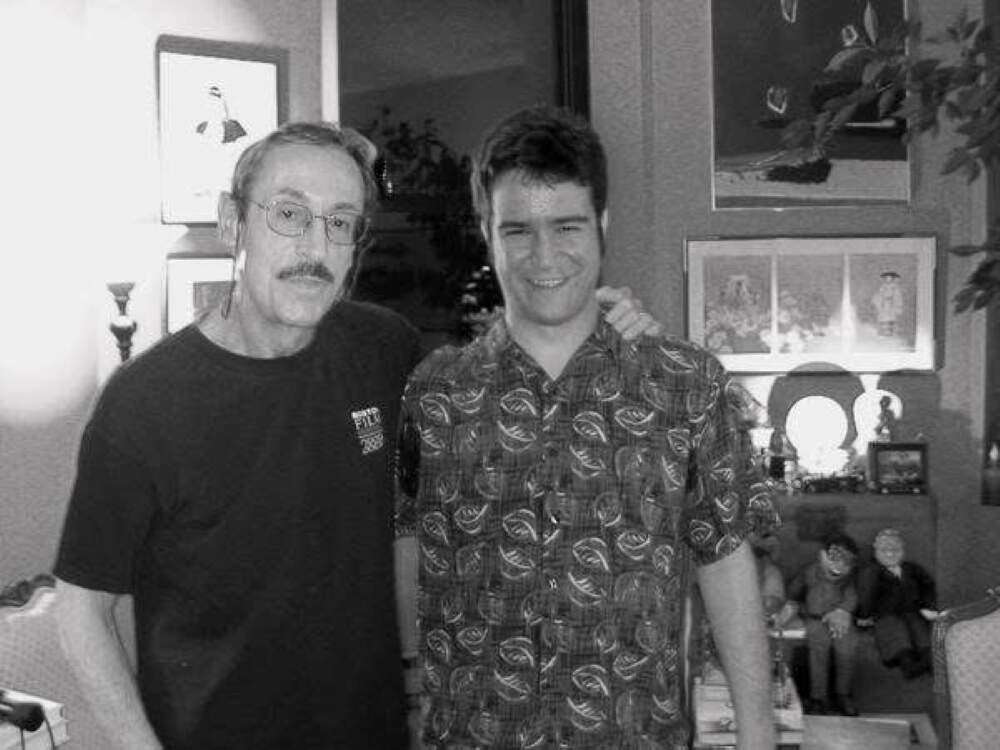
The last time I did the program, in July of 2004, I was able to invite my dad along. (Pro Tip: If you want to impress your father, bring him to the radio show he’s been listening to for 18 years.) Brudnoy being Brudnoy, he immediately started plotting to get my dad stoned by dosing him with “the Alice B. Toklas fudge” he kept stashed in the back of the fridge. (I put an end to this plan.) We went off the air at 10 p.m. but everyone hung around and kept talking until almost midnight. “Hot damn,” David wrote to me the next day, “that’s what I call an evening.”
My friend was eulogized by senators, celebrities, Kennedys and Boston Mayor Tom Menino. Months after he died, an episode of the TV show “Boston Legal” began with William Shatner silently reading Brudnoy’s front page obituary in the Globe. The camera held on it for a beat before the show’s dialogue began, as if in dedication. David Brudnoy was a man of great consequence whose program may very well have been the last bastion of civilized discourse in a medium — and let’s face it, a whole country — where it seems like everybody would rather hear themselves shout than listen to each other’s ideas.
But I’ll always remember him as a guy who went out of his way to befriend a lonely, intimidated kid who was just starting out in the business. He was nice to me when he didn’t need to be. He was nice to me because he was a nice person.
I’ll always remember him as a guy who went out of his way to befriend a lonely, intimidated kid who was just starting out in the business.
The last time I saw David was after a screening of “Ocean’s Twelve,” a few days before he died. It was one of those early December afternoons where it’s already dark as midnight at 4:30 p.m. I was standing outside the AMC Boston Common on Tremont Street smoking a butt when Brudnoy emerged from the theater, unsteady on his feet. He didn’t look good. He was waiting for a friend to come around with a car to take him home. He wobbled and I offered him an arm.
“You’re kind,” he said with a directness that made me uneasy. Steadying himself on my shoulder, he continued, “You try to hide it, but you’re a good person.”
Being an emotionally constipated Irishman, I don’t do well with this kind of talk. I stepped on my cigarette butt and gestured at the two of us, standing arm-in-arm under the streetlight.
“You know, David,” I said, “if people see us like this, they’re gonna talk.”
He laughed as his friend pulled up to the curb.
“You’ve done worse,” he smiled, then got into the car.
I can’t ask for a better sign-off than that.