Support WBUR
Boston's Morning Newsletter
The potential silver linings of a historic wildfire season in Mass.
Editor's Note: This is an excerpt from WBUR's daily morning newsletter, WBUR Today. If you like what you read and want it in your inbox, sign up here.
Before you inspect our chances of a white Christmas (which, it turns out, actually has a very nitpicky definition), we’re starting today’s newsletter with a look at the big natural phenomenon of this fall.
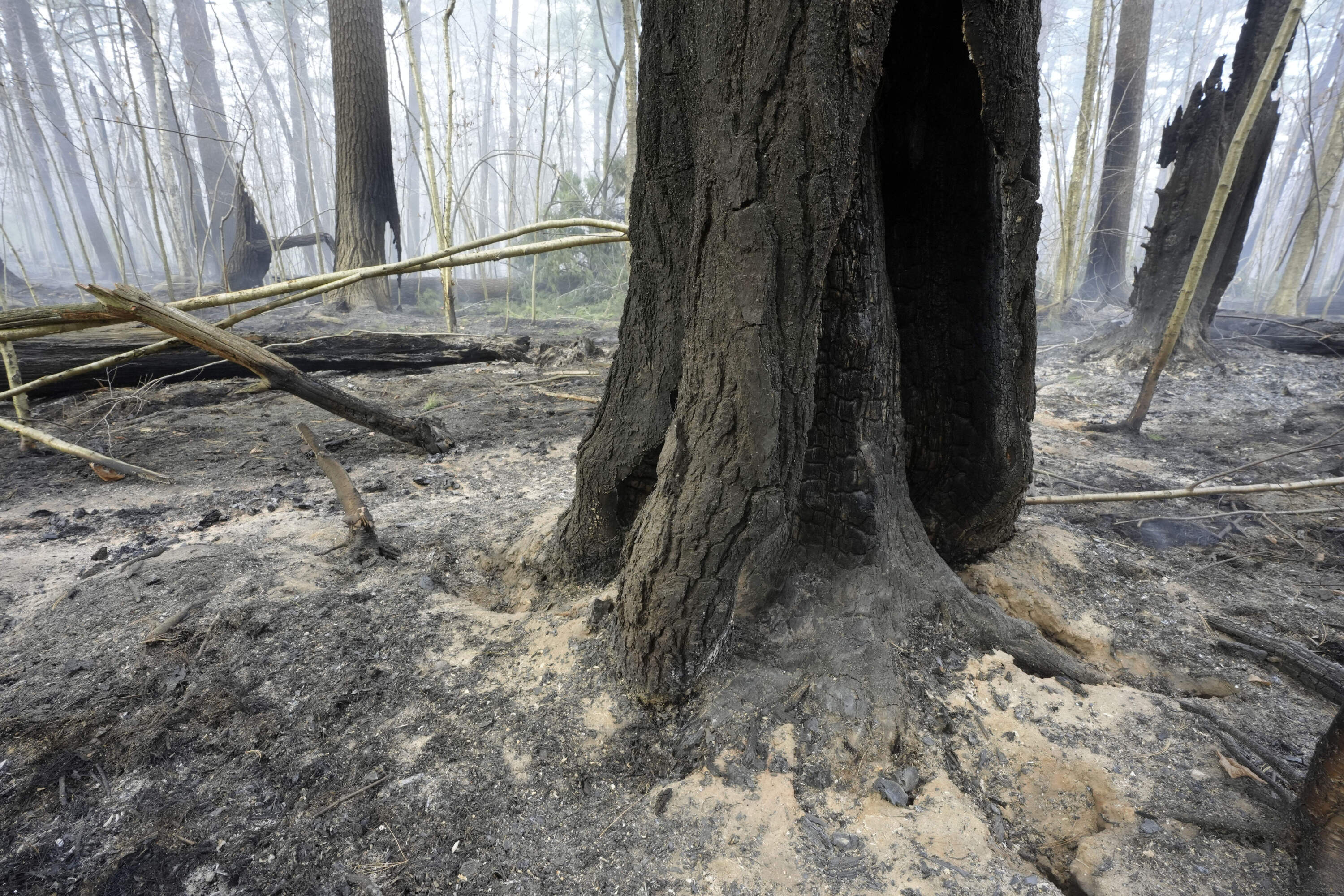
WBUR senior producer Amanda Beland breaks down what was a historically unusual season for wildfires in Massachusetts — and why the coming winter will be key for determining their long-term impact:
There were 1,285 wildfires in Massachusetts this year. That’s actually on par with the number of fires, on average, over the last few years. But what is not so average is how many acres were burned, says David Celino, chief fire warden for the Massachusetts Department of Conservation. In total, 4,579 acres were engulfed — a record over the last few decades. The majority burned in October and November due to dry, windy weather, and lots of leaves on the ground. But there is a bit of a silver lining as the smoke begins to clear:
- Fire itself is not new to the party: In fact, it’s an expected and welcomed guest. According to experts, fire has been a natural part of the New England landscape for generations. It’s even used in a prescribed way to bring renewal to forests (think of it as a cleansing of forest floors). It also can have ecological wins. Species like oak, hickory or pitch pine trees benefit from being hit by fires, which expose their seed beds and allow for natural regeneration. Some herbaceous plant species only naturally pop up after fires. There are even some animals that have evolved to thrive in landscapes recently hit by flames. “They have adaptations that allow them to actually move out of the way as best possible, as long as it’s not a large conflagration and then they readily come back,” Caren Caljouw, the prescribed fire manager at the Massachusetts Division of Fisheries and Wildlife, said.
- All in moderation: While fire can be beneficial to a landscape, it’s a balancing act. Big, sustained fires can damage environments and excess smoke can cause health problems. One study last year showed over 3 million U.S. households — billions of dollars in property — could be at risk for wildfires every year over the next few decades. “It’s a positive part of the story when it comes to the ecosystems that we find fires in,” said Celino. “However, in response, we need to protect human values in life and property.”
- What happens now: All the fires in Massachusetts are out, but some may still be smoldering, says Celino. This means researchers studying the impacts of the fires on our local landscape won’t survey the damage until spring. In the meantime, they’re hoping for a wet winter, ideally with snow cover. And not just any type of precipitation will do. Sustained events rather than quick downpours or storms are preferred because they’re more likely to deeply soak the ground, snuff out the smoldering areas and build up water in the ecosystem — all of which could provide better protection against new fires in the spring.
Last bell: The Kennedy-Longfellow School in East Cambridge is closing at the end of this academic year. The city’s school committee voted this week to close the elementary school, which has long struggled with low enrollment and performance. (According to The Boston Globe, the Kennedy-Longfellow has been the least-chosen school for over a decade under the city’s school choice program.)
- What’s next: Cambridge says the school’s 200 students will be reassigned to the city’s other 11 public elementary schools before the start of the 2025-26 academic year.
Save the date: Gov. Maura Healey will deliver her second State of the Commonwealth speech on Jan. 16, 2025. (In her first address earlier this year, Healey said the commonwealth was “stronger than ever.” Will it be even stronger in the new year? TBD.)
In court: Dennis Hernandez, the older brother of late New England Patriots tight end Aaron Hernandez, pleaded guilty yesterday to threatening a shooting at UConn, as well as threatening to kill three other people. His sentencing is set for Feb. 6.
Take two: Massachusetts’ Cannabis Control Commission has picked a new executive director — again. After their previous pick turned down the job, the CCC voted yesterday to make an offer to Holliston town administrator Travis Ahern.
P.S.— As a little holiday gift to readers, our Cognoscenti team put together a Spotify playlist of songs that inspired their essays throughout the year. Give it a listen here.