Support WBUR
Boston's Morning Newsletter
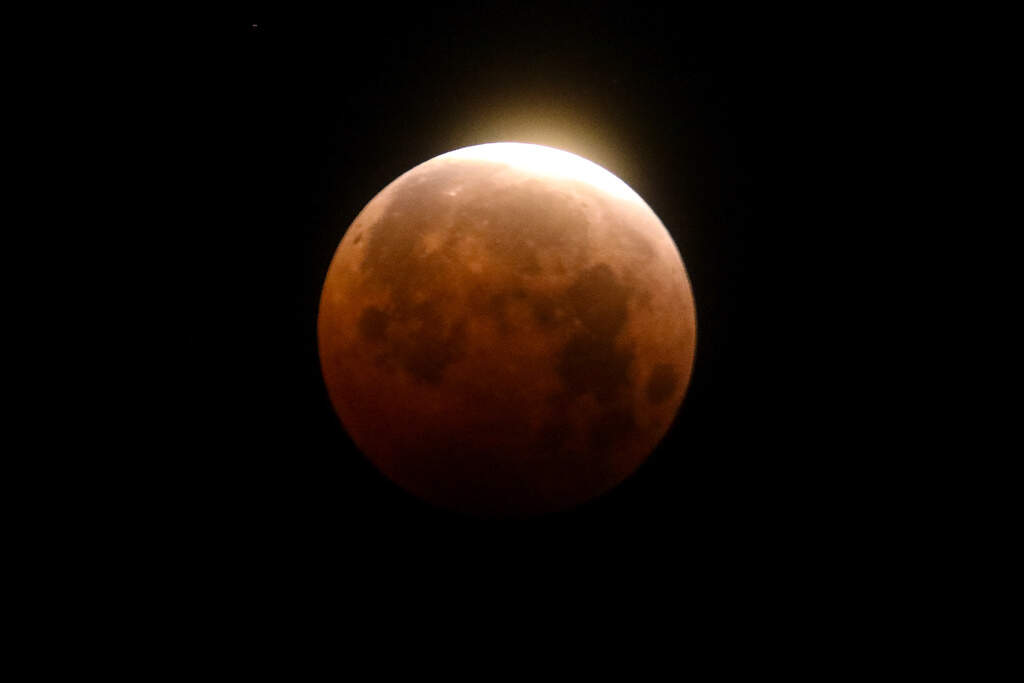
Why is Thursday's 'Blood Moon' red? Here's what to know and when to look up
Editor's Note: This is an excerpt from WBUR's daily morning newsletter, WBUR Today. If you like what you read and want it in your inbox, sign up here.
Happy “New England spring of deception” to all who celebrate. Before you go outside and frolic in that sunshine, let’s run through the news:
Total eclipse of the… moon? The first of two eclipses this month takes place overnight Thursday into Friday. First up is a total lunar eclipse, also known as a “Blood Moon.”
- How did it get its nickname? UMass Lowell physics professor Silas Laycock told WBUR’s Fausto Menard that the name comes from how the moon takes on a reddish glow during its eclipse. “As the sunlight passes very close to the Earth, blue light gets scattered out and only the red light long wave lengths are left. And so, as the moon passes deep into the Earth’s shadow, it only sees that light that’s passed just through that sunset part of the night sky,” Laycock said.
- When to see it? It starts just after midnight when the full moon begins passing into the Earth’s shadow. Totality will occur from about 2:30 a.m. to 3:30 a.m., so Laycock suggests setting an alarm for around 2 a.m. And no need for special glasses; a lunar eclipse can be viewed with the naked eye. But binoculars may help you see more impressive views.
- Why are lunar eclipses, like Thursday’s, visible from most of the country? Laycock said large parts of the Earth are usually able to see total lunar eclipses because the Earth’s shadow is really big compared to the moon. “It’s the reverse for solar eclipses because the moon’s shadow, of course, is really small compared to the Earth,” Laycock added.
- Speaking of… On March 29, there will be a partial solar eclipse, when the sun will be about 50% obscured in the Boston area. That will occur right at sunrise, at 6:30 a.m.
Bring on the innovation: The Healey administration is investing $75 million in a program that would designate certain regions of Massachusetts as “TechHubs.” But what does that moniker mean?
- Let’s break it down: Regions can apply to be designated as TechHubs if they foster companies doing innovative work in sectors like aerospace and defense, artificial intelligence, cybersecurity, digital health and robotics. (It’s also open to industries that want to develop further in these sectors.) A press release from Healey’s office says nonprofit organizations, economic development agencies, local governments, colleges, universities and community organizations can also apply on behalf of their region. Healey’s office says the goal is to make sure the success of the tech sector reaches across the state.
- How is it funded? According to MassTech, the development agency behind TechHubs, the program was established as part of the state’s 2024 economic development bill. If an application is approved, the winners receive grants for infrastructure projects and strategic planning to bring more tech innovation in their region.
About that announcement: Yesterday, we said Boston Mayor Michelle Wu’s office was gearing up to announce something big around housing. That turned out to be the acquisition of Mattapan apartment complex Fairlawn Estates by local real estate firm Related Beal. It’s good news for the building’s tenants, as the new owner has promised to keep all 347 units in the complex affordable, thanks in part to a $10 million grant from the city.
- Go deeper: As The Dorchester Reporter’s Seth Daniel reports, tenants at Fairlawn Estates had raised alarms about rental increases and eviction proceedings from the apartment complex’s previous owner, DSF Group, since 2018. “This is a community victory won by neighbors working together,” said Betty Lewis, of the Fairlawn Tenants Association.
Following the thread: The Everett city council unanimously passed a no confidence vote against Mayor Carlo DeMaria yesterday. Why? You may recall from last week’s newsletter that a state inspector general report accused DeMaria of improperly receiving $180,000 in bonus payments over five years, which were allegedly hidden in the city’s budget. Last week, the council ordered DeMaria to return the money within 30 days, but he’s denying the findings and did not attend yesterday’s meeting.
P.S. — If the weather doesn’t cooperate or you miss your alarm for Thursday’s blood moon, the next lunar eclipse is in March 2026. So you won’t have to wait too long. But to say you saw two eclipses in one month would be pretty darn cool to brag about.