Support WBUR
The Weekender: Boston's Saturday Morning Newsletter
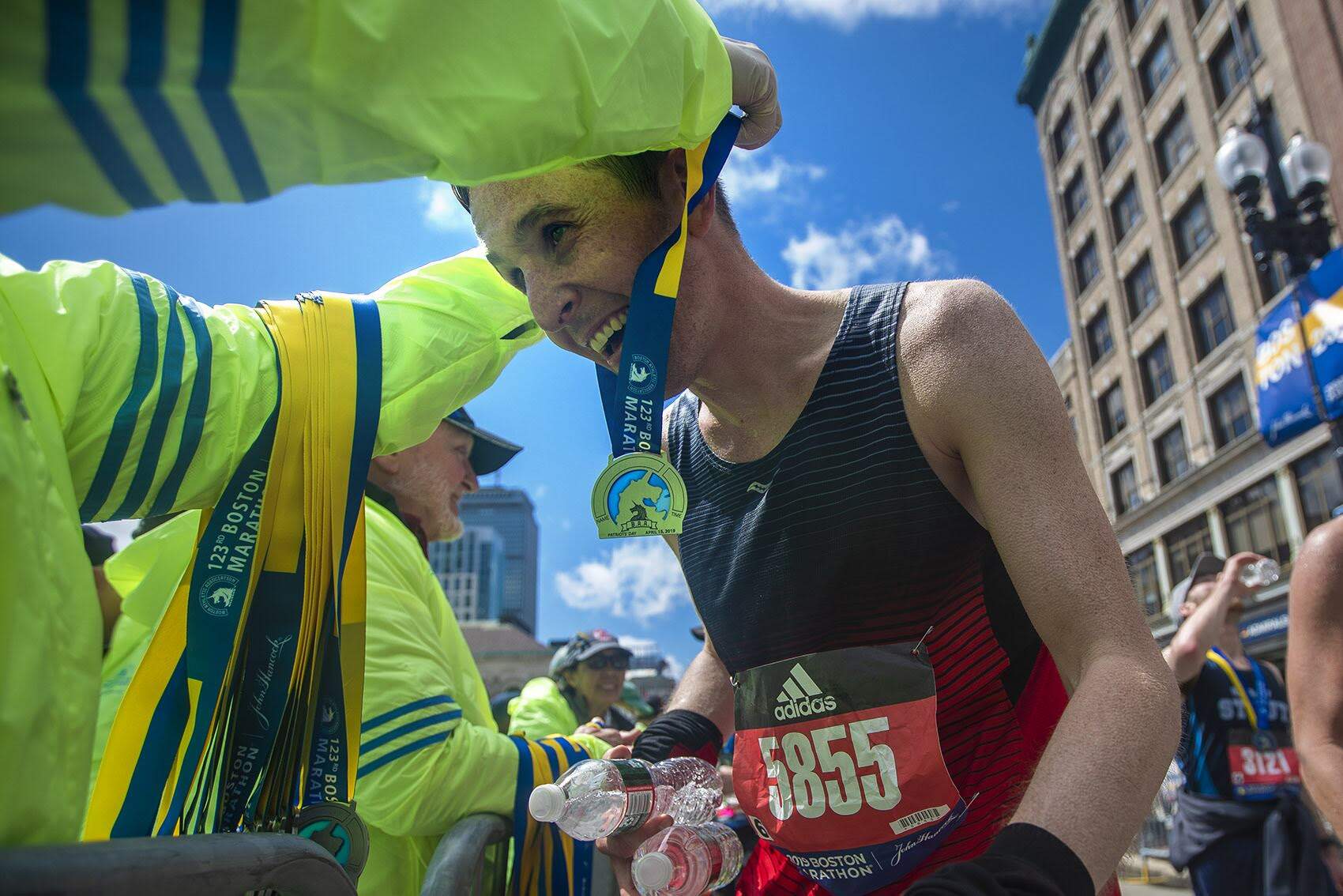
Feeling inspired to run next year's Boston Marathon? Here's where to start
Editor's Note: This is an excerpt from WBUR's Saturday morning newsletter, The Weekender. If you like what you read and want it in your inbox, sign up here.
This Monday, roughly 30,000 runners will set off from Hopkinton toward Boston's Boylston Street for the 129th annual Boston Marathon.
If you've ever been a spectator at this storied race, you know seeing someone run 26.2 miles is an astonishing, yet inspiring human feat. People of all abilities, ages and backgrounds run the race each year. And you could, too — with the right training and preparation starting around, well, now.
I spoke with John Furey, a longtime Boston Marathon coach who's led thousands of runners to the race, and Scott Cody, coach of the Boston Athletic Association Running Club, to get some tips to turn your marathon dreams into a reality for next year.
Here's what they shared.
Your starting point (spring and summer)
If you want to tackle the Boston Marathon, running should already be a regular part of your exercise regimen a year out, according to Furey. “You probably want to be someone who’s been running for at least a year, and can comfortably run three to four days a week, five to six miles,” he said. (So, about 15 to 24 miles per week.)
Meeting that basic criteria means “your body is ready to handle some pretty good impact,” said Furey. While it's possible to train for a marathon with little to no running experience, it’s not exactly recommended. Inexperienced runners have a higher risk of injuring themselves, if they ramp up their mileage too quickly, according to Furey.
Late spring and summer is also the time of year you want to start thinking about the sign-up logistics outside of running. Unless you're fast enough to meet the Boston Marathon's notoriously hard qualifying times, you'll likely need to apply to run for a charity.
The BAA has an online list of nonprofits with charity bibs. Cody suggests reaching out to your charity of choice to see when they're accepting applications for new runners. And before you commit to running for a cause, make sure you have motivation, discipline, and time in your schedule to dedicate to both running and fundraising, said Furey. Most charities require runners to fundraise upwards of $10,000 for a bib (and if you don't hit your minimum, much of the time your credit card is the one on file to make up the difference).
“The fundraising piece is almost like a part-time job," Furey said.
But there are also benefits from getting involved in a charity group.
“The thing I love about the charities is that you're running for a purpose,” said Cody. You’re also running with a guide and group of people, who might have more experience and tips you can borrow from, he added.
Registration and practice races (fall)
Registration dates for next year’s marathon will be announced after this Monday’s race. But in years past, the five-day registration week typically falls in September.
Cody and Furey say this is also the perfect time for runners to up the ante by competing in local road races and half-marathons.
Boston, Cambridge, Lowell, Marshfield and Hanover all host prominent half-marathons in the fall. You can even soak in the last moments of summer — while practicing for the marathon — at the “3 Beach Minimum” half-marathon along Nantasket Beach. (New Bedford also hosts a half-marathon in March that Cody says is good prep for Boston "because it's got a lot of downhill and uphill.")
Furey suggests checking New England Runner’s calendar for more local races. If you have a “pretty good experience” running a half marathon in the fall, he says it’s a good indicator you’re on track with your training for Boston in April.
In the thick of training (winter)
The BAA has an official 20-week marathon training plan to help runners increase their mileage in preparation for the marathon. If you haven't begun an official training plan yet, the latest you'll want to start is Thanksgiving (that's approximately 20 weeks before the marathon).
During this training, Furey said you'll want to be mindful of injuries. Knee pain, achilles tendinitis and shin splints are common injuries from running. And they can “definitely come up” while training, said Furey. Though you might not be able to run while healing, he suggests staying active by going to the gym and using an elliptical or bike. But in serious cases, you might need to see a physical therapist.
New Englanders also know that the weather here isn't exactly pleasant between November and April. (Other major marathons — like the Berlin and the New York City marathons — are held in the fall, letting runners train through the summer instead.) You'll have some of the hardest training for Boston through snow, slush and freezing rain, and the weather on race day has ranged from 30 degrees and wet to 87 degrees and sweltering.
“Do you want to get up every Saturday morning for 20 weeks and do a long run?" Furey said. "Do you want to run when it's cold and dark? You don’t want this to be something you’re doing just because it’s a bucket list thing."
If you're still feeling dedicated after facing these hard realities, then you're officially ready to begin you journey to the starting line alongside thousands of fellow perseverant peers.
What did they all have in common, according to Cody? The right outlook, in addition to training. “Just run to enjoy it," he said. "If you’re not training to run a specific time, the Boston Marathon’s a lot of fun.”
And you could start right now — this weekend even. Here are a few local running paths to begin training, plus a few more pointers from other running experts.
P.S.— Not a runner? No problem. Marathon Monday's athletes will rely on that Boston energy and excitement along the sidelines. Here's what to know about this year's race as a spectator, from start times to how to get to (and around) the course.