Support WBUR
Review
At the MFA, Van Gogh's portraits reveal his capacity for friendship
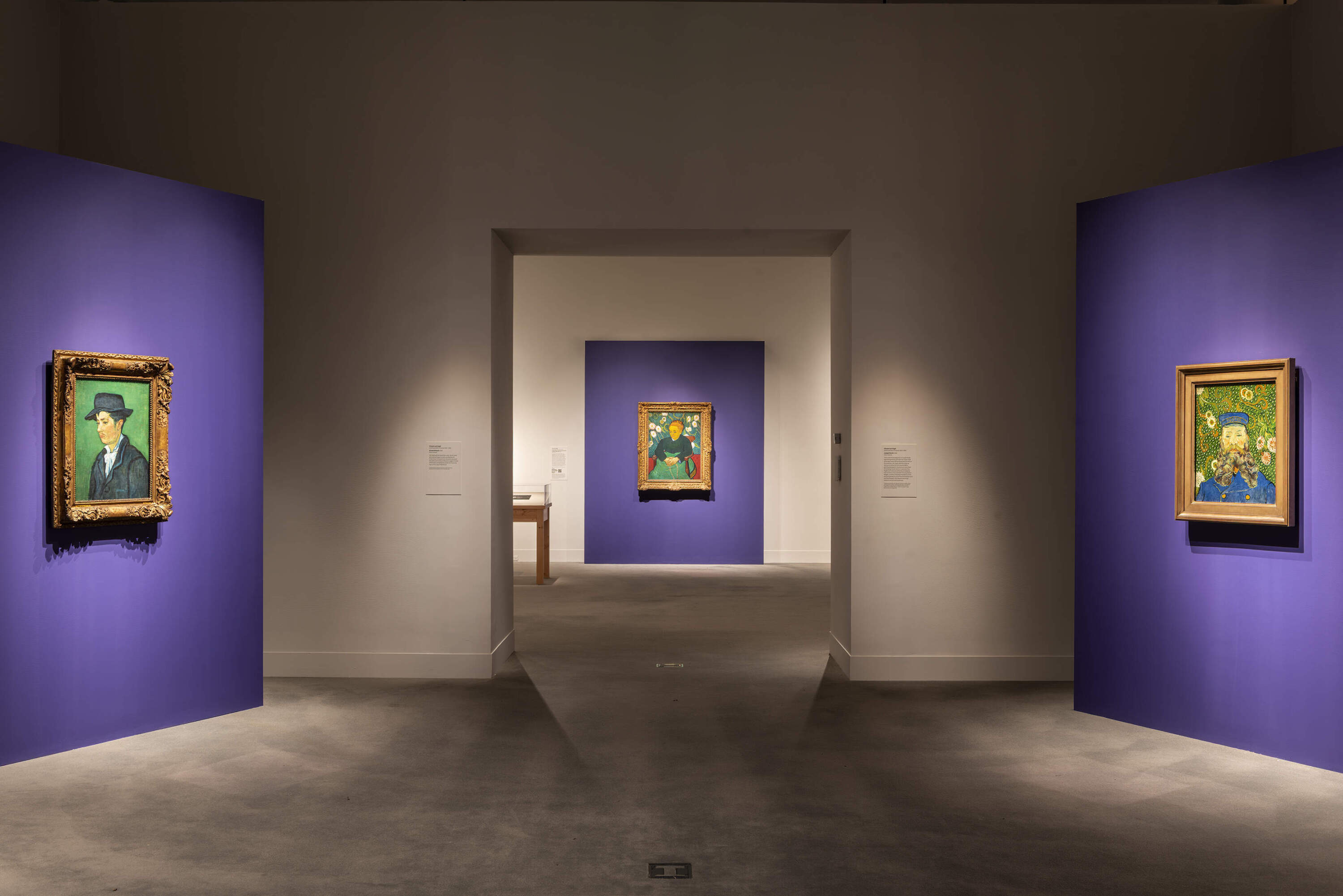
If the new show at the Museum of Fine Arts, Boston, “Van Gogh: The Roulin Family Portraits,” were only what the title indicated — an exhibit of the paintings and drawings Van Gogh did in Arles in the last two years of his life of his friend, the postman Joseph Roulin, and his family — it would be a significant event. It would be the first show ever devoted to these intimate portraits, and would tell us some new things about an artist we all think we know through his most popular work.
The wonderful surprise is that the title is only the starting point. Hanging in the second room of the show is Van Gogh’s first portrait of Roulin — a large-scale seated figure in his official blue uniform, bursting with painterly energy but touching in the way it captures Roulin’s reticence, even shyness. Van Gogh called Roulin “a Socratic type, no less Socratic for being something of an alcoholic, and with a high color as a result.” It’s one of the most beloved paintings in the MFA’s own collection.
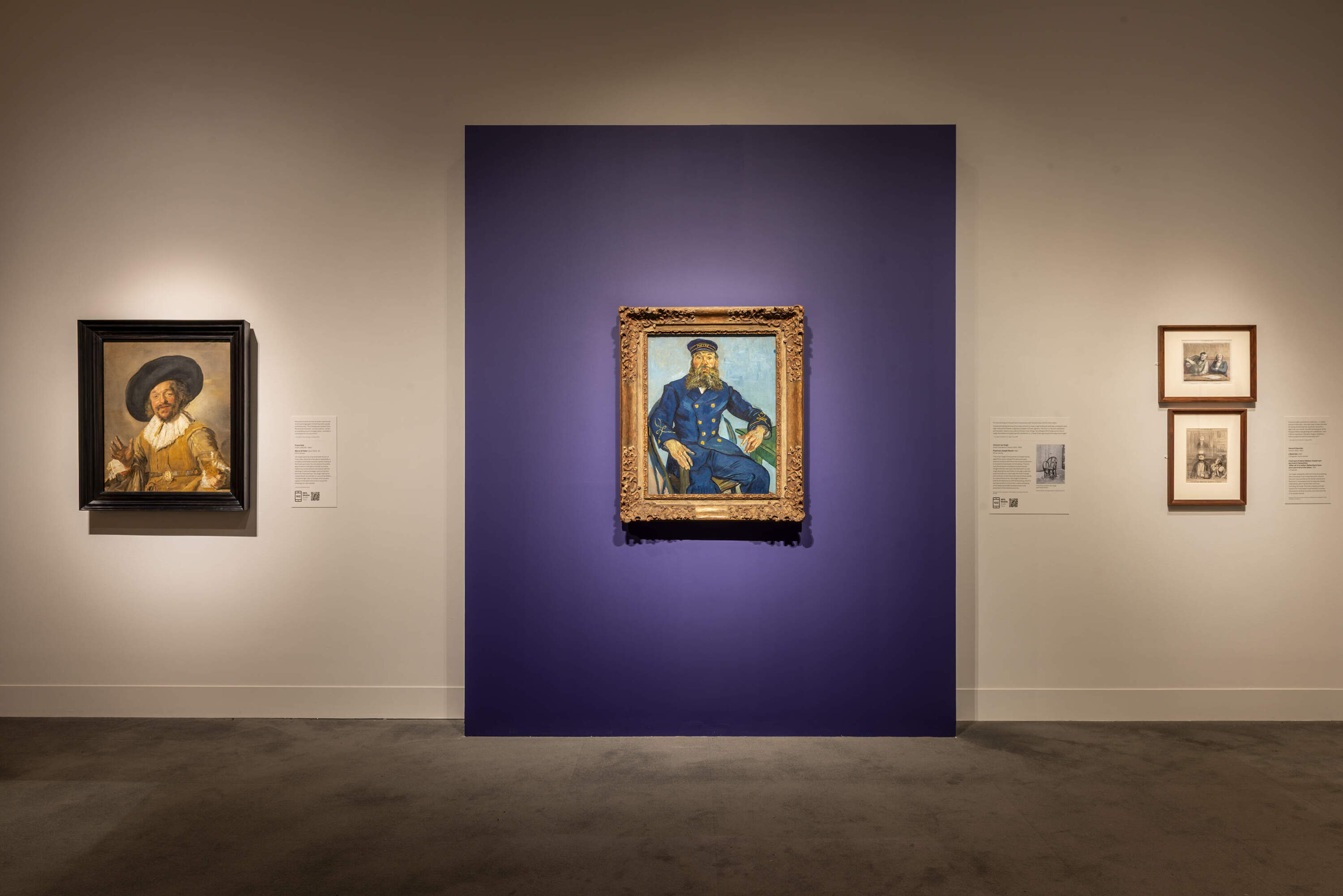
But the painting next to it is not another Van Gogh. It’s Frans Hals’ world-famous “Merry Drinker” (an astonishing loan from Amsterdam’s Rijksmuseum).
Van Gogh, the curators tell us, was not painting in a vacuum, or stuck inside his own sometimes demented brain. He was actually working — and aware of working — within a tradition of Dutch and Flemish art that went back more than two centuries. And one of the show’s most revealing juxtapositions lies in these two vivid portraits.
Both paintings are overflowing with life and character. But the detail I find most thrilling is the similarity of the hands, the Merry Drinker is raising his right hand, perhaps mid-joke. Roulin’s left hand is hanging over the edge of a table. Hals’ hand is open, Van Gogh’s closing. But both hands are painted with such complex detail, gnarled and shadowy, with many colors and such broad strokes that, the closer you get, the hands themselves almost disappear into the brushwork.
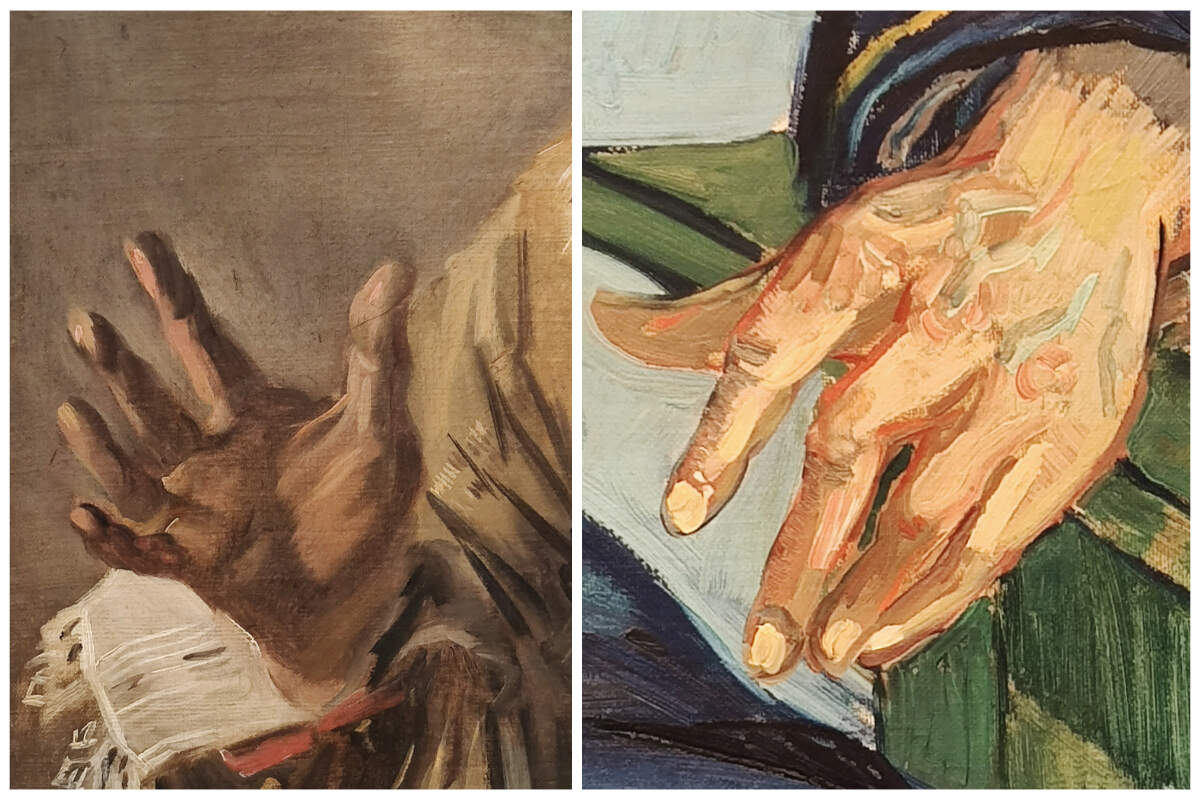
The point of this juxtaposition seems to be that both hands could almost be painted by the same artist, and how much Van Gogh seems to have learned from his observation of Hals, how much he owed Hals.
So along with 14 (including two extraordinary drawings) of the 26 portraits Von Gogh did of the Roulins are four marvelous works by Hals (any visit to this country of a Hals should be an occasion for celebration), as well as other 17th-century work by Rembrandt and Adriaen van Ostade (a self-portrait with his large family, from the Louvre), along with Japanese woodblock prints, satirical Daumier lithographs (Van Gogh himself owned several), and a pastel by Jean-François Millet, a beloved artist from the previous generation, once wildly popular, then considered excessively sentimental, and now highly regarded for his draftsmanship (Van Gogh admired the nobility of his depiction of poor farmers and peasants). And also of great interest, works by Van Gogh’s friends Émile Bernard and, of course, Paul Gauguin, who famously lived with Van Gogh in the yellow house for two months.
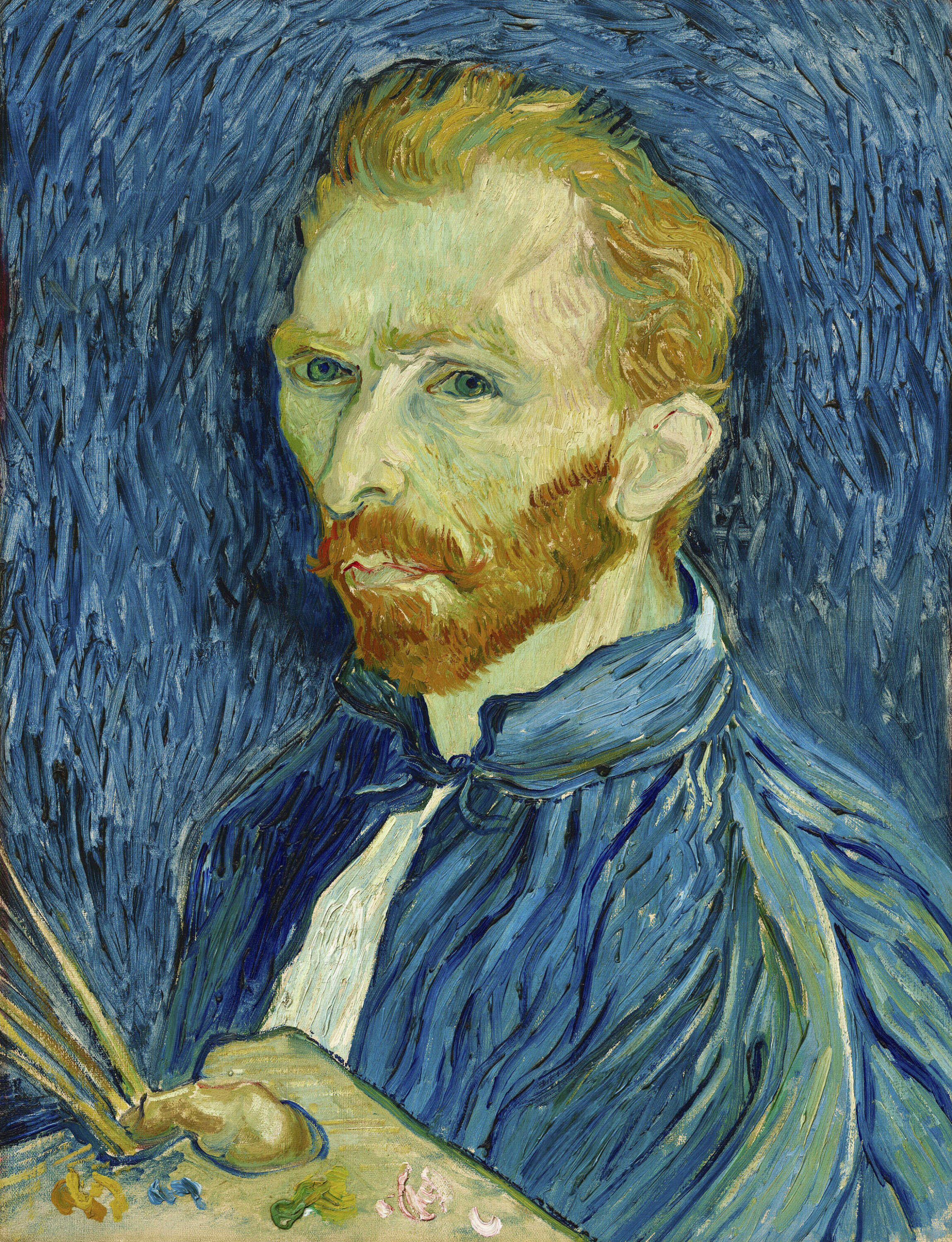
Of course, at the heart of this show are 14 of the 26 portraits Van Gogh made of the Roulin family, demonstrating not only his art but his heartfelt capacity for friendship. The Roulins emerge as his family. But the Roulins are also seen here in the context of Van Gogh’s great self-portraits, including the one with the dazzling quasi-turquoise background from Harvard’s Fogg Museum (given more breathing room here than it gets in Cambridge), and especially the one (from the National Gallery in Washington) in which he depicts himself as an artist — holding his brushes, his thumb sticking through the thumbhole of his palette, wearing a shimmering deep cobalt painter’s smock, with a midnight blue background streaked with light, spinning around his head — an image of inspiration? — like the sky in “Starry Night.”
There are also two masterpieces that are not portraits (or are they?). The very first painting you see when you enter is Van Gogh’s radiant painting of the yellow house in Arles where he lived and worked for two richly productive and appallingly distressing years (there’s even a life-size model of his studio that visitors can walk through and see exactly how much space he had to work in). And before you exit into the gift shop, with its wide range of swag from the superb catalogue to Van Gogh skateboards, one of the last paintings you see is the artist’s magical, dizzying painting of his blue bedroom (on loan from The Art Institute of Chicago), which has one of his own self-portraits hanging precariously above his narrow bed. “Every painting,” the late Boston artist Ralph Hamilton used to say, “is a self-portrait.”
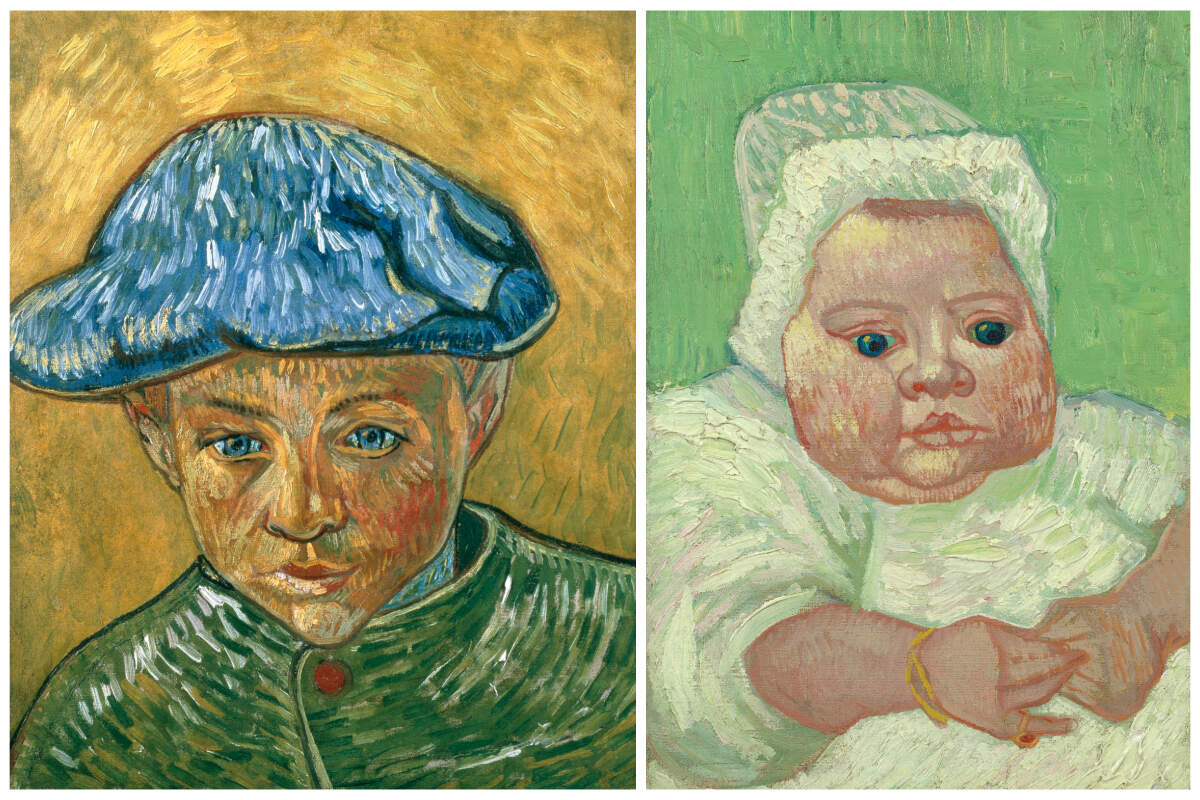
The show is beautifully designed and spaciously laid out, so that even on a busy day, it’s still possible to see the pictures. In the octagonal third room, we’re surrounded by all five members of the Roulin family. There’s the brilliant small painting of Joseph’s head (from MoMA), a painting of a ghostly Madame Augustine. Roulin (virtually a sketch) holding up her pudgy baby daughter, and the most touching of Van Gogh’s images of the two Roulin sons, the tender young Camille and the more ambiguously adolescent Armand — a sullen, depressed, bewildered, slightly hunched over 17-year-old. (At the end of the show are actual photographs of each of these figures, but the only one you’d recognize from Van Gogh’s paintings is Papa Joseph — older, in the photo of course than when Van Gogh painted or drew him, and here with a benign passivity quite different from the wide-eyed energy and inner strength his artist friend saw in his younger self.)
The richest part of the show is the large central room, called “Creating Community Through Art,” which fully reveals the complex layering the curators offer us. This is the most extensive consideration of Van Gogh in relation to his contemporaries and antecedents. The hanging includes some of Van Gogh’s best-known and least-known portraits, as well as Rembrandt’s gorgeously painted portrait of the elderly Aeltje Uylenburgh, more Japanese prints with their sharply outlined figures and flowers, Van Gogh’s younger artist friend Émile Bernard’s coloring-book-like portrait of his grandmother, with its startling area of flat white, and the Millet pastel (all from the MFA), opposite Hals’ achingly forthright “The Fisher Boy” (from Royal Museum of Fine Arts, Antwerp), not in the painter’s more familiar comic tone, and clearly the model for Van Gogh’s portraits of Camille Roulin. It’s one of the most subtly beautiful and moving paintings in the entire show.
Among the most intriguing pictures here, of course, are the paintings and drawings made during the two months Gaugin was sharing Van Gogh’s studio. We see Van Gogh’s “Self-Portrait Dedicated to Paul Gauguin,” his famous “La Berceuse” (“The Lullaby,” which shows Augustine Roulin sitting in front of a heavily flowered wall and holding the rope with which she’s rocking her infant daughter’s cradle), and a lesser-known painting her holding her daughter. And then there’s a portrait of Augustine Roulin by Gauguin, who makes her look more like one of his mysterious Tahitian women than an Arlésienne matron. And in glass cases in the center of the room are a page of three delicately shaded, beautifully detailed Gauguin sketches of Camille Roulin, more “photographic” than Van Gogh’s portraits, and a small notebook, on loan from the Israel Museum, open to the page with Gauguin’s drawing of the Roulin baby, far prettier than in Van Gogh’s images of her.
Another small Van Gogh baby portrait from a private collection from Hong Kong and an awkwardly toothy 11-year-old Camille against a background of broad red and orange areas that look like they’re out of Rothko, from São Paulo, suggest how hard it would be to get to see everything in this show if you miss it here.
And there are more surprises.
“Letters from the Postman” is a room with 10 waist-high pedestals, with a letter on top of each written by Joseph Roulin to Vincent and his siblings, Theo Willemien van Gogh, just after Christmas of 1888, after Van Gogh cut his ear, through October 1889, when Van Gogh seems to have recovered and returned to painting. These letters are full of affection and concern from someone who sounds like a truly devoted friend. I mean “sounds” literally. When you lean over to look at a letter, you hear a gentle male voice with a bit of a French accent reading it aloud in English. This could have been just a shtick, but it’s actually very affecting — another dimension to this show’s many layers.
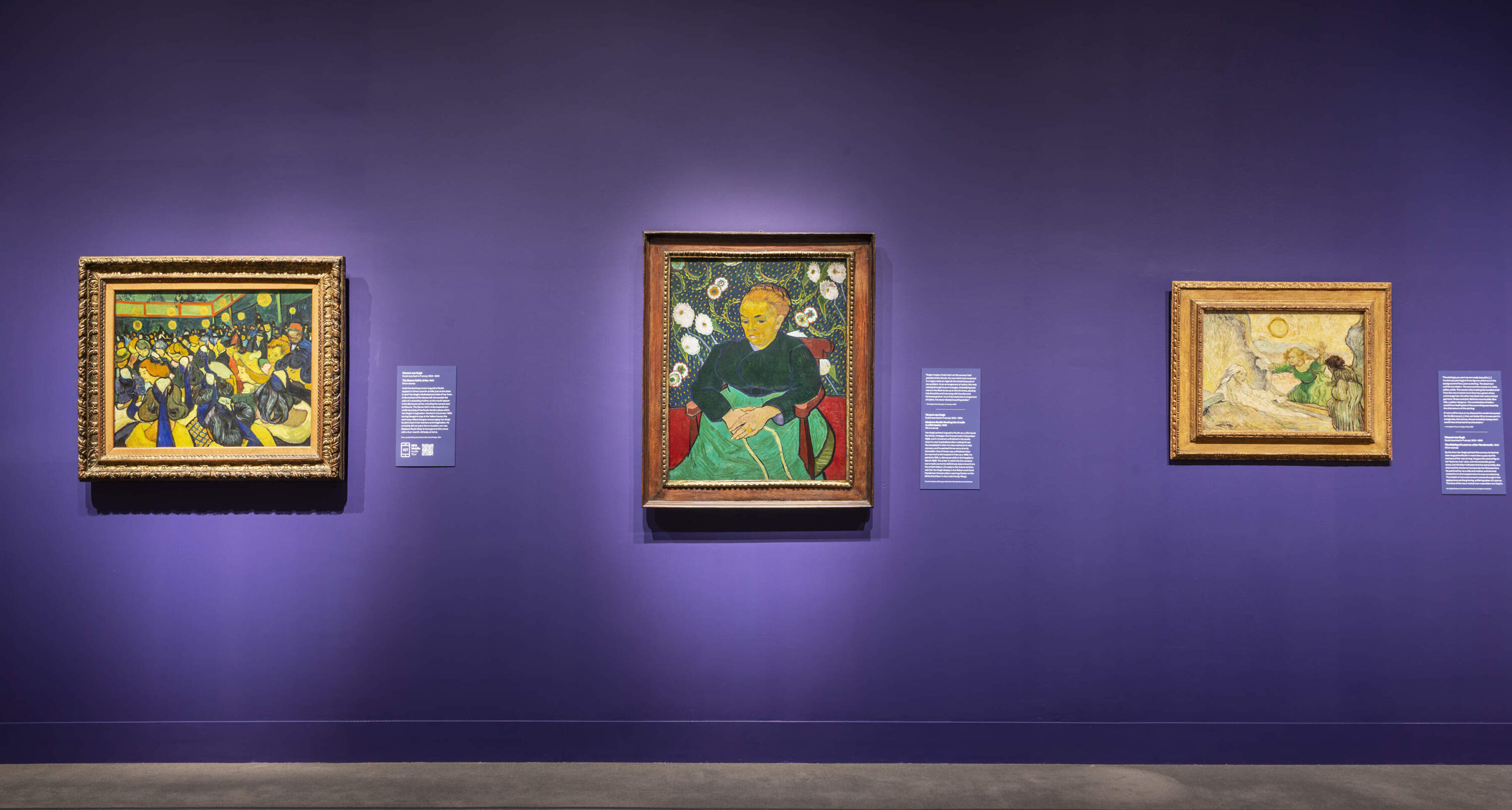
The last two rooms also contain marvels. The paintings in the room called “Observation and Inspiration” catch your eye from unexpected angles. Here is the most interior and thoughtful of Van Gogh’s five versions of “Madame Roulin Rocking the Cradle” (from the Art Institute of Chicago), with the most expressive depiction of her hands (the left covering, virtually comforting the right), and the most exciting high-contrast, practically three-dimensional view of the floral pattern behind her. The five versions of this were all painted within months of one another, which seems to make it impossible to figure out the exact sequence.
Augustine Roulin’s face recurs in an adjacent painting that looks more like a Toulouse-Lautrec than a Van Gogh — a scene of a crowded dance hall with her head in the midst of all the action, a place the living Augustine seems unlikely to have ever known first-hand. Was Van Gogh teasing her? Her image then reappears in a very strange biblical painting inspired by Rembrandt’s etching “The Raising of Lazarus” (also on view), with Van Gogh painting himself as the resurrected Lazarus and Augustine as his consoling sister. Augustine, the caption informs us, had visited Vincent in the hospital a year before, which must have moved him deeply.
This room also displays two late landscape paintings (both from the MFA): the quietly pastoral “Enclosed Field with Ploughman,” essentially a view from Van Gogh’s hospital window in Saint-Rémy-de-Provence, and in dramatic contrast, a visually turbulent scene called “The Ravine,” another local landmark, with two barely visible travelers trying to make their way through what Van Gogh sees as a wild, tumultuous area, swirling with paint.
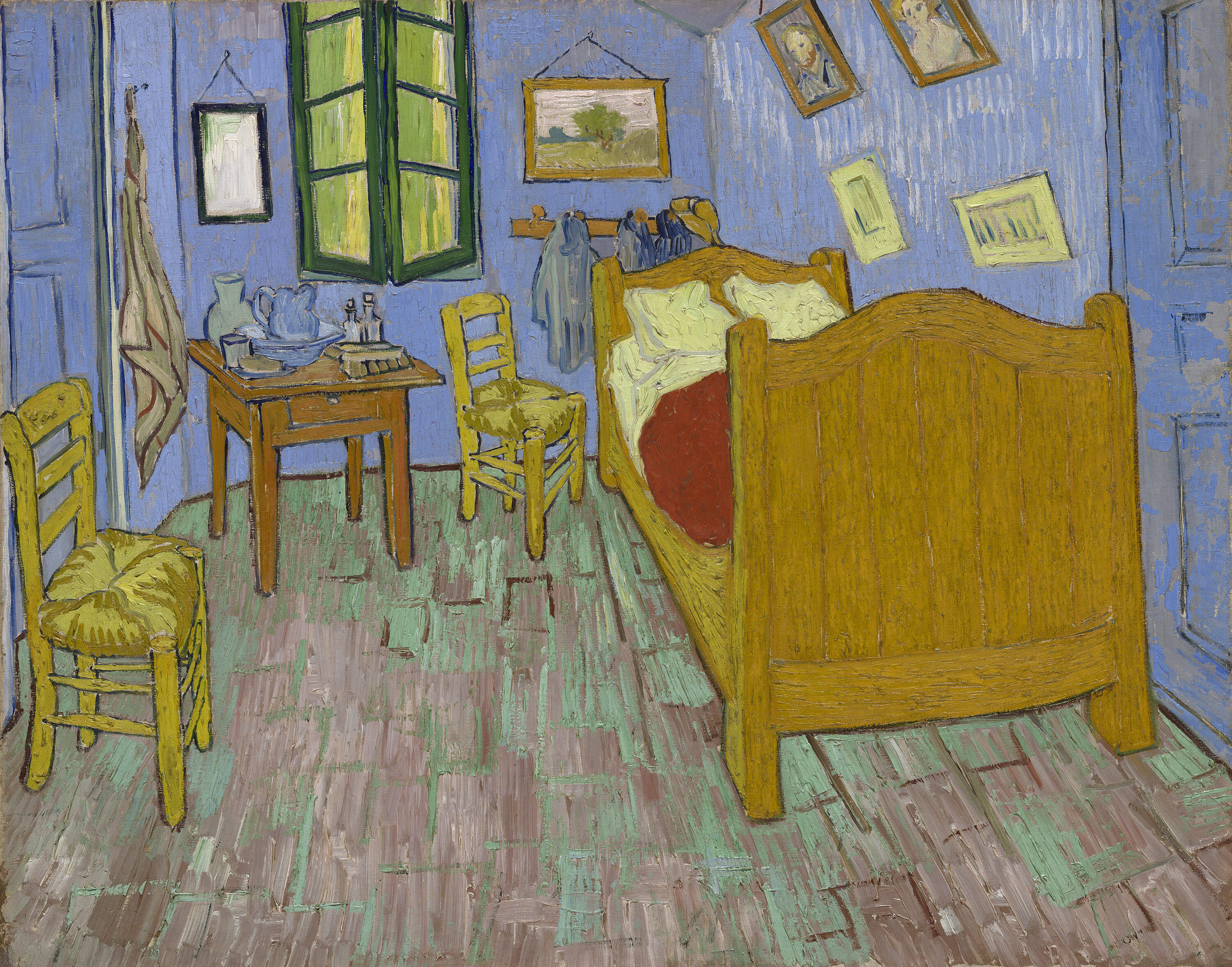
The final room is called “Enduring Legacy,” perhaps because it concludes with two of Van Gogh’s greatest paintings, parallel to the two paintings at the start of the show: another self-portrait, the one of himself as an artist, paired with a domestic scene, the extraordinary painting of his bedroom. There’s also one more little portrait of baby Marcelle, the painting Vincent sent to Theo and his wife on the occasion of their first child. And here are also the photos of the Roulins at various stages of their lives.
But it seems to me the real “enduring legacy” of this show is the way that, like no other Van Gogh show I’ve ever seen, not only humanizes him but also places his work in the direct lineage of Dutch art and also connects him to the world of art immediately around him. The depth of this contextualization is remarkably illuminating, even profound, and we need to be extremely grateful to MFA curator of European painting Katie Hanson and curator Nienke Bakker from the Van Gogh Museum for this enjoyably serious and seriously enjoyable, once-in-a-lifetime exhibit. Even without chrysanthemums, sunflowers, blackbirds or starry skies.
“Van Gogh: The Roulin Family Portraits” is on view at the MFA through Sept. 7 before moving on to the Van Gogh Museum in Amsterdam, the show’s co-sponsor, where it will make its only other stop and in a different format.