Support WBUR
Customers, leaders shocked by sudden shutdown of nonprofit grocer Daily Table
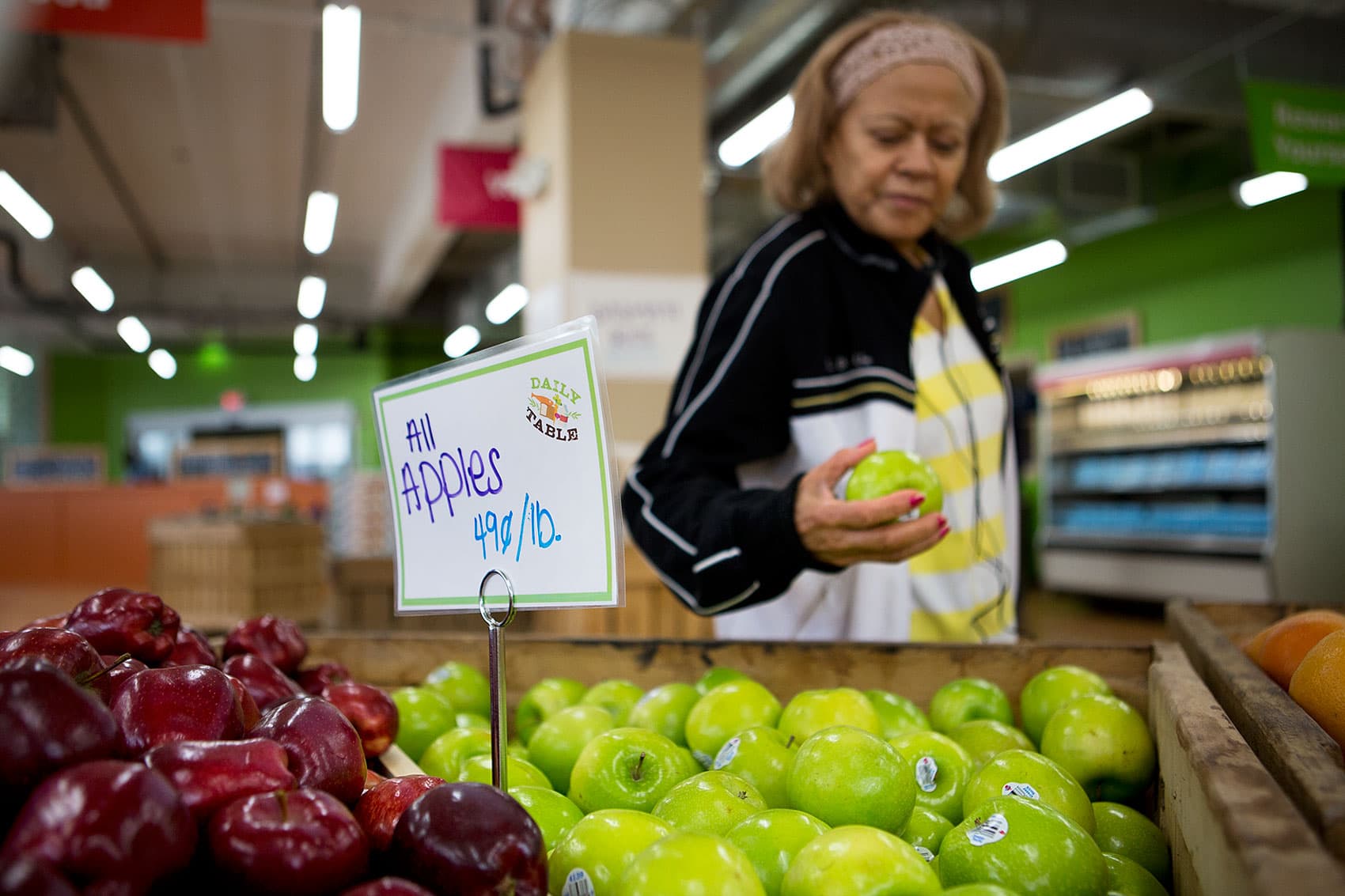
Residents in some neighborhoods of Dorchester, Roxbury, Cambridge and Salem suddenly have to find new places to buy nutritious groceries and prepared meals cheaply.
Nonprofit grocer Daily Table shut down abruptly over the weekend due to financial problems. It had four locations. A fifth, in Mattapan, closed in January.
The stores sold food other grocery businesses would have discarded because it didn't look perfect or was close to expiring. It served retirees on fixed incomes, families and individuals on Medicaid and others in need, according to the organization's leaders. A report from Daily Table said more than 260,000 customers used its stores in 2024, a 24% increase from the year before.
Dorchester resident Robert MacEachern walked to Daily Table to shop once or twice a week. The 49-year-old cemetery administrator said he's on a tight budget and doesn't own a car. He was unemployed during the pandemic but was still able to eat well.
"I found myself experimenting when I cooked, because of the access to affordable stuff, where I wasn't thinking about the price," MacEachern said. "So I started using scallions more, peppers more, different types of onions, different types of squashes that quite honestly, I didn't know existed before the Daily Table. ... I feel devastated that it's closing."
Bill Walczak helped establish Daily Table and served on the board from the time the first location opened in Dorchester's Codman Square 10 years ago. He's the co-founder and former CEO of Codman Square Health Center, which partnered with Daily Table. Walczak says the sudden closing of the nonprofit grocery stores is a shock.
" Part of [what led to the closing] was the fact that the price of food has gone up tremendously. And so we were continuously trying to adjust," Walczak told WBUR's All Things Considered host Lisa Mullins. "About 30% of the food was donated, and 70% were purchased. ... When the prices started wildly fluctuating in the last year or so, it became really difficult to basically ride that. In addition to that, we found that donations were off."
The organization also tried but failed to secure state funding and learned recently it would lose federal funding from the Supplemental Nutrition Assistance Program, Walczak said.
He's urging governmental and philanthropic leaders to come up with a system to sustain low-price, nonprofit grocery stores in areas that are considered "food deserts."
"We know, for instance, that community health centers are funded by the federal government because the regular healthcare system doesn't operate in areas with high numbers of low-income people," Walczak said. "If we care about people having nutritious food, we need to make sure that there's a system for allowing those kinds of stores to be able to operate in low-income communities ... or we're going to be paying on the other end, which is in the healthcare system."
This segment aired on May 13, 2025.