Support WBUR
Boston's Morning Newsletter
Could AI give Boston school buses more green lights? The city will test it
Editor's Note: This is an excerpt from WBUR's daily morning newsletter, WBUR Today. If you like what you read and want it in your inbox, sign up here.
Suddenly, we're back to below-average temperatures — and you know what's coming this weekend. But first, the news:
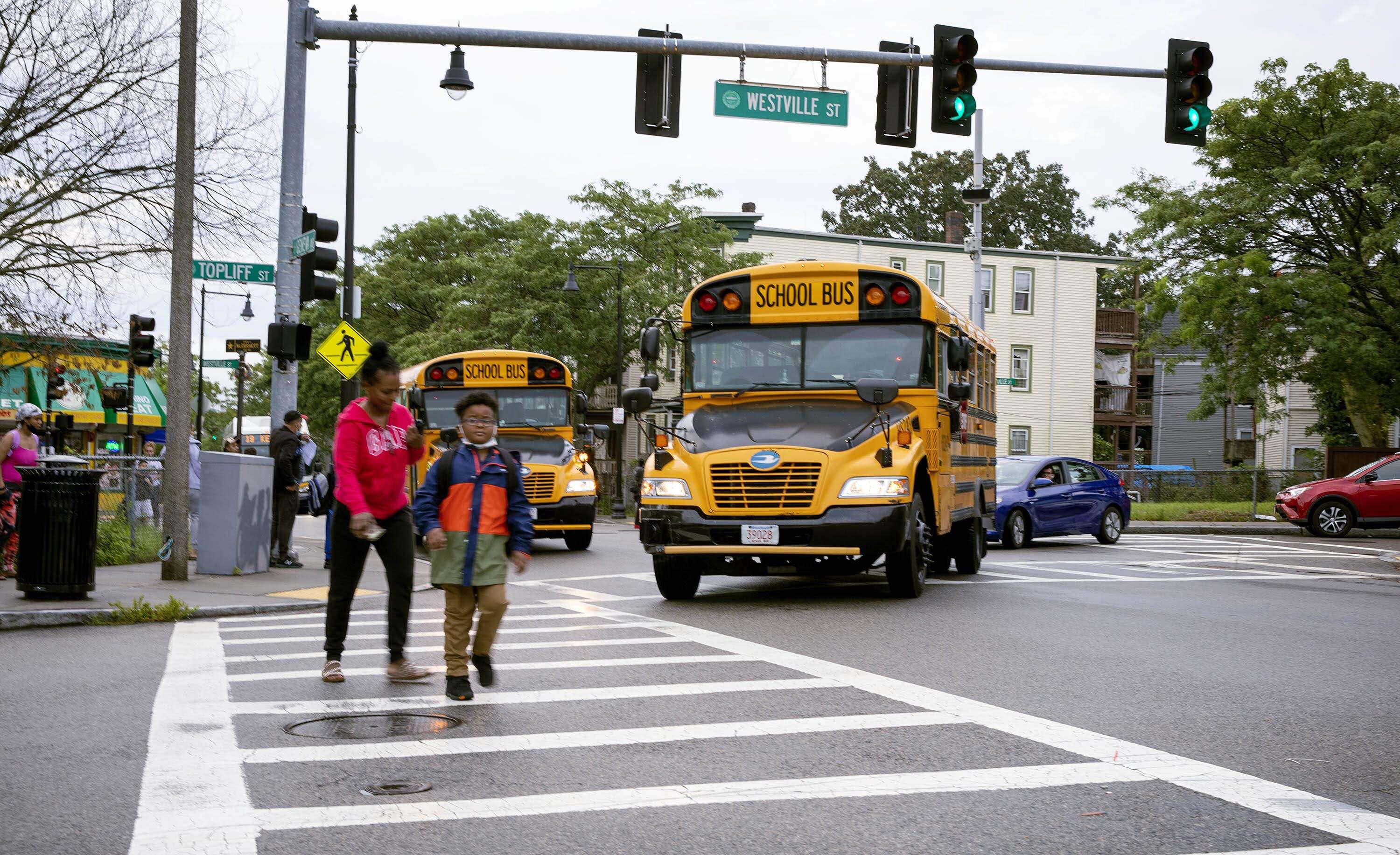
Can AI help Boston's school buses beat traffic? The city is giving it a look. As WBUR's Andrea Perdomo-Hernandez reports, Boston was named one of 50 finalists yesterday in a Bloomberg Philanthropies competition of over 600 global municipalities to find innovative ways to improve the lives of local residents. Making the final round means the city gets a little seed money ($50,000) to pilot their proposal.
- What's the proposal? For Boston, the main idea is to use AI-powered sensors on traffic lights to give school buses priority, making the light turn green when the bus approaches an intersection. It's something that city officials say they've seen the MBTA use to improve their bus speeds. "We're working on trying to identify what school buses and what intersections would create a good pilot for us," Santiago Garces, the city's chief information officer, told Andrea.
- Why focus on school buses? Garces says Boston's stifling congestion has long been one of its biggest quality of life issues. And it's a big reason the city's school buses have struggled with on-time performance. While a recent Boston Public Schools report said that school buses' morning on-time performance had improved to 94% as of this past March, it noted that the rate is "likely to plateau" without additional changes. "Congestion doesn't impact everybody equally," Garces told Andrea. "When your kid's not able to get picked up from school, it also might impact your ability to get to work and do other things."
- What's next: In the coming months, Boston will use the $50,000 to plan and prototype the pilot. And if the people at Bloomberg think it's promising, the city will get a lot more money to bring it to life. In January, Bloomberg will select 25 winning cities that will get $1 million to implement their projects.
Contingencies in Cambridge: Harvard's Kennedy School of Government has unveiled a backup plan to allow international students to complete their degrees, even if the Trump administration is successful at blocking their return to campus. As WBUR's Emily Piper-Vallillo reports, the Kennedy School announced yesterday that students who can't attend class in person will be allowed to complete their degree via online courses or enroll as a visiting student at the University of Toronto. (Either way, their degree will still say Harvard on it.) Emily has more on the details here.
- Why it matters: The Kennedy School says over half of its students come from outside the United States, making it "one of the university’s most international schools."
- Catch up: The plan comes after a judge on Monday again blocked an attempt by the Trump administration to stop Harvard from enrolling international students, saying it violated the school's freedom of speech rights.
A second former Boston University women's soccer coach is facing accusations of inappropriate conduct toward a player. The Boston Globe reported yesterday that former head coach Casey Brown was accused to giving unwanted attention to a current player on the team. The allegations come after Brown's predecessor, longtime coach Nancy Feldman, was accused of sexual harassment by popular podcaster and former BU soccer player Alex Cooper earlier this month.
- In a statement to WBUR, BU said it launched an external investigation and found "no BU policy violations and no evidence of sexual harassment." Brown also told the Globe that the accusations against her are "selective" and "out of context." Still, she resigned last December. (BU holds WBUR's broadcast license.)
Newton will require public school students to be fully vaccinated, starting this fall. While the city's previous superintendent waived student vaccine requirements during the COVID pandemic, current school leaders are reinstating the hard-and-fast rule that any student who is not fully vaccinated (who doesn't have a religious or medical exemption) will be not be allowed to attend school.
- By the numbers: At least 182 Newton students went to school this past year without full vaccinations, including 42 who were not vaccinated against measles.
Kseniia Petrova, the Russian-born Harvard researcher accused of smuggling clawed frog embryos into the United States, is facing new charges. A federal grand jury yesterday indicted Petrova on one count of concealment of a material fact and one count of false statement, in addition to the existing smuggling charge. Despite the new charges, the 31-year-old will remain on pre-trial release.
P.S.— It's concert night at City Space. Our Sound On summer concert series continues tonight at 7 p.m. with the Lawrence-based hip-hop group Glasshouse, which was our judges' favorite Massachusetts submission in last year's NPR's Tiny Desk Contest. Door open at 6 p.m. Click here for our judges' local favorite Tiny Desk entry of 2025!