Support WBUR
Dispatches from the Triennial: Downtown Crossing
Editor's note: This story is an excerpt from WBUR's weekly arts and culture newsletter, The ARTery. If you like what you read and want it in your inbox, sign up here.
Back in May, I wrote a feature about the inaugural Boston Public Art Triennial. The event is a massive undertaking, involving 20 original commissioned public art pieces placed all around Boston. Triennial organizers raised $8 million to pull it off, betting that the buzz generated by a big endeavor would justify the investment. The site-specific pieces deal with knotty social and political issues, like climate change, youth homelessness and Indigenous rights. They are designed to pique interest, prompt questions and even provoke.
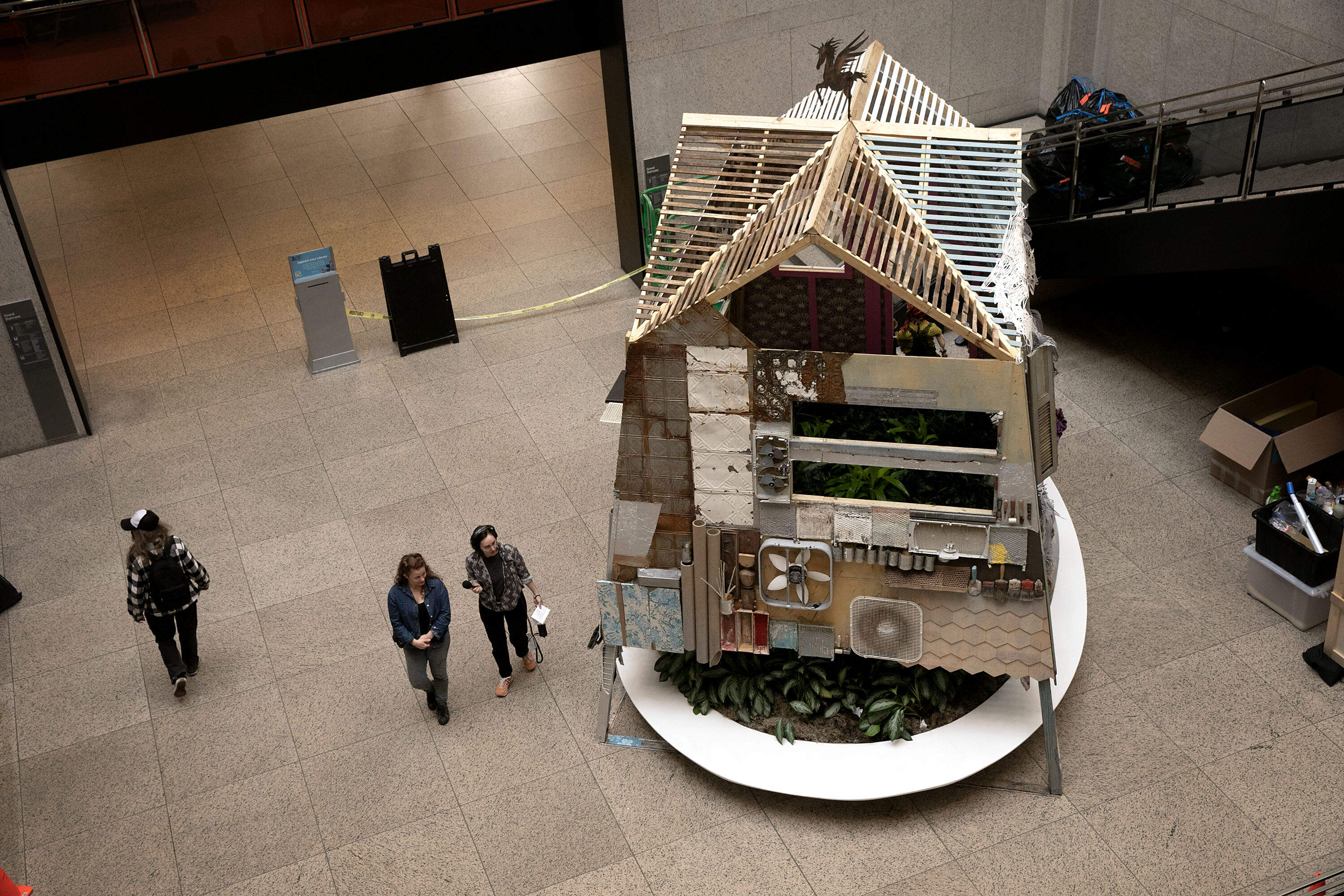
While I was reporting, many of the planned installations were yet untested in the public realm. I was able to see one sculpture, by Caledonia Curry (also known as the street artist Swoon), just after it was installed at the Boston Public Library’s main branch. The piece is based on a children’s story Curry wrote, and features large wooden puppets depicting the story’s main characters. While I was there, a passing child tried to climb inside the installation, and was quickly shooed away. Evidently, during the design process, no one had stopped to consider that a colorful sculpture containing life-sized wooden puppets might be something kids would like to play on. The moment encapsulated what is so tricky, and therefore exciting, about public art: you simply don’t know how the public, uninhibited by the rules of etiquette that govern museums and galleries, is going to respond.
Over the next few months while the Triennial is on view, I will be traveling to each installation and releasing occasional dispatches of my impressions. I am curious to see how these site-specific pieces come across in the wild: how they alter the cityscape (or don’t); how their stated intentions live up to reality; and how the public interacts with them.
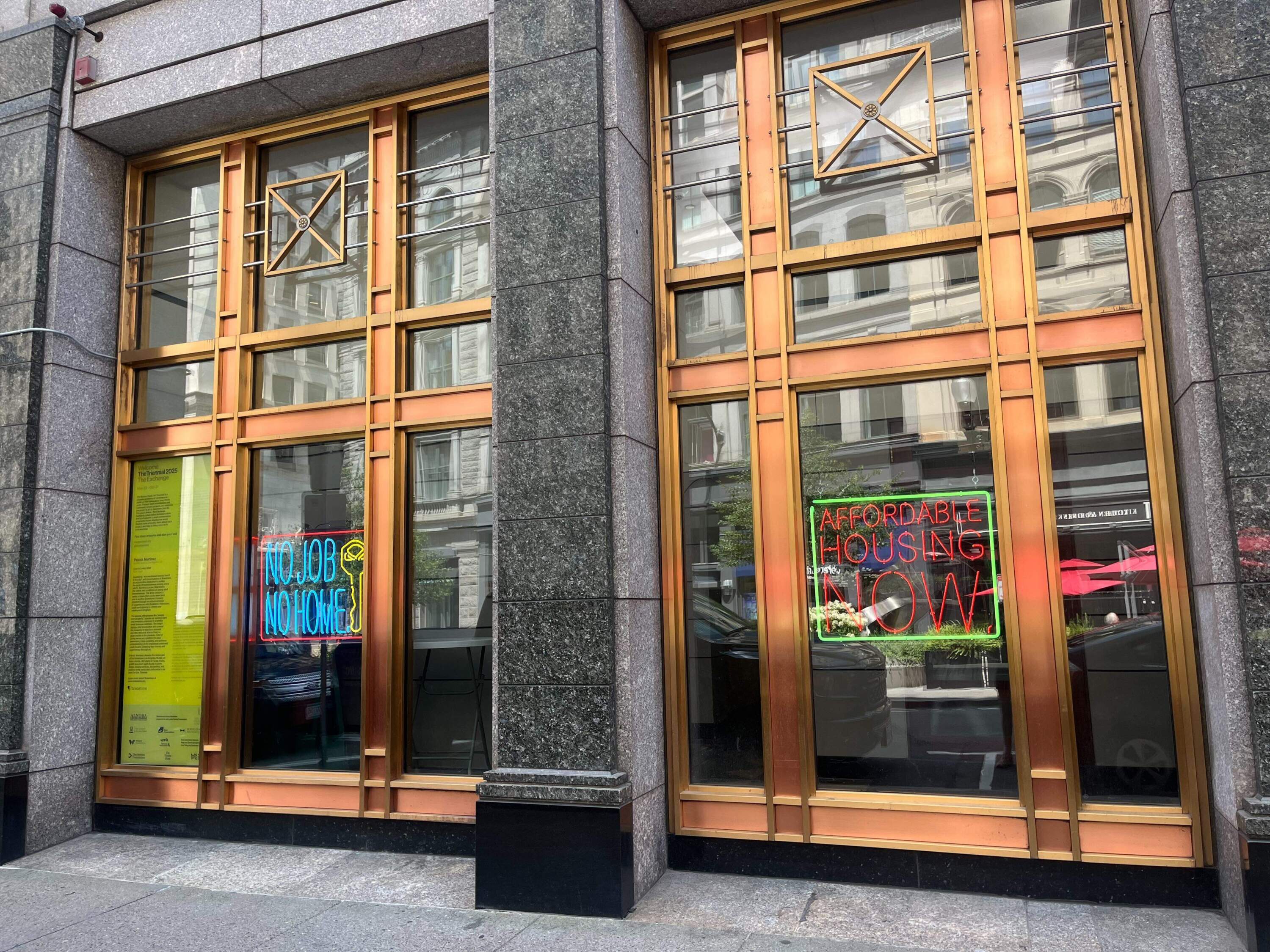
This week, I rode the subway to Downtown Crossing in search of an installation called “Cost of Living” by the Los Angeles artist Patrick Martinez. On Franklin Street, I found a pair of neon signs hanging in the windows of the building that houses Breaktime, a nonprofit dedicated to helping young adults experiencing homelessness. The signs are simple — basically just text — and inspired by Martinez’s conversations with participants in Breaktime’s job training program. The letters are rendered in glowing red and brilliant blue: “NO JOB NO HOME” and “AFFORDABLE HOUSING NOW.”
When I visited, it was the middle of an unusually idyllic summer day, and chatter wafted from across the street where diners ate lunch in the sun. There was a lot of foot traffic, but few people glanced up at the signs as they walked past, and none stopped to read the accompanying text printed on a bright yellow poster. For neon signs, these were surprisingly subtle — too subtle, perhaps. I was reminded of the way city dwellers are accustomed to passing people living on the street, avoiding eye contact and never stopping.
My next stop was a lot harder to miss. In the middle of a brick pedestrian pathway near Quincy Market, a bizarre sculpture towers over the tourists streaming past. Poised atop a stack of boxes labeled “tea,” the cartoonish figure is posed like Lucky the Leprechaun, the Celtics’ winking Irish mascot. Instead of leaning on a cane, he holds a musket, tied in a knot, with a purple flower blooming from the end. His masked face is contorted in the unmistakable rictus of Chief Wahoo, the racist caricature that long represented the Cleveland Indians, now known as the Cleveland Guardians. (President Trump recently called for the team to revert to its original name.) Our rakish interlocutor wears a feathered headdress and a pilgrim hat, its brim festooned with a deranged cornucopia of seafood and fruit. Arrows sprout from the hat’s tall cone, along with a beer tap.
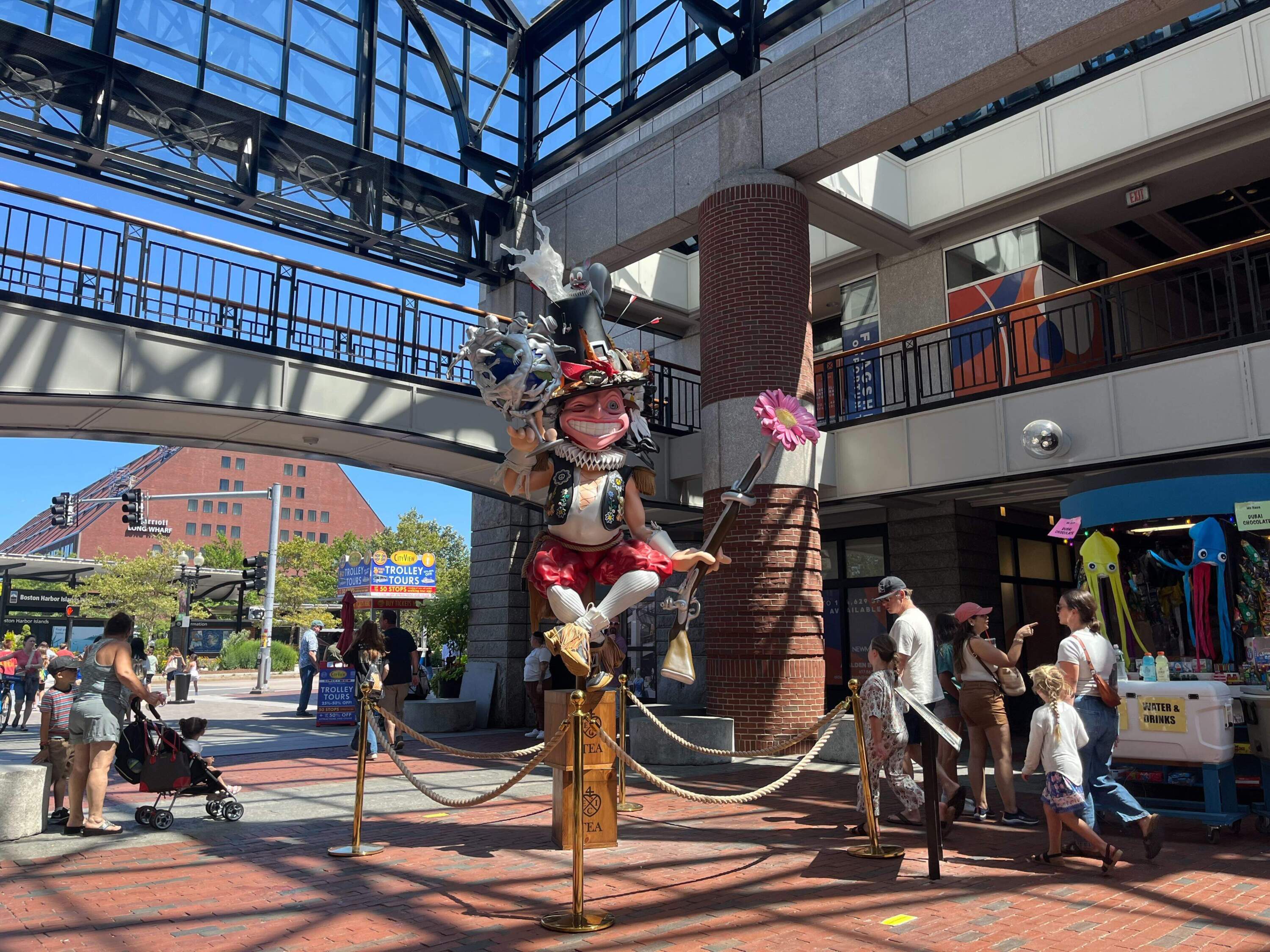
A nearby plaque identifies the sculpture as “Material Monument to Thomas Morton (Playing Indian)” by New Red Order. The Indigenous-led group, which calls itself a “public secret society,” designs wry artistic interventions calling attention to the Indigenous experience in America and the Land Back Movement to return ancestral lands to Native communities.
“ A lot of our work is hinting at … the public secret of settler colonialism and how we're all occupying stolen land all the time, but it's something we don't really discuss,” Adam Khalil, an Ojibwe artist and one of New Red Order’s core instigators, told me when I interviewed him earlier this year. “So what's the best way to insert that narrative, to yell out that secret in public?”
The sculpture in Quincy Market is certainly yelling out for attention, but the plaque at its feet offers no direct interpretation of the figure’s disorienting mishmash of signifiers. Rather, it relates the story of Thomas Morton, an early settler and merchant who defected from Plymouth Colony and denounced the Puritans’ treatment of their Indigenous neighbors. “Morton’s legacy prompts not a critique of the past, but a call to action to realize alternative settler dynamics in the present,” the plaque declares.
Khalil explained that New Red Order aims to “create a context for active viewership instead of passive viewership.” He added, “Some kinds of public art … can give the feeling of having done something when you've just passively consumed something.”
I watched countless passersby clock the sculpture and immediately pose in front of it for a photo. This might be an inevitable response to any successful public art installation these days. Who can resist the urge to photograph a visually striking surprise encountered, delightfully, in the middle of the city? And how tempting to then post the photograph online. The result is free publicity for the art, though it is practically a guarantee that the work will cease to be understood on its own terms as people consume it passively, free of context, in the course of an endless scroll. Yet it has always been the case that you cannot compel a specific reaction to art, no matter how thoughtful the signage. This is especially true about public art, which is designed to be encountered by happenstance. People who visit a museum do so with a certain mindset. Public art meets people in the streets, whether they seek it out or not. This is its beauty and its peril.
Still, “Material Monument to Thomas Morton (Playing Indian)” succeeded in being both eye-catching and strange enough that many people stopped to read the plaque in search of an explanation. One family spent several minutes studying the text and discussing the sculpture. Before they left, they made sure to pose for a picture.