Support WBUR
Evan Greer on making music to meet the moment
Editor's note: This story is an excerpt from WBUR's weekly arts and culture newsletter, The ARTery. If you like what you read and want it in your inbox, sign up here.
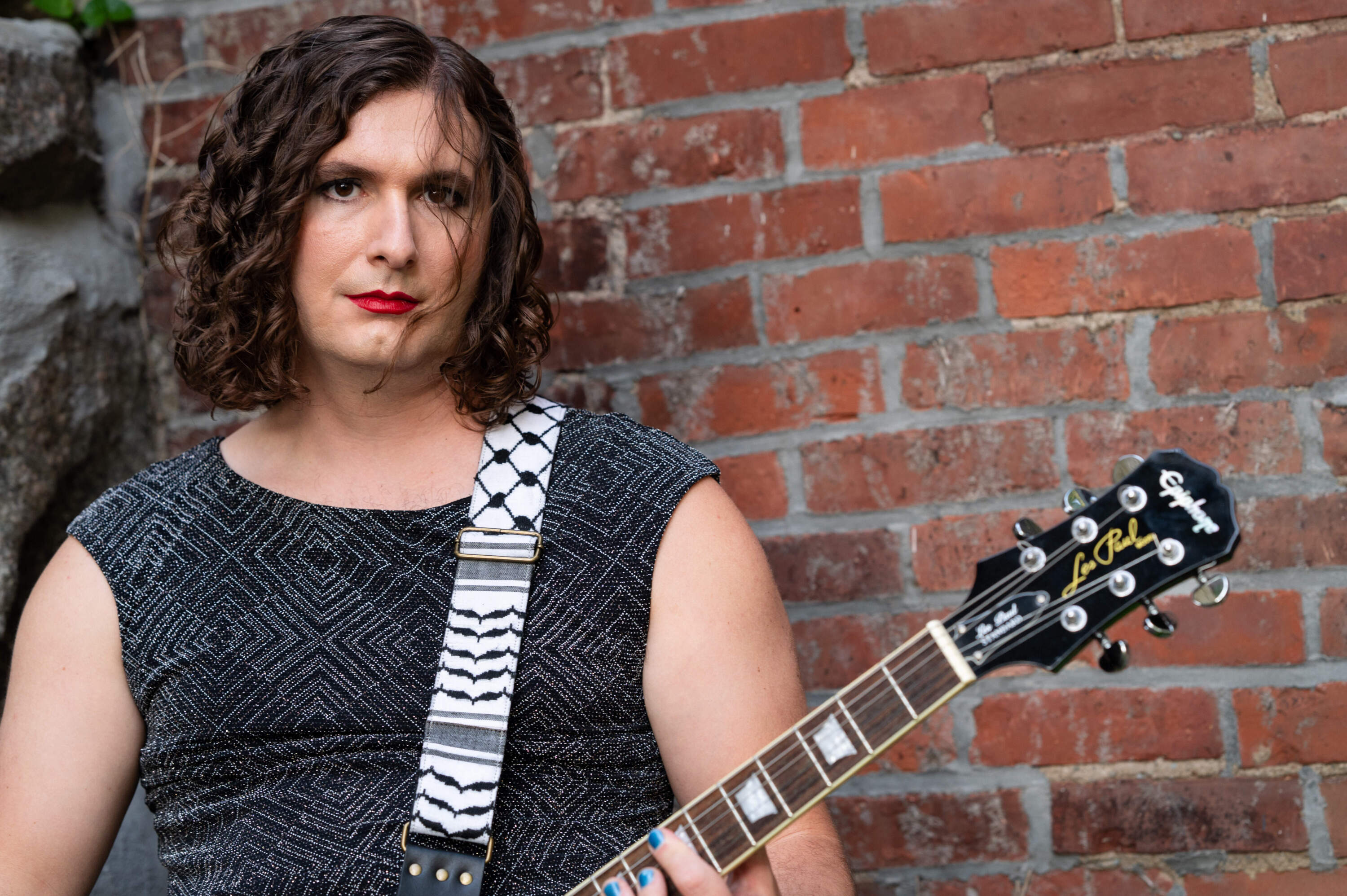
Evan Greer is not afraid of a provocative headline. The self-described queer anarcho-indie-punk musician titled her last album “Spotify is Surveillance,” thumbing her nose at the tech behemoth even as she streamed her songs on its platform. Now Greer is back with “AMAB/ACAB,” another title that respectfully declines to mince words. The acronyms stand for “assigned male at birth” — a reference to Greer’s transgender identity — and “all cops are bastards,” a controversial anti-police slogan popular among punks, anarchists and Black Lives Matter protestors.
“AMAB/ACAB” contains plenty of punk fury. Greer tends to render her political critiques in blunt, confrontational terms. The single “Protect Trans Kids (WTFIWWY),” for instance, offers this refrain: “Leave them alone/ Leave them alone/ What the f--- is wrong with you?” But other tracks on the album reveal a more contemplative side. The song “$5” is a nostalgic, ambivalent look back at Greer’s early punk days, featuring, appropriately, a collaboration with early-aughts alt-rock band Eve 6. (Among the album’s other guest musicians is Josh Kantor, the organist for the Boston Red Sox.) The song’s title is a reference to the $5 cover fee at the DIY shows where a young Greer found community and an outlet for her burgeoning activism. “Five dollars at the door,” Greer sings. “We were angry, we were hungry, we were bored.”
Greer lives in Jamaica Plain, is mom to a teenage daughter and works a day job as the director of Fight for the Future, a digital rights advocacy organization. Recently, she hopped on the phone to talk about “AMAB/ACAB,” which drops Sep. 19 and will be celebrated with an album release party at Deep Cuts in Medford on Sep. 20. We talked about how Greer’s perspective has changed with age, what it means to make political music and what it feels like to fight for a better world amid creeping authoritarianism. (Our conversation has been excerpted and lightly edited for clarity.)

Amelia Mason: You've released other albums previously, so I was curious — what were you trying to do differently this time?
Evan Greer: This is a punk album made by a 40-year-old mom. Musically, there are parts of it that are more aggressive and loud and raucous than most of the previous music I've released, so it's not that it's getting quieter, or something like that. But I think if there's a theme that runs through these songs, there’s a lot of self-reflection. There's a lot of kind of weaponized nostalgia, of looking back at what it means to have been an activist and a musician for the last 20 years, and then, like, look at the state of the world around me. And my kid coming of age, and getting into music and politics and art and culture and all the things that she's into. And so I think, if anything, this record is less of a call to action than maybe some of my previous records have been.
If anything, I gave myself a little more space to just be a little vulnerable and admit, like, I don't know what we should do, y'all. Things are looking pretty grim. But I know that I'm going to keep fighting and doing the work that I do to try to make things slightly less terrible. And I know I'm going to keep trying to make music.
What do you mean by weaponized nostalgia?
I'm being a little tongue-in-cheek or something like that. But there's something weird about [being] a geriatric millennial, right? I was born in 1985. I came of age politically and musically around 9/11, basically. That was the defining political event of my teenage years. And then the rush to war in Iraq and Afghanistan.
There's interesting discourse online among the next generations, like Gen Z and Gen Alpha, where there's sort of this romanticization of the early 2000s. And, you know, things are pretty bad right now, so I kind of get that. But then I'm also like, I remember getting my ass kicked by the cops protesting an unjust war in the Middle East. It wasn't all that different back then, in a lot of ways.
But at the same time, I romanticize that time period. I look back at the bands and the music and the aesthetic … in the same way I think my parents look back to the ‘60s. That's the era in which I came of age and became my own adult person.
What was the era that you were writing the songs in? Because it occurs to me that you must have been working on this before Trump took office.
Which is kind of interesting, right? Because you're totally right, I wrote this entire album before Trump was elected.
I remember actually talking to Casey Neill, who helped produce this, and being like, “Man, are these songs still going to feel urgent enough, or relevant enough, if that thing that we're all terrified about happens?” … And here we are. And yeah, it is interesting to [try] to make myself a third-person observer. How do these songs interact with the current moment? And for better or for worse, it does feel like they're all still really relevant.
And maybe that speaks to the fact that so many of the things that have brought us Trump are not about Trump, but are about these underlying systems, economic systems, racist systems, political systems, cultural systems that have paved the way for this authoritarian takeover that we're dealing with.
I think it stands up as a Trump-era record in the sense that it speaks to what it feels like to be trying, at a time when it feels almost pointless to try. Or where hope is really, really hard to come by. I think there's still a little bit of hope in this record, even though it definitely is exploring themes of apocalypse and, not necessarily the end of the world, but the end of the world that we wanted or thought we were building over the last couple decades.
You mentioned being a 40-year-old mom, and I wondered if you could talk about how being a parent has changed your perspective.
I may be just being a little jokey or self-deprecating when I lead with it, but I think it, again, speaks to this idea in popular culture that you're radical and edgy when you're young. And then you grow up, you get all these responsibilities, you have a kid, you have bills to pay, and then you become more conservative. And I think, for me, and what I observed among so many of the other parents that I know, is that actually having a young person to fight for in this world makes me so much more radical, but also it raises the stakes in a way that then makes you like, “Oh, it's actually not enough to just say radical things or be really, really angry about something in the world. I have to actually pick and choose my battles and be thoughtful and strategic about how I use my time because this really fricking matters.”
And I don't want to pretend that that's some unique experience, right? People who don't have kids have other loved ones in their life who they care about just as much and want to fight for. So I don't know if it's even necessarily about being a parent specifically. But I think, for me, what's changed about my politics over the last 20 years is, all the basic bullet points are all roughly the same, but I think I've just started to focus more on strategy and less on ideology. … I'll work with people who believe a wide variety of things as long as we're all strategically trying to accomplish the same goal.
I think, also, just learning how to focus, which for me as someone with ADHD is hard to do in general, but I think politically, it's hard, too. We look around the world and everything is on fire. … If there's one thing I've learned over the last 20 years, it's trying to put out all the fires is like when your house is super messy and you try to clean the whole thing all at the same time. We all know how that works. You get a little bit done and then you get tired and you go watch Netflix.
I think that's really the lesson I've learned as an activist over the last 20 years, is you got to pick something to focus on if you're going to be effective. And maybe I haven't learned that lesson, because I don't know that this album focuses on one thing or something like that, but that's the beauty of art, right? My day job is working on tech policy and I picked a thing to focus on and I feel like we're doing our best, and we aren't always winning, but we are effective and strategic in the work that we do. Then art can be the place where it's okay to leave it with a bit of a question mark. Not every record has to be a piece of utilitarian political propaganda, and in fact shouldn't be.