Support WBUR
Merriam-Webster goes old school with first new hardcover Collegiate dictionary in 22 years
Here's some news for the word nerds out there. Merriam-Webster, the country’s oldest dictionary publisher, is releasing a hefty, new Collegiate edition for the first time in 22 years.
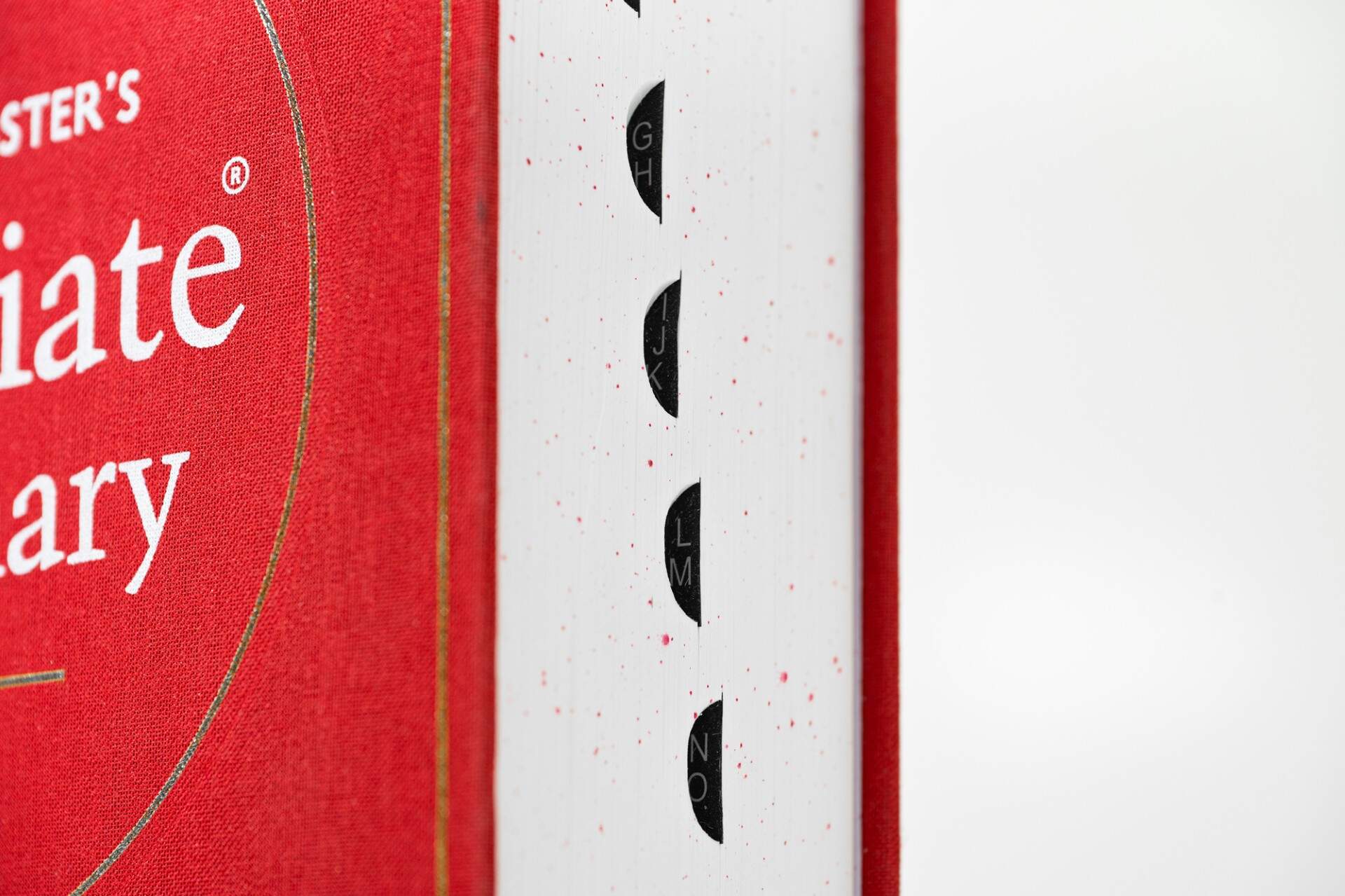
“So, the Collegiate is our flagship product,” editor-at-large Peter Sokolowski explained on the second floor of Merriam-Webster's historic headquarters in Springfield. “The Collegiate is also kind of an American institution. It’s the best selling book after the Bible.”
He walked past rows of word-crammed card catalogs and tall bookcases lined with Collegiate editions spanning more than a century before heading into a conference room for the big reveal.
Sokolowski reached into a cardboard box and pulled out a fresh copy of the company’s new Collegiate."You'll see it's very red. It now says, ‘since 1828.’ That’s new. We didn't use to give that information before, but that's the date of Webster’s first big edition.”
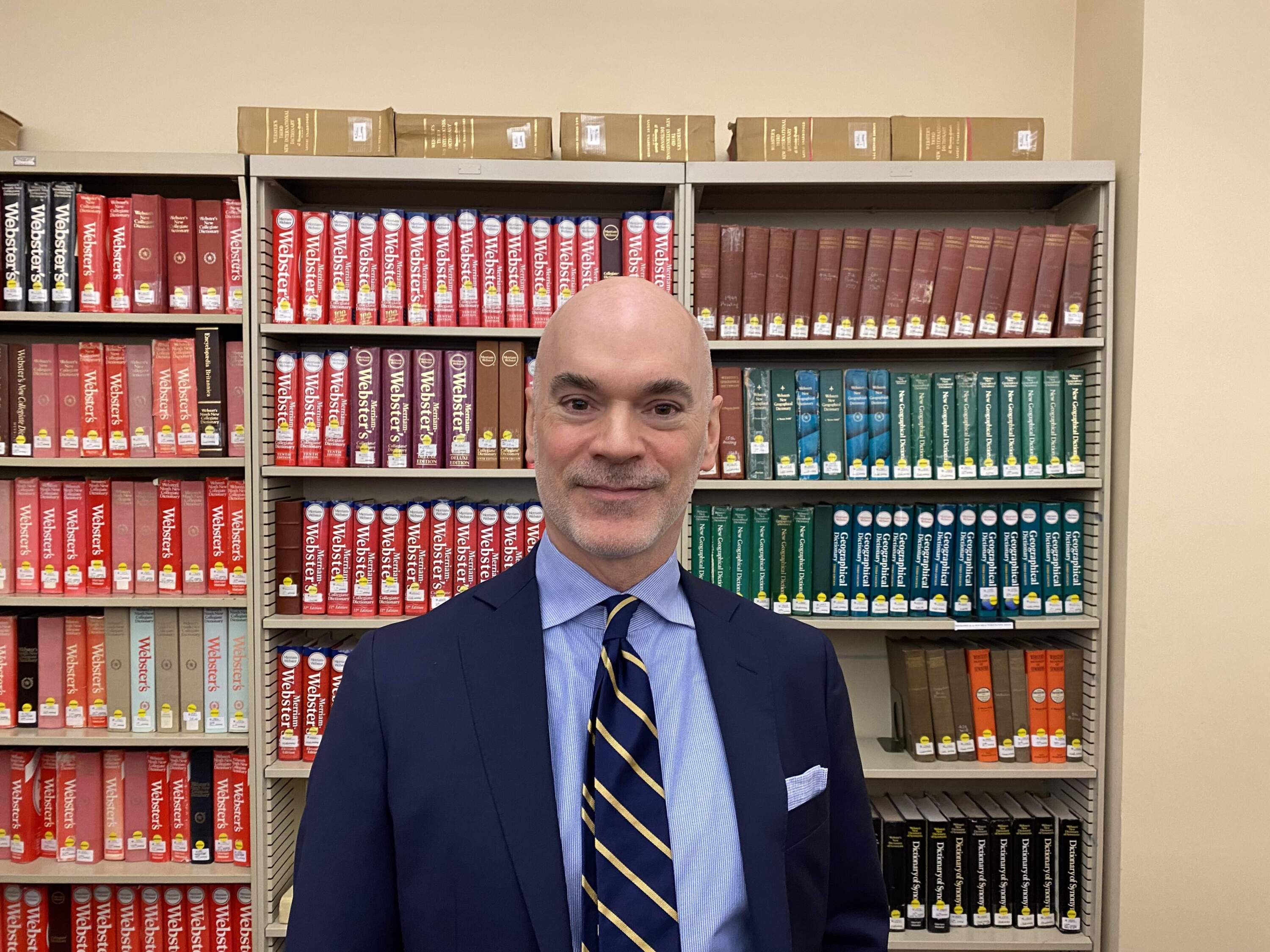
The revamped 12th Collegiate weighs about 5 pounds and still sports those satisfying thumb notches. Sokolowski pointed to pages that are whiter, print that’s a bit bigger, and more space between columns that make reading this edition easier on the eyes. But, the new Collegiate also represents an entire generation of contemporary words — some 5,000 of them.
“Like 'nepo baby,'” Sokolowski said. “'Farm-to-table' is something that is not new for most of us, but it's new to a print dictionary.” Other additions include cold brew, heat dome, rizz, doggo, dad bod, beast mode, gaslight and cancel culture. “The moment you hear these things, you think, 'yes, this is the way the language has developed in the last decade or more.”

Sokolowski and his colleagues rigorously chronicle English’s evolution on Merriam Webster’s popular digital dictionary. He said it attracts a hundred million page views a month and has become the company’s principal business.
“The work that we've done for the last 20 years that has gone online — but not gone into a book — now it's reflected in a print edition,” he said. “The definitions that I wrote, the definitions that my colleagues wrote, many of these words take five or 10 years just to get into the dictionary.” One of his favorite entries is "petrichor," which means the smell of the earth after a fresh rain.
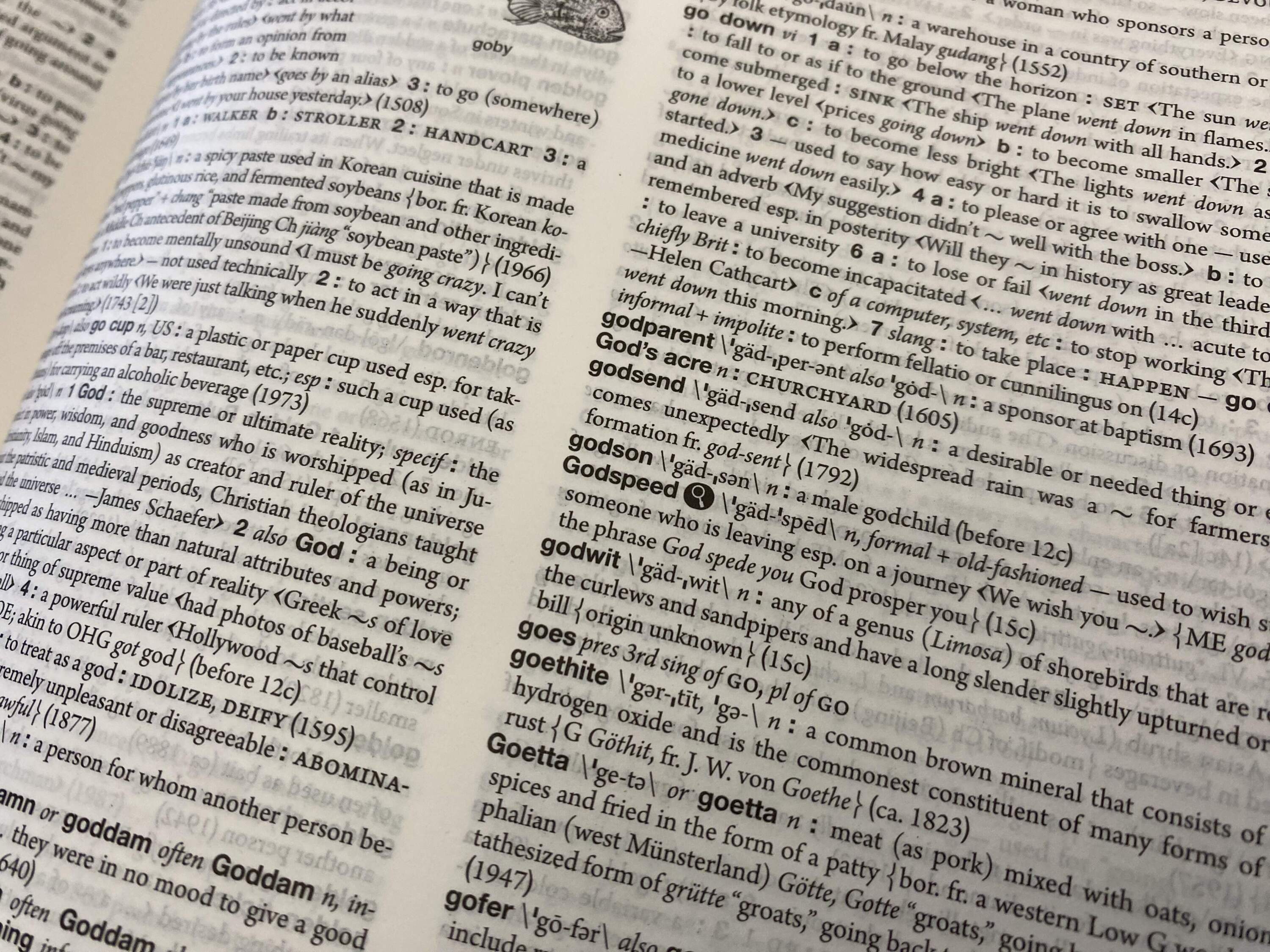
In the new book, the words most often looked up online are identified with a tiny magnifying glass. And the editors decided not to include archaic, rarely looked up words like "timberman."
But with a dynamic, digital product — along with the playful “M-W Word of the Day” newsletter and podcast that Sokowloski voices — why invest in publishing a print edition in 2025?
“There's been a presumption that the book is dead for a long time,” Sokolowski answered. “But people don't know we sold a million and a half books in print last year.” A lot of those are paperbacks, crossword puzzle books and Scrabble dictionaries, he added, “but also big, hardcover dictionaries like the Collegiate. We recognize that real word lovers and word professionals — editors, journalists, writers — they use dictionaries all the time.”
With a smile Sokolowki added, “Also, it has to be said, the dictionary is a pretty nice piece of technology.”
The company riffed on that idea with a cheeky social media ad teasing the new Collegiate’s arrival. At first, it seems to introduce Merriam Webster’s new AI “Large Language Model.” A voiceover touts the LLM’s power, saying it has “over 217,000 rigorously defined parameters. It never hallucinates. It does not require a data center. And uses no electricity.”
The punchline? “It is a big, heavy book,” Sokolowski said with a laugh, “The AI video was viewed maybe 30 million times — it was a huge success.”
“The sentiment that it captured is one that's true in my daily work,” senior editor Emily Brewster said about the video, “whether we're working on the electronic dictionary or the print dictionary — our work is handcrafted.”

Brewster has been a lexicographer at Merriam-Webster for 25 years. She contributed her research and writing to the 12th Collegiate. But on the day of our visit Brewster had yet to hold a hot-off-the-press dictionary in her hands. “I'm actually a little envious of the people who have,” she said.
Then Brewster had her chance. She picked up the new tome, opened it up and quietly gasped, “It’s really beautiful.” The veteran wordsmith ran her fingers over its telltale thumb notches and flipped through the pages. “A good dictionary invites you to get lost,” she said, “and I think this one will get some people lost in the best way.”
Brewster loves the serendipity of searching for a word on the pages of a dictionary, “and your eyes falling on another definition.” She's a fan of the smell and feel of books, but said in her world there's more than enough space for both print and electronic dictionaries.
Peter Sokolowski agrees, because words – and their meanings – matter.
"I do think that in order to be informed citizens we do need to have a baseline of truth and facts," he said, "A language is a shared set of facts, and we need to protect and produce those facts as consistently as possible."
And — as the new 12th Collegiate proves — words are also a lot of fun.
This segment aired on November 18, 2025.