Support WBUR
Inside the Norman Rockwell Museum — and the distortions of his art
Editor's note: This story is an excerpt from WBUR's weekly arts and culture newsletter, The ARTery. If you like what you read and want it in your inbox, sign up here.
When you hear the name Norman Rockwell, what pops into your mind?
“Bald guys with big ears.” “It’s Americana, it’s a lot of sort of ‘50s idealism.” “So perfect that it was almost campy.” “Tiny white boys looking cheerful.”
These are a few of the responses from a straw poll I conducted at a recent dinner party. It was by no means a representative survey. My friends are all millennials, for one thing — none of us was even born when Rockwell was still alive and painting. Several people confused him with other artists, including Renoir (an Impressionist) and Warhol (pop art, soup cans). One friend announced confidently that her husband had taken an entire course on Rockwell in college. “Different painter,” he corrected her. “You’re talking about Winslow Homer.” (Landscapes, Maine, lots of pictures of boats.)
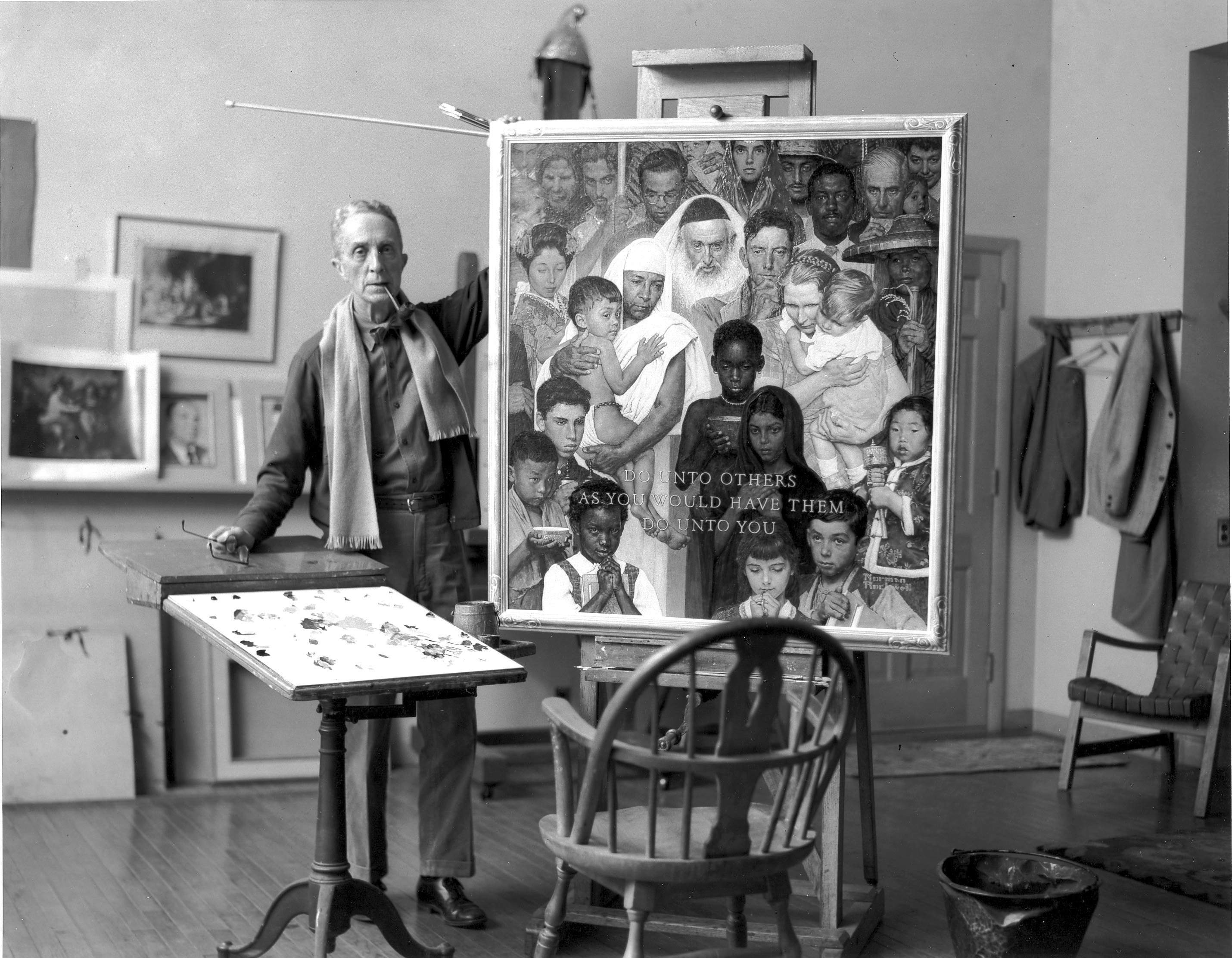
Still, there was general awareness that Rockwell was an artist, and that his work seemed to capture something essentially American. From 1916 to 1963, Rockwell painted cover art for the Saturday Evening Post, producing some of the most enduring images of the 20th century: a family gathered around the Thanksgiving table, workmen on the torch of the Statue of Liberty, a little boy seated at a diner counter chatting amiably with a policeman. In an age when print media was king, Norman Rockwell was a household name.
Today, Rockwell is more apt to surface in memes. (Maybe you’ve seen the one at the Thanksgiving dinner table, but grandma and grandpa have been replaced by political figures or Marvel superheroes.) He even cropped up in the title of a Lana Del Ray album — specifically, 2019’s “Norman F---ing Rockwell!”
“Nowadays, for younger people, there's a lot less knowledge,” Rockwell’s granddaughter, Daisy Rockwell, told me. “Sometimes they're not even sure if they know who Norman Rockwell is, and you have to say, ‘Oh, he's the Thanksgiving meme.’”
Recently, Rockwell’s work yet again took on new life in a series of social media posts by the U.S. Department of Homeland Security, the agency overseeing the Trump administration’s aggressive and legally disputed immigration crackdown. One Facebook post featured a Rockwell illustration of a group of people gazing reverently at the American flag, which he originally painted for the Boy Scouts of America. The DHS provided this caption: “Protect our American way of life.”
It’s a message Daisy Rockwell takes issue with.
“I see that as a white supremacist message, because everybody in the painting is white, and ‘protecting our American way of life’ means getting rid of all the other people,” she said. “ And I don't think it's controversial to say that because we see daily images of people of color being torn out of their workplaces and away from their families.”
When the Rockwell family got wind of the DHS social media posts, they were outraged. Daisy drafted an op-ed, which a number of family members signed. The letter was published earlier this month in USA Today. Rockwell’s family wrote he would have been devastated to see his paintings mustered in support of the Trump administration’s anti-immigration agenda. They described Rockwell as politically progressive, embracing an image of a multicultural and multiethnic America.
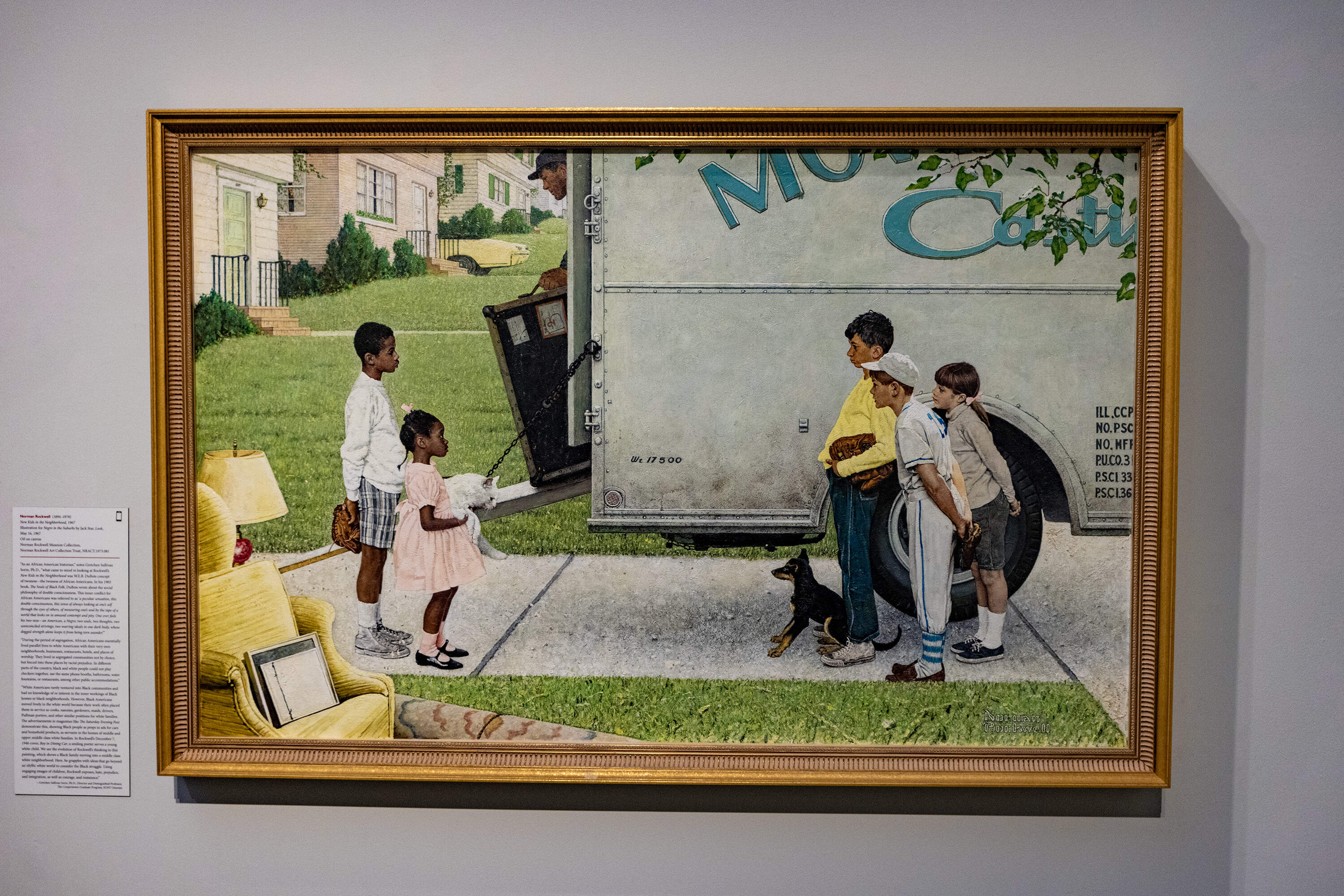
There is plenty of evidence of Rockwell’s political leanings, especially in his later work. In the 1960s, he painted striking images in support of the Civil Rights Movement and desegregation.
“That’s so impressive,” Daisy Rockwell said. “There's lots of things he could have done that wouldn't have taken much effort, but at the age of 70, he went in this very new direction.”
And yet, the perception persists that Rockwell’s work possesses some essential conservatism.
“ Consistently, if something is subverted in a certain kind of way, it becomes that,” artist Sylvio Lynch III told me. Lynch, who wrote his dissertation on Rockwell at Bowling Green State University, pointed out that the content of the artist’s illustrations was dictated by the commercial interests of the publications he worked for.
“The Saturday Evening Post had a certain projection of images they wanted to portray, and that came with the exclusion of people of color,” Lynch said.
It’s easy to distort the meaning of Rockwell’s paintings when you leave out this context, he added. Rockwell’s work has come to symbolize “ the nuclear family and everything that was great about America,” Lynch said. “And now we don’t have that. That's the assumption.”
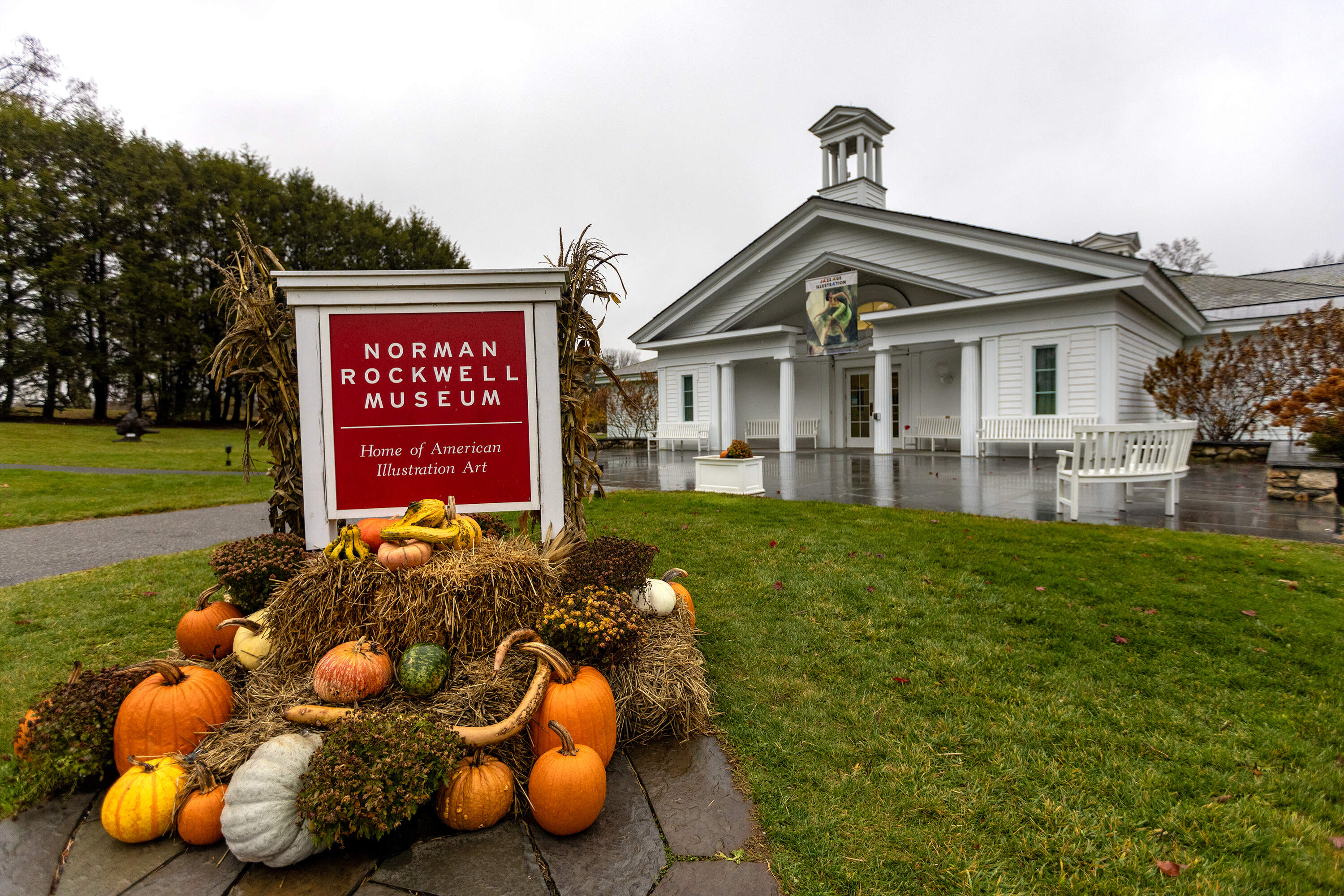
To get to the bottom of these warring interpretations of Rockwell, I decided to go to the source: the Norman Rockwell Museum in Stockbridge, Massachusetts.
Rockwell lived in Stockbridge for the last 25 years of his life. The town became the basis for many of the images of small-town America that appeared in his paintings. The daughter of a neighbor provided the model for one of his most famous works, “The Problem We All Live With.”
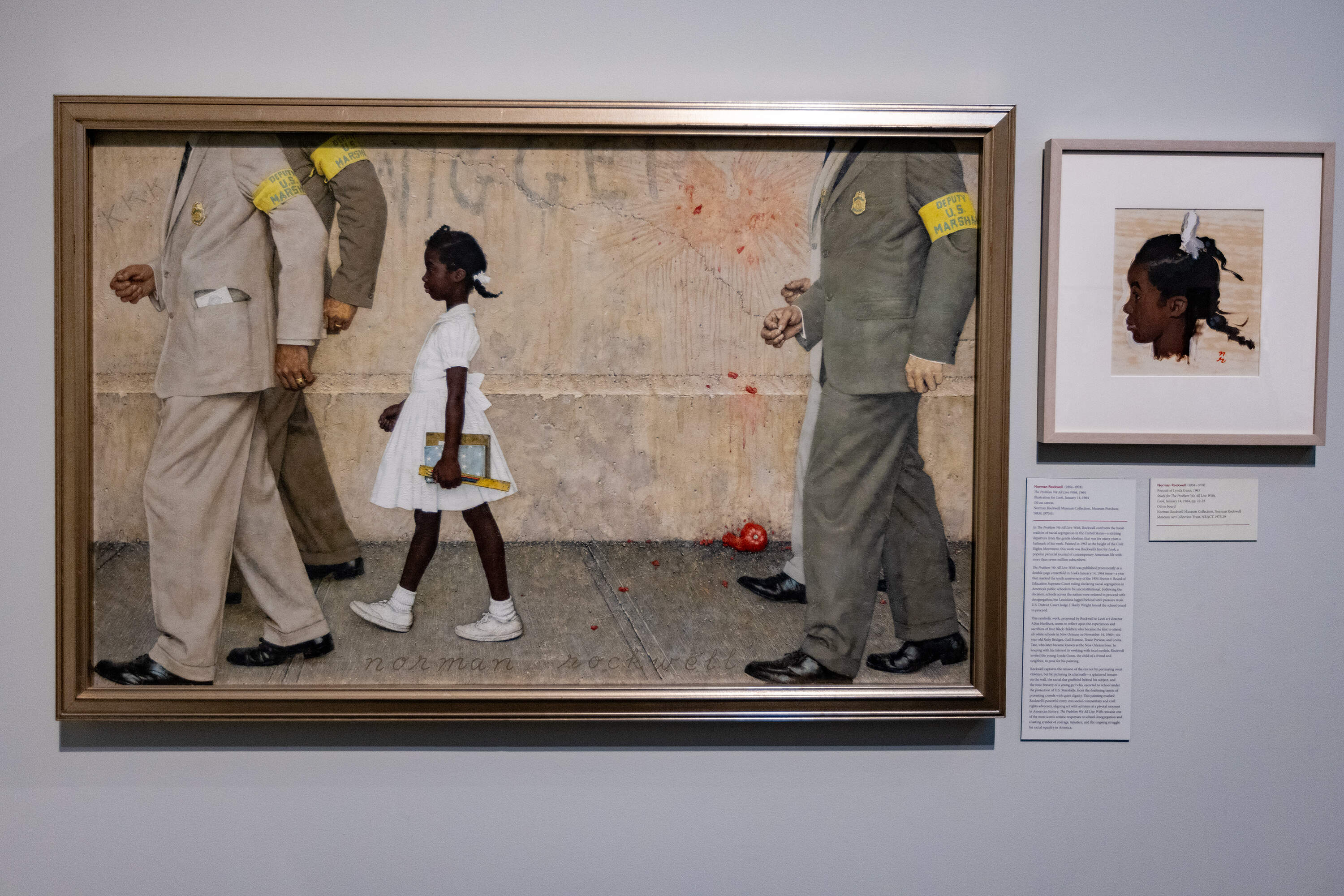
The piece was published as a two-page spread in Look magazine in 1964. The painting itself hangs in the Norman Rockwell Museum, far larger than the pages for which it was destined. It depicts the 1960 New Orleans school desegregation crisis, when four Black girls matriculated at the city’s white elementary schools and were met with vitriol and death threats. In the painting, a little girl in a crisp white dress strides purposefully forward, flanked by U.S. federal marshals, who in real life were sent to protect the students from mob violence. We do not see the angry white mob in question, only the faint outline of a racial slur scrawled on the wall behind the girl, and the remnants of a thrown tomato.
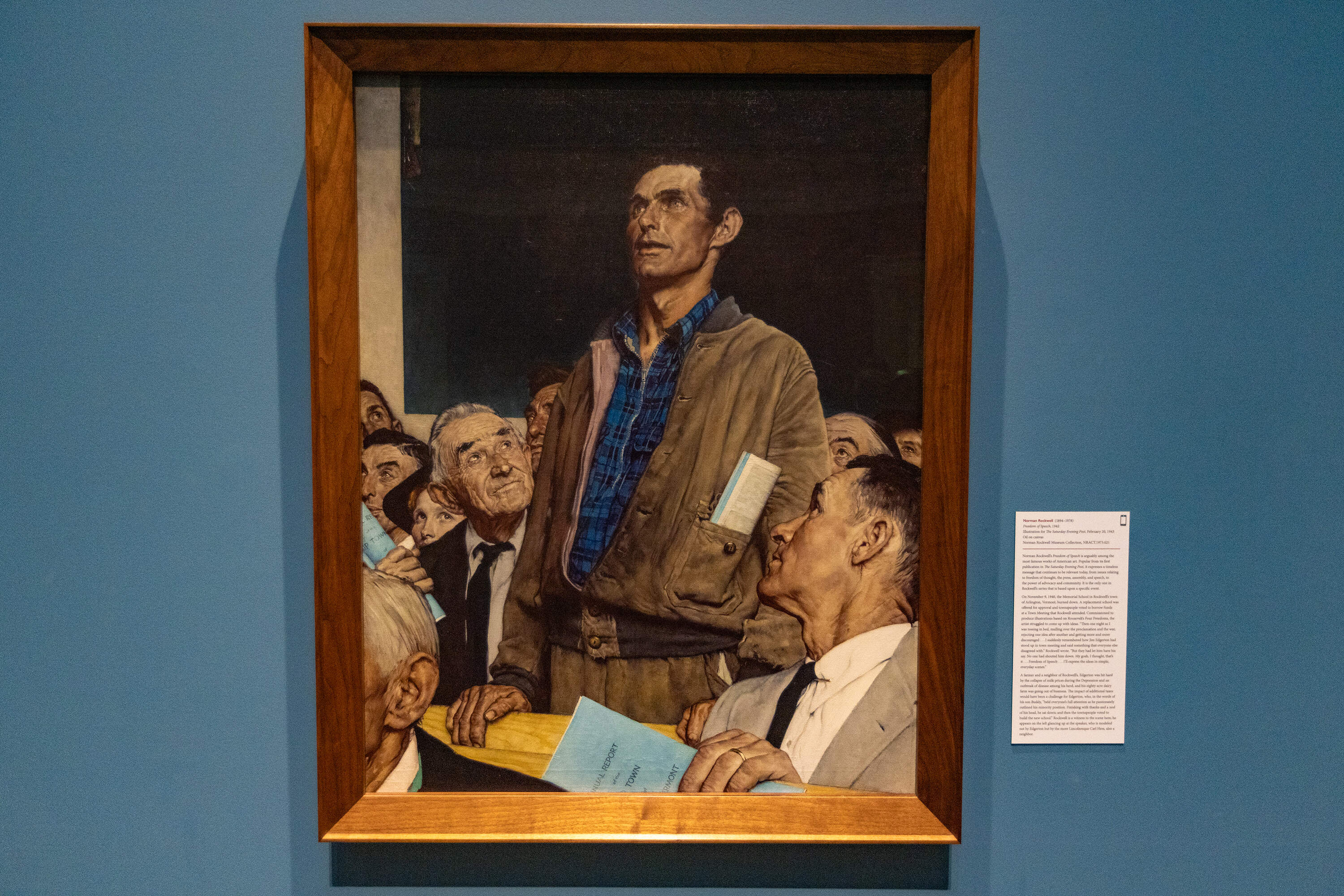
It’s a bracing picture, dramatic and unflinching. But its intent is hard to misread. In the next gallery over, I found a more flexible image: a painting of a guy in a ratty coat, looking noble as he addresses a crowd of men in jackets and ties. This painting, titled “Freedom of Speech,” lives today in meme form, that strong-jawed citizen giving voice to the internet’s hot takes.
The museum’s chief curator and deputy director, Stephanie Plunkett, told me that the painting was based on a real town meeting Rockwell attended, in which a farmer stood up and objected to a proposal to rebuild the town’s school on the grounds that it might raise his taxes.
“As Rockwell described it, he stated his case, no one screamed at him, everyone treated him respectfully,” Plunkett said. “He sat down, and they voted to build the school.”
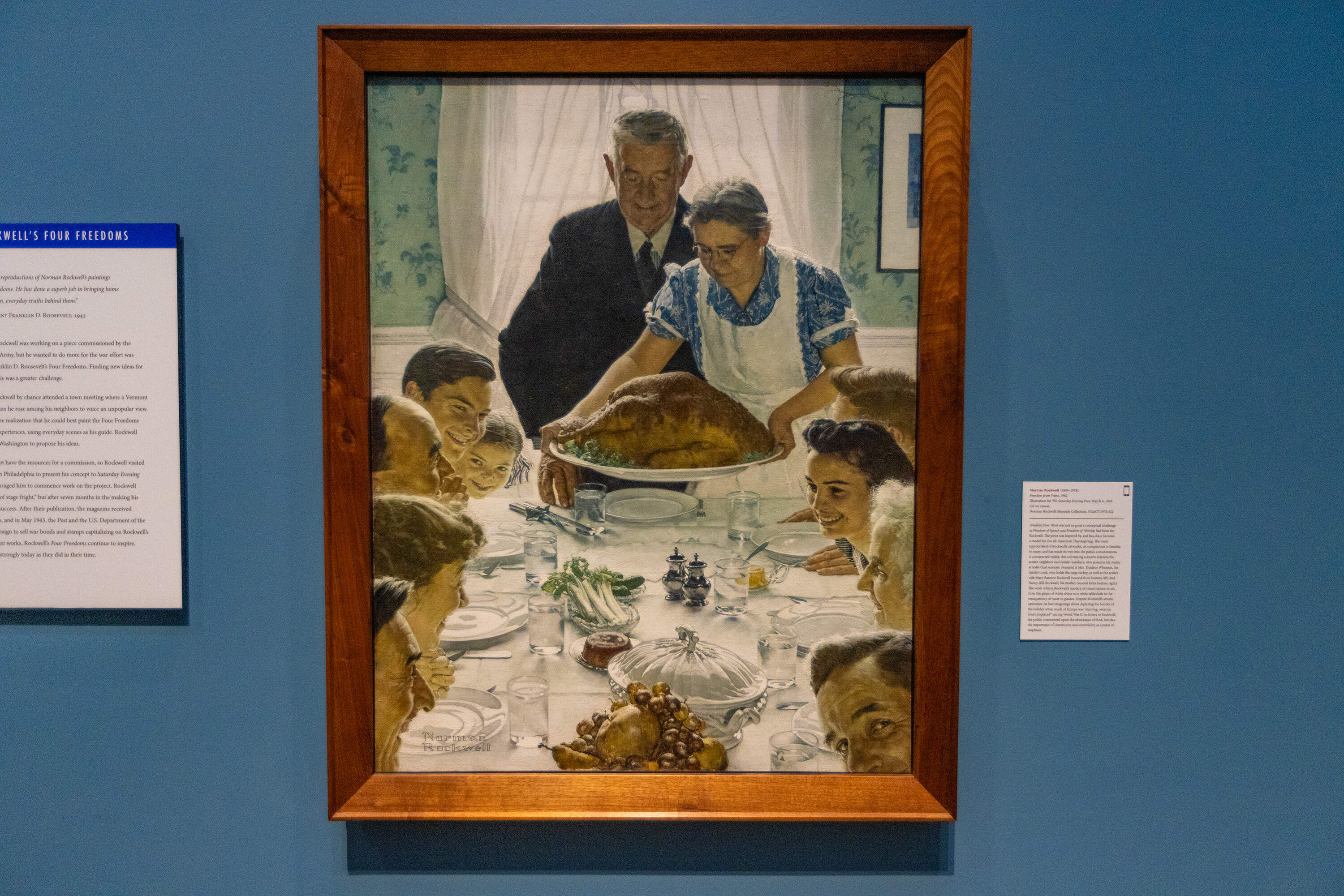
“Freedom of Speech” is one of four illustrations, collectively called the “Four Freedoms,” that Rockwell painted in response to President Franklin D. Roosevelt’s 1941 State of the Union address. In that speech, the president outlined the four freedoms essential to human rights and made the case for U.S. involvement in World War II. Rockwell’s paintings were later part of a touring exhibition to raise war bonds.
“So it gives you a sense of how the American public desired to have these very concrete images to remind them of what they had, and what should not be lost,” Plunkett told me.
I pointed out that the paintings could be seen as propaganda — images to sell a war.
“I don't think they were selling a war,” Plunkett said. “I think they were selling ideals, right? And ideals that were central to who Americans believed they were.”
It’s possible to interpret “Freedom of Speech” a little more literally: as an almost worshipful depiction of a white, working-class man, daring to speak an unpopular truth to an audience of white collar elites. It’s easy to imagine how it might speak to a MAGA mindset — or, conversely, to a Bernie bro.
Plunkett offered a more metaphorical reading: "This idea that the common man can be a great orator, and can express ideas in very articulate ways.”
Either way, Rockwell’s “Four Freedoms” still strike a chord. Plunkett said that people are sometimes moved to tears in the gallery. Visitors tell her that the paintings remind them that our freedoms are not guaranteed, and that we must fight to keep them.
Interpret that as you will.
This article was originally published on November 13, 2025.
This segment aired on November 17, 2025.