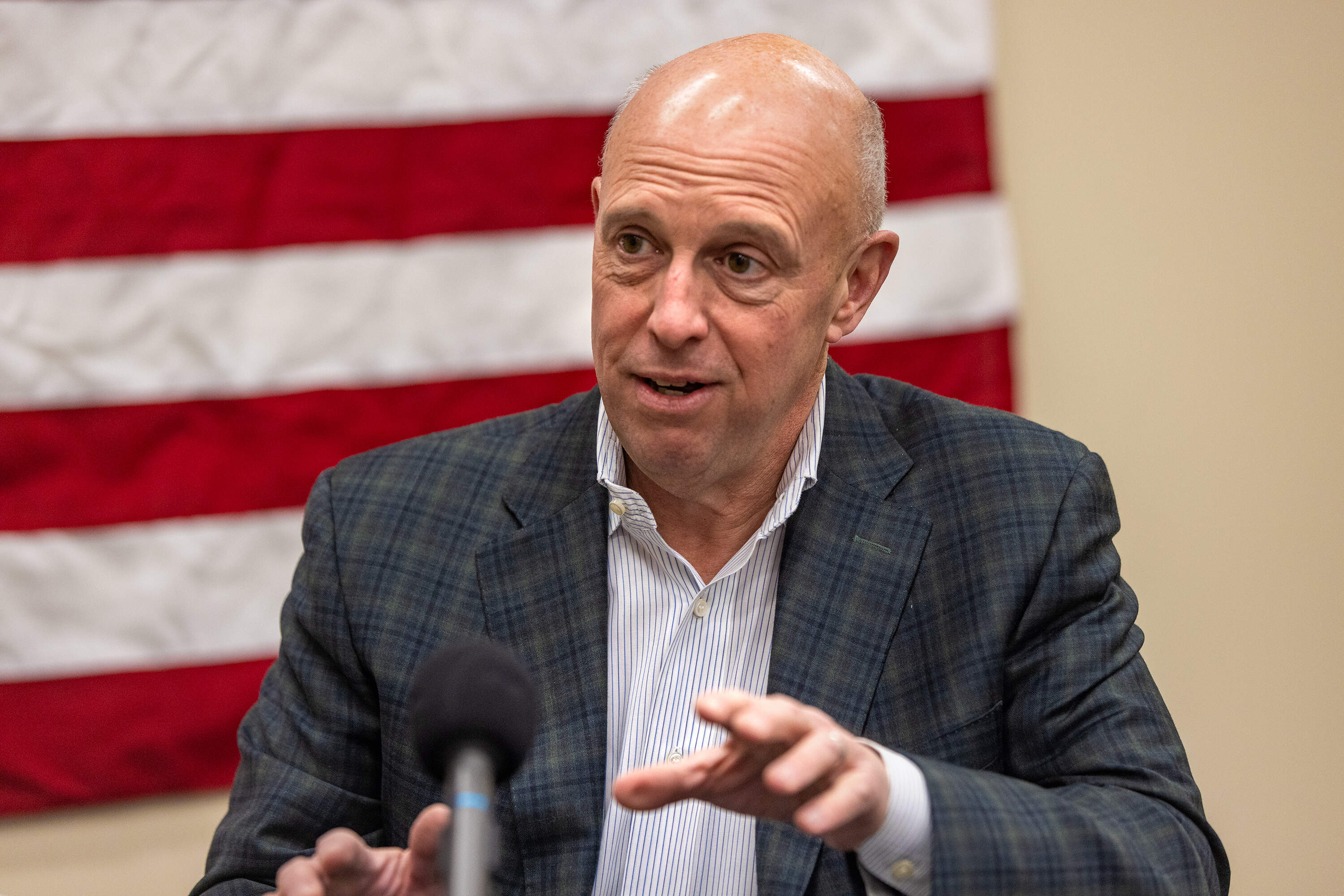
We asked, they answered: GOP gubernatorial candidate Mike Kennealy
The election for governor of Massachusetts is months away, but the primary race to determine who will challenge Gov. Maura Healey is already heating up. Three well-funded Republicans are on the trail to secure their party's nomination.
Mike Kennealy, a former housing and economic development secretary under former Gov. Charlie Baker, launched his campaign for governor in April. He's raised more than $1.9 million through October, though most of that is self-financed, state records show.
The 57-year-old has worked in private equity, served as a special advisor to Lawrence Public Schools and was most recently a senior advisor for the Boys and Girls Club of Boston.
WBUR sat down with Kennealy to discuss his thoughts on immigration, the federal government shutdown, his Republican primary opponents and President Trump’s actions that have impacted Massachusetts. The conversation has been lightly edited for length and clarity.
— Q&A —
You’ve made immigration a key plank of your campaign. The number of people, including migrants, in hotel and motel shelters has subsided. The Healey administration has closed those hotel and motel shelters. And now, the immigration debate seems to be more centered around U.S. Immigration and Customs Enforcement agents arresting people. Is immigration still an effective talking point for Republicans?
Kennealy: "I think it's a real issue, and so we'll continue to talk about it. I can't tell you if the political class will think it's a talking point or not, but it's a real issue.
"And it's worth reminding people that I warned Gov. Healy about this. We had this transition meeting after she was elected, before the Baker administration ended, and I said, 'I believe you're going to have a crisis here' due to the confluence of three factors, a humanitarian crisis in some of the countries to our south, an open federal border during the Biden administration and our status in Massachusetts as the only one of the 50 states that's right to shelter.
"And I said the confluence of those three factors will virtually guarantee that, if unchecked, thousands of people will come here and it's going to get very expensive. And that's what happened.
"And so I believe it's cost us over $3 billion so far. And so in terms of whether or not it's a so-called political issue or talking point, I don't know, but it's a really valid issue, because it speaks to leadership. And I think the first role of a leader in a crisis is manage the root causes early and aggressively. And that didn't happen for sure."
(The Healey administration says it spent $978 million in fiscal 2025 and $894 million in fiscal 2024 on the emergency shelter system and related services. State officials reported spending $109 million in fiscal 2026 through mid-October.)
During the federal government shutdown, you said you would have used the state’s nearly $8.6 billion rainy day fund to cover the cost of SNAP in November, as benefits were hung up amid legal fights. Healey and legislative leaders said that was a bad idea because it would have left officials picking winners and losers among federal programs. Why did you think using the rainy day fund was a good idea?
Kennealy: "If we're sitting here with citizens, a million who may go hungry due to what's happening in Washington, and we can use 2 1/2% of the rainy day fund and pay out SNAP benefits for a full month, that struck me as a very prudent and appropriate use of those funds. I couldn't imagine a higher and better use of those funds."
What about the argument that using the fund was picking winners and losers?
Kennealy: "As governor, you get to make the call on that stuff when and if it happens, right? So all I know is right in front of us, right then, were a million people that might go hungry, and we've got $8.6 billion, why not use it?"
Mike Minogue, a former biotechnology executive, launched a campaign for governor as a Republican last month. What do you make of his candidacy, and how do you compare yourself to him?
Kennealy: "I'll give you my view of the race, which is that of the three Republicans running, I'm the only person with any chance of defeating Gov. Healey. I think the other guys have zero chance of doing so.
"And I say that because we have to convince the voters to fire the incumbent governor and hire the Republican, and they're not going to do that unless we nominate someone who they're convinced can do the job day one."
Healey, as of the end of October, had more than $4.4 million in her campaign account. Her favorability ratings range between 49% all the way to 59% depending on the poll. Minogue poured $1.5 million of his own money into his campaign in his first month in the race. What is your path forward here, and what is your strategy to get through the primary?
Kennealy: "It's a good question. Look, I'll point to a couple of other poll numbers as well. There was … the first poll among the three contestants in the primary race, and it's got me well in the lead among the other two. So, right now, I'm the clear leader in the primary. I told the team I view that as like our — we've been in the race seven months — I viewed that as like our seven-month report card. So that's great."
(A University of Massachusetts Amherst/WCVB poll released this month found 37% of Republicans and independents who plan to participate in the GOP 2026 primary election supported Kennealy. That is an early lead over challengers Brian Shortsleeve and Minogue.)
President Trump has targeted Massachusetts with federal funding cuts, increased immigration raids and hammered local universities. What do you make of Trump’s actions, and how do you convince voters to elect a Republican in this climate?
Kennealy: "Look, I think the path to success always in politics and, for that matter, in government, is to speak to the people and understand their needs and their opportunities and come up with solutions. I don't care what party you represent or who holds what other office; that's always the path, and that's what we're doing ...
"I get asked all the time, by the way, with regard to any number of federal policies, do I agree or disagree? I think there's two questions that are probably more interesting to ask of anybody who is governor, who wants to be governor, with respect to federal policy, and those are, one, what would you do to shape federal policy to the advantage of the people here in Massachusetts? And secondly, if policies get enacted that you don't like, how would you respond?
"I think Maura Healey's answer to question one is, ‘I would go on MSNBC and criticize.’ I think her answer to question two is, go on MSNBC and criticize. My answer on question one is, have strong relationships everywhere, right, and advocate for policies that I think are best for the people. And my answer on question two is, if things happen here that are challenging for Massachusetts, do what I did on SNAP and come up with plans."
"I think the path to success always in politics and, for that matter, in government, is to speak to the people and understand their needs and their opportunities and come up with solutions."
But, you must get this question on the campaign trail, whether you agree or disagree with Trump’s decisions?
Kennealy: "I've said before, no governor in any state at any time, no matter who is president, would be in favor of funding leaving their state — in no circumstance. And so the question is, what are you going to do about it?
"In my case, I would go down to Washington and make the case for why people should invest in Massachusetts, OK? And if funding does get cut, I would figure out a plan with people here on how to address it. That's my answer on that one."
So it sounds like there's a point at which you would find some of this stuff unacceptable. There is a red line?
Kennealy: "It's not a red line. It's a question of, how do I frame the issue? For me, it's always about the people of Massachusetts.
"What is best for the people of Massachusetts? How can I run state government better for the people? How can I pass legislation that's best for the people? How could I advocate for federal policy that's best for the people, and when there are challenges, how can we harness the resources and programs we have here for the benefit of the people?
"So it's less about red lines. OK? It's about, how do I look at the work? And the work is all about doing the best I can for the people of Massachusetts."