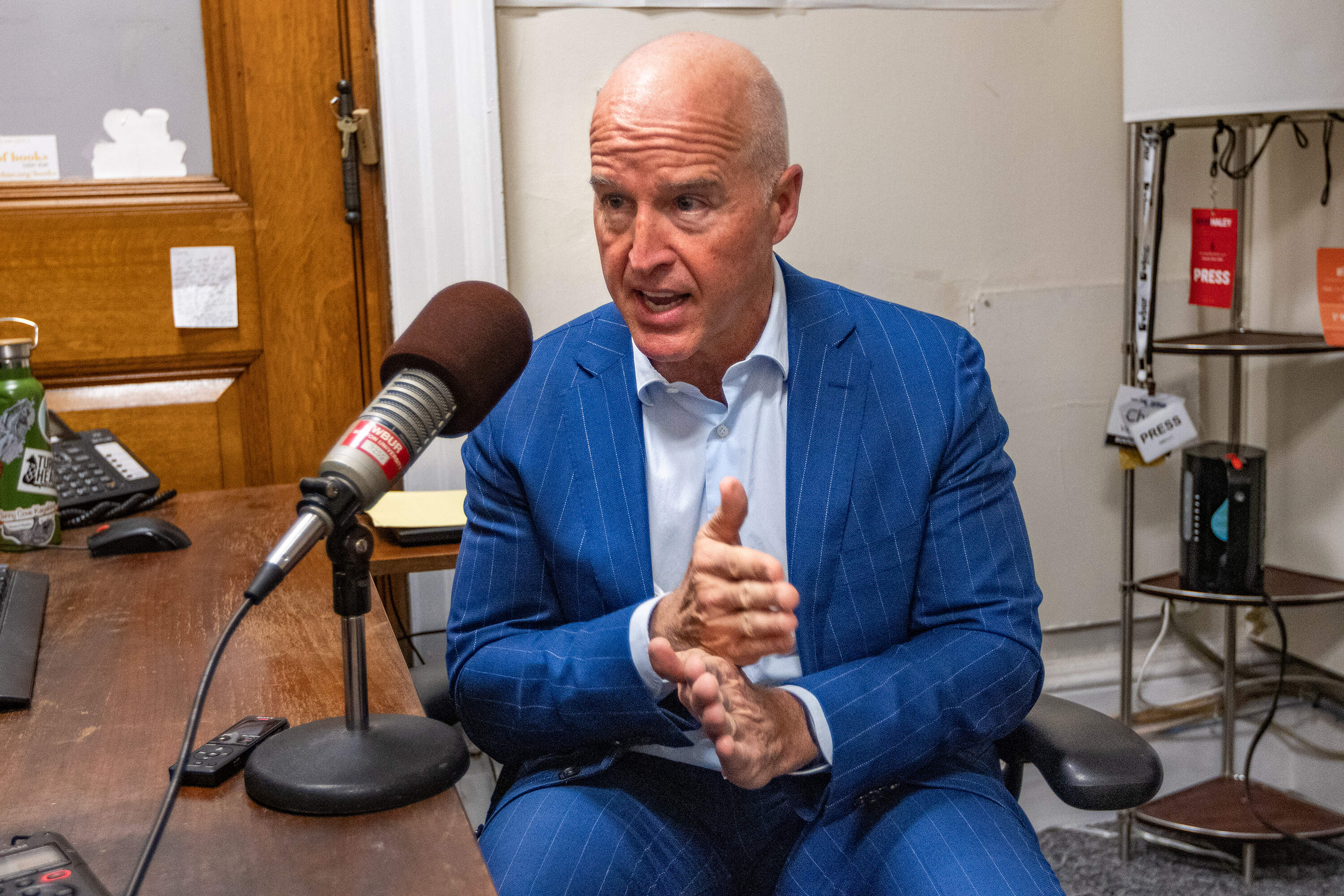
We asked, they answered: GOP gubernatorial candidate Mike Minogue
The election for governor of Massachusetts is months away, but the primary race to determine who will challenge Gov. Maura Healey is already heating up. Three well-funded Republicans are on the trail to secure their party's nomination.
Former biotechnology executive Michael Minogue launched a campaign for governor in October with a promise to be a “new kind of governor,” joining two other Republicans who want to challenge Gov. Maura Healey in the 2026 gubernatorial election.
Minogue is a wealthy South Hamilton resident who reaped a windfall from selling the Danvers company Abiomed Inc. to Johnson & Johnson in 2022.
He previously served as an Army Ranger and is a big-dollar donor to national Republican causes. In his first month in the race, he poured $1.5 million of his own money into his bid and raised another $373,000 from individual donors.
He’s focused his message on what he describes as droves of working people leaving the state, Democratic dominance on Beacon Hill and the high cost of living in Massachusetts.
WBUR sat down with Minogue to discuss immigration, his strategy for taking on Healey, his past support for President Trump and the White House’s focus on Massachusetts. The conversation has been lightly edited for length and clarity.
—Q&A—
Your two Republican competitors have made immigration a central plank of their campaigns. With an influx of migrants, Massachusetts used hotels and motels as emergency shelters. But the conversation has shifted to images of U.S. Immigration and Customs Enforcement agents in masks arresting people. How much will you focus on immigration, and is it still a winning topic for Republicans?
Minogue: "When I'm governor, I will uphold the law, I will keep the community safe. I will respect the taxpayers, which means you do audits. And I'll also do math and be kind to people …
"It does not apply common sense or compassion that we are bankrupting the state with right-to-shelter. It doesn't apply to illegal immigrants. And if you give free things, you attract more of them to our state. Also, you can be compassionate to them as well.
"However, it also doesn't make common sense and is not upholding the law and keeping our community safe when we're taking people that are known gang members, MS-13, Tren de Aragua, with criminal, violent records, that are dealing drugs, that are killing our people …
"We need to go back to common sense and these criminals that are the gang members, we need to deport them from our state and our country. And I think that's an issue that everyone agrees with.
"The other components of being compassionate — America is a land of immigrants. My great-grandparents came from Ireland. But we're also a nation of laws, and I think that's what people want. They don't want the party politics."
It’s going to be difficult to beat Gov. Maura Healey. She’s a popular incumbent democrat with a lot of money stashed away. You have no problem matching her money, but what’s your path to victory?
Minogue: "I'm running as the common-sense, auditing, doing-math candidate.
"First of all, the [legislative] audit, which we haven't talked about. It is public record that I worked with the auditor. I helped identify the lawyer that would represent the Office of the Auditor, and I would provide financial support. Seventy-two percent of our voters voted for that. They've made it a law. So 72% of the state agrees with me and the state auditor. And many of those are Democrats. Many of those are independents.
"The nice thing about Massachusetts is we have the highest number of independents, and we have one of the lowest numbers of Democrats. So if I focus on the issues that matter, starting with the audit, I know that the majority of people agree with me. And they need to do the audit, it's law.
(Massachusetts had more than 5 million registered voters as of February, according to state data. Nearly 1.3 million, or a quarter, were registered Democrats while more than 423,000, or 8%, were Republicans, the data showed. More than 3.2 million, or nearly 65%, of registered voters, were unenrolled.)
"The second thing is, most people agree — right to shelter does not apply to illegal immigrants…
"Third is, most people agree with me that criminal, violent gang members that are illegal immigrants need to be deported from our state and from our country ...
"The majority of people also agree that high school girls need safe and fair sports."
President Trump made gains in Massachusetts during the last election. But by no means was he the popular presidential candidate in this state. What do you tell those unenrolled voters who maybe lean a little more Democratic, who don’t see Trump in a favorable light, that you’ve supported him in the past?
Minogue: "The breaking news is that a Republican supported the Republican Party. I have been registered as a Republican. I've also been registered as an independent. For 19 years, I ran a public company, so I worked with both sides, and that's why I'm a new kind of governor, a new kind of candidate.
"I don't identify with a party. I didn't swear an oath to the Constitution at West Point to a party. I swore the Constitution to America. And so I am very focused on the things around Massachusetts, and what I just talked about as my positions.
"I want people to vote for me because they think it's in the best interest of Massachusetts, it's the best interest for their kids, and it's the best interest for the future. I don't line up, and I'm going to go out and I'm going to recruit and build a base of new voters, new volunteers that are going to include independents, and it's going to include fiscally responsible Democrats.
You say you haven’t pledged loyalty to one party or the other. You are running as a Republican. Why not run as an independent?
Minogue: "Well, I think there's two parties and you have to pick. And just like the last election, there's two parties and you had to pick. And so I'm focused on bringing the ground game. I'm focused on bringing the answers on the issues that matter to most people.
"And we've never had an independent governor. So I align with the Republican Party on my principles, but I'm also a business person, a leader and a veteran, and I'm only focused on Massachusetts.
"I want people to vote for me because they think it's in the best interest of Massachusetts, it's the best interest for their kids, and it's the best interest for the future."
"If the government and the D.C. people, whether Democrats or Republicans, do things that are in the best interest of Massachusetts, as governor, I'll support it. If the president of either party — because remember, we could have a different party halfway through — does things that are poor or not helpful for Massachusetts, I won't support it. But that's all I'll care about. And I think that's refreshing.
"If you look at SNAP, our governor could have fixed the problem by lunchtime instead of doing press releases and press conferences …
"We have a rainy day fund. For $240 million, she could fix it for the month."
President Trump could have turned to a contingency fund by the same token that the governor could have used the rainy day account.
Minogue: "They all could have. They're all responsible. Both parties.
"We should put a rule in place that when you have a shutdown, that Congress and the Senate, either party, they're not getting paid back pay. So if they want to do this, and they don't want to be paid for two months, three months — either party, you're not getting paid. That’s the standard. And they need to solve the problems.
"But again, when you're here in Massachusetts and you're the governor and you can fix a problem, you should fix it."
Trump has tried to slash federal funding here. He’s tried to walk back renewable energy projects in the wind sector. He’s battled with our universities. Generally speaking, his focus on Massachusetts, which includes increased immigration enforcement, what do you make of it? Is he generally on the right track?
Minogue: "I don't think we want a governor that antagonizes either political party. And I'll give you an example of, when I agree with them, I'll go along, and when I don't.
"So I don't agree — because life sciences, medtech, biotech, where I've spent my whole career, we're one of the top places in the United States for life sciences. These are incredible jobs, purposes, manufacturing research. We need to be best in the world. And when I'm governor, I'm going to focus on that; high-tech jobs and manufacturing …
"The president did not exempt the life sciences, medical devices industry from the tariffs. I disagree with that. I think we should protect some of our industries and our focuses where we help people all over the world. And it's a dominant market for us. We lead the world. And what could be better than being responsible for making products that save people's lives?
"I know it sounds hokey, but it's valid, and you feel it in life sciences – people, it's in their core. We have to protect this industry, and that's the kind of governor I'll be. I'll protect the industries. Same thing with the defense industry or fishing, I will do things that are in the best interest.
"And if it means I have to work with either party, I've done that before in my old job. As the CEO, I was focused on what's in the best interest of my company and saving people's lives with our heart pumps. That's how I'll be as a governor.