Support WBUR
Review
'Song Sung Blue' and 'Marty Supreme' are savvy underdog tales with top-notch casts

Leading a Neil Diamond tribute band and becoming the pingpong champion of the world might not sound like the loftiest or most relatable goals, but these are the driving motivations behind two of this holiday season’s most satisfying crowd pleasers. Craig Brewer’s “Song Sung Blue” and Josh Safdie’s “Marty Supreme” are savvy underdog tales with top-notch casts, following oddball characters in hardscrabble times, chasing their kooky dreams. Terrific examples of what used to be called “audience pictures,” they’re movies you can go see with your family at Christmastime and everyone will enjoy them. You don’t have to care a whit about cover tunes or table tennis; stories like this are universal. As Neil himself once asked, did you ever read about a frog who dreamed of being a king?
The thing about Neil Diamond songs is that they’re impervious to irony. You can snicker all you want at the kitschy arrangements and sequined shirts, but once those husky-voiced melodies and insidiously catchy hooks kick in, any intellectual resistance is futile. “Song Sung Blue” understands that the appeal of Neil lies in what kids today call “cringe,” and the film charges along with unabashed sincerity, starring Hugh Jackman and Kate Hudson in the true-life story of two adorably dorky musicians who fell in love while working the state fair circuit.

Billing themselves as Lightning and Thunder, Mike and Claire Sardina’s exuberant Neil Diamond tribute act made them local legends. The couple was even invited to play with Pearl Jam at a Milwaukee music festival. (Eddie Vedder joined them onstage for a performance of “Forever in Blue Jeans” that went the 1995 equivalent of viral.) Their romance was the subject of a 2008 documentary also called “Song Sung Blue,” which won the Grand Jury Prize at that year’s Independent Film Festival Boston. The Hollywood version sands down some of the story’s seedier edges and gives the couple quite the glow-up, but it keeps the Sardinas’ recklessly sunny optimism, which starts to seem either superheroic or delusional in the face of some seriously rough breaks.
Jackman has always struck me as overly self-conscious onscreen, too much of the greatest showman to really get under the skin of a character and breathe. His best work is when he’s supposed to be lying to himself or otherwise putting on a performance, which is why he’s so poignant here. As a Vietnam Vet who struggled mightily with addiction and PTSD, Mike’s peppy, obliviously upbeat attitude isn’t naivete; it’s a guy who’s seen the worst the world has to offer and has determined he’s going to stay positive anyway. He’ll call himself Lightning and sing “Soolaimon” at a biker bar because he’s convinced himself that’s what will bring people some much-needed joy. And for a little while, it works.

Few actresses working today can light up the screen like Kate Hudson, which is easy to forget because she’s spent the past 25 years starring in garbage. She’s incandescent in “Song Sung Blue,” rocking mom jeans and a Midwestern accent, beaming beatifically through their duets. Director Brewer sends the movie soaring on those songs, which compensate for a couple of curious storytelling choices and occasional overplaying by the supporting cast. The climax of the movie is too big for its britches, departing from the true story in ways both obvious and unbelievable, yet you’ll probably still cry anyway. As in his 2005 Oscar-winner “Hustle & Flow,” and the underseen 2019 Eddie Murphy comeback vehicle “Dolemite Is My Name,” Brewer exhibits a warm affinity for folks on the far fringes of show business and the ad hoc communities that spring up around foolhardy, starry-eyed dreamers. Everybody knows one.
Marty Mauser, the fictional pingpong prodigy played by Timothée Chalamet in Josh Safdie’s propulsively entertaining “Marty Supreme,” isn’t so much a frog who dreamed of being a king as he’s a toad convinced he’s royalty. With his pockmarks, unibrow and sleazy little moustache, Chalamet seems to be actively trolling his teen idol persona, playing a fast-talking hustler who’s all guts and gumption, arrogantly convinced of his own greatness and almost entirely devoid of redeeming qualities. It’s the most appealing he’s ever been onscreen.
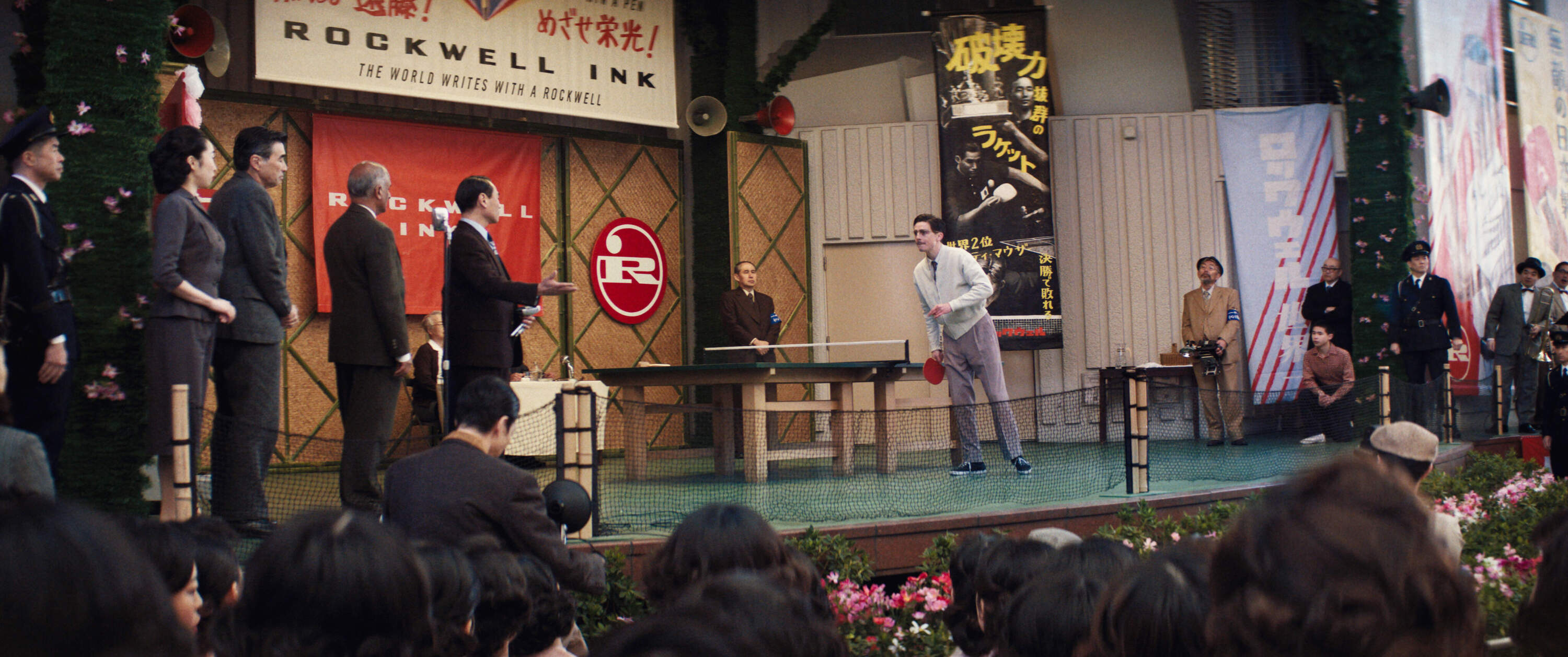
A bustling picaresque set in 1952 New York, the film follows Marty in his efforts to get himself over to Japan for an international table tennis championship, coming up with countless scams and schemes to pull himself out of a post-war Jewish ghetto brought vividly to life by legendary production designer Jack Fisk. You might be alarmed by how hard you’ll find yourself laughing at our hero’s attempts to dodge the downstairs neighbor he’s impregnated (a fantastic Odessa A’zion, from the terrible HBO show “I Love LA”) while stealing from his uncle’s shoe store, hustling chumps at the arcade, swindling various investors and wooing the movie star wife of a ruthless millionaire who might be the only person in the movie more unscrupulous than Marty.
The millionaire is played with maximum smarm by Kevin O’Leary from TV’s “Shark Tank,” where each week he is amazingly able to be the most loathsome person on a program that also stars Mark Cuban. It’s a brilliant bit of meta-casting, topped only by director Safdie coaxing Gwyneth Paltrow out of semi-retirement to play a former Hollywood starlet and trophy wife trying to re-start her career on the Broadway stage, aghast to find herself falling into the arms of this unerringly confident little pipsqueak who won’t stop talking about pingpong. Paltrow has become such a silly celebrity in her wellness guru era, it’s nice to be reminded that she’s also one of the greatest actresses of her generation. Her scenes with Chalamet are marvelously droll little cat-and-mouse games, and I’m afraid I made a spectacle of myself when he tries to steal her necklace during an enthusiastic bout of shower sex.

“Marty Supreme” is paced like a rocket and as deafeningly loud. Safdie excels at a shouty strain of Jewish comedy where the anxiety is compounded by the sheer volume. The movie is crammed with inimitable voices and marvelous mugs like Abel Ferrara, Fran Drescher, Sandra Bernhard, Larry ‘Ratso’ Sloman and David Mamet. The one-damn-thing-after-another plotting has been compared to director Safdie and his brother Benny’s previous picture, the 2019 cinephile favorite “Uncut Gems.” But that film always struck me as too heavy and overdetermined, so in thrall to its obvious influences that it felt secondhand. (At the time I described it as like trying to watch “The Killing of a Chinese Bookie” while someone is playing the radio too loud in the other room.)
“Marty Supreme” is a much more buoyant and enjoyable experience. A lot of that has to do with Chalamet, who brings such a winning lightness that you can’t help rooting for Marty and his seemingly unlimited chutzpah, even when his actions are appalling. There’s a young DiCaprio quality to the way he invites the audience to become his co-conspirators, his brashness made even funnier by the slightness of his physique. I’ve long been on record as a Timée agnostic, but when the screening was over, I texted a friend saying, “I get the Chalamet thing now.”
What I don’t get are the film’s final moments, which attempt to attach some emotional growth to a movie that’s been too freewheeling and frenetically paced to earn the kind of cathartic, tearful close-up that Safdie and Chalamet are shooting for. I understand why they wanted to finish the movie on a redemptive note, and it will probably make a big difference at the box office. But I didn’t buy it for a second. If they’d ended instead with a shot of Marty sneaking out the back door, this would have been one of my favorite movies of the year.
“Song Sung Blue” and “Marty Supreme” open in theaters on Wednesday, Dec. 24.