Support WBUR
Rep. Clark faces dual primary challenges from the left
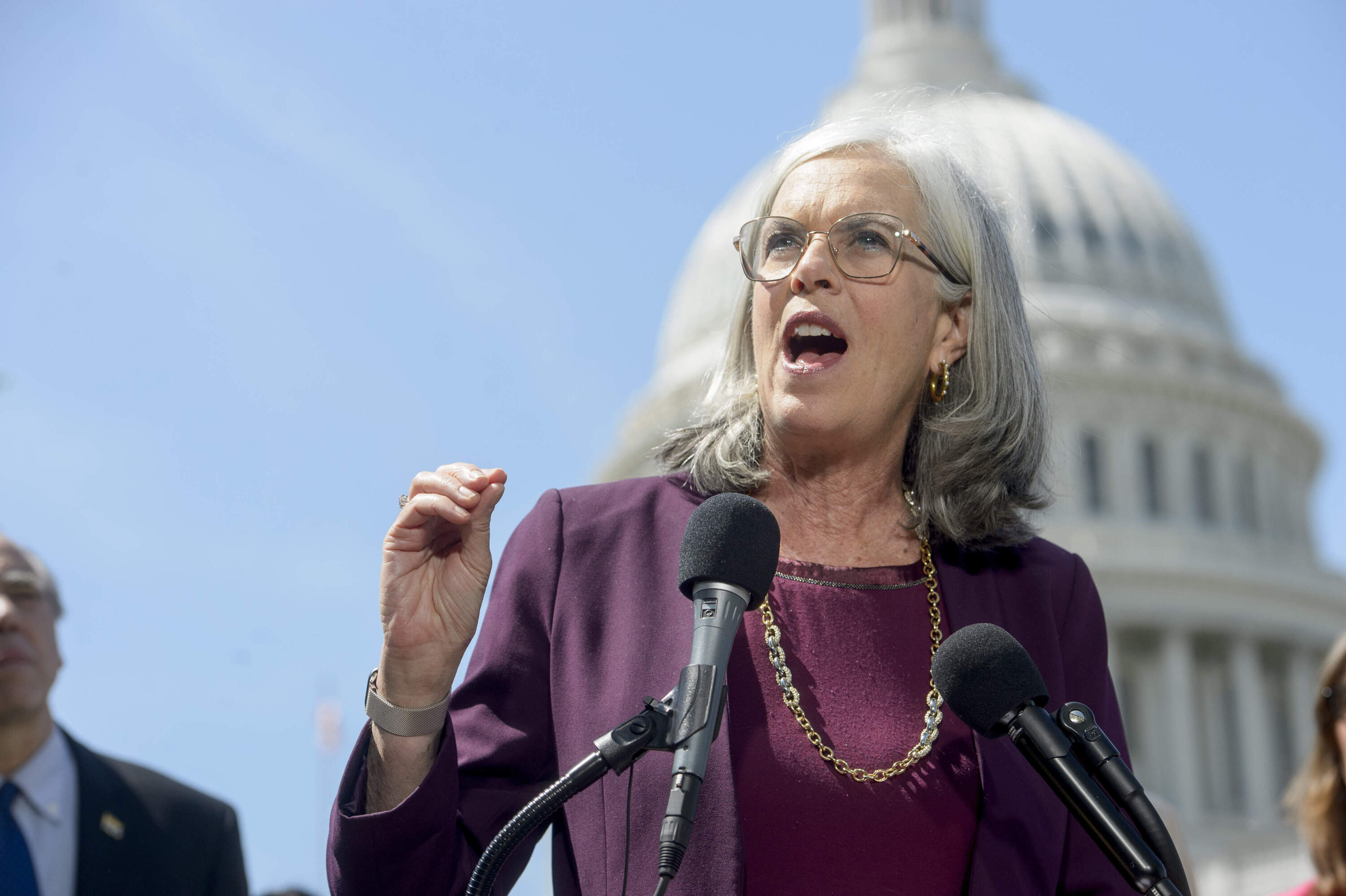
Two Massachusetts natives born to immigrant families will challenge House Minority Whip Katherine Clark in the 2026 primary for the Massachusetts 5th District.
The two candidates face steep climbs in taking on one of the country's most powerful Congressional Democrats.
Jonathan Paz, 32, recently announced his bid to unseat the representative from Revere in this year’s primary. Paz said he’s running because party leadership is out of step with working class voters.
He said Congress should abolish Immigration and Customs Enforcement and redirect the vast sums appropriated to the agency to housing, healthcare and education.
“That money can go a long way,” Paz said. “Rather than tearing up our communities, it could actually do something to support working people who are struggling.”

Paz was born in Boston and spent eight years growing up in Bolivia before returning to Waltham. He served as a Waltham city councilor for four years before running unsuccessfully for mayor in 2023. He said he works in shipping logistics for a Hong Kong-based firm.
As immigration enforcement ramped up in early 2025, Paz founded the group Fuerza Community Defense Network, which monitors ICE activity in Waltham. He said state officials should take a more aggressive stance against ICE arrests in district courthouses.
Also challenging Clark is Tarik Samman, 27, of Cambridge. The Harvard Law School researcher was born in Lowell to a Syrian immigrant family. Samman said his family left Lowell for Damascus after facing Islamophobia in the wake of the 9/11 terror attacks. He spent most of his childhood in Syria before returning to the U.S. in 2014.
Samman has called for greater investments in housing, health care and child care. And he pledges to oppose weapons transfers to Israel and to support recognition of a Palestinian state. Samman said he was part of a pro-Palestinian protest that visited Clark's office in August 2025, and he was dissatisfied with the response.

Samman said he’s worried about the future of democracy, and feels Clark is among the politicians who promise change but deliver excuses.
“The main issue that we're facing with our current representative is that there is a lack of leadership in the halls of D.C. — and there's a lack of presence in the district itself,” Samman said.
A spokesperson for Clark did not respond to a request for comment.
Clark, 62, has been in Congress since 2013, when she won a special election to replace Ed Markey after he ran for U.S. Senate. In 2022, Clark's colleagues elected her to serve as Democratic House whip, a high-profile role aimed at galvanizing support for legislative goals, and helping plan opposition when the party is in the minority. After Minority Leader Hakeem Jeffries, Clark is the top-ranking Democrat in the House.
Shy of a political scandal, analysts say it’s hard to imagine anyone beating such a powerful incumbent in Massachusetts.
“Katherine Clark is safe as she can be,” said Jeff Berry, a retired Tufts University political scientist. “She's popular in her district. She's popular in the Democratic Party. She's part of the leadership in the Congress and will have access to all the money she needs to run a vigorous campaign.”
Berry said primary challenges are often “symbolic candidacies,” aimed at boosting name recognition ahead of future runs. He cited Mitt Romney’s loss to U.S. Sen. Ted Kennedy in 1994 before Romney went on to win the governor’s race in 2002.
“The race is not going to result in the challengers getting lots of votes, but they certainly are going to catch Rep. Clark's attention,” Berry said.
The last Massachusetts Congress member unseated in a primary was Michael Capuano, who lost his House seat to Ayanna Pressley in 2018. Before that, Seth Moulton beat long-term incumbent John Tierney in 2014.
David Paleologos, director of the Suffolk University Political Research Center, said Pressley had demographics in her favor, while Tierney was dogged by years-long political scandals that helped Moulton edge him out of office.
Clark’s money advantage is another factor. For upstart candidates to introduce themselves to voters, Paleologos said, they need to raise around $1 million.
“It’s not just going to one event here and there," said Paleologos. "It's repeated direct mail, it’s using social media, it’s paid advertising, it's a lot of money and a lot of organization.”
State campaign finance records show Paz raised $5,300 in 2025, before announcing his bid for Congress. Over the same period, Clark raised just shy of $2 million, while two Clark-affiliated political action committees reported receipts of nearly $1.3 million through the first half of 2025.
Samman has yet to file campaign finance reports.
Beyond cash and name recognition, there's clout. If Democrats win a House majority next year, Paleologos said, Clark would be among the most powerful people in Congress. That prospect makes it even harder to convince voters that the Massachusetts 5th needs a new representative in D.C.