Support WBUR
Review
Two new films offer bold and uncompromising visions from brilliant female filmmakers

In a business dominated by men making movies for little boys, there’s typically a drought of female voices. But they say it never rains except when it pours, and this weekend brings not one, but two powerful pictures directed by formidable women. Words like “bold” and “uncompromising” feel inadequate when describing Kristen Stewart’s “The Chronology of Water” and Mona Fastvold’s “The Testament of Ann Lee.” The former is a jagged, prismatic story of a sexual abuse survivor finding her voice as a writer, while the latter is a hallucinatory historical epic about the founding of an 18th-century religious colony. What both movies have in common — besides brilliant female filmmakers — is that you’ve never seen anything like them.
Arthouse audiences have gotten used to sitting through a lengthy procession of production company title cards before the movie begins. I’ve been at festivals where folks make fun of this, but I’ve always admired the hustle. As arts financing becomes more difficult, you’ve got to respect a filmmaker out there scraping funds together from so many sources to get their vision seen. The way I see it, the more logos before a movie, the more passionate the project. No fewer than 10 of them unspool before “The Chronology of Water,” a testament to the eight years Stewart has spent struggling to bring her directorial debut to the screen. You can see that dedication in every frame of the final product. The movie is so intense it feels like she’d die if she didn’t make it.
Adapted from a 2011 memoir by Oregon writer Lidia Yuknavitch, the film is a fragmented flood of images and sensations putting us in the anguished headspace of its protagonist. We don’t see scenes so much as slivers and shards of a shattered life. Played as an exposed nerve by Imogen Poots, young Lidia is a championship swimmer emotionally and sexually abused by her father (Michael Epp). We watch her spiral out over decades in the self-destructive aftermath, first seeking oblivion through sex and drugs, eventually finding catharsis by writing short stories so ugly and personal they’re more like exorcisms. She reads aloud one doozy about incest that’s graphic enough to make a classmate throw up.

The movie asks a lot of the viewer, leaving us to stitch together the narrative threads through flashes of a sometimes unreliable memory. Stewart is also working in the tradition of performance artists like Karen Finley, foregrounding female physicality in ways we’re not used to seeing in cinema. The movie is full of menstrual blood, vomit, vaginal secretions and the sticky, messy business of being human, narrowly skirting self-parody when the star squats on a jail cell toilet and noisily defecates — 128 minutes of this is probably too much. (Stewart could have cut one of Yuknavitch’s three marriages without altering the film’s trajectory.) Yet the sensory overload is integral to the experience. The movie is a piledriver.
Poots seems to have been on the cusp of stardom for at least a decade now, and she hurls herself into the role with the same fearlessness as her director. The supporting cast is uniformly superb, with the much-missed Thora Birch giving a gorgeously haunted performance as Lidia’s stoic sister. There’s a chilling little cameo from Kim Gordon as a dominatrix, and a most delightfully unexpected turn from Jim Belushi as Yuknavitch’s mentor at the University of Oregon, the legendary Ken Kesey. Decades of terrible sitcom reruns have made it easy to forget Belushi began his career as a fine character actor in movies like Oliver Stone’s “Salvador” and Michael Mann’s “Thief.” He plays Kesey as a guy who’s been famous for so long he understands his effect on people, and he knows what it means to Lidia when he tells her she’s a real writer. Their scenes together are hugely moving, and come as warm relief in a film that can sometimes feel oppressive.
When actors start directing, their movies are usually about watching actors act. Stewart, who has always exhibited a precocious artistic temperament, approaches this material from a more cinematic perspective. “The Chronology of Water” is a movie about a woman struggling to express herself, and as she learns how to do so, the fractured, chaotic filmmaking begins to resolve itself into something more stable. The form of her expression doesn’t just match the content, it is the content, which is sophisticated in ways that a lot of more experienced filmmakers would never try. The tranquility of the final scene feels hard-won. And well deserved.
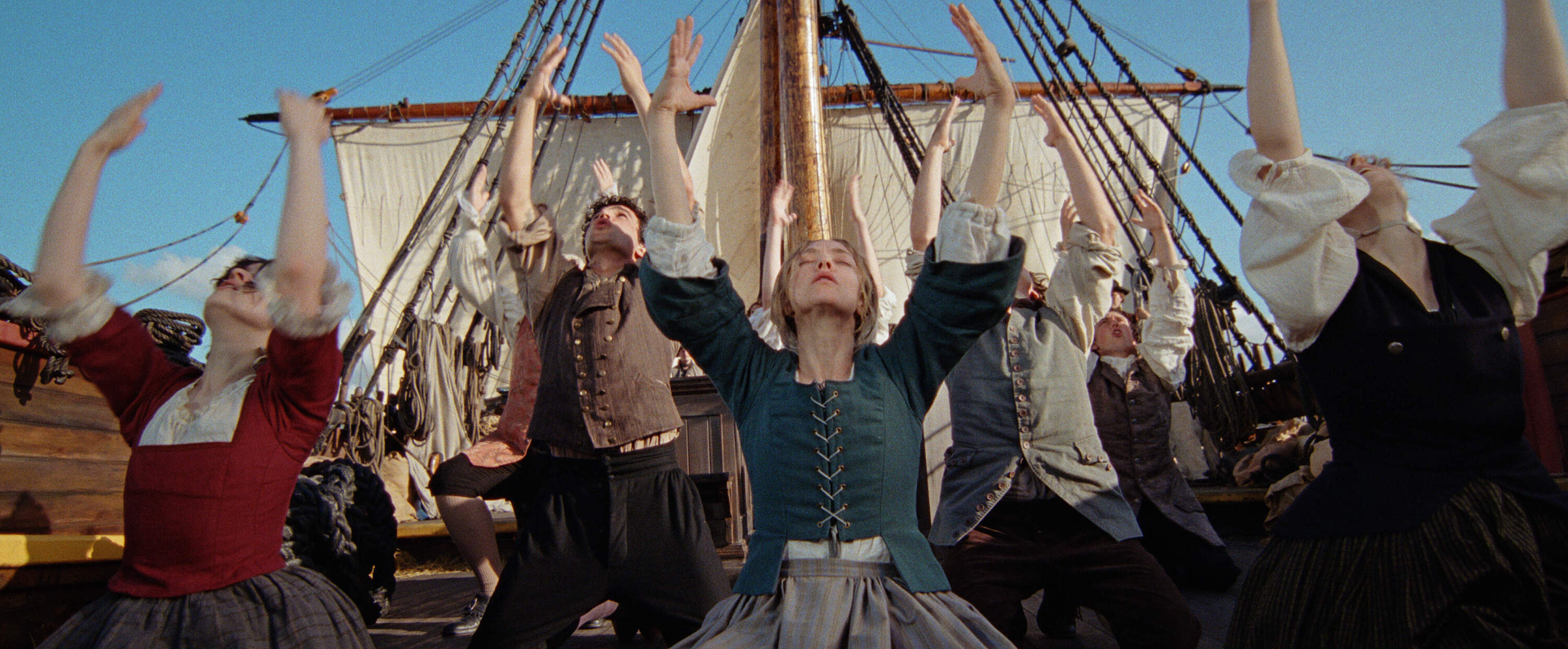
The religious reveries of “The Testament of Ann Lee” alone make the movie worth watching. Choreographer Celia Rowlson-Hall arranges the characters’ arms and legs across the widescreen frame in waves of undulating ecstasy. There’s a joy of movement in the movie that’s mesmerizing, using modern dance to convey the allure of the extreme Puritanism being pushed by the title character. Amanda Seyfried stars as Lee, who in 1774 emigrated from England to upstate New York with a radical sect of Christians so repressed they weren’t allowed to be fruitful and multiply. These are folks for whom the Quakers were too decadent.
Known as the Shakers for their fevered physicality during worship, they’re mostly remembered today for their sturdy furniture and the vows of celibacy that ensured their traditions wouldn’t be passed down through the generations. Fastvold’s hypnotic film frames Lee’s life as a musical folk tale, with old Shaker hymns repurposed into earworms by Oscar-winning composer Daniel Blumberg. The film accepts her visions and revelations at face value, though with a bit of editorial wiggle room. (God always seems to appear to Ann when she’s starving or otherwise under duress.) No matter, as Seyfried’s ardent, bug-eyed performance sells her testimonies with a devout certainty that’s oddly comforting. You can see why so many people followed her to America. I’d follow Amanda Seyfried anywhere.
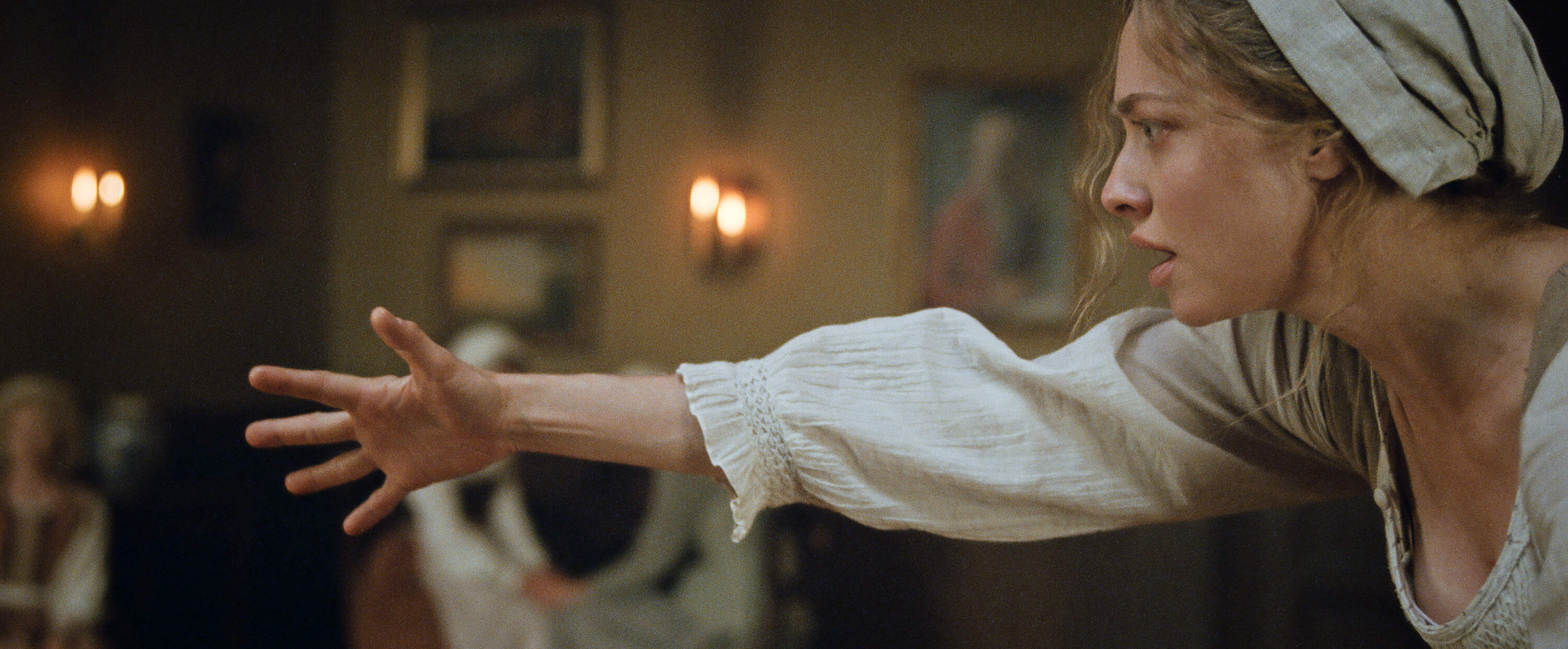
Running underneath everything is the implicit acknowledgment that the Shakers move like this because they’re sublimating all their pent-up sexual energy into an outlet that isn’t forbidden. The first time we see such a display is when a parishioner is scolding himself for having caught sight of his little sister in the bath, and the movie quivers with a psychosexual tension throughout. All the rhythmic roiling and heavy-breathing exhortations of these church services are just suggestive enough to let audiences come to our own conclusions about what’s behind the fanatical, full-bodied fervor.
Director Fastvold previously helmed the tragic 2021 love story “The World to Come,” which took place in a nearby stretch of New York state about a hundred years later. She’s probably best-known for co-writing “The Brutalist” and “Vox Lux” with her partner Brady Corbet, who shares co-scripting duties on “Ann Lee.” Like “The Brutalist,” this is a staggeringly expensive-looking period piece shot in Budapest for around $10 million, a fraction of what Hollywood movies currently cost. (When it screened at IFFBoston’s Fall Focus in November, the first thing I said when the lights came up was, “Those two really know how to stretch a buck!”)
It's such a handsomely mounted picture, distributor Searchlight has struck 70mm prints to screen at special engagements throughout the country, including at the Somerville and Coolidge Corner Theatres. I’m looking forward to seeing it again in the larger format. Especially those dance sequences.
“The Chronology of Water” opens Friday, Jan. 16 at the Coolidge Corner Theatre and the Alamo Drafthouse Seaport. “The Testament of Ann Lee” is now playing on 70mm film at the Somerville Theatre and the Coolidge Corner Theatre, with digital presentations at other area theaters.