Support WBUR
For a Kurdish family in Maine, hopes of regime change in Iran
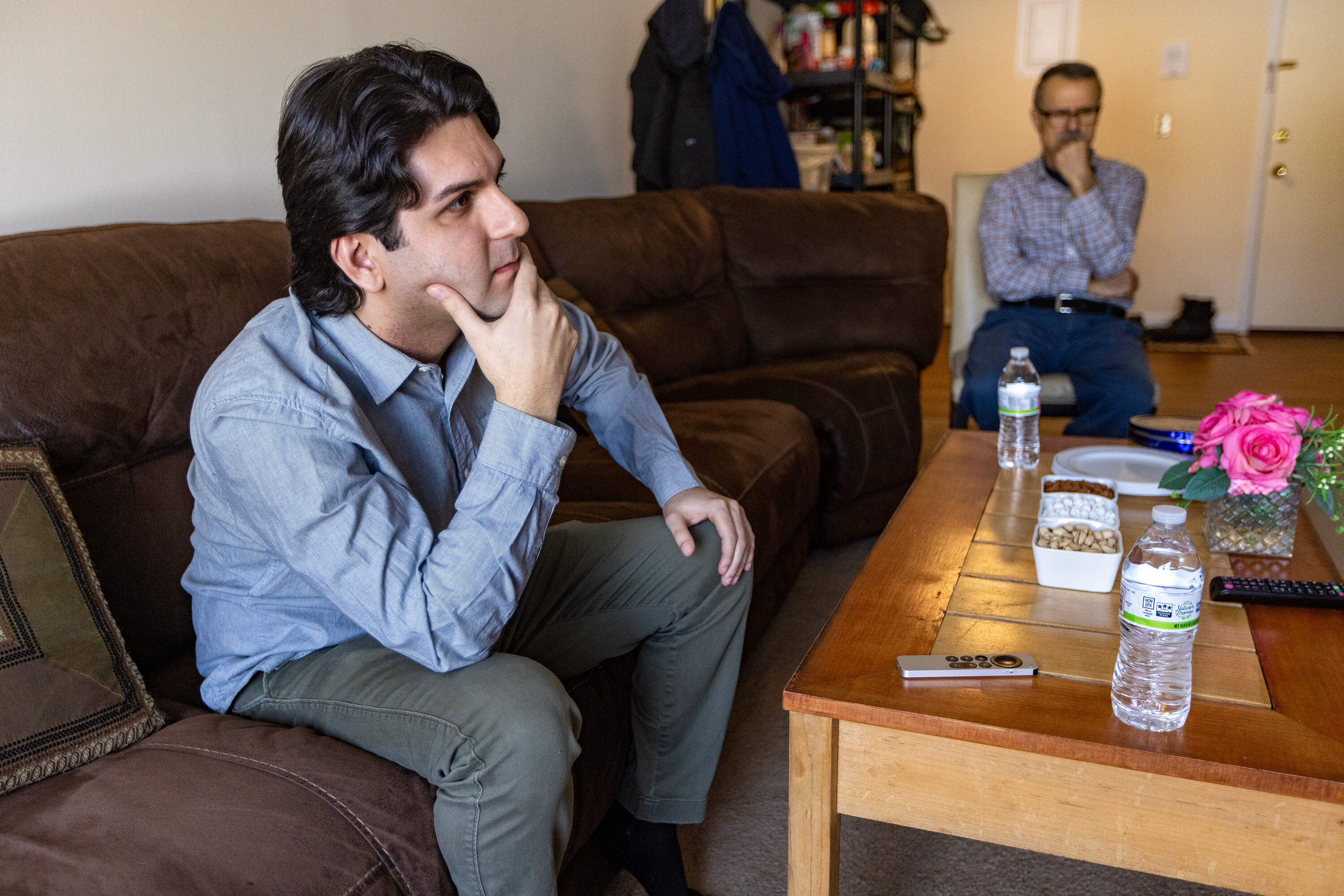
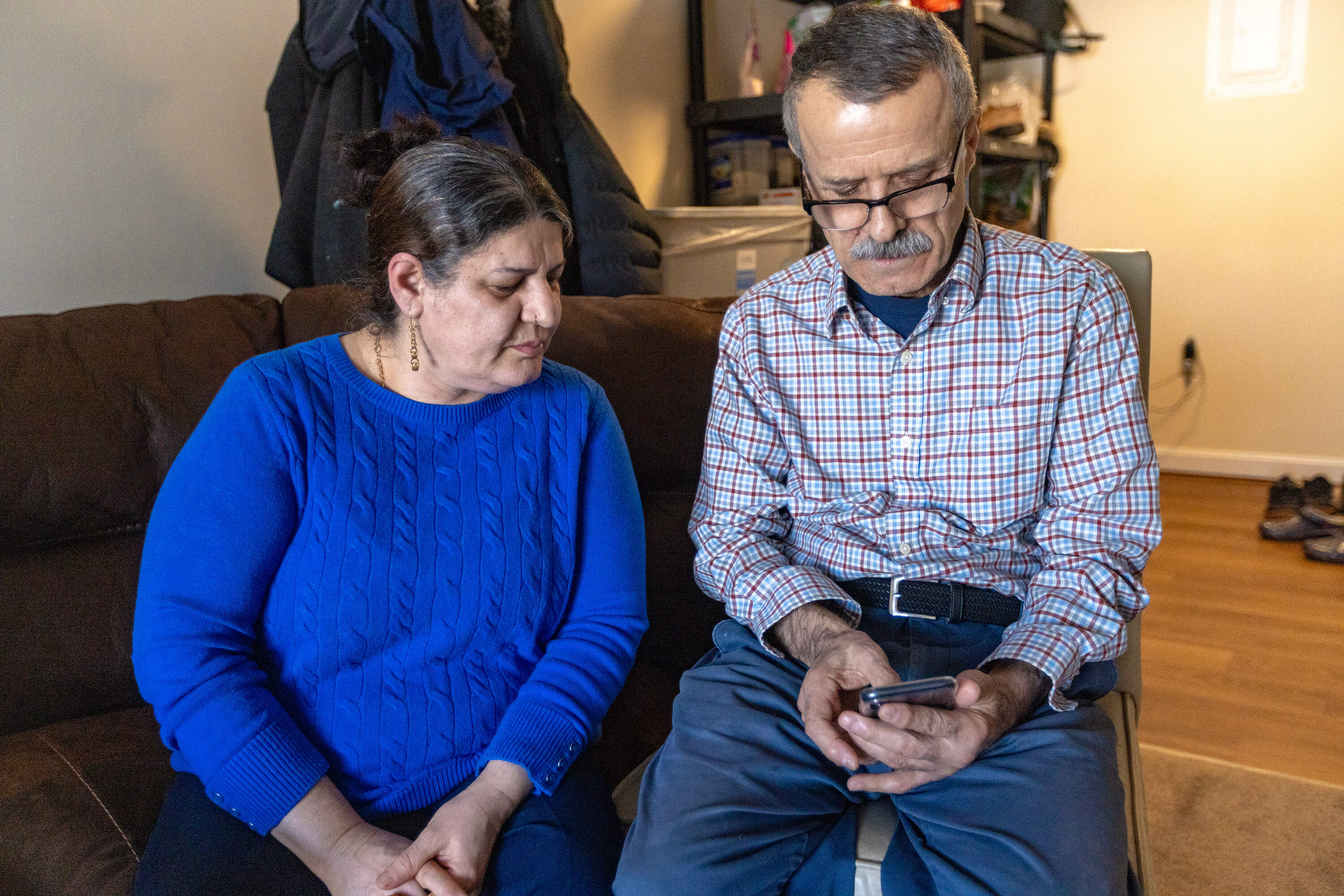
In a humble apartment in South Portland, 66-year-old Karim Haddadi and his family gathered around a TV to watch a Kurdish news channel. They’ve been glued to their screens since the attack on Iran started last week.
Haddadi pulled out his phone to show images of female Peshmerga fighters assembled in battle gear just across the border from Iran.
“Freedom fighter,” he said proudly.
Haddadi said his family's hope that those fighters will soon move into Iran to fight the Iranian military, assisted by a massive U.S-Israeli bombardment of bases and hardware there.
The Haddadis belong to one of the largest ethnic groups in the world without its own state; roughly 40 million Kurds are spread across Iran, Iraq, Turkey and Syria.
The Kurdish people are emerging as a player in the campaign to attack the Islamic Republic of Iran. It's the latest chapter in a fraught history of Kurdish involvement in American wars. But for many Iranian Kurds, it’s also a rare moment of possibility.
The Haddadi family’s journey out of Iran started in 1979, when the Iranian Revolution seized power. Haddadi was an elementary school teacher at the time. At first, he hoped the Islamic Republic would be better than the monarchy it replaced. But then, Haddadi said, an ominous letter arrived from Tehran. It said he could continue teaching only if he would spy on fellow Kurds.
“I told them, 'thank you so much, I am never ready for this rule,' ” he recalled. “Because I am teacher. I want to [be] teaching the kids.”

That’s when he headed for the mountains in Iran, where he’d spend the next two decades teaching the Kurdish language and engaging in combat with the Iranian Revolutionary Guard Corps. After having children in Turkey and Iraq, Karim led his family to the United States in the late 1990s.
The family has since dreamed of the fall of the Ayatollahs. Now more than ever, they believe that’s within reach.
“This is really a once-in-a-lifetime opportunity,” said Karim’s son, 31-year-old Hawreh Haddadi.
Like his father, Hawreh Haddadi is an educator, teaching social studies in a South Portland high school. At home, he and the family watch Fox, CNN and the BBC, as well as Kurdish and opposition Iranian outlets broadcasting on YouTube.
Then there are reports on social media: One video shows a missile strike on Iranian Kurdistan. He said the targets include military bases and prisons filled with political prisoners.
“There are millions of Kurds within Iran ready for this moment,” he said, “ready for this day, and excited to see something I never thought we'd see in our lives. This clear of a position by the United States government in taking out Khamenei, and saying it's time for the regime to go.”
The country’s roughly 9 million Kurds could be the tip of a spear in a ground assault against the Islamic Republic. CNN reported this week that the Trump administration may arm Kurdish forces to take part in a ground operation in Iran. The Trump administration has so far denied this is a done deal, with Press Secretary Karoline Leavitt confirming the president has spoken with Kurdish leaders but denying that a plan is in place.
Relying on the Americans is a high-stakes gamble for the Kurds, said Brian Glyn Williams, professor of Islamic history at UMass Dartmouth, who’s spent time living in Kurdish areas of Turkey.
For example, the Kurds benefitted from the U.S.-led overthrow of Saddam Hussein in Iraq. In other cases, Williams said, they've been abandoned after helping the U.S., including in the war against ISIS a decade ago.
“ If they succeed and they carve out an autonomy of the sort we’ve seen in Northern Iraq, then the gamble will pay off,” Williams said. But he fears Trump will just as quickly abandon the Kurds when it suits him.
Despite facing a more powerful army, Williams said the Kurds are the group best equipped to take on the regime. But they’re also a minority in a country of 90 million people, many of whom see the Kurds as separatists who threaten to fragment Iran.
And they’re not the only group looking to take power from the Ayatollahs.
In the Haddadi family’s living room, a familiar face appears on the TV: Reza Pahlavi, the scion of Persian royalty angling to become the next leader of Iran. Many Iranians support Pahlavi to become an interim head of state. But that’s bitter medicine for Kurds who remember the reign of his father, the Shah of Iran.
Karim Haddadi said Iran doesn’t need another monarch.
“Pahlavi, I hope he is not like father and mother and grandpa,” he said.
But would the crown prince be better than the regime that’s ruled Iran for nearly five decades?
“One hundred percent," he said.
Karim’s son Hawreh nodded, his eyes fixed on the face of the prince on TV.
“We want a democratic, federal system in Iran,” the younger Haddadi said. “That's what we want, because for the past 100 years, we've seen that centralized power in Tehran does not work.”
This segment aired on March 6, 2026.