Support WBUR
Boston's Saturday Morning Newsletter
'Remember the Ladies': 4 influential women of the American Revolution
Editor's Note: This is an excerpt from WBUR's Saturday morning newsletter, The Weekender. If you like what you read and want it in your inbox, sign up here.
The lead-up to the United States’ semiquincentennial has been busy with 250th anniversaries here in Massachusetts: Paul Revere’s ride, the Battles of Lexington and Concord, Evacuation Day… the list goes on. Many of these reenactments and ceremonies focus on the achievements of men.
This weekend, however, provides an opportunity to remember the ladies.
The Adams National Historical Park in Quincy is hosting a series of events Saturday and Sunday to mark the 250th anniversary of Abigail Adams’ famous “Remember the Ladies” letter. Adams wrote the letter on March 31, 1776 to her husband, John Adams, who would later become the second president of the United States. The correspondence, which she wrote from her farm in what’s now Quincy, implored John to “Remember the Ladies, and be more generous and favorable to them than your ancestors,” as he met with fellow Founding Fathers in Philadelphia to decide the laws of the new nation.
The letter is a valuable lens into the minds of women during the American Revolution, since most accounts of the era come from men, said Sara Martin, editor-in-chief of the Adams Papers at the Massachusetts Historical Society. “When we broaden our focus to hear those voices [of women], we get a broader understanding of the Revolutionary era, and how women are contributing to the political conversation of the day,” she said.
Adams wasn’t the only one. Here are a few influential women of the Revolution we’re remembering ahead of the anniversary of Adams’ letter.
Abigail Adams
Hilary Miller, chief of interpretation at Adams National Historical Park, says that a lot of people don’t realize that Adams was a close advisor to her husband during the Revolution.
Abigail Adams was an early women’s rights advocate, and made her opinions known through her letters to John. Her “Remember the Ladies” letter continues with, “Do not put such unlimited power into the hands of the Husbands. Remember all Men would be tyrants if they could.” She also notes that “if particular care and attention is not paid to the Ladies, we are determined to foment a Rebellion, and will not hold ourselves bound by any Laws in which we have no voice, or Representation.”
The couple regularly wrote letters to each other about the war and politics, while John was at the Second Continental Congress and Abigail was keeping the farm and family going.
“She’s finding ways to raise money so they can finance their lives, she’s raising their children,” she said. (One of those children, John Quincy Adams, went on to be the country’s sixth president.) “It’s so incredible what she’s doing and we want to give her her time in the spotlight.”
Miller hopes this weekend’s free programming at the park — which includes a symposium, trolley tours and a live performance by an actress playing Abigail — will help people learn more about the former first lady’s contributions to the Revolutionary movement.
Elizabeth Freeman
Elizabeth Freeman was an enslaved midwife in the Sheffield home of Col. John Ashley. Freeman did not know how to write, but that did not stop her from listening to the political ideas being discussed by Ashley, who was part of the committee that drafted the Sheffield Declaration in 1773, according to Martin.
“The declaration involves a natural rights philosophy, that humans are endowed with unalienable rights, regardless of the laws or customs or societies in which they live,” said Martin. This philosophy would be mirrored in the Declaration of Independence and the Massachusetts Constitution, which was drafted in 1780.
Shortly after the Massachusetts Constitution was ratified, Freeman used similar language to sue for her freedom with the help of her lawyer, Theodore Sedgwick. Previous petitions for freedom generally focused on some violation by the enslaver, said Martin. “Here, her lawyer attacked the principle of slavery itself,” said Martin. “It set a legal precedent for the abolition of slavery in Massachusetts [in 1783].” Freeman earned her freedom that same year, and went on to live in Stockbridge with the Sedgwicks, working as a paid servant until her retirement.
Mercy Otis Warren
Born in Barnstable, Mercy Otis Warren was a poet, playwright, political writer and activist who published satires in Boston newspapers that lampooned the British colonial government, said Martin. Warren was close with the Adams family as well.
However, one of Warren’s most influential works critiqued not the British, but the Founding Fathers. In an 1788 essay published under the pseudonym “A Columbian Patriot, Warren warned that the newly proposed Constitution would lead to “an aristocratic tyranny” and an “uncontrolled despotism” if it did not include guarantees to protect the freedom of the press, freedom of religion and a right to a trial, among other things. The popular essay is believed to have contributed to Congress’ passage of the Bill of Rights in 1789.
In 1805, Warren also published a history of the American Revolution, titled “History of the Rise, Progress and Termination of the American Revolution,” which was one of the first histories written of the conflict, according to Martin. “She publishes under her own name and is one of the first women to do so,” Martin added.
Hannah Fayerweather Tolman Winthrop
Winthrop was a contemporary of Adams and Warren. “She doesn’t rise to the same level of public recognition, but she is a political writer,” said Martin. During the Revolutionary War, the Cambridge writer closely detailed her changing environment through letters, from the advancement of British soldiers to her family’s own escape to Concord.
“She’s writing about the smallpox epidemic, and what Boston and Cambridge were like during the British invasion and the destruction and chaos that ensued,” said Martin. “She exemplifies an educated woman of privilege who is sharing her thoughts. She offers a very vivid picture of what women were thinking and how politically minded they were.”
She wasn’t afraid to get creative with her prose, either. In a letter to Warren on April 2, 1776, Winthrop celebrates the retreat of British soldiers with this passage: “Let me salute you with the returning spring, and congratulate you on the memorable interposition of a kind providence in changing the face of our affairs & delivering us from those pestiferous barbarians, the Troops of George.”
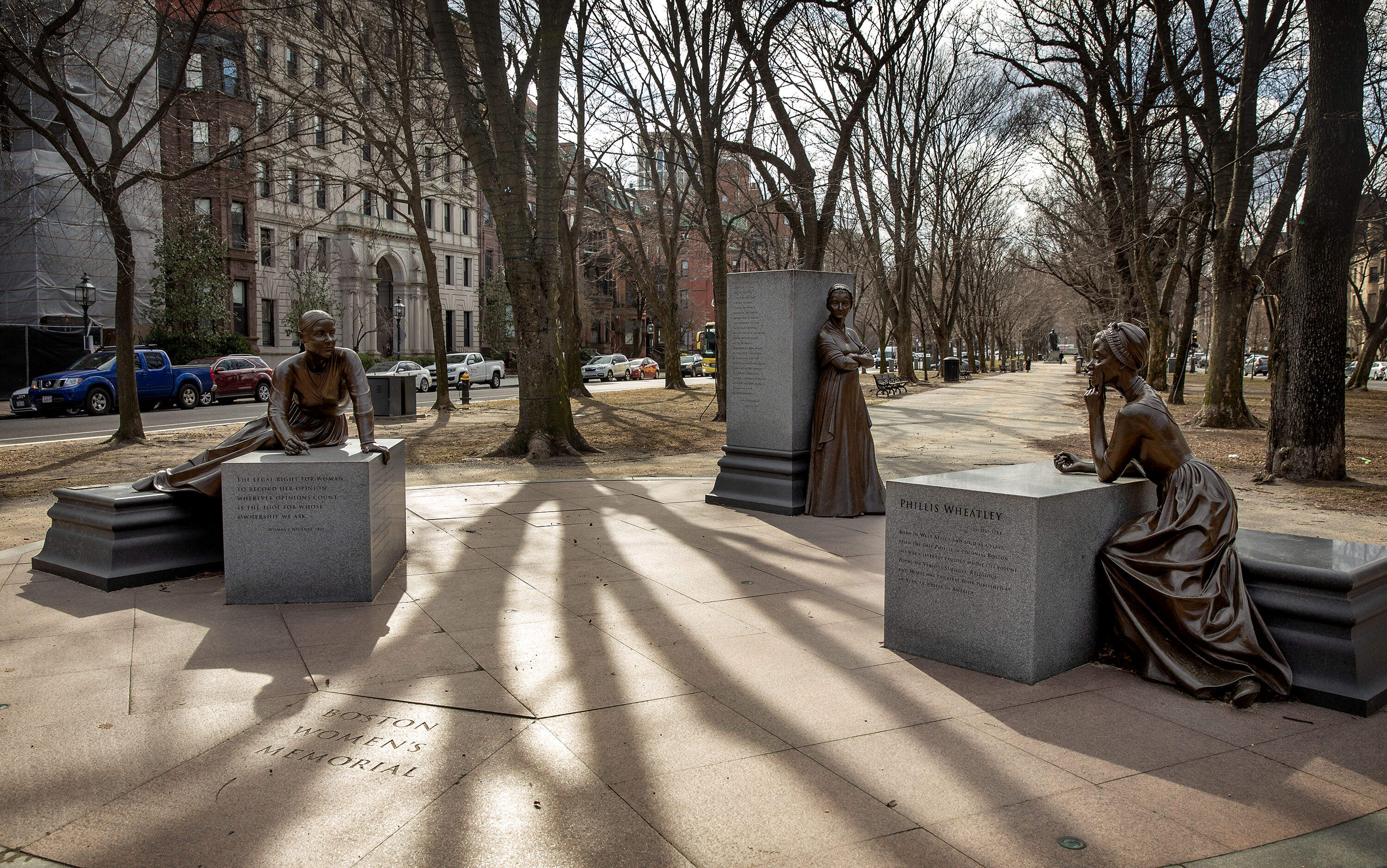
P.S.— Want to learn more about women of the American Revolution? The next time you’re walking along Commonwealth Avenue Mall, stop by the Boston Women’s Memorial to hear stories of influential women of the era — including Abigail Adams — told by three local leaders.