Support WBUR
Boston author Kylie Lee Baker's 'Japanese Gothic' upends horror tropes
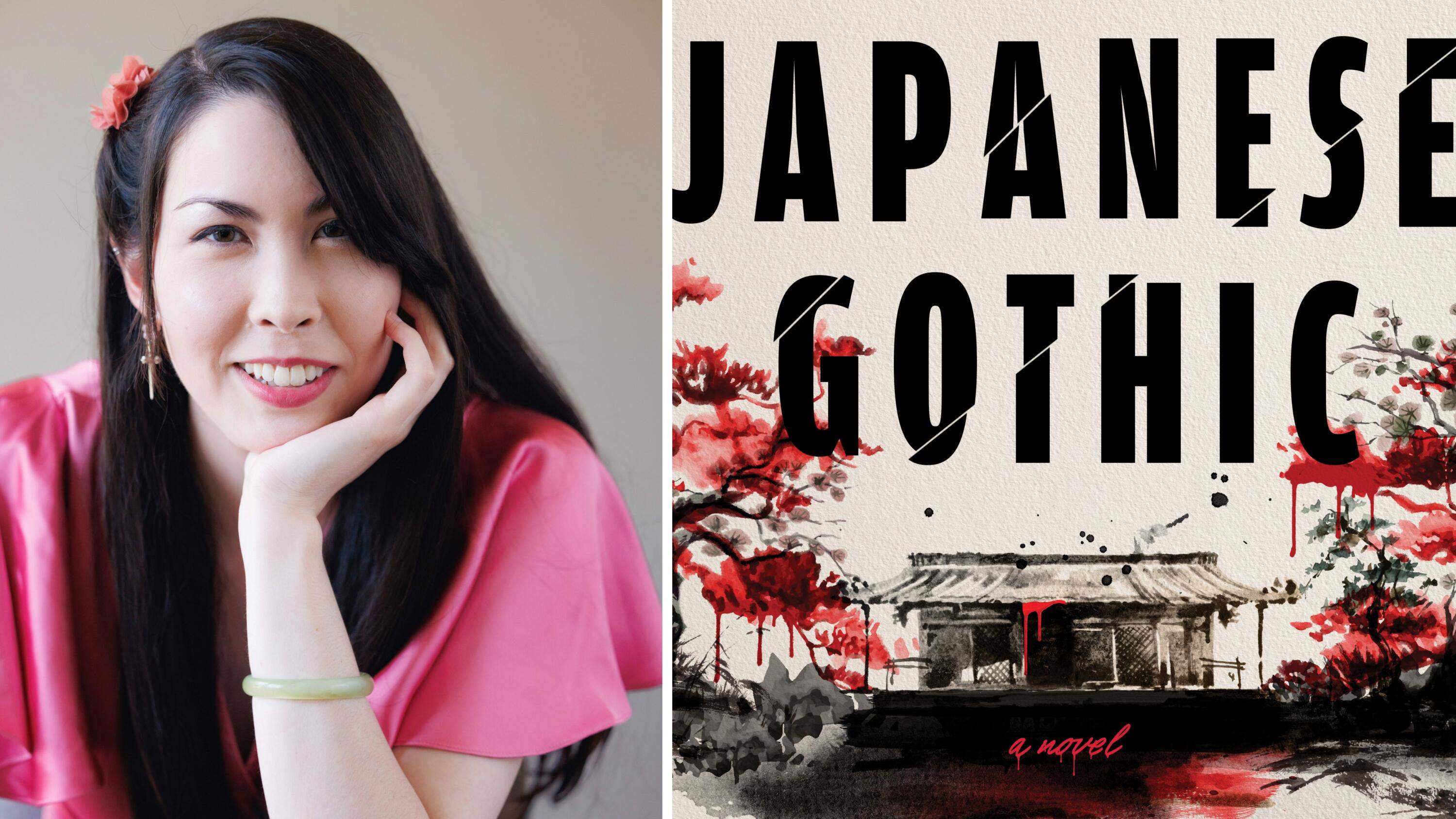
College student Lee can’t remember why he murdered his roommate or where he hid the body. In Boston-based Kylie Lee Baker’s electric new horror novel “Japanese Gothic,” sedatives have been a staple in Lee’s diet since his mother disappeared eight years ago. Escaping to his father’s new house in 2026 Japan, Lee is shaken by his mother’s visceral screams for help and a ghost brandishing a katana in the yard.
But Sen, the novel’s sword-wielding protagonist outside, thinks the pale face in the window is the evil spirit. As the daughter of the only surviving samurai from the 1877 Satsuma Rebellion, Sen anticipates lethal dangers around every corner. Whether it’s the imperial army with orders to gun down her rebel father’s whole family, a demon who claims to live a century and a half in the future or her father himself, Sen is trained to strike first or meet her last breath.
These two killers flee from the cops and their treacherous pasts to the same house, 150 years apart. But who’s haunting who? Conjuring an immersive nightmare with gruesome ghosts, human cruelty and psychological twists that pierce like blades, “Japanese Gothic” strips readers to their primal fear response to stare down death across time and cultures.
After first publishing four young adult fantasy books, Baker did not expect her 2025 horror novel, “Bat Eater and Other Names for Cora Zeng,” to become a runaway success. She was blown away by the warm reception from the horror community, which landed the book on multiple “Best of 2025” lists, including at the New York Times. Like many horror writers, Baker said she started devouring Stephen King books and watching horror movies with her dad “way too young.”
“Horror feels like my first language,” Baker said. “‘The Grudge’ set the stage for the rest of my life.”
The film clinched her devotion to the genre and would eventually inspire the premise for “Japanese Gothic.” Many U.S. remakes of Japanese horror movies feature white Americans who are “inexplicably” in Japan, Baker pointed out.
“Depending on how careful the directors are, that can feel pretty othering,” said Baker, who has Japanese, Chinese and Irish heritage. “This pretty innocent white girl is being terrorized by scary Japanese ghosts.”
She turns the trope on its head with Lee, a white character who is decidedly not innocent.
As Baker writes in “Japanese Gothic,” “Lee had read that when good people killed, even in self-defense or by accident, they were devastated by the thought of ending another's life. What did that make Lee, who felt nothing at all?”
By contrast, Baker said, “The person holding a sword in the dark is still scary and fun, but there’s more nuance.”
Sen gives her unwavering loyalty to a man who would kill her without remorse and a group whose glory days were decades prior. Even though the samurai class was abolished when Sen turned 11, her father would sooner slay himself than trade his katana for an office job. He embodies how “the loyalty that defined the samurai could not be eroded by time.”
Yet “Japanese Gothic” does not laud the samurai as heroes. As one character describes, “They were warriors, then they were bullies, then they were bureaucrats. Then one day, all at once, they were gone.”
Baker said, “As much as I love my culture, the way I write about it is levelheaded because I have such conflicting thoughts about it.”
Late in the drafting process, Baker realized Sen’s samurai clan would have colonized her ancestors on Okinawa. (Baker is one-quarter Okinawan, an ethnicity that’s distinct from Japanese.) Japan forced Okinawans to abandon their language and their traditions. Several generations passed. Baker’s grandmother grew up in Hawaii speaking Japanese and learning new cultural touchstones. When Pearl Harbor was bombed, the U.S. government incarcerated her family for being Japanese, an identity that had been forced upon them.
“I have inherited Japanese cultures and traditions,” Baker said. “I’m so aware we have these because of what has been lost and taken from us.”
Readers may be surprised to learn that Baker published a YA time travel romance in between her two horror stories. (For those counting, that’s three books in the last year.)
“As much as I love writing about darkness, I am a very unserious person,” Baker said, describing how she likes to crack jokes, play pranks and throw parties. “It was nice to have a book that was lighthearted and fun. I’m not suppressing any part of my personality. Horror books are fun in a different way.”