Support WBUR
Bodycam video raises questions after Boston police arrest leads to ICE custody
As he got home one night last November, Alejandro Orrego Agudelo discovered a neighbor had moved his scooter to take its parking spot. He said the bike was damaged and unrideable. Frustrated, he kicked the car bumper, headed into his apartment and went to bed.
But the drama in East Boston was only getting started.
The next morning, Orrego said, the neighbor who moved his moped, Richard Boyd, was brandishing a metal rod in the street, yelling for him to come down.
“ ‘I’ll wait here the whole day if I need to,’ ” Orrego recalled Boyd saying. “ ‘I’ll make you pay for this.’ He was angry — really, really angry.”
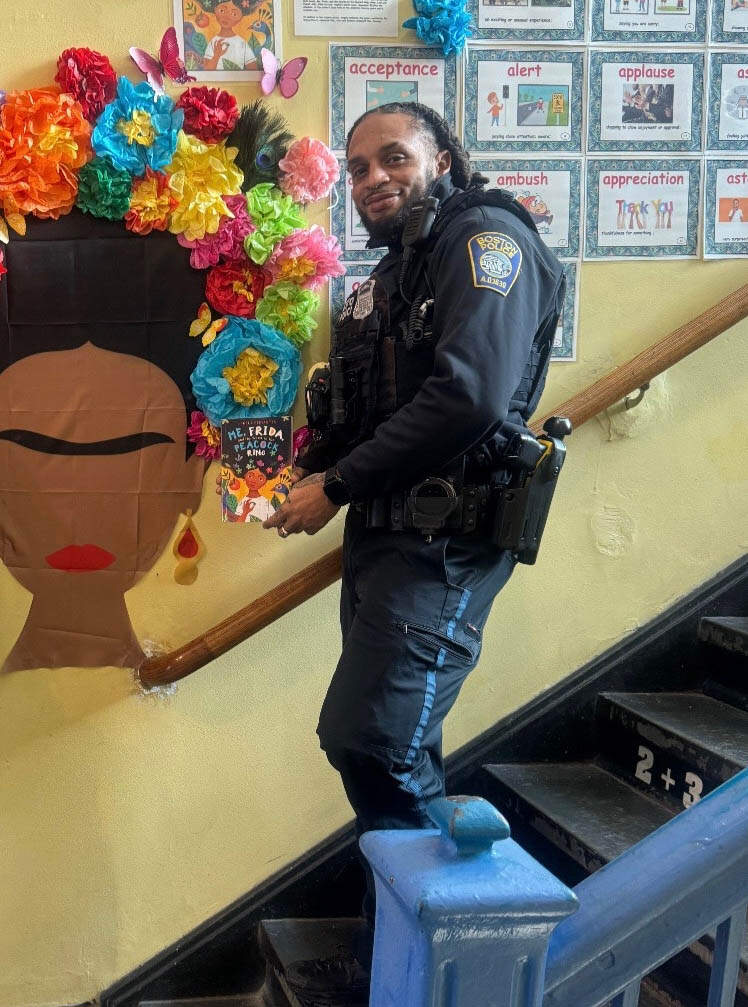
Orrego said he didn’t want trouble so he stayed inside. But a half hour later, somebody was banging at his door. He thought it was Boyd coming to confront him. But it was Boston police officer Lorenzo Hooker III, and his body camera was rolling. He pounded hard at the door. After the third time, Hooker announced himself: “Boston police, come to the door.”
Orrego didn’t answer, so the officer went back down to the street. And there began a series of encounters with law enforcement that landed the 27-year-old Colombian in U.S. Immigration and Customs Enforcement custody for the next four months.
WBUR has followed Orrego’s case since he was arrested outside an East Boston courthouse, targeted by immigration agents hours after his arrest by Boston police. The police department charged him with assault and battery on an officer, and painted him as a threatening figure who provoked — and resisted — his own arrest.
But new body camera footage obtained by WBUR from Boston police casts doubt on the officer’s narrative, suggesting it was the officer who escalated a tense situation into a violent one. Policing experts who reviewed the video say Orrego should not have been arrested in the first place. And if not for that arrest, Orrego likely would have never ended up in ICE custody.
'No, we do gotta do it like that!'
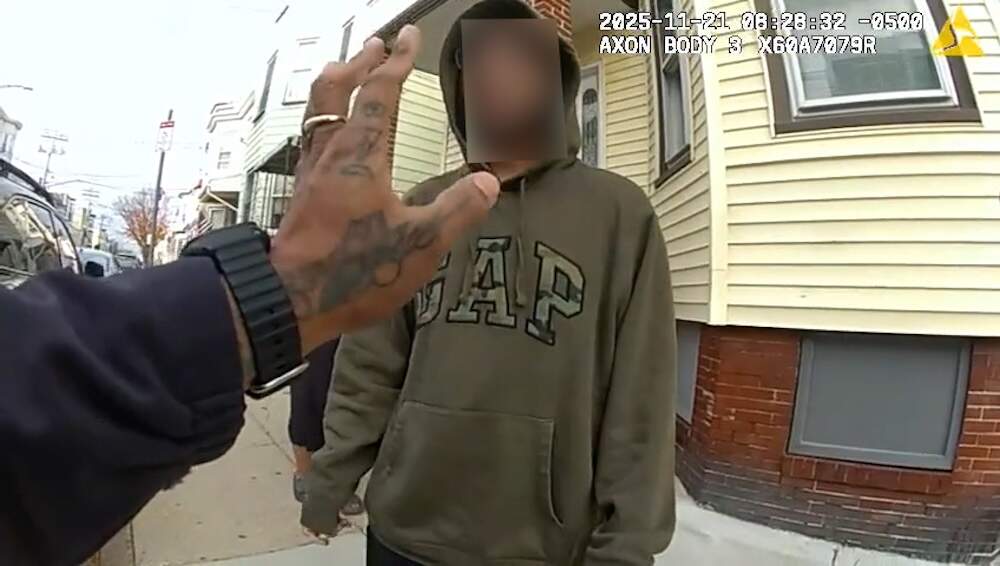
The body camera footage shows Boyd propping a laptop on Orrego’s scooter and trying to find video he said he captured of Orrego kicking his car. But before he could show it, Orrego walked out the front door of his triple-decker. Boyd started in on him about his bumper — Orrego tried responding, but the officer shut him down.
“First of all, you're not gonna come outside, and you're not gonna be aggressive,” the officer said.
“I'm not being aggressive, sir,” Orrego replied, crossing his hands over his chest as if to show he wasn’t a threat.
Struggling to speak English, he tried to tell the officer that Boyd had damaged his scooter, but Hooker cut him off again.
“ I don't want to hear nothing that you gotta say. He has you on video kicking his car,” Hooker said. His arrest report would later say Boyd had been unable to download the video.
“What about my motorcycle?” Orrego said.
Boyd interjected to describe how he moved the scooter. Hooker turned to him: “Don’t say nothing. I asked you not to say nothing.”
Then Hooker ordered Orrego to get his ID; Orrego asked why.
“You're still standing here,” Hooker said.
“No, don't talk to me like that,” Orrego answered.
Orrego then reached into his pocket for his phone and started to record. The officer would claim Orrego shoved the phone in his face and poked him in the chest. But that’s not evident in the bodycam video. What you do see is the officer tackling Orrego, who weighs all of 130 pounds.
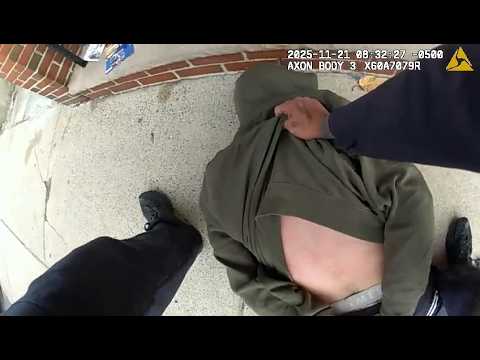
Orrego was face down on the sidewalk for nearly four minutes, repeatedly pleading for help and screaming in pain. The officer held him by the nape of the neck, at first with a set of keys in his hand, and kneeled into his back, commanding Orrego to put his hands behind his back.
“ You never put your hands on someone that is wearing this uniform!” Hooker shouted, insisting over and over that Orrego had put his hands on him.
Boyd, who commented throughout the 15-minute video, backed up the officer: “I got it on video.”
As he's down on the sidewalk, Orrego can be heard denying the officer's allegations: "I was just talking to you," he said. "We not gotta do it like that, man.”
“No, no, no,” the officer yelled. “We do gotta do it like that!”
The video shows a supervisor arriving at the end of the arrest, and Hooker recounts his version of what took place.
Hooker would charge Orrego with assault and battery, resisting arrest and disturbing the peace. There was also a charge of vandalism for damaging Boyd's vehicle — that's a felony and an arrestable offense. Orrego was transported to Nashua Street Jail.
Then ICE learned about the encounter.
Orrego was arraigned at East Boston District Court that day, and the case was ultimately dismissed. But agents were waiting outside for Orrego — and there ensued yet another physical struggle, this time lasting a half hour, as agents tried to get Orrego into an SUV.
The ICE agents claimed he bit one of them. Orrego denies that as well, and he never faced charges over allegedly assaulting two federal agents.
Experts weigh in
Boston police’s “bias free policing” guidelines say officers must treat all people who come into contact with officers fairly and objectively. And the department’s use of force policy says the “department is committed to de-escalating” before officers use force, a rule rooted in state law regulating the use of force by police.
WBUR showed the body camera footage to two police veterans who have testified as experts on both sides of misconduct cases.
Former Los Angeles police Lt. Jeff Wenninger oversaw the review of hundreds of deadly force cases during his three decades in the department. He said the East Boston body camera video shows it was the officer who “closed distance” with Orrego, who appeared to have both hands on his phone when Hooker grabbed him.
“ All the aggression was the officer towards the individual,” Wenninger said. “However, it doesn't mean that [Orrego] was free of any culpability in doing things better himself — he should have complied.”
Once on the ground, Hooker’s arrest report said Orrego had a hand pinned under his body near his waistline. Wenninger said that can be a concern for officers because suspects can hide weapons in a waistband. Yet the video, he said, doesn’t back up Hooker’s claim.
“So that just kind of puts into question, really, the credibility of every assertion in that arrest report,” he said.
Wenninger said it’s not uncommon for police to tell people not to resist — even when no active resistance is evident.
“There were periods of time during my career that you were taught to state, ‘Stop resisting, stop resisting,’ ” he said, “because it would be consistent with supporting force that you may be using.”
He said we can’t know all the details based on body camera footage, but Hooker might have believed Orrego was actively resisting arrest — even if he was not.
Wenninger said the footage shows Orrego displaying “contempt of cop,” which is not a crime, but seemed to precipitate his arrest. He said officers need to keep a level head, even when suspects aren’t being fully cooperative.
“So what if he wants to videotape you? You're recording as well, so you just continue to try to obtain compliance, verbally interacting with him,” Wenninger said. “And perhaps had he done that, this thing would've ended very differently."
Former Massachusetts state trooper Todd McGhee served as a defensive tactics coordinator at the State Police Academy. After reviewing the body camera video, he said excessive force by the officer could be an issue in this case. His first concern, though, is why Orrego was taken into custody at all.
“ I'm still trying to figure out what the guy's arrested for,” McGhee said. “ When he pulled out his cellphone to film the officer, to me is when things escalated, but filming a police officer is protected by the First Amendment.”
McGhee said Orrego was arrogant, but that Hooker should have just issued him a summons and walked away.
“If you're an illegal alien, you should be nice as pie to the police officer,” McGhee said, adding, however, that anyone “who steps on U.S. soil, our U.S. Constitution protects them.”
McGhee said police are the ones with training and authority — and they should be held to a high standard.
“ Officers have a job to do in the streets: protect and serve, and to enforce the rules,” McGhee said. “That being said, citizens also have a responsibility to comply.”
“ I'm still trying to figure out what the guy's arrested for ... Filming a police officer is protected by the First Amendment.”
Former Massachusetts state trooper Todd McGhee
City payroll records show Hooker became a Boston police officer in 2022. Boston police declined to provide records on his disciplinary history, saying there’s “an active and ongoing investigation.” The department cited four Internal Affairs Division cases, two opened last year and two this year, but did not say whether the Orrego case was under scrutiny.
Hooker’s status under the Peace Officer Standards and Training Commission, the state body that certifies police officers, is listed as “further certification review.” Among more than 2,000 sworn Boston police officers, Hooker is one of five with that status. According to the POST Commission, that means more information is required to process a recertification application, or the officer is challenging a decision.
Reached by phone, Hooker declined to comment on Orrego's case. The neighbor, Richard Boyd, has also refused to comment, or to provide any of the video he has claimed to have.
Orrego feels vindicated
Orrego was released from ICE custody in March after a protracted legal battle in front of three different courts to get him released from ICE custody. He’s back working at a local café while he prepares for his upcoming asylum proceedings to try to stay in the country.
Sitting on his back porch in East Boston, Orrego watched the body camera footage for the first time.
“I feel a bit angry and helpless, seeing how injustice can function,” he said in Spanish. “And I also feel sad about everything that happened, and that it could have been different.”
He admits he should have handled the encounter differently.
“I wish to go up and show my ID to the police officer and fix things a different way, not like this,” he said.
But when he sees the end of the video, where Officer Hooker describes the arrest to a superior, Orrego shakes his head.
In the video, Hooker says Orrego had come out of the house aggressively and tried to fight the neighbor. The officer tells his superior Orrego “poked me in the chest,” resulting in the decision to take him to the ground.
Orrego said the video backs up what he’s said from the get-go: that he never touched the officer, and he only wanted to tell his side of the story.
That wasn’t easy for someone who struggles with English.
“They was yelling, they was talking too fast," he said. "And I was nervous, I was in shock."
In November, Orrego will get a chance to tell his story in immigration court — and the body camera footage could help with his effort to seek asylum.
Daniela Hargus, the immigration attorney who helped get Orrego out of ICE custody, said the Department of Homeland Security could still use Hooker’s arrest report to oppose the asylum petition, even though the charges were dropped.
Hargus said Orrego ended up in an “unlucky situation” that does not reflect his character. “And I think this video shows that.”
This segment aired on May 19, 2026.