Support WBUR
The report card is in: Water quality at Greater Boston beaches improved last year

Greater Boston’s beaches beat their previous scores on the most recent water quality report card, released annually by the nonprofit Save the Harbor/Save the Bay.
For the first time in more than two decades, each of the 15 metropolitan beaches included in the report scored above 80%, according to Chris Mancini, executive director of Save the Harbor/Save the Bay. That means on average, each site was safe for swimming six days a week or more in 2025.
“What it tells people is, you can have some degree of confidence in these waters,” said Mancini.
For years, South Boston has been home to some of the cleanest sea water around Boston Harbor. Two of the neighborhood's beaches maintained top marks: City Point Beach achieved a perfect score for the seventh consecutive year and Pleasure Bay narrowly missed with 97%.
The report card's scores are based on data from the Department of Conservation and Recreation's water testing programs. Technicians look for bacteria levels and use an EPA-defined threshold to deem the water swimmable.
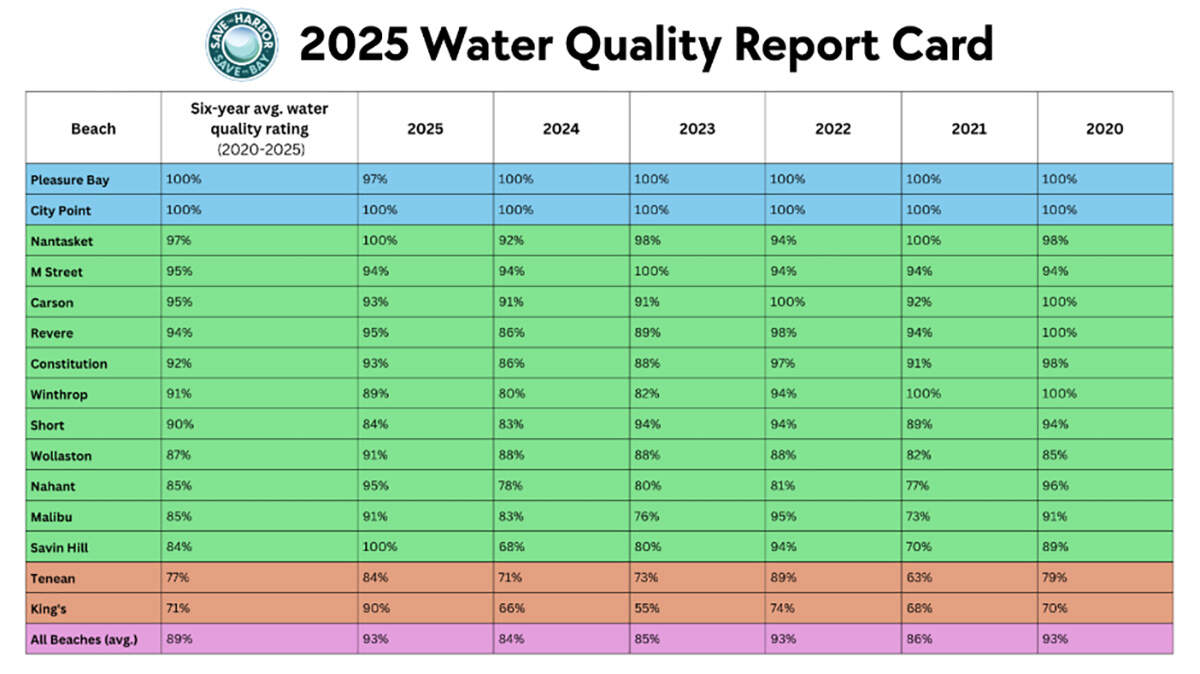
The report card showed major improvements for the prior year's lowest-ranked sites, including Savin Hill Beach and Tenean Beach in Dorchester, and King’s Beach in Lynn. Mancini said King's Beach has been known as “the dirtiest beach in the commonwealth” due to poor stormwater drainage. But in 2025, it was swimmable on nine out of 10 days.
A number of factors might have contributed to the improved water quality at King's Beach, said Mancini, including a drier than average summer, ongoing infrastructure improvements and an initiative using ultraviolet light to disinfect the water.
He said more data is needed to determine which had the greatest impact, but “it was probably a combination” of all of them.
In a statement, state Sen. Brendan Crighton, who co-chairs the Metropolitan Beaches Commission, called the report card's high marks “a testament to 40 years of investment in water infrastructure.”
The state Department of Public Health posts results online from tests of water quality at both ocean and freshwater beaches from mid-June through Labor Day.
Despite infrastructure improvements, rain and runoff are still among the biggest contributors to ongoing beach pollution. Intense storms that have become more common with climate change can send a mixture of rainwater, runoff and sewage into rivers and streams. These sewer overflows can worsen water quality along Boston's rivers, beaches and waterways.
Mancini recommends waiting at least 24 hours after a heavy downpour to spend a day at the beach. He also said it’s a good idea to check the state Department of Public Health's dashboard for water quality updates and beach closures.