Support WBUR
Does the U.S. need new nuclear weapons?
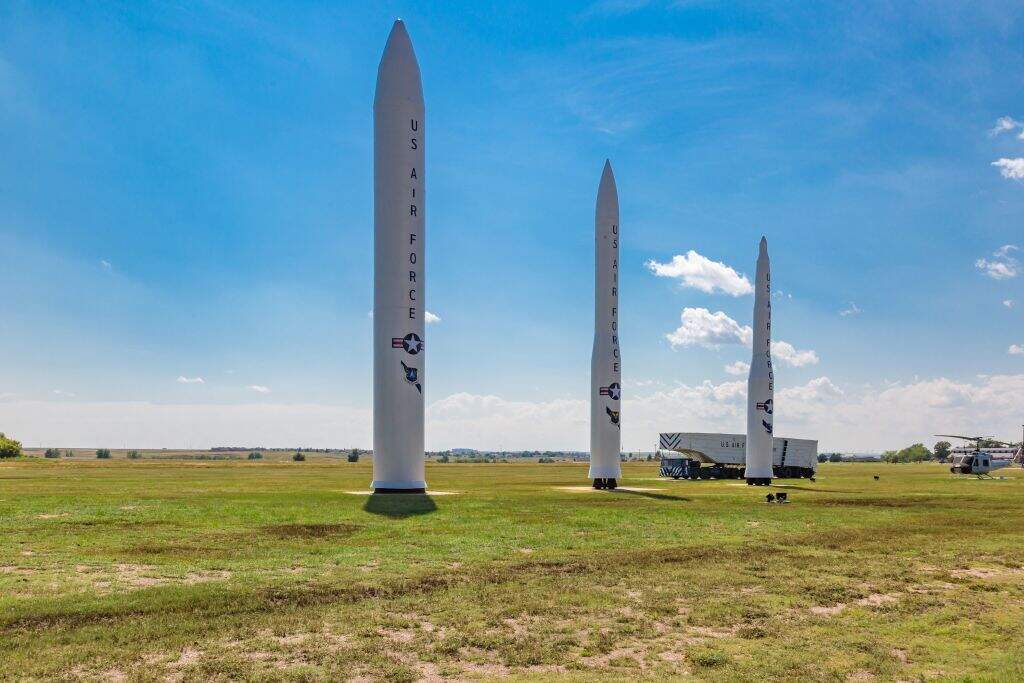
The U.S. is building new nuclear weapons, including a massive missile called the Sentinel.
They're up to 20 times more powerful than the bomb dropped on Hiroshima.
The program could cost more than $130 billion.
Today, On Point: Why does America need new nuclear weapons?
Guests
Stephen Young, senior Washington representative for the Global Security program at the Union of Concerned Scientists.
The Honorable Madelyn Creedon, principal deputy administrator of the National Nuclear Security Administration from 2014 to 2017.
Also Featured
Jeremy Murray, manager, Air Force Global Strike Command ICBM Policy.
Sarah Scoles, freelance science journalist. Author of the book “Countdown: The Blinding Future of Nuclear Weapons.”
Transcript
Part I
ASSOCIATION OF AIR FORCE MISSILEERS: A new ICBM baseline design, which will deploy 400 new missiles, update 450 silos, and modernize more than 600 facilities across almost 40,000 square miles of U.S. territory, which spans over six states, three operational wings, and a test location.
MEGHNA CHAKRABARTI: That is from a video produced by the Association of Air Force Missileers.
It's describing a massive new nuclear missile called the Sentinel. The Sentinel program would replace America's 400 existing land-based Minuteman III nuclear missiles. And the project has a price tag north of 130 billion. The U.S. Air Force says the United States' existing nuclear arsenal is decades old and in need of modernization.
Here's Lt. Gen. Richard Moore, Jr., the Air Force's Deputy Chief of Staff for plans and programs earlier this year.
MOORE, JR.: There is not a viable service life extension program that we can foresee for Minuteman III. It was fielded in the 70s as a 10-year weapon. And we will do everything we can to keep it in the field. It will remain safe, secure and reliable. But extending it for some lengthy period of time, that’s not a viable option. And so Sentinel will be funded. We’ll make the trades that it takes to make that happen.
CHAKRABARTI: The 130 billion outlay was not the Air Force's original estimated cost. In January, the Air Force revealed that the Sentinel program likely would exceed its projected budgeted costs by 37%.
And that cost breach triggered a mandatory investigation of the program by the Pentagon. Some in Congress, like Massachusetts Democratic Senator Elizabeth Warren, are deeply troubled by Sentinel's growing price tag. At a Senate Armed Services Committee hearing in February, Warren pressed General Anthony Cotton, commander of the Air Force's Strategic Command, on just how much higher Sentinel's budget overrun would go, even as the Air Force is having trouble delivering on the project.
Even before this latest cost breach, there were bright blinking warnings that this program was not on track. We got to have a plan here that is actually going to work. We can't just keep burning money.
CHAKRABARTI: While Sentinel's ballooning budget is the target of public scrutiny now, the truth is, the United States is on a nuclear spending spree.
This nation is on track to spend more than a trillion dollars on a nuclear modernization program that spans multiple presidential administrations. New silos, new bombers, new, more devastating, nuclear weapons. And while the recent political outcry has been over dollars and cents, another important question is, what is the sense behind doubling down on nuclear weapons and the fear of mutually assured destruction as the centerpiece of not just U.S., but global security?
Joining us now is Stephen Young. He's Senior Washington Representative for the Global Security Program at the Union of Concerned Scientists. Stephen, welcome to On Point.
STEPHEN YOUNG: Thank you, Meghna. I wish I could say I'm happy to be here, but I'm actually not happy to be here because this is a scary topic.
CHAKRABARTI: Yeah.
YOUNG: But it's a very important one, and we need to talk about it.
CHAKRABARTI: So let's talk about it in detail, because you've written quite extensively on the overall plans and expansions of America's nuclear arsenal. I'd like first to learn more from you about Sentinel. These are missiles that haven't yet fully been constructed, because obviously there's an issue about the delivery of the program.
But what is the Sentinel missile? How would it ostensibly work? It is a land based, long range nuclear armed missile.
YOUNG: Each missile would carry one to two or three warheads potentially, and each warhead would likely be about 20 times more powerful than the bombs dropped on Hiroshima and Nagasaki in the Japanese war.
So these are massively powerful weapons that have about a 30-minute flight time from the U.S. to almost anywhere in the world. We've had these systems like this for decades, but in reality, we don't need them at all. We actually have no need for land-based missiles. We can be perfectly safe without them.
CHAKRABARTI: Okay. So when we say that there are orders many times the strength of, or the devastation power of the bombs that landed on Hiroshima and Nagasaki, you're talking about then therefore bombs that could kill millions and millions of people, should they be used.
YOUNG: That's correct. Absolutely.
CHAKRABARTI: Okay. Now, their land base, which is the key thing here. You've also written about other weapons systems, for example and, there's a lot of, we're talking about the Defense Department, so there's a lot of acronyms and numbers here, help me keep them straight. Is this, is Sentinel the same thing or something different as the proposed gravity bomb that has been discussed before.
YOUNG: So the U.S. maintains what's called a triad of nuclear systems, the land-based weapons are one leg of that triad. Another leg is the air based weapons delivered by jet fighters and bombers. That's what uses gravity bombs. And the third leg are missiles launched from submarines at sea.
The third leg of the triad. So we have navy, ICBMs, bombers, and nuclear armed submarines, are the three legs of the nuclear triad. I would argue we could get rid of one, if not two of those legs of the triad and still have a very strong deterrent to keep us safe.
CHAKRABARTI: Okay, so the gravity bomb then is the one that's also, it's flown in by a bomber.
And there's one at least that you've written about called the B61-12, which as you report, would cost more than its weight in gold. Is it in production though?
YOUNG: It is. It's taken a very long time and cost far more than initially estimated. But yes, it's in production now. And they will complete production in the next two to three years, probably. And it will be deployed in the United States and also about a hundred U.S. weapons are actually deployed in Europe, and four or five European countries maintain U.S. nuclear weapons. And should a war happen, those weapons would be handed over to those countries for nuclear war fighting.
It's a scary thought.
CHAKRABARTI: So that's gravity bombs. And then Sentinel falls under the land-based missiles that you talked about a bit earlier.
YOUNG: Yes.
CHAKRABARTI: Are there other land based missiles that are in development, or new types of warheads? We only have the one land based missile currently deployed, the Minuteman III, and the one to replace that is the Sentinel.
Minuteman III, as we mentioned in the previous discussion, was deployed first in the '70s. It's been updated and upgraded many times since then, so it's not still a 70-year-old missile but it definitely needs to be refurbished again, or simply retired. I would argue we should retire it.
But yes the Sentinel Missile is the only missile we will have, if it is indeed built, despite the cost increases it's going through. And then again, the third leg is the nuclear armed submarines. ... 20 or so nuclear armed missiles that have mini warheads on those.
CHAKRABARTI: Okay. And so are there new sea based or submarine based ballistic missiles in development? Because I think you've written about a new warhead. Is that different than the quote, low yield warhead that the Trump administration deployed?
YOUNG: So the submarines can carry, each submarine has currently 20 missiles on it, and they can carry multiple warheads, and some of those warheads, most of those warheads are very high yield weapons.
Again, ones that are 20 to 30 times the size of the bomb dropped in Hiroshima. But under the Trump administration, the U.S. has had to deploy a few weapons that are lower yield, only a third of the size of the bomb dropped in Hiroshima. But still, if you drop it in a big city, that would kill tens of thousands to hundreds of thousands of people in minutes.
CHAKRABARTI: Okay.
YOUNG: Still, massive destruction.
CHAKRABARTI: But Stephen, I just want to be sure that I hear you clearly. So the low yield ones are a third of the size of Hiroshima, which is still very devastating. And then you say the other regular yield submarine based nuclear weapons, I want to be sure I'm not mishearing you, were 20 to 30 times the size of the bomb dropped on Hiroshima?
YOUNG: That's correct. And in total, if you add up all the explosive yield of all the bombs on U.S. submarines, one submarine has seven times the destructive power of all the bombs used in World War II. And we have 12 of those submarines. So one submarine, again, has seven times destructive power of all the bombs used in World War II.
And we have 12 of those.
CHAKRABARTI: All the bombs, including conventional artillery and yes, fire bombs, et cetera. Not just nuclear bombs.
YOUNG: Yeah, that's correct.
CHAKRABARTI: All the bombs of all types, including nuclear bombs in World War II.
YOUNG: It's just incalculable the level of obstruction we have at our fingertips.
CHAKRABARTI: And yet, this is an effort to modernize and even expand America's nuclear might, is an effort that has been consistent over several administrations, both Republican and Democratic. We'll talk in a little bit more detail about what happened under Obama, what happened under Trump and what may be going on under Biden.
But what's your conclusion from that, that there's a consistency from the White House and also the Pentagon, in the belief that this massive modernization and expansion of America's nuclear power is essential for U.S. security?
YOUNG: Yes. And there is a bipartisan consensus at one level that the U.S. needs to maintain a nuclear deterrent. If you actually have a vote in the U.S. Congress, most Democrats actually would support getting rid of the Sentinel Missile Program, but not enough of them. So if the President called for cancelling the Sentinel Missile, he probably would lose a vote in Congress because enough Democrats agree with Republicans that they think this is a valuable contribution.
But the reality is the military simulations they play out are just so terrifying, that people worry, oh, we have to be just sure that we're going to be safe by having more of this destructive capability. But the reality is we have still far more than we need. And I think the argument to me is pretty clear that the risk is simply not worth it.
We don't need this massive nuclear arsenal. We don't need redundancy upon redundancy. We don't need to have every target covered multiple times with multiple yield warheads that are massively destructive. It's simply overkill, again and again.
Part II
CHAKRABARTI: We started the show talking about the Sentinel program, and those would be the new nuclear weapons that would replace the current land-based weapons we have here in the United States, namely the Minuteman III intercontinental ballistic missile systems. Now about 400 Minuteman III missiles have been at the ready in Wyoming, Montana, and North Dakota in underground silos since about 1970.
And that means so has a maintenance crew working 24/7 for the past half century.
JEREMY MURRAY: My coldest day I've worked in was negative 65 degrees Fahrenheit with the windchill, back in 2005-time frame in Minot, North Dakota. The winters, you can see anywhere from zero to negative 10 degrees, and that's what I even work in on a yearly basis.
CHAKRABARTI: Jeremy Murray worked in maintaining Minuteman III's for the Air Force for around 20 years including time as a technician. Now he's the manager of Air Force Global Strike Command ICBM policy and based in Louisiana. Now we should note that Air Force Global Strike Command did not let us interview Murray directly, citing national security concerns.
So we sent the Air Force a list of highly detailed questions. Strike Command's public affairs officer then asked generalized versions of those questions to Murray and sent us his responses. So we acknowledge that this is by no means as incisive an interview as we would have liked. However, it is a step closer to genuine first-person accounting of what it takes to maintain America's nuclear arsenal.
Now each Minuteman III missile weighs around 79,000 pounds and can travel more than 6,000 miles, and every single one is stored in its own silo.
MURRAY: Everything is laid out, and you'll expect it to look like a big industrial area from the 1960s. The missile looks pretty similar to today's uniform color wise.
Hints of olive green, coyote brown, with some brushed metal on top.
CHAKRABARTI: Jeremy Murray is referring there to today's camouflage Air Force uniform colors. He says he's enjoyed his time working on the Minuteman III out in the field.
MURRAY: The job is awesome. The team camaraderie is there. You work with the team, you typically go out there as you and a buddy.
There's no leadership out there, you just have the time to focus and do the job. But it is cold. That's typically what you're going to hear from every technician that really enjoy what they do. Also, you can see some of the best views up there. As of recently, we had the Aurora Borealis come out. That almost nightly on a clear sky in North Dakota.
CHAKRABARTI: Aside from the beautiful night skies. We did ask, or tried to ask, what is involved in the Minuteman III's comprehensive maintenance plan?
MURRAY: Periodic upkeep is a combination of the operational checkouts, fluid servicing, and component replacements. The second piece of the maintenance is our reactive maintenance.
A lot of the reactive maintenance centers around site access equipment. Our missile maintainers focuses on missile component failures. Then we have our facility technicians, which focus on HVAC and both power and generation issues.
CHAKRABARTI: Again, we would have liked to follow up with questions such as what is reactive maintenance, and can you give us an example of missile component failures, but of course we could not, due to the national security concerns cited by the Air Force.
Murray did say, though, that to do the repairs, technicians can usually use traditional tools like you might find at a mechanics shop, though they do have a few nuclear missile specific tools.
MURRAY: The pipe pusher is a big old piece of equipment that's used to open and launch a closure door. You're talking several tons, to roll it back to perform the maintenance.
We have a few maintenance vehicles that are unique. One called a PT, payload transporter, and one called a transport erector. With our PTs and our TEs, the current ones, parts are getting older. And we need to move with the times, in regards to security, as well as maneuverability for our weapon system.
CHAKRABARTI: And the most important maintenance goal, he says, is to keep the missiles in a state of complete readiness at all times. In the event that the President of the United States orders a nuclear strike, the Air Force says Minuteman III's can be launched within 60 seconds. And that's why Murray told us that until the Sentinel missiles are ready, his team and the Air Force are getting the most out of what he calls a still credible Minuteman III system.
And once again, Jeremy Murray is manager of Air Force Global Strike Command ICBM policy. Stephen Young, I just have one quick question for you based on what we heard from Jeremy Murray there. The maintenance and the 24/7 need for maintenance of what is an aging, it's a half century now, an aging nuclear stockpile in the Minuteman III.
Is that not a legitimate enough reason to indeed spend the money to modernize a system that literally dates back to pre-Cold War, the era?
YOUNG: Again, the fundamental question is, do we need them at all? And I would argue we do not. The reality is that Minuteman missiles are old.
They're actually not as old as that. They have been almost entirely rebuilt more than once over the last 50 years. But they are old. But we just really don't need them at all, is my bottom line. The reality is the U.S. would be perfectly safe. And the other fact people forget is that those weapons essentially are targets.
They're known locations. And in the event where the worst happens and Russia or perhaps China decides to attack us, they would launch nuclear missiles at those weapons, at those silos, and the fallout would fall across the entire United States, and 100 million Americans could die as a result of that attack.
It is simply a weapon designed to be destructive, that is also a target that leads to the deaths of hundreds of millions of people if the war happens. So we hope it obviously doesn't happen, but if those go away, the targets go away, and those sites wouldn't be hit.
CHAKRABARTI: Okay, so Stephen Young, stand by for just a second because I'd now like to bring the Honorable Madelyn Creedon into the conversation.
She's Principal Deputy Administrator, was Principal Deputy Administrator of the National Nuclear Security Administration, from 2014 to 2017. Also served in the Pentagon as Assistant Secretary of Defense for Global Strategic Affairs from 2011 to 2014, and Chair of the Congressional Commission on the Strategic Posture of the United States.
Madelyn Creedon, welcome to On Point.
MADELYN CREEDON: Thank you very much, Meghna. It's a pleasure to be here with you today.
CHAKRABARTI: So I'd like to read to you just a quick paragraph from an article that Stephen Young wrote in the bulletin of Atomic Scientists. And he says, quote, there's a massive program to rebuild every piece of the U.S. nuclear arsenal at a cost likely to top two trillion dollars over the next three decades. Though, excuse me, through this modernization program, the military industrial complex is building new submarines, new land based missiles, new stealthy bombers, new stealthy fighter craft, and new stealthy air launched cruise missiles, plus a suite of all new nuclear warheads and bombs for the delivery vehicles to carry.
It is an enormous, yet largely unnecessary, excuse me, undertaking, end quote. What is your response to that Madelyn Creedon?
CREEDON: So thank you very much. This whole debate and discussion really is about the fundamental security of the United States. And I think the fundamental security of the United States, the backbone of deterrence of the United States, is really based on our nuclear weapons.
And as big as these numbers are from a cost perspective, they really do have to be put in perspective. The nuclear budget of the U.S. is about 7% of the overall defense budget. And the triad, as you have been discussing, so the three legs of our nuclear deterrence, the land, the sea and the air legs are all in modernization and they've been in modernization since about 2010.
And it's a more or less for like replacement of the bombers and the ICBMs and the submarines, but it is an absolutely essential part of our deterrence, as well as the deterrence of our allies.
CHAKRABARTI: So the point I think that Stephen was making is that if, specifically let's talk about sea launched missiles, if we have such a mighty arsenal on at least 12 nuclear, 12 submarines that are patrolling the world's oceans right now, why would we need those land-based ones that would be launched from here in the United States?
First, we also have to look at the strategy and we also have to look at what our adversaries are doing. And in this case, what I mean by adversaries, are really China and Russia, but each of the three legs of the U.S. triad provide a different purpose. And you look at China, they're also developing a full nuclear triad, and Russia has also had a full nuclear triad for many years, like the U.S.
But each one of these provides a very different response. So our sea-based leg is really for a second strike. It's survivable, and by the way, all 12 of the submarines are not at sea at any one given time, obviously they have to come back, they have to change crews, they go through refurbishment.
So it's important to keep in mind that we want these different capabilities, both in the air, the sea and land.
CHAKRABARTI: Okay. But this, I really appreciate your insight here because Ms. Creedon, I have to say I'm struggling to understand, and from a layperson's perspective, what would the different scenarios be that would lead to the preference of using land-based ICBMs, for example, than a sea launched nuclear capability that would ostensibly be closer to whatever targets were selected by the Commander in Chief and the Pentagon?
CREEDON: The idea here is that a president has multiple options to respond to whatever the situation presents. Obviously, no one wants any sort of a large scale nuclear war. So one of the things that the recent strategic posture commission concluded is that it's important for our national strategic posture to also focus on our conventional capabilities, so that we never get into a situation where we actually have to use the nuclear weapons, but they are all there.
As our backbone of deterrence, and there are different scenarios that each of these would be used, but the most likely in a conflict, in a regional military conflict, is probably first used by either someone else, Russia or China, or what we refer to as the theater nuclear weapons. Not the strategic nuclear weapons, the strategic nuclear weapons are fundamentally there to deter an all-out nuclear war, which we don't want.
CHAKRABARTI: Okay, this is a really good point. So Stephen, let me go back to you, because as you well know, both of you will know that we came closer, everyone experienced a greater fear of potential nuclear war in the past couple of years than we have in some time, specifically because of Russia.
There was legitimate talk about would Vladimir Putin use nuclear weapons in his war against Ukraine? If that were to happen, how would the United States or the rest of the world respond? People were very appropriately anxious about this. So does that not give creed, give heft to what Madelyn Creedon here is saying in that we actually are closer to a potential nuclear war than we've ever been before?
And so therefore now is not the time, in fact, to let the United States arsenal languish?
YOUNG: A great question, Meghna. Thanks for asking it. And just so the audience knows, I've met, Madelyn and I have known each other for over 30 years now, and been debating these issues for all that entire time. We've often agreed, often disagreed but much respect for her. Madelyn, good to hear your voice.
Thanks for joining us today. Really, yes, nuclear war is a terrifying thought, and she's correct. The most likely scenario is that probably Russia might use a nuclear weapon in Ukraine. If it starts to lose that war, it could use a nuclear weapon in Ukraine to try and say, stop, I want to win this war so badly, I'm willing to start nuclear war.
And that is a terrifying scenario. The reality is though, if they do that, we would not need to respond with nuclear weapons at all. We have vast conventional capabilities, and Russia could be decimated with those capabilities. And that's far preferable to us launching a nuclear strike in response, because that leads to their retaliation and a nuclear escalation that would never be stopped, and we'd all be dead.
The reality is that if Russia did go nuclear, we would absolutely not want to respond with nuclear weapons. We would want to respond conventionally, and to avoid further escalation, if at all possible. We can't control that. But if we do respond with nuclear weapons, we can guarantee escalation will happen.
We won't be dead.
CHAKRABARTI: Madelyn Creedon, you want to respond to that?
CREEDON: I hope we would never obviously use nuclear weapons, but the whole point of the nuclear weapons is for deterrent effect. So Russia has a very interesting nuclear strategy that has several aspects, but one of the aspects is that they could very well initiate this limited first use of a nuclear weapon to coerce termination of an ongoing conflict.
And the reason they would do it is they would want to be able to terminate this conventional conflict on terms acceptable to Russia. So the whole notion of deterrence is to persuade Russia not to use that in the first case, because their use of a nuclear weapon would not in fact be successful. In other words, they would not Be able to terminate a conventional war on their terms.
It's that unknown. It's that risk that's what deterrence is all about. Obviously, there is huge opportunity for miscalculation or uncontrolled escalation. And that's one of the ultimate, that's one of the ultimate dangers and conflict to begin with the whole purpose of having various options and providing the president with options. Is so it is that the U.S. tries to convince an adversary that their use of the nuclear weapons will not achieve their objectives.
CHAKRABARTI: I think the thing that I keep struggling with is that even as everyone agrees that we never want to use nuclear weapons, that we don't want to usher in the complete annihilation of mankind.
We still continue to support the construction of more and more powerful weapons. So there's always that concern that ultimately, if you have a hammer, when the time comes, it will be very difficult to not use it, Madelyn Creedon.
CREEDON: So thanks, Meghna. An interesting point in what you just said is interestingly, the U.S. is not on balance. They're not increasing the destructive power of the new warheads. For instance, the very last megaton class weapon that the U.S. had in its arsenal, the B83, is set to retire. And I know you all were talking earlier about The B61-12 gravity bomb and the refurbishment of that warhead is actually resulting in a slightly lower yield than the original B61 bomb that is now being life extended.
Unfortunately, Russia does have these megaton class weapons.
Part III
CHAKRABARTI: Madelyn Creedon, just before the break, you had talked about one of the most powerful nuclear weapons, which is set to be retired, right?
That's the B83. In fact, I think it's the most destructive weapon in the U.S. nuclear stockpile. Now initially, I just want to give listeners a a timeline here. The Trump administration had reversed the retirement of the B83. But then the Biden administration came in and reversed the reversal, meaning it is, yes, set to be retired as a weapon in America's nuclear arsenal.
Who knows what will happen come the November election. But we're talking about a bomb, again, just so that listeners know, that has an explosive yield of 1.2 megatons. And as Stephen describes in his writing, that's 80 times larger than the bomb that was dropped on Hiroshima. And in one of the Union of Concerned Scientists simulations, one of those B83s, if it were to be dropped on a nuclear facility in Iran, say, would kill more than 3 million people.
And spread deadly radiation across Afghanistan, Pakistan, and India. Okay. So that is a bomb that right now under the current administration will be retired, but then Madelyn Creedon, you also mentioned the B61, which is still 24 times more devastating than the bomb that was dropped on Hiroshima. So I'm trying to figure out a way to ask a better version of the question that keeps coming up today, which is why would we even need a bomb that powerful?
CREEDON: So I'm going to go back to deterrence, again, and it really has to do with the tenants of deterrence and the tenants of nuclear deterrence. And you want to, as anybody they want to be able to hold at risk those things that the adversary values most. And so you look at what those things are, and then you determine based on presidential guidance your goals for deterrence, because your deterrent has to be credible, not only to you, but to your allies as well as to your adversaries and the things that you would need to hold those targets at risk.
Then the U.S. certainly has made significant strides in reducing, as has Russia, the total number of warheads. At one point the U.S. had 37,000 warheads. We're down to about 3,700. And the Soviet Union had 47,000 warheads. And they're down to probably about five. But the whole idea is to reduce the size of these large warheads.
That's why we're getting rid of the B83, which is a megaton class weapon. And try and have lower, somewhat lower yields, to the extent that we can and still meet the objectives of deterrence.
CHAKRABARTI: Yeah. Okay. So Stephen Young, Madelyn Creedon's bringing up a really good point about an accurate evaluation of the size of America's nuclear arsenal, because I can understand how, even in this discussion, I may be describing the arsenal coming across as like a Dr. Strangelove. And let's just grow the arsenal until we're all riding on a nuclear weapon into oblivion. But you've even reported that, for example, the Biden administration in its 2022 nuclear posture of you, actually cancelled some sea based nuclear weapons, saying that they were simply no longer necessary. To be fair, do you think that Madelyn Creedon's analysis of the scary size of America's nuclear stockpile or nuclear arsenal is, it's just, that's just an unfair way to describe it?
YOUNG: No, even she'll acknowledge it is, but that's the whole point. The whole point of nuclear stockpile is to be scary.
Very scary, so scary that no one would think about starting a nuclear war. That is the fundamental way deterrence works. Problem is, that's a terrible basis for security, because if it happens, again, we all die. And it is the reality right now, if a nuclear war happens, even if the far smaller arsenals we have now than we had 20 years ago, as Madelyn says, we've made progress.
But the fundamental reality has not died. If nuclear war happens, most of humanity dies. And that's the reality. People have become inured to that fact over the decades. In the '80s, there were mass protests in the streets. Under President Reagan, we had the Nuclear Freeze Movement, and there were a million people in Central Park.
Trying to stop a nuclear arms race. Sadly, we're headed back that direction again. As Madelyn says, we're not going to go up that high as we would have before, probably. But, we're quite likely going to have more weapons than we had previously. And we're going to have better weapons than we had previously.
They'll be more capable not more destructive, but more accurate. And so the reality is they are more deadly than ever before in many ways. And that is not a world I want to live in. Now, is it easy to get out of, under this Twitter turns umbrella? No, it's not. But in my mind, we need to do that. We need to find a way to live in a world where we all don't have to die in an hour if that happens.
CHAKRABARTI: Yes, no, Stephen, I hear you, but I think, just again, to put it in blunt terms, when we say mutually assured destruction or deterrence as a centerpiece of America's security posture, that feels actually more urgent now than ever. Because I think you can argue what choices the United States have in 2024. When to Madelyn's point Russia has, it was the one that Putin was the one who said, Hey, maybe I'll use tactical nukes in Ukraine. China continues to develop its nuclear arsenal.
Of course, there's terrible fears about what might happen if China invades Taiwan. We have the ongoing sort of baked into the mountains nuclear tensions between India and Pakistan. There are other nuclear powers as well that are engaged in wars as we speak. In a sense maybe people are not in the streets as they were in the '80s because the need for deterrence, given all the other potential bad actors out there, is higher than ever, Stephen.
YOUNG: I wouldn't agree with that. I think, Meghna, the reality is that there are just so many crises in the world right now that people don't have the capacity to respond to all them. Between the COVID virus, nationalism, climate change, the number of crises the world face now. It's a poly crisis. It is a terrifying environment to live in.
And in that environment, you don't know what the right choice is sometimes to make you feel safe and secure. And there is some element of the American public that says, I'm not, I don't like these, but they make us feel safe and secure. But the reality is if we keep this system indefinitely, it will fail.
This is a human design system and it's based on human belief, human perception, human actions, and human beings are simply not reliable enough to have this power. We need to find a way to not rely on nuclear weapons for our security.
CHAKRABARTI: And as we went over before, between the moment where a president of the United States makes the decision to use nuclear weapons and the launch of the Minuteman, for example, it's only 60 seconds.
But Madelyn Creedon. There was something that you had said earlier that linked to what Stephen just said, and I'm paraphrasing here, but you had talked about how the opportunity for mistaken use, if I can put it that way, is concerningly large here. Do you want to clarify that so I understand what you said correctly?
CREEDON: Yeah, so it is very concerning. And so there's this whole notion of misperception, misunderstanding. It is very concerning. But I want to go back just a bit. The U.S. tried very hard all the way back to 2007, at least when a series of op-eds appeared in the Wall Street Journal by former Senator Sam Nunn. Former secretary of defense William Perry and others, to really try and get the world on a path to zero.
And the U.S. tried to do that. The U.S. went with Russia on the New START treaty. That was the goal was to try and get on that path. And the problem is that Russia and China chose a completely different path. And now the U.S. is on the cusp of having 2 nuclear peers. It's an unprecedented situation.
It's not the world we wanted. It's not the world we planned for. But it's the reality of the world we have. Making sure that the U.S. military, in fact, the whole of U.S. government can continue to successfully deter any sort of nuclear armed conflict is extraordinarily important. And, I just, want to point out that the U.S. has about 3,700 right now, of which about 1,550, a little more are actually deployed. But this is our backbone and we don't want to have this miscalculation. So the U.S. has tried to be quite transparent. About its policies, in some respects about its strategies and also about its assurance of U.S. allies. And you can't say the same for either Russia or China, neither of which wants to engage now in any sort of risk reduction or strategic stability type talks, which we will all seek.
CHAKRABARTI: Okay. Throughout this hour, we've also tried to bring listeners a little closer to the reality of the weapons themselves.
You heard Jeremy Murray earlier, who worked on the Minuteman III missiles. So to that end, there's one more little feature I want to give here. And that has to do with the actual materials that go into making new nuclear weapons. And if you've ever seen The Oscar winning movie Oppenheimer, of course you've no doubt heard of Los Alamos National Laboratory in New Mexico, home of the Manhattan Project.
It's still one of the United States government's most important research facilities. And right now, at the real Los Alamos, there is a specific building called PF-4.
SARAH SCOLES: PF-4 is this very large building in the depths of Los Alamos National Laboratory, and it's one of the most highly guarded portions of the lab, and it's where they do most of their plutonium work.
CHAKRABARTI: Sarah Scoles visited PF-4 last year. She's a science journalist and working on a book called Countdown: the Blinding Future of Nuclear Weapons.
SCOLES: We had to check ourselves for any open wounds, even like small cuts to make sure that there were not extra ways for any potential radiation to get inside of us.
There's like a TSA-like security portal when you go in the door and then you have to walk through a sort of, it's not exactly an airlock in the way you might think of it, like a spaceship, but like a set of two doors that keep what's inside, inside and what's outside, outside.
CHAKRABARTI: From the outside, PF-4 looks like a common old warehouse, but inside, researchers and technicians are handling one of the world's most delicate elements, plutonium.
SCOLES: A lot of scientists say it is the strangest element on the periodic table. It can be shimmery, rainbowy. It can look like a dull silver. It can be in a number of very different states, given very small changes to its condition. So it can be like the most viscous liquid on earth. It can also be very brittle. When it becomes a solid, it expands instead of contracts like water becoming ice.
CHAKRABARTI: And of course, it's also a key ingredient in nuclear weapons. Now, when Sarah visited PF4, she says no plutonium work was going on in the labs at the time.
SCOLES: They were mostly full of glove boxes, where you can stick your hands in gloves that go through glass, and you can manipulate something inside of this box so that you are protected from, in this case, plutonium. At the top of those rooms was a weird little trolley system that runs near the ceiling and moves plutonium from room to room without exposing it to anything else.
CHAKRABARTI: Now, in the coming years, the United States plans to use Los Alamos National Laboratory to construct dozens of new plutonium pits for nuclear weapons. And Sarah says Los Alamos has already hired about 2,500 workers for this project. Now, plutonium pits are hollow spheres of plutonium metal that are at the center of nuclear weapons. How they're built is mostly classified information, of course.
SCOLES: The basics of the process are that the technicians who are going to build plutonium pits build them in pieces that then fit together into one sphere.
It's like a shell of plutonium metal that just looks like a small silver bowling ball that is hollow in the middle. And so they take these individual pieces and fit them into essentially a perfect little sphere.
CHAKRABARTI: The spheres are measured to make sure they're exactly the right size, and then they actually get a physical stamp of approval, a literal stamp.
They're then shipped to a facility in Texas to eventually get loaded into nuclear weapons. And here's the thing. The United States is doing this now, but it hasn't made plutonium pits at scale in decades.
SCOLES: So we're talking about ramping pit production up from zero to 80 pits per year, so that the United States hasn't made any plutonium pits since the late 1980s.
There was a facility in Colorado that used to make them and make about a thousand per year, in some years. After that shut down, we have not made more that have gone into the nuclear arsenal. And so we're essentially almost starting from scratch.
CHAKRABARTI: So that's science journalist Sarah Scoles. Her book is Countdown: The blinding future of nuclear weapons.
Madelyn Creedon and Stephen Young, we've just got a minute left to go. And I want to give you both a quick chance to have a last thought here. Madelyn Creedon, just it sounds like we're basically at an impasse between the belief of the need for deterrence versus, as Stephen was saying, we have alternative weapons that are non-nuclear to achieve a similar kind of either deterrent or actual battlefield victory, should that be necessary.
Is there any way out of that impasse, Madelyn Creedon? So thank you for that.
CREEDON: I just want to point out one of the things that the Strategic Posture Commission laid out, and that was the importance of conventional deterrence and the fact that the U.S. has to spend more, has to look seriously at increasing our conventional deterrent.
To be suitable to be able to both deter conventionally and then prevail if needed in two theater wars simultaneously, and we don't have the conventional capability for that. One of our conclusions was that if we're not able to deter conventional war conventionally, then we are going to have to rely more, not less on nuclear weapons.
And that's not our goal. Our goal is to be able to rely less, not more. So part of the nuclear, or part of the strategic posture commission, and we are the posture commission, is to say, we have to look at our overall defense posture, our whole of government posture, to make sure we can have this conventional deterrent first, but it is always underpinned.
Our allies are also heavily reliant on our nuclear deterrent to protect them, as well. That's our backbone.
This program aired on May 15, 2024.