Support WBUR
Kamala Harris re-introduces herself to the American people
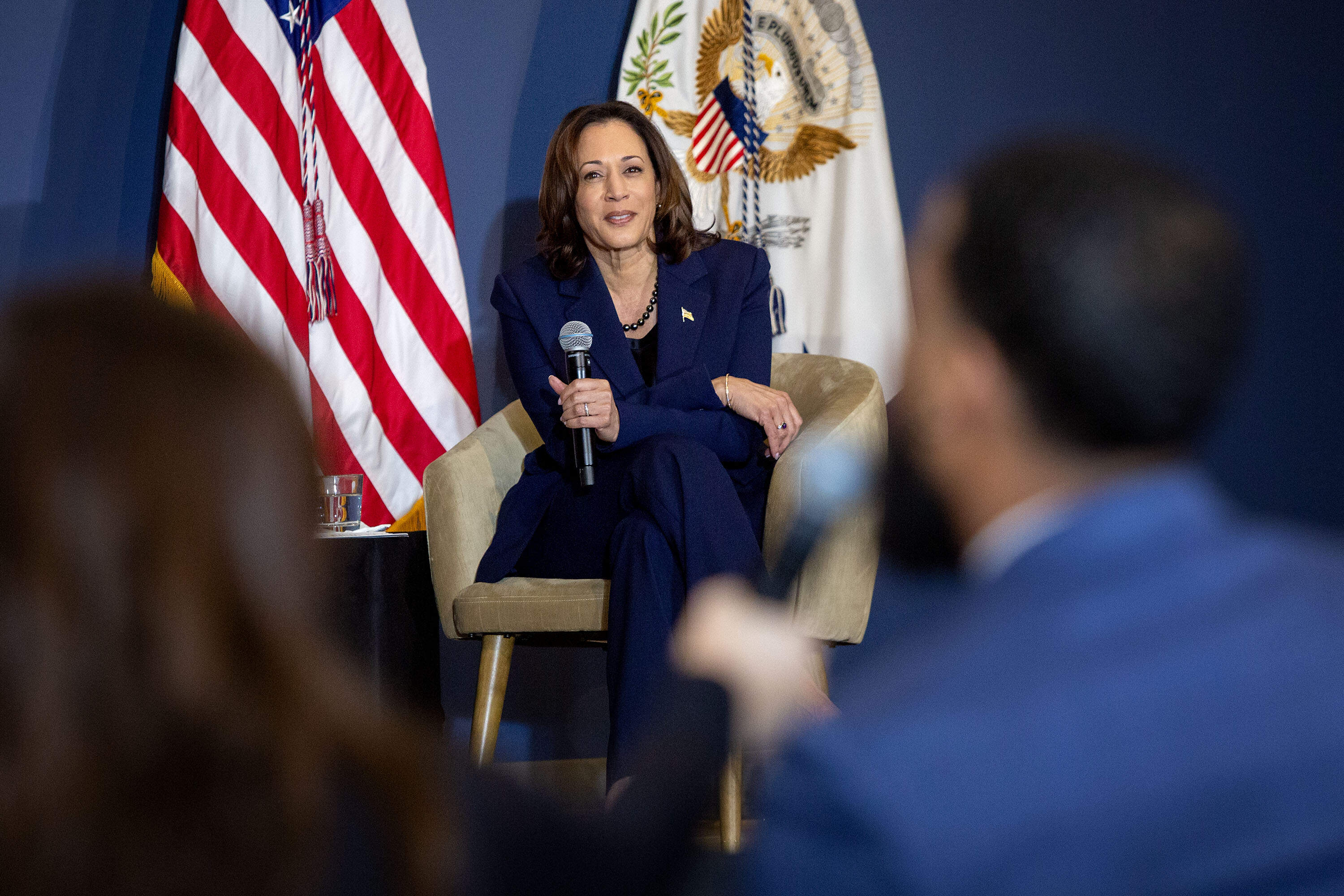
Kamala Harris is making her prosecutorial experience center stage in her presidential bid against Donald Trump.
Today, On Point: What Harris’s record tells us about who she is, what she believes, and how she might govern if elected.
Guests
Sharon Austin, professor of political science at the University of Florida.
Jasmine Wright, politics reporter at NOTUS.
LaTosha Brown, co-founder of the voting rights group Black Voters Matter.
Transcript
Part I
MEGHNA CHAKRABARTI: Political honeymoons are short, aren't they? As we're seeing, they last barely two weeks these days. Whatever honeymoon Senator JD Vance and Vice President Kamala Harris had after the national spotlight turned sharply and swiftly on them just a fortnight ago is over.
Voters will want to know what Vance, the Republican vice-presidential nominee, and Harris, the presumptive Democratic presidential nominee, really believe, and they'll want to know how these two will govern. And by the way, I have to say that Harris is the presumptive presidential nominee because it's not officially signed, sealed and delivered until she formally accepts the nomination at the Democratic National Convention, which begins on August 19th.
So today and tomorrow, what we're going to do is we're going to examine what JD Vance and Kamala Harris actually believe. Not their biographies, but their values and principles, and crucially how they've acted on those principles in their time in federal office so far.
So tomorrow it's Vance. Today we're going to talk about Vice President Harris. Now, of course, this is her second try for the presidency. Her first was back in a crowded Democratic field in 2020.
KAMALA HARRIS: We need a nominee who has the ability to prosecute the case against four more years of Donald Trump, and I will do that.
You ask them, how are you measuring the greatness of this economy of yours, and they point to the jobless numbers and the unemployment numbers. Yeah, people in America are working, they're working two and three jobs. So when we talk about jobs, let's be really clear. In our America, no one should have to work more than one job.
Growing up, my sister and I had to deal with the neighbor, who told us her parents couldn't play with us because she, because we were black.
Okay, guys, you know what? America does not want to witness a food fight. They want to know how we're going to put food on their table. (CHEERS)
CHAKRABARTI: That was Kamala Harris in the crowded Democratic presidential debates back in the 2020 race. But I should correct myself because technically speaking back then, Harris wasn't even a 2020 Democratic candidate, because her campaign never gained enough traction, and it ended almost a year before election day.
She dropped out of the race on December 3rd, 2019, two months before the Iowa caucuses and the New Hampshire primary. However, soon after that, she did, in fact, make history, becoming Joe Biden's VP pick, and then becoming the first female vice president of the United States. But again, honeymoons are short in politics.
As vice president, when people paid attention to Kamala Harris, it was sometimes because they couldn't quite figure out exactly what she was trying to say.
HARRIS: And then to partner, to ensure that we are speaking the same language, inspired by the opportunity of it all, but then doing the work of updating how we have been talking and thinking about --
Present culture is the way we express how we're feeling about the moment. And we should always find times to express how we feel about the moment. That is a reflection of joy. Cause it comes in the morning.
(LAUGHS)
And I'm talking about the significance of the passage of time, right? The significance of the passage of time.
So when you think about it, there is great significance to the passage of time in terms of what we need to do to lay these wires, what we need to do to create these jobs. And there is such great significance to the passage of time.
CHAKRABARTI: What wonders hath wrought the passage of time for Kamala Harris?
The word salad moments are suddenly gone. And in just the past two weeks, the Democratic presidential hopeful seems to have found her voice and her message.
(MONTAGE)
HARRIS: I took on perpetrators of all kinds. (CHEERS) Predators who abused women, fraudsters who ripped off consumers, cheaters who broke the rules for their own gain. (CHEERS)
So hear me when I say, I know Donald Trump's type. (CHEERS)
(APPLAUSE) And Wisconsin, this campaign is also about two different visions for our nation. One where we are focused on the future, the other focused on the past.
We believe in a future where every person has the opportunity not just to get by, but to get ahead. (CHEERS) So Wisconsin, ultimately in this election, we each face a question. What kind of country do we want to live in? Do we want to live in a country of freedom, compassion and rule of law? Or a country of chaos, fear and hate?
So friends, we have 105 days until election day, and in that time, we've got some work to do. But we're not afraid of hard work. We like hard work, don't we? (CHEERS)
CHAKRABARTI: Vice president Kamala Harris kicking off her 2024 presidential campaign in Wisconsin. And of course, now there's even less than 105 days, just 98 and ticking down. Again, the question is, at least for us, in that compressed time, what will she show voters about what she actually believes, and specifically how she would act on those beliefs and translate them into how she'd govern?
Today we're joined by Sharon Austin. She's a political science professor at the University of Florida. Her research focuses on African American women's political behavior. She's also currently writing a book on Black women and the presidency. Professor Austin, welcome to On Point.
SHARON AUSTIN: Thank you very much.
CHAKRABARTI: Also joining us today is Jasmine Wright. She's a politics reporter at NOTUS, which is a Washington based publication from the nonpartisan Allbritton Journalism Institute. Previously, Jasmine was a reporter at CNN, where she covered the White House. And she also worked as an embed in the 2020 presidential campaign, covering then Senator Kamala Harris.
Jasmine Wright, welcome to On Point.
JASMINE WRIGHT: Thanks so much for having me. Okay.
CHAKRABARTI: So let me ask both of you first, and Jasmine, I'll just kick off with you. The Kamala Harris, the vice president that we've seen in the past two weeks, from your experience with her, how similar or different is she from the Kamala Harris in 2019 and 2020?
WRIGHT: Yeah, I think that she is vastly different both in performance and I think in the small little policies that you're seeing them trickle out as they work to get their broader message. In 2019, she broke into the race as this really inspirational figure. People called her the next Obama, and she and her campaign vocally said that they would like to recreate the Obama coalition to win the Democratic primary.
But of course, that did not happen. And after she really reached a high point in some ways in the summer of 2019, people were calling her even the front runner above Biden in the race, her campaign torpedoed down for a myriad of reasons, including the inability to fundraise and fighting within the campaign and the inability to really focus on what her message is and be able to convey that to the American people.
And I think what you see now is a politician who has spent three years in the White House, really being a partner, a No. 2 to a very professional president. Biden, of course, was in the Senate for 40 years before he even entered into the vice presidency, under then President Barack Obama and to his own presidency.
So I think you've seen her study and really understand the way that that D.C. works in a way that she didn't understand before, because she had only been in D.C. for two to three years before, or excuse me, two years before running her own campaign and then of course, joining Biden's.
So I think that's a vastly different person from what I see with my own eyes. Of course, when you talk to her own aides or when I do, they say that they see a different politician, but the question is going to be, how does she keep that momentum going? And I think that's something that they're trying to answer right now behind the scenes.
CHAKRABARTI: Absolutely. So Jasmine, I'm going to want to hear a lot more from you over the course of this hour about again, what you've observed and what your sources have told you about, in a sense that I don't want to, I don't mean this in a pejorative, but the understudy role that vice president Harris had being one step away from the Oval Office with Joe Biden, particularly as president.
So we're going to talk about that in a second, but Professor Austin, I would love to get your view on that same question from the perspective of someone who is outside of political reporting, but looking at politics as a whole, as a professor, do you see a different Kamala Harris now than you saw in 2020?
AUSTIN: I think she stands for the same issues that she stood for when she ran for president before, but I think I agree that she has learned from her mistakes of 2019. Even then, as Jasmine mentioned, she was doing well at first, but the problem was her inability to raise funds. But now just in this past week, she's raised a ton of money from different sectors, different communities.
And so I think just with that fact alone, she's showing that she has broad based appeal. And I think she learned from her earlier loss when she was running for president, just the need to really just appeal to everyone, because a lot of people are going to try to paint this as if it's something in which a lot of African Americans are going to vote for her.
And that's the group that pretty much is the only group that's going to turn out in large numbers to vote for her. But that is certainly not true, from what I've been seeing. I even have sat in on some of the conference calls, like women for Harris and with Black women for my research to see what they were saying.
And in that time, I have seen just people from all backgrounds and ethnicities, and especially the fact that she now can invigorate young people who were pretty much turned off by the Biden administration. So I would say that she's changed in the sense that she's learned from her mistakes, but she's the same in the sense that she is now promoting the same issues that she promoted when she was in the U.S. Senate.
CHAKRABARTI: Now, Professor, I may have misheard you, so please correct me. But did you say that, I'm paraphrasing here, that even now there wasn't necessarily a guarantee that Black voters would turn out en masse for Vice President Harris? Or did you say the opposite, actually? Forgive me.
AUSTIN: I said that there was an assumption that African Americans would be the only group that would turn out in large numbers to vote for her. And that's not true, because I'm here in Florida. Just recently, there's an area called the Villages, which is a retirement community for seniors, middle class, upper middle class predominantly white.
And they just had a big fundraiser for her there. And they tend to, Florida is a really tricky state. Because like most states, there are blue counties and red counties, and the Villages is thought to be more of a red community, mostly Republican. But even they had a big fundraiser for her. And that shows that her campaign is appealing to seniors.
But I said earlier that it was assumed that African Americans would be the only group that would turn out in large numbers, but it doesn't look like that's going to be the case. She's appealing to people of different races and ethnicities, younger people, seniors, and et cetera.
Part II
CHAKRABARTI: Professor Austin and Jasmine Wright, let's go through some of the major issues that are front and center in the minds of Americans this election cycle.
So first and I guess not first and foremost, but one of the bigger ones is of course, immigration. This one is immediately a point in which Republicans are attacking Vice President Harris on, in part because back in March of 2021, President Joe Biden appointed Vice President Harris with a quite important position regarding immigration.
Now specifically, Harris was charged with leading efforts with Mexico, Guatemala, Honduras, and El Salvador to manage the flow of unaccompanied minors and migrant families arriving from those countries. I will admit across journalism, that was simplified in 2021 as Vice President Harris being the southern border czar.
And which is not entirely accurate, that has though haunted her. And for example, here's an interview with New York Times reporter, Astead Herndon, just back in November and Astead talk to Vice President Harris about her work on immigration. And here's her response.
HARRIS: Okay. So let's start with the work that I've done and the work that I've done has been to focus on the root cause issue.
So not the border issue, but why is it that people are leaving, and to address those issues. And I come at that from the following perspective. Most people don't want to leave home. Most people do not want to leave home. They don't want to leave the place where they were raised. They don't want to leave their grandmother.
They don't want to leave the church where they grew up in. They don't want to leave their community or their friends. And when they do leave, it usually is one of two things. They are fleeing harm, or they simply cannot satisfy the basic needs of themselves or their family if they stay.
CHAKRABARTI: That's Vice President Harris speaking to Astead Herndon of the New York Times back in November.
Jasmine, I think it's clear that that Vice President Harris has a solid sense as to what she believes needs to be done regarding the root causes of migration from especially Central America. But I think most Americans who are thinking about the border issue now are literally thinking about it in terms of what is happening at the U.S.-Mexico border. Do you have some insight on what the vice president actually believes about what needs to be done to reduce or control the flow of undocumented immigrants trying to cross the border?
WRIGHT: I think what you've heard from the vice president's office as she has launched her campaign is that she is going to stay with what the Biden administration has done. Of course, championing that bipartisan legislation that would have impacted the border greatly, that they believe was torpedoed by former President Trump.
That's going to be a case that she makes over and over again. I think when she is confronted with these accusations, that she was the border czar and I think also that she's going to really follow the line of what the Biden administration did, particularly because as we know, border crossings and all of those things at the border are down right now.
And it has led the administration to feel like they've been doing what is right. But from day one, they called on Congress to step in and formally change what is happening at the border, to lessen the pressure on the border and lessen migration. But I think just going back to the foremost point that she is not incorrect in that interview that she gave to Astead because she was not tasked with the border.
She was tasked with figuring out the root cause of migration in diplomacy in Central America. Now that is a mouthful and I don't think it ever translated that to that, particularly because Republicans from March 2021, after Biden gave her this issue, that again, he dealt with similarly when he was vice president to then Barack Obama.
Republicans were very good at making sure that was a political loser for the vice president, and it's something at the time that I reported on, that her office was adamant that they did not want on her portfolio. Because they felt like it would be such a big deal. Fast forward to now, of course, it is one of the main issues that Republicans continue to whack the vice president over again and again, this relationship that she had potentially being the border czar, as they say, her office says that they weren't.
So I think that this is going to be an issue that continues to follow her throughout November. And then even if she is successful in November while in office, just because this is something that President Biden wanted her to do, something that at the time her aides did not want her to do.
And they felt like potentially the West Wing wasn't thinking about how it would play right now. But of course, it happened. And this is something that she's stuck with.
CHAKRABARTI: And of course, being charged with doing what one can to stem root causes of migration in other countries. Even if you were wildly successful, that is not a problem you'd feel the effects of a solution for many years.
Definitely not within a presidential election cycle.
WRIGHT: Oh, I was just gonna say, and I think if you look at back to what she had done in office on that issue, it was things like expanding Wi-Fi and broadband in some of those regions. It was things like private and public partnerships with major corporations like Coca Cola to get more funds and to start small businesses, to enrich like coffee farms and things like that.
So her actions were very much so focused in that region and not on things that would happen on the border. But again, I think that this is an issue that's just going to continue to follow her.
CHAKRABARTI: So professor Austin and there's no doubt that issues about the border will continue to follow whomever is in the White House.
After the November election, but particularly for a Democratic nominee, it's an extremely thorny one, right? Because Jasmine's right, right now, border crossings have gone down, but basically between 2021 to the end of 2023, they were on the rise. And we did several shows on how as many of those migrants were then moved to Northern cities, we looked at Chicago for example.
In fact, in those places, it was Black residents who were particularly concerned that resources that should have gone to their communities were being used to handle the migrants coming in. So I'm just wondering, like, how do you see Harris, the border and migration in terms of her potential pitfalls as a presidential candidate.
AUSTIN: I think the border issue is going to be the most troubling issue for her. Simply because even during the assassination attempt, that's what Donald Trump was talking about. Some of the data that he's been showing is basically false, but the problem that she's running into is that when your opponent makes an accusation, it doesn't have to be true.
He just has to convince people to believe that it's true. And the common belief is that the Biden administration dropped the ball on the issue of the border. And as Jasmine said, the border crossings have come down, but nevertheless that is an issue that she was sent. It was said that she was the border czar, we now know that wasn't necessarily true, but that's what a lot of people believe.
So this is going to be a really troubling issue for her. But I think that the more she gives interviews and she appears at rallies, but especially when she starts giving more media interviews and when she clarifies her positions on the border. And also, if and when hopefully this will happen, that she debates Donald Trump, she'll be able to address a lot of those allegations and bring out the facts. Because a lot of people do believe that she was the border czar and there were a lot more border crossings under the Biden administration.
And now those border crossings have gone down, but a lot of people are still looking at her and pointing the finger at her for not handling that situation correctly.
CHAKRABARTI: Jasmine, let me turn back to you on something. Because I think you said that as far as we can tell thus far, Vice President Harris says not only is she aligned with what the current policies of the Biden administration are, but that perhaps she would continue to advance them should she be president.
To be clear, I think it was back in February. Biden promised to quote, shut down the U.S.-Mexico border. If Congress had passed that immigration compromise, that a bipartisan group of senators had been working on, of course, that never happened, right? As you mentioned, that immigration bill just died a sad death.
But the fact that the president even promised to shut down the border was quite a different tone than he had taken on before. So do you know, do you get a sense if the vice president was aligned with that?
WRIGHT: Yeah, I think it shows just how serious that the issue was at the time and how politically damaging it was for the president.
Again, I think that the vice president didn't want to get anywhere near the border issue, particularly because of those border czar accusations or labeling her of it. So really the president was handling the issues of the border on his own, because that in the vice president's office view, was not her domain.
She was handling the root causes. Now, I think you could very well argue that whatever the president was doing for the most part of those three years in office, the vice president was, as his partner, behind and supportive and was never going to publicly distance herself from. But again, I think that they were very clear and very careful throughout those three years to make sure that she didn't really have, she couldn't be accused of being the border czar, even though it so happened, because she wasn't working on the border.
Now, in terms of going forward, we know that she is now back the Biden administration's budget request for increasing funding for border enforcement. So I think that's important. It's just going to be an ongoing conversation of how closely she sticks to what President Biden did in the last year on immigration and whether or not she distances herself from it is, I think, a question to come, she is his number two and she, her mentality throughout this whole three years is that she's wanted to be loyal, supportive of Biden.
If she had any problems, she wanted to voice them privately. And I don't think that I, at least from what I've heard, that there was any major differences on her opinions and how the White House was handling the border issue at the times when it was so severe.
CHAKRABARTI: Okay. Okay. That is good to know.
So let's move on to criminal justice, right? Because this is a really interesting part of trying to understand the vice president's beliefs. Because of course, a major part of her career was as attorney general for the state of California. And she is now making that prosecutorial experience a major part of her 2024 race.
But of course, back in 2020, it was something of an albatross for her, because many progressives were quite critical of her tough on crime stance as a California AG, including her crackdown on truancy when she was Attorney General of California.
HARRIS: Last year alone, we had 600,000 truant students in our elementary schools, which roughly matches the number of inmates in our state prison system.
And is it a coincidence? Of course not. And as unacceptable as this problem is, I know we can fix it. In San Francisco, we threatened the parents of truants with prosecution and truancy dropped 32%. So we are putting parents on notice. If you fail to take responsibility for your kids, we are going to make sure that you face the full force and consequences of the law.
CHAKRABARTI: So that was Kamala Harris as Attorney General for the state of California. Professor Austin, talk to me about your thinking on how you've seen Kamala Harris on criminal justice issues. Is this another point of evolution for her, or once a prosecutor, always a prosecutor?
AUSTIN: I would say it's a point of evolution, but it all depends on how the public perceives her.
She calls herself a progressive prosecutor, but a lot of progressives even now are still hesitant about supporting her because of some of the actions that she made during the time that she was both the prosecutor and California Attorney General. Especially the fact that her office didn't really, they didn't endorse a bill back in 2015 to investigate police shootings.
There was another issue that involved body cameras and there could have been a law to mandate or to require that police officers wore body cameras, and she didn't support that. And there are some other things as well that are very troubling in her background. And that is something that I think the Trump campaign is going to bring forward, because now she is thought of as a progressive.
She just recently got an endorsement from the progressive caucus in Congress. But as a prosecutor, that's the type of job that it is. On one hand, it could work against her. When people look at some of the things that I've mentioned, but in a way, it could also work to her advantage, because there's a stereotype that women are soft on crime, and she was anything but when she was a prosecutor.
And then as far as the truancy issue, that was something that as the clip just said, truancy went way down because children were not attending school and she threatened to prosecute the parents if they didn't send them to school. And as a result, they started doing so. So in a way, it could work to her advantage because she can show that the stereotype that we have of women as being soft on crime and not really knowing what to do, she is not like that.
So I guess it could work both to her advantage and to her disadvantage.
CHAKRABARTI: Now, of course, to state the obvious, in 2020 it was the country was still roiling in the aftermath of the murder of George Floyd and policing, criminal justice, racism reached and the nation's engagement with these important issues reached a fever pitch.
Professor Austin, do you see things, as the questions around criminal justice, being a little bit different now than they were in that particular moment in 2020?
AUSTIN: I would say yes, because in 2020, as you mentioned, there was a lot of a focus on racial justice after the murder of George Floyd.
And it was more of an enthusiastic effort to try to look into racial justice and to find the root causes of it than I've ever seen in my lifetime. But now that's sort of fallen by the wayside. And now we don't really hear very many people talking about racial justice, nearly as much.
Although we do hear it somewhat with Sonya Massey, the African American woman who was recently murdered in her home by a police officer. But it's not the same type of energy. The same type of fever pitch that we saw in 2020. So I think that now there's not as much of a focus on racial justice.
If anything, there's been a backlash with all of the anti DEI movements. Even she has been called a DEI hire, legislation in different states that are being passed to regulate and mandate the way that you talk about race, removing books and that type of thing. So now we're in a totally different type of climate than existed in 2020.
CHAKRABARTI: Jasmine, we've got a minute before the next break here, but I'd love to hear your thoughts on Harris and criminal justice.
WRIGHT: Yeah. I think back in 2019, if you go back and look at the timeline, it was either right before or right after she announced her candidacy, a big op-ed about her time as attorney general came out.
And it totally made them back away from her prosecutorial record, which I would argue is what is so central to her, being a prosecutor. That's the way that she thinks. And that's the way that she operates. And that's the way that people knew her the best. And so it befuddled us in 2019 when she did that. But of course, now 2024, it is something that is paramount on her list of attributes that she shows to people, particularly when she takes on Donald Trump. And so I think it'll be interesting to see how far that expands and how far that evolves. But I would agree with the professor that it's not so much the vice president that has evolved on her own record, but the American --
CHAKRABARTI: Just a second here, Jasmine, we've got to take a break.
Part III
CHAKRABARTI: Professor Austin, we've got to let you go here in just a second, but I wanted to ask you one last question, and that is, of the major issues that a president must address as a leader of the American people, is there any particular issue that you haven't yet heard enough from Kamala Harris on, and that you yourself don't fully think you understand?
What she believes about that issue and would want to know more about.
AUSTIN: I would say that the economy, she needs to focus more so on Joe Biden's successes during his term in office, because if she is saying that she's going to continue Biden's policy, Donald Trump's gonna attack her on that.
Because he is trying to paint Joe Biden as a failure when it comes to the economy, but he has a relatively successful record. And so I think that she really needs to, instead of all these attacks back and forth, she really does need to tell people more about some of the things that Joe Biden achieved in terms of the lower unemployment, as far as reminding people of how things were during the pandemic.
And he was able to bring us out of that. It's as far as inflation going up, but then passing the Inflation Reduction Act. Which is bringing inflation down and those types of things, because I think that's what people are more concerned about, not so much the insults or the jokes or that type of thing.
But I think people are more concerned with the fact that how is she going to make it so that we will have jobs and prosperity in this country. So I think she really does need to focus more so on those types of issues.
CHAKRABARTI: Sharon Austin, Professor of Political Science at the University of Florida, currently at work on a book about Black women and the presidency.
Professor Austin, it's been a great pleasure. Thank you.
AUSTIN: Thank you for having me.
CHAKRABARTI: Now, I'd take Professor Austin's point very well, because the specifics on what Kamala Harris believes about how a Harris presidency would improve the economy, those specifics are not yet forthcoming. But just like every other presidential candidate, Republican or Democrat, for the past many decades, she has talked about her focus on the middle class, even as far back as 2012, when in that year's Democratic National Convention, Attorney General, then Attorney General Kamala Harris was speaking in support of Barack Obama's reelection.
She was talking, she talked about the housing crisis and similarly, as she's doing now, in her presidential bid back in 2012, she talked about the middle class.
HARRIS: The fact is, we don't have to guess what Mitt Romney would have done if he were president, because he told us. He said we should let foreclosures, and I quote, hit the bottom so the market could, I quote, run its course.
That's not leadership. Doing nothing while the middle class is hurting. That's not leadership. Loose regulations and lax enforcement. That's not leadership. That's abandoning our middle class.
CHAKRABARTI: That was Kamala Harris back in 2012. Joining us now is LaTosha Brown. She's co-founder of the voting rights group Black Voters Matter, and she's with us from Atlanta, Georgia.
LaTosha, welcome to On Point.
LaTOSHA BROWN: Thank you for having me.
CHAKRABARTI: Okay, so give us your view of right now about in your work in terms of supporting Black voters and getting out the vote. What do you think the questions are that they may have, that they would like Kamala Harris to answer about how she might be president?
BROWN: I think there's been a, I think it's been a game changing moment. There's been 180 degree change in terms of people's attitude and even interest in this election early on in the year. As we were going through all the states that we work in, people, there were some that said that they were committed to vote, but there was no energy.
And then there were others that were saying that they were in this state that they didn't know if they would vote or not, if they would be moved to vote. And then some were very critical of the Biden administration, because of the war in Gaza. However, what I've seen in the last week, I could not have imagined in the last two weeks, where there has been a complete shift in many of the people that I've spoken with, that there's an air of excitement, there's an air of interest.
And then I think that there's a lot of intrigue around and curiosity. I think the curiosity around who she is as a candidate, how will she govern? But there's also in the backdrop of recognizing this thread of Project 2025 and this Trump ticket. And so when I've been talking to people, there've been three things that they're really concerned about.
The first thing is really around economic security. I think we underestimate how much economic anxiety that people felt during COVID, that coming after COVID and out of COVID, it shook us, it shook working class people, it shook most of us in terms of feeling this sense of job security. And that seems like it's on the top of, the forefront of people's mind. The second issue that comes up consistently is around criminal justice reform. There's still a need and demand that many, there was a whole generation of voters who were activated in the George Floyd uprisings, which ultimately, I think led and right before the 2020 election was a factor in the 2020 election.
And so while it's interesting, there has been some concern around wanting to have that legislation that really holds people, the police more accountable. And I think that's still a really core issue that I do believe that people want Vice President Kamala Harris to speak to.
But I think the interesting thing is I think that there's a much broader understanding of her record as prosecutor. And even now, I think there's been a change that where before, it was seen as a negative as I've been talking to Black voters, particularly older Black voters. But as I've been talking to Black voters, they actually see that role, particularly of who she's up against.
This former president who has 34 felony convictions, they actually see it as additive. That the best way in terms of in this race, that there's a stark contrast between she and former president Trump. And so it's really interesting to see how that plays itself out as well.
I think the other piece though is interesting. In the last three years, what we've seen from the administration we've also seen the DOJ that when you look at some of the, like the Ahmaud Arbery and some of the other Breonna Taylor cases, those were not cases that the police were held accountable by the state.
Or state administrators, they were actually federal cases. It was under the Biden-Harris DOJ, the Department of Justice that actually prosecuted those cases. And I actually think that can work. I think that works in her favor. I think that's something that I think she should lift up.
And I think the campaign should lift up that there has been, while there's not been comprehensive criminal justice reform in that way, that there's also, what we've seen is we've also seen police accountability, leadership of that, and these states and these horrendous murders of Black people by the police actually be led out of the Harris-Biden DOJ.
CHAKRABARTI: Okay. Okay. So three really interesting points there, Jasmine, let me turn back to you because going back to what LaTosha Brown just said about the economy. Because look, that's the number one issue for all voters and it takes particular importance for voters who don't feel economically secure.
And it was really interesting to me, because when I was going back and listening to Harris from 2019, 2020, at the very top of the show, there was a little clip that I put in there. Where she was criticizing the Trump administration for talking about how many jobs had been created in the Trump administration.
Cause she said clearly that doesn't mean that people are secure because they might have to work two or three jobs to get by. That was Harris in 2019. Now, president Joe Biden talks incessantly about the huge numbers of jobs created in his administration, which then would include Vice President Harris as part of that administration.
So how do you see her navigating that, because wouldn't the same criticism hold that you might have a job, but it may not help you get by?
WRIGHT: Yeah, I think that she's going to tout the positive parts of the economy that President Biden was able to create after the pandemic. Jobs will be a part of that.
A huge part of that. Of course, President Biden has a lot of success in creating jobs. And it's something that the vice president has talked a lot about, and very proudly of, other points of the economy that She'll be able to tout as well. I think that she'll stay far away or try to stay far away from inflation.
But to take a step back, if you really think about her platform in 2019. When it came to the economy, a lot of it focused on the care economy, how people take care of both their children and their elderly parents, how people get tax breaks for having children. Or being able to put their kids in preschool, one of her first policy platforms that she put out in 2019 was to give teachers a $13,000 raise. And so those are some of the things that she has also taken with her in during her vice presidency.
Obviously, she's talked about bills that help parents who deal with both children and elderly people or their elderly parents. She's talked about bills or basically creating pathways for small businesses to get more money from the federal government, really trying to utilize those private and public partnerships with larger corporations to help in that effort.
She's worked very closely with the Treasury Secretary Janet Yellen on some of those SBA loans. And community funds to make sure that Black owned and brown owned businesses have more access to capital, have more ability to actually create themselves. And so I think that those are all things that she is going to bring with her as she makes her case to the American public.
Now, these type of messaging points are still in the works, still really under construction. I was talking to one source last week who said that they were building the plane as they fly it. And so I think we're going to see little droplets of things that she wants to do. Of course, whenever she sits down for that big interview, she's going to have the chance to lay out exactly how she sees her economic argument, particularly going against Trump. But I think for what the Biden administration has done, they have racked up a lot of records, a lot of success, particularly when it comes to the lower unemployment rate, when it comes to people of color and all things like that, Black unemployment rate.
So she has a lot of things to tout. The question is, and I think one of the critiques against Biden in this race was that they would continuously talk about the economy and how great it was. But people weren't feeling it in their pockets. And that was that divide. But she has a chance that she doesn't have to adopt that, because she was not the president.
She was a vice president. So she could take all the good things without having to shove down people's throat that it's so good. It's so good. I don't understand why people don't feel that way. And say, Hey, this is what we were able to do. But this is also what I want to do going forward.
CHAKRABARTI: Yeah, no, I think that's a really good point.
No, go, yeah, go ahead. LaTosha.
BROWN: There's a couple of other points that I think people, to the point, I agree. I think that she has an immense opportunity. Now we have less than a hundred days, but I think there are some key pieces, particularly to communities of color, poor and working class communities.
One of the big pieces, what we know is the number one driver for bank rupture in this country has been medical bills. And so just in June of 2024, this year, she announced this effort to ban medical debt on credit reports. That is a game changer for many people, around literally for women and people of color, who are more likely to struggle with debt than their white and male, white and male counterparts.
And so I think that's a huge shift that needs to be lifted up. I also think that when you're looking at the care community, particularly women of color, many of us are, in addition to our jobs and the things that we do, we also are caregivers. And so actually having this care economy, one of the things that she did in April, she actually announced that there were going to be these two rule changes that would improve long care, and the support of the economy.
One of them was specifically around elder care and the crackdown on nursing homes that were being abusive or not literally taking the health and wellness of its residents. And one improves home care for seniors and people living with disability. Those are two major pieces. And I actually think they're really reflective of why it's important, and what an additional perspective of a woman candidate brings, that we bring our full families. That as we are leading, we don't have the luxury just to lead at for ourselves.
We lead, we bring our families, and I think you're seeing that kind of leadership and what we've seen even with the Biden administration, including the student debt. So I think looking at everyday folks, working class folks in poor communities, and figuring out how they can also share part of the American dream. I think that's really important. I think that's a message that she actually has an advantage of that she should use on the campaign.
CHAKRABARTI: LaTosha, we only have one minute left and I just want to point out, and this better than anyone, that Black voters across this country have historically felt a great deal of disappointment with many of the candidates that they rallied behind. Because Democrats specifically turned to Black voters every four years.
And say, I'm going to do the best I can to help the Black community, but then when they get into office, many times those same voters feel very disappointed about having essentially been forgotten or the promises not being kept. Doesn't vice president Harris face that same concern from Black voters this time around, regardless of the current energy around her campaign, we've just got 30 seconds to go, unfortunately.
BROWN: So the answer, the short answer is yes. I also think that the electorate has shifted. The landscape has shifted. I think people are looking at policy more than they're looking at personality. And so while there's a personality call on the other end, I think people are looking at what are progressive policies.
And I think that she has a record that she can stand on.
This program aired on July 30, 2024.