Support WBUR
The solution to anti-tourism: Don't travel less, travel better
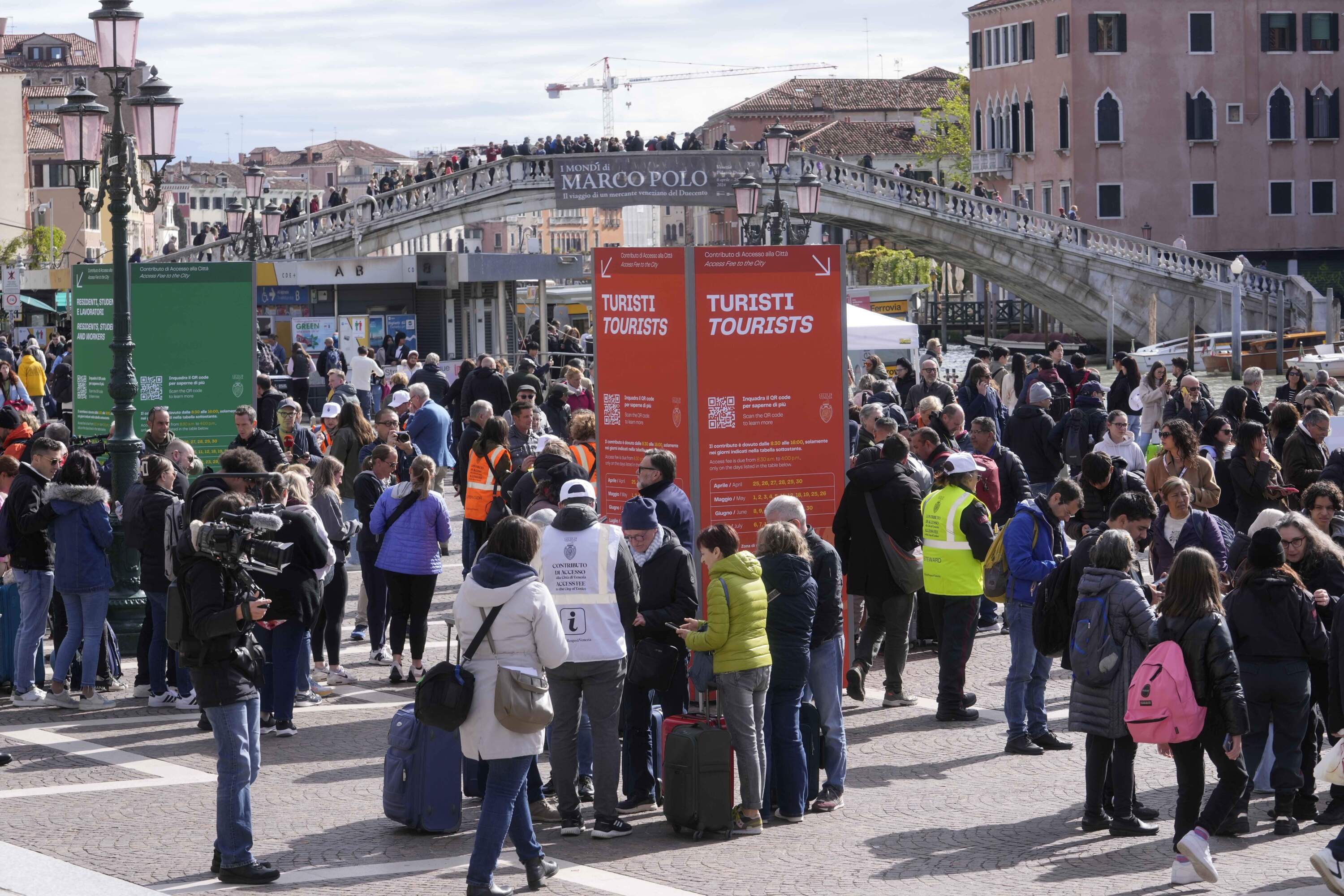
Anti-tourism protests spread around the world this summer. Some cities are charging tourist entry fees, banning cruise ships or imposing fines for bad behavior.
Some say the solution to the world’s growing wanderlust isn‘t for people to travel less, but to travel better.
Today, On Point: How to achieve the right kind of tourism.
Guests
Paige McClanahan, American journalist and author based in France. She primarily focuses on tourism and the world of travel for the New York Times. Author of "The New Tourist: Waking Up to the Power and Perils of Travel."
Also Featured
Simone Venturini, the tourism councilor of Venice, Italy.
Mikkel Aarø-Hansen, CEO of Wonderful Copenhagen, the tourism organization of the capital region of Denmark.
Transcript
Excerpted from THE NEW TOURIST by Paige McClanahan. Copyright © 2024 by Paige McClanahan. Reprinted by permission of Scribner, a Division of Simon & Schuster, LLC.
Transcript
Part I
DEBORAH BECKER: If you're traveling this summer, you're not alone. Hundreds of millions of Americans travel the weeks between Memorial Day and Labor Day, maybe to see loved ones who don't live nearby or go to a part of the world that's new, or just to get away for a change of scenery.
But tourism is facing something of a backlash with recent anti-tourism demonstrations in places around the world, such as Barcelona, Athens, Amsterdam, Venice, the Canary Islands. So we asked our On Point listeners how they feel about living in a popular tourist destination. We got a lot of responses.
Here's a collection of them.
(LISTENER MONTAGE)
I live in Charleston, South Carolina, and it is overwhelming the number of tourists that we have. Not just in the summer season, but all year round and you can't even move downtown. I don't even know why they enjoy coming, because you can't get anywhere. It's very sad in a lot of ways because it's ruined our city.
In Moab, Utah, our tourist economy was growing organically and slowly and then the state over promoted tourism in our area. The result was that hotels were overbuilt and now many of the rooms don't fill.
I live in Washington, D.C. and I really find the whole tourist thing cool having all these people from all these places visit where it is that I live.
I have lived on Maui. And I've also lived in Juneau, Alaska. Tourists just walk all over the place like it's Disneyland, and they don't really take any consideration for the local people.
Savannah, Georgia is definitely a tourist destination, especially for a lot of bachelorette parties. But for the most part, it's been a lot of fun to meet tourists who need directions. Or have them around, and it affords us more chances to have nicer restaurants and concerts and things than we would have for this size of city.
None of these places are the same since they've become popularized. I just wish people would understand that what they share online impacts the areas negatively that they wish to visit.
There's a lot of concern about what Jackson Hole has become and what it will be. And if that type of visitor who wants to commune with nature, wants to have some solitude, wants to slow down and do anything more than take a photo of a famous place, and if that will ever come back.
Tourism is a very important source of income lifeblood really for places like Honolulu. But the caveat is we just need to be respectful visitors when we go to other people's places where they call home. Maybe a vacation for some people or us when we're visitors, but we have to remember that's someone's house and someone's home and they have to live there 24/7. So we just need to be respectful.
BECKER: Those were On Point listeners Kim Rogers of Charleston, South Carolina, Rachel Nelson of Moab, Utah, Danny Williams of Washington, DC, Tamara McCorkdale of Weeki Wachee, Florida, Christie Odom of Savannah, Georgia, Pamela Cornell of Jemez Springs, New Mexico, Brian Bultema of Jackson Hole, Wyoming, and Sean Nakamoto in Denver, Colorado.
As we said, a lot of response from our listeners. And as one of our listeners mentioned, tourism can be a lifeline, but others say it can also cause a lot of damage. So we want to take this hour exploring what is the right kind of tourism and how can we all become better tourists.
We're joined today by Paige McClanahan, an American journalist and author based in France. She focuses on tourism and the world of travel in her writing for the New York Times. She's also author of the new book, The New Tourist: Waking Up to the Power and Perils of Travel. She joins us from Paris. Welcome to On Point, Paige.
PAIGE McCLANAHAN: Thank you, Deborah.
BECKER: What do you think, when you heard that mix of reaction from our On Point listeners, about what they think tourism is doing to their communities, what do you feel about those reactions?
McCLANAHAN: I think it just goes to show that tourism has touched every part of the world. It's this vast phenomenon.
We think of tourism as an industry. It is. And it's so much more than that. I really see it as a vast and potent social force. It's changing our cultures. It's changing our economies. It's changing our physical environments. And as you can hear from the listeners, it's really having an impact on so many people's daily lives.
And I've experienced this personally, as well. I've seen it in my journalism, but also in 2018, I moved with my family to a little village in the French Alps that's completely dependent on tourism. And it was moving to that village in 2018 that really got me starting to think about just how important tourism is.
And I was looking in the media and reading what I was reading about tourism. I just didn't think that it was getting the scrutiny that it deserved, from a positive and negative aspect really, because it's so important. Tourism can do a lot of damage, as we've seen, if it's not managed properly.
But I think that if we could really harness the power of tourism, it can be a really powerful and constructive force for good in the world.
BECKER: You write about that most of us probably think we're travelers, not tourists. And I thought that was pretty accurate. Can you explain?
McCLANAHAN: I think, thank you so much for that question. I think there's a lot of stigma around the word tourist, right? A tourist, I'm not a tourist, I'm a traveler, the tourists are all the people standing in line ahead of me waiting to get into the Louvre, right? And one of the aims of my book was really to try to shake loose some of that stigma because I just really don't think it's helpful.
I think if we see tourism as something that only other people do, if we don't own it ourselves, then we won't implicate ourselves in everything that's wrong with tourism. Because of course, tourism can be really destructive, but it can also be really constructive. It can be really positive.
And if we own tourism, if we accept our identity as tourists, then that really just gives us the chance to shape this powerful force and transform it into something that can do, I think, a lot of good in the world.
BECKER: And has, but certainly as we heard from our listeners and as we've read about, we've certainly all seen the headlines about the demonstrations against tourism.
Has it gone off the rails and how do we know how to bring it back, at least in those areas where it seems to have caused a great deal of damage?
McCLANAHAN: Yeah, certainly. Tourism is growing really fast. It was growing before the pandemic of course; we saw the complete collapse of tourism during the pandemic.
And now coming out of the pandemic, it's growing faster than ever. And with that growth is going to come a lot of headaches. There's going to be problems. And it's important that we continue to work on that as tourists. And that, we as members of the voting public, that we pay attention to this.
And it's important that the governments pay attention to this, as well. And I really hope that governments in places that receive a lot of tourists are paying attention and remembering that even as they're spending a lot of money to attract tourists to their cities. That they're also prioritizing the needs of their residents.
And I just want to say that for every headline that we see about the negative aspects of tourism or clashes between tourists and residents, there are literally a dozen, more than a dozen other places, other cities that you're not reading about in the news, that are working as hard as they can to get as many tourists as possible to visit, to come.
There are so many places that want more tourists. And I think in Spain, we're seeing a huge growth in tourism and it's really boosting the economy. Tourism is driving Spain's economic growth at the moment. That's coming with some headaches that governments need to listen to and need to respond to really proactively.
BECKER: And of course, you said you live in a community that's completely dependent on tourism in the French Alps, right?
McCLANAHAN: Yes, that's right. Actually, so I was in this little village for five years, 2018 to 2023, but last year moved to Paris. Of course, another major tourist destination, especially at the moment for the Olympics.
But the five years I spent with my family in that little village, it really just gave me this other perspective. Because this village, without tourism, it would have become a ghost town probably by the sort of '60s and '70s. The only other thing going on there economically was really farming and a little bit of stone masonry.
But now, the village welcomes skiers and winter and hikers and mountain bikers and rafters in the summer. And it employs almost all of the parents that my kids, the school that my kids went to in the village. And it really brings a huge amount of cultural, just energy and social life to this village in a way that really benefits the lives of the people who live there.
In a way that I really benefited from the fact that tourism was such a big force in this village. At the same time, sometimes I sat in bumper-to-bumper traffic, in the middle of a Saturday afternoon, just trying to get back to my house from the grocery store with the groceries melting in the back of the car.
Because the two-lane road that leads to my house also leads to a very popular hiking destination at the end of the road. So I lived with the headaches as well. But also really saw it from a very personal way, the immense constructive power of tourism in that community in particular.
BECKER: As well as the destructive power, right? So we have to figure out how to strike a balance, especially in areas that can be over traveled. So you came up with a term in your book that I think is interesting and I hope you can explain it. And we'll get into some of the history, which I think is really the context of why so many people travel and why things have become so crowded and undated with visitors.
We'll talk about that in a minute, but I wonder if you could explain first this difference between the old tourist and the new tourist and why you think that's important.
McCLANAHAN: Thank you so much for that question, Deborah, because this is really one of the main points that I want to make in the book.
And I got the idea for this Old and New Tourist, it was really in reading an excellent essay that was published in the New Yorker in June 2023. And it was written by a very celebrated and incredibly respected philosopher named Agnes Callard. And she wrote this essay in the New Yorker called The Case Against Travel.
In that essay, she defines tourists, she calls them unchanged changers, right? An unchanged changer. Somebody who goes to a place and inflict their presence on the place and comes home completely unmoved by the experience. And I read the essay, and I really appreciated her, so much of what she shared in that essay and so much of what she shared in that definition of the unchanged changer.
And that for me is what I think of as an old tourist. So this is somebody who is a pure consumer, who probably sees themselves as superior to the people or places they're visiting. And who comes and inflicts their presence on the place in a manner in which they're really not even aware of how they're changing the place that they're visiting.
So if we use that as our starting point for what is an old tourist, I say, there are plenty of old tourists in the world. Like each of us has probably been an old tourist ourselves at some point in our lives. But I think that so many of us have been and so many of us can be something very different and something much, in my opinion, much better.
Part II
BECKER: Before the break, Paige, you were talking about the old traveler versus the new traveler, the old tourist versus the new tourist.
You had said that the old tourist is someone basically unchanged by their experience, really, and who may not be completely respectful of the places they visit versus the new tourist who is traveling. Who's the new tourist? Who's going?
McCLANAHAN: So I think of the new tourist as a changed and enlightened changer.
If we move away from the unchanged changer, the changed and enlightened changer. So first of all, enlightened, a new tourist is somebody who takes the time to really learn about the challenges that the place they want to visit is experiencing. Whether that's related to tourism or otherwise. And they're very aware of the fact that their presence on the place is going to change the place. We can't visit a place without having an impact on it.
But the new tourist is somebody who takes the time to inform themselves about what that impact might be. And then makes decisions that are gonna minimize any negative impacts and maximize the positive impacts of their presence in that place. And so to go back to the changed aspect, so we need to be changed by our experiences as tourists, and that means opening ourselves up to the experience.
It means traveling with a huge amount of humility and modesty and curiosity. And it means really seeking out human connections when we travel. It means making sure that we don't see ourselves as superior to the people or places that we're visiting. And it means traveling really with a view to having our minds changed.
Because as the great Rick Steves likes to say, one of the most beautiful gifts that we can get from travel is a changed perspective.
BECKER: I wonder though with so much money on the line, could the search for a changed perspective or just a change in general, could authenticity be compromised to try to give that change experience?
So it's not actually that experience. Do you understand my question?
McCLANAHAN: I think I understand what you mean. I think I want to be really careful around the word authenticity or the idea of having an authentic experience, because if we're going to a place and we're just trying to live the life of a local, that's something we really need to be careful about. Because the tourism infrastructure within which we need to operate, right?
Because we are tourists. We need to respect that fact. The tourism infrastructure might not be set up in a way to welcome us in a sustainable manner if this is really our goal. We need to make sure that we're visiting places that are ready to receive us and that are eager to receive us.
And there are so many of these places around the world. And we need to make sure that we're making decisions when we travel that keep us within the bounds of how tourism can operate in a sustainable manner in that place. By authentic or authenticity, you mean making real connections with people, you're trying to make friends with people who live in the place you're traveling to.
That I think is a really beautiful goal that we should all aspire to, if it's trying the local cuisine, or if it's having a cultural experience that you wouldn't get at home, I think these are all really wonderful aims, but just trying to replicate the life of a local, if that's what we mean by authentic, then I just, that's something we need to approach with some caution.
BECKER: No, I don't mean it like that. The market will respond for your search for that connection, thereby potentially compromising the real connection. If you are searching for local cuisine and suddenly the market realizes that's a popular thing to look for, everybody will be making quote-unquote local cuisine that's not really local.
So is that a concern?
McCLANAHAN: This is what we get into in tourism, right? Because tourism, what does it do? It commodifies things. It commodifies our natural environment. Tourism in the Grand Canyon, you're commodifying, one of the most astounding natural wonders in the United States.
Tourism in Hawaii, as an example, you can go to, I'm doing air quotes here, a luau. and In Waikiki, that is a kind of a commodification of an aspect of native Hawaiian culture that many perhaps native Hawaiians would not recognize as an authentic expression of their cultural heritage.
So I think it is, as tourists, we really need to be careful in our decisions and, really, approach it with a lot of curiosity, a lot of humility, a lot of modesty, and let that really be our North Star.
BECKER: Some well-known tourist destinations are expressing concerns about so many people visiting and what that does to their communities and their services, and to their authentic sense of self, really. So they're taking steps against over tourism. And Venice, Italy, is one of those communities, and the city is starting to put in place new rules for visitors. And we spoke with Simone Venturini. He's the tourism counselor of Venice. This is a little bit of what he had to say.
SIMONE VENTURINI: Venice is a great city, unique city, but is also a very small and fragile city. So it's a 1,000 years old city. It's a unique, everything is a sort of a monument. Even the stone that you step during your walk is a national monument, because it has at least five centuries. So everything needs to be safeguarded by erosion, by vandalism. By other tourism.
BECKER: And Venturini's job really is to make sure that the city's tourism industry is thriving, but still controlled.
We need to find not only rich tourists, but also tourists that want to fall in love with Venice and respect Venice. And on the other end, we need to discourage day tripper and tourists that can cause too much stress to the city.
BECKER: So during peak days in the summer when Venice can have as many visitors as it has residents, the city came up with this idea to try to limit visitors. And that was to charge day trippers an entry fee of about $5 U.S. dollars. It was the first city in the world to try this, and Venturini says made a difference.
VENTURINI: It was less busy, less packed, and the number of tourists was better spreaded in the other days during the week, but we need to push more on the discouraging effect.
We cannot arrive with a magical stick in one minute saying a special formula. But we are arriving step by step after 40 or 50 years of only debates, a lot of books was written about Venice, a lot of talk, a lot of international press articles, but nobody take action, only just talks.
Now we are doing some action.
BECKER: And that action in the form of the entry fee experiment ended about two weeks ago, it brought in about $2.5 million that will go toward operating the program. And the city plans to double the fee next year and charge it for an even longer period of time.
VENTURINI: So the entry fee this year worked for 29 days only, and we are thinking to expand this period the next year, and even to make a higher fee to entry in Venice.
But it's very important, we are the first city in the world to know in advance how many people will visit our city in those particular days. So it's very important even to arrange the services, the transport, the cleaning of the city, the safety and security and so on.
BECKER: That's Simone Venturini, Tourism Counselor of Venice.
Just one city that's trying to limit the impact of tourists. Joining us to talk about travel and tourism is Page McClanahan, who is author of the new book, The New Tourist: Waking Up to the Power and Perils of Travel. And what do you make of this idea on the part of Venice, Paige? To charge entry fees to get a handle on how many people are going to come into your community and perhaps control tourism?
McCLANAHAN: I think it's wonderful to see Venice taking this step and it's wonderful to hear some initial reactions from the deputy mayor there on how it's going so far. And what I really hope is that more and more cities and other tourist destinations are paying attention and are going to innovate and try their own, try to find their own solutions. Because the challenges that we see in tourism are so specific, both in terms of place and time, time of day, time of the week, time of year, and the solutions that we're going to need to tackle those problems are just as specific. Venice has come up with a program that it's trying and we'll adjust going forward, and other places I hope will do the same thing.
And we see Tourist taxes coming in and a lot of places. We see a new tourist fee this year in Bali. We've seen that the Galapagos has doubled the fee for international visitors up to 200. And we see Amsterdam, which has recently increased its tourist tax from 7% to 12.5%, making it the highest in Europe.
So I think all of these places are trying new policies. Some of them are going to work. Some of them might not work, but the important thing is that they're trying and that we're going to learn from these experiences. And improve the policies going forward.
BECKER: I just want to spend a minute talking about how we got here and reminding folks of how quickly we've gotten to this point of overtourism. Because I think your book provides a really fascinating history and talks about some of the factors and the context reminding us that, travel by millions of people, like we see now, wasn't really common until about 30 years ago. Really, this was the '90s and then there were all kinds of things that led up to that and then social media. But I wonder, how do you describe this huge growth in travel and tourism and in a broad sense and that the context we're living in, where communities are taking steps that they actually have to limit visitors?
McCLANAHAN: I know. It's such a profound and such a phenomenal change that we've experienced. And I think it's so easy for us to forget, the transformation that we've lived through many of us in our life, in the space of our lifetimes. Over just two generations, tourism has gone from being a really niche activity.
Like in 1950, we had 25 million international tourist arrivals, 1950, to it is now the world's biggest mover of human beings. We're going to have 1.5 billion international tourist arrivals this year, yet nothing moves more people than tourism right now. And yeah, looking back at the history of this, I think there are a few sort of points that we can pull out.
In the book, I loved writing about the recent history of tourism, and I told the story through the eyes or through the lens of Lonely Planet, which I see as the most influential travel brand of the 20th century. And Tony and Maureen Wheeler, the co-founders of Lonely Planet, who really has lived this boom in tourism, both personally and professionally.
In the 1960s and '70s, we saw the rise of the hippie trail, this popular overland route across Europe and Asia. We saw the explosion of jet travel, which meant that more people than ever before were traveling long distances. In 1978, we saw the deregulation of the airlines in the United States, which saw flight prices really dropping.
By the 1980s, we had 286 million international tourist arrivals, so already more than ten times the figure from 30 years earlier. Also, in the '80s and '90s, we saw this explosion of travel guidebooks Lonely Planet, but we also had Rick Steves, Let's Go, The Rough Guides, we had this plethora of guidebooks that were really helping people, travelers, helping Westerners explore parts of the world that really were very difficult. It was very difficult for an Anglophone traveler in 1970 to get information about Brazil or information about even parts of Southeast Asia, right? And so suddenly we have these guidebooks that are paving the way for more travelers to follow in their footsteps.
By 2000 we had 680 million international tourist arrivals and the switch to online, which really, once we had low cost airlines, Expedia, TripAdvisor, Google flights, it really just took off from there.
BECKER: So it's huge. There's a lot of money there. And certainly a lot of reasons for communities to try to get a piece of that travel pie, right? But you also talked about, it's not only the money that this can bring in, but it's the cachet, the influence, the soft power, you call it, right? And you talk about Iceland in that regard which I also thought was really interesting.
Can you explain?
McCLANAHAN: Yeah, certainly. Iceland, I think is a really fascinating example of a place that has benefited enormously from tourism and that has also had its fair share of tourism challenges. Iceland had, famously, this economic collapse in 2008, as this financial collapse and the IMF had to come along and bail out the country to the tune of, I think it was a loan of something like.
$33,000 per Icelandic citizen, a huge loan to Iceland needed. But in the end, Iceland was able to pay back that loan in advance.
And according to the country's first lady, this is because, largely because of the growth in tourism and what that did for the Icelandic economy. So Iceland really very explicitly turned to tourism after its economic collapse as a way to bring in new people to Iceland, to bring in foreign income and to revitalize its economy. The other example that I like to think of is Liverpool. So this is a city in northern England that in the 1980s was known as Smack City because it had such a heroin problem. And it really used tourism to completely revitalize its international image and bring in a huge amount of income as well.
BECKER: At the same time, you talk about Hawaii, where there's something different going on. And that was also a very interesting story about really the divisions there about how to deal with tourism in a responsible way.
McCLANAHAN: You know, I think Hawaii is such an interesting example and my sister has lived in Hawaii for more than 20 years.
So I've been lucky enough to visit many times over the years and watch how tourism has evolved there, and to keep a little bit of tabs on how resident sentiment toward tourism has shifted as well. So I knew I really wanted to dig into tourism in Hawaii in the book. And I really wanted to center Native Hawaiian voices.
So you'll hear from three different Native Hawaiians in the book. One who is very pro tourism, one who is very anti tourism, and one who is right there in the middle, saying tourism is really important and it's really important that we do this in a really constructive way. So I think tourism in Hawaii is obviously, it's so well established.
It's been going for so many years. It's such a huge part of the local economy. And it's something that when tourism in Hawaii was getting going in the '60s and '70s, the tourism marketers really very explicitly chose to market the native Hawaiian culture as this is what makes Hawaii distinct from Mexico or the Caribbean, the other places you might go for a beach vacation.
So right from the very beginning, the sort of iconography of tourism in Hawaii has really centered the native Hawaiian culture. Image in the form of the hula girl, right? And right now, we're seeing a really interesting dynamic in the state with Native Hawaiians wanting to take back the narrative around tourism.
They want to be the ones telling the story of tourism in Hawaii and managing it. And so it's yeah, it's a fascinating debate. I think they have a long way to go, but there are a lot of really interesting policies happening there now.
BECKER: And just briefly, how is their effort being met by the folks, the established tourism industry in Hawaii. Can you explain?
McCLANAHAN: I think it's really fascinating. And when I was in Hawaii to research the book in the summer of 2022, I was lucky enough to sit in on a meeting of the Hawaii Tourism Authority, a meeting of the board, sorry, at the Hawaii Tourism Authority.
And it was really interesting because right up there, at the front of the meeting, leading the meeting was John De Fries, who was the first Native Hawaiian tourist to lead the native, sorry to lead the Hawaii Tourism Authority. And he's a man who really embraces sustainability, who understands the concept of caring capacity and community support.
And around him was the board of directors and a lot of these board of directors who, he has to answer to at the end of the day. Are major players in the state's tourism industry. So there's a real, the hoteliers have built the infrastructure, they're going to fill their rooms and there's this need, there's a really a growing cry among the community members in Hawaii for a more sustainable approach.
Part III
BECKER: Communities around the world are grappling with how to handle an unprecedented growth in the number of visitors over the past few decades.
Some have some innovative ideas about how to do that. In Denmark, Copenhagen is not trying to encourage less tourists, but better ones. Specifically, environmentally conscious ones, and it's offering rewards to travelers who are. Mikkel Aarø-Hansen, who leads the city's tourism agency, Wonderful Copenhagen, says most visitors want to travel sustainably, but it just doesn't happen.
MIKKEL AARØ-HANSEN: So the problem that we're trying to tackle is that we know that four out of five business consumers have the intention to act sustainably, but only one out of five of us as travelers and business and consumers are doing so. We have to turn that intention into action.
BECKER: And the city is trying to do that with a pilot program called Cope and Pay.
It began in mid-July. It'll run until August 11th. And the initiative is testing whether using positive incentives might create more climate friendly behavior.
AARØ-HANSEN: If you, as a visitor, act sustainably, then we will give you a reward. Your action could be to take the bicycle instead of the car. It could be to participate in clean up efforts, local clean up efforts.
It could be voluntary work at urban farms. And all that could give you access to a variety of enriching experiences. We call it Everyday Wonders of Copenhagen. And that could include a guided museum tour, a free car rental, a free vegetarian lunch.
BECKER: About two dozen companies are participating. One is a rooftop bar that offers a free drink if visitors ride a bike there or take public transit.
A local museum offers a free coffee or tea if a patron brings a reusable mug. Mikkel Aarø-Hansen says it's too early to say if the program is making a difference, but he says a lot of visitors have already participated and he thinks it'll only grow as the word spreads.
AARØ-HANSEN: What this all comes from is that traveling is one of the biggest industries in the world.
It's a super job creator, it's a moneymaker, it's a big superpower basically. And if we can turn that superpower of tourism into a positive force for change, then we can make a true difference.
BECKER: That's Mikkel Aarø-Hansen, CEO of Wonderful Copenhagen, the city's tourism agency. We are joined by Paige McClanahan, who's a journalist and author based in France and has written about travel for the New York Times and has just written a new book about tourism.
And I wonder what you make of this, Paige. This idea of rewarding visitors for better behavior and for more eco-friendly patterns of behavior when they're traveling.
McCLANAHAN: I think that's such a wonderful example that we're seeing in Copenhagen. And I think it really speaks to, we are seeing in surveys that travelers are more inclined to say that they want to prioritize sustainability, but there is a gap, as your interviewee just mentioned, between that intention and their actual behavior change.
So initiatives like this that make it easy for the tourists to contribute in a sustainable way to the local economy or to contribute to green initiatives, et cetera. I think that's really wonderful. We want to make it as easy as possible for people to follow through on their good intentions.
BECKER: What are some of the interesting ideas that you've heard about in various communities, about ways that they're trying to strike the right balance of welcoming tourism, making sure that they're getting the financial benefits from travel, but also making sure they're not being damaged by over tourism.
McCLANAHAN: Yeah. I think there's really a spectrum on the sort of carrot to stick, we have the, on the one hand, the carrots, like we're seeing in Copenhagen, where they're offering free museum tickets or this kind of thing to people who behaves in a sustainable way.
We're also seeing, in Hawaii, they've adopted the Malama Hawaii program, which is allowing visitors to participate in beach cleanups and tree plantings. In Iceland, we've seen the Icelandic pledge, which is something you can go online and do before your visit where you're going through and you go through the little system and you're pledging to, not to misbehave on the beaches, or not to litter, not to go off road in a place where you're not supposed to.
And it gives you a chance to educate yourself in a way that will hopefully inspire you to behave appropriately during your visit, Palau has done a similar Palau pledge. It's actually stamped in your passport, where you sign your name and pledge to be a good visitor to the nation of Palau.
And Palau is also going to take later this year, a cultural approach to a reward system where it's going to offer special access to places, to people who do things like purchase reef safe sunscreen or patronize businesses that are reducing their environmental impact.
So I think there are a lot of these examples that we're seeing and it'll be really interesting to see how they evolve and how visitors respond to them.
BECKER: Another thing that I found interesting that you wrote about not only in the book, but you've written about for the New York Times as well, and that is last chance tourism, where visitors try to go to a place that's threatened, that may disappear, right?
It's maybe the last chance you'll get to see this place. And I wonder if you could explain what that is and are there communities, because I couldn't help but wonder as I was reading about them, are there ways to almost use a carrot approach like this, that maybe funds from these visitors could help minimize the amount of damage threat to these areas that do face extinction if they're not better protected. So explain what it is.
McCLANAHAN: Yeah. At Last Chance Tourism is really fascinating and all the interviews I've done about the book, this comes up all the time. I think people are really interested in this topic. And it's this idea that climate change is threatening, in some cases, actually obliterating tourist destination. In the book I read about a glacier, but this is also happening in Coral Reefs at some sort of archaeological sites as well. But let's take the example of glaciers, so the fact that a glacier is disappearing, surveys are showing that this actually increases its appeal to a lot of tourists. And so you can look at that and you can say oh my gosh, this is horrible.
People are just coming to get a selfie in front of this dying glacier quick before it disappears. But you can also look at this as an opportunity, right? And surveys are showing that if the visitor to the Dying Glacier, if they have a strong emotional response to seeing this Dying Glacier, and if they have the chance to get some education about climate change and their contribution to climate change while they're at this glacier, having this emotional experience, then they can actually come away from that visit with a stronger intention to adopt environmentally friendly behavior in the future.
So it's a double-edged sword. Because of course, a visit to the glacier might contribute to greenhouse gas emissions to the atmosphere. At the same time, if we harness that in the right way, we can create a tourist who is more environmentally aware going forward.
BECKER: And this is how we started the conversation where you said we do need to harness this power, right? This power that we now have as world tourists, that we didn't have really just a few decades ago, but we have it now. And so harnessing that power can be a force for change, but what are some other ways that you suggest people become better tourists or steps that people take to become better tourists and use the power of their travel and their travel dollars to be helpful rather than harmful.
McCLANAHAN: Yeah. Thank you so much for that question, Deborah. If we're looking at really concrete tips, one thing that I always like to stress is that people can go fewer places and stay longer. And this is going to be, I think of this as a triple win, right? This is a win for the environment, right? Because you won't be getting on as many planes if you're going fewer places and staying longer. It's a win for the community that's hosting you, because if you're staying longer in a place, you're going to make a real contribution to that economy.
The opposite, right, is a day tripper to Venice, right? This is a person who might come and buy an ice cream and a postcard, but yet they crowd the streets. If you go to Venice and you stay for five or six days, you have the chance to build some, maybe start some friendships and really contribute to the economy in a sustainable way.
So go fewer places, stay longer. This is also going to give you a really rich and rewarding experience. So that's the triple win. I also like to say, really concrete tip, hire a local tour guide. Even if you're going to a city that you think you can navigate on your own, find a local tour guide.
Spend half a day with them, spend a day with them. You're going to make a direct contribution to the income of someone who lives in that community. You're also going to have the chance to create a one-on-one connection and learn about, what was their childhood like? What is their life like now?
What are they struggling with? And that kind of one-on-one connection is really one of the most beautiful benefits of travel and hiring a local tour guide is a wonderful way to do that. Finally, I would say, get out of your comfort zone when you travel. And that can be by trying a new cuisine, but it can also be by seeking out alternate narratives when you travel.
Don't just take this, if we're thinking about Paris where I'm sitting right now, don't just come to Paris looking to have a baguette and get a photo of the Eiffel Tower, right? Do that. Okay. But then also explore other sides of the city, explore the Arab and Muslim culture and history here in this beautiful city, explore the Black history and culture in this city.
Look beyond the cliche at travel with a view to having your mind changed and you will come away with a really beautiful experience.
BECKER: I wonder if you could talk a little bit about what some of your most, or maybe one of your most meaningful travel experiences has been, and I know that may be a little bit like asking who your favorite child is to a parent with many, but I wonder if there's a story that you could also tell about your evolution as a traveler and as a tourist.
Because you do mention that there were times when you would have definitely fallen into that tourist not traveler definition, as opposed to perhaps a more enlightened traveler that you are now. So how would you talk about your travels and explain it to folks?
McCLANAHAN: Oh, thank you so much again for that question. Yeah, I share some examples in the book of, where I'm looking back at my own previous decisions and saying, Oh gosh, maybe that wasn't the wisest choice there. And I do that really with a few, encouraging and just like gently, very gently encouraging my reader to do the same thing, because we all need to engage in some introspection.
We all need to be able to look back at our past decisions with a little bit of empathy for our past self, but also with a motivation to do better in the future. But if I can just share one particular travel experience really stands out as one that really opened my mind in a really important way.
And it was actually when I was way outside my comfort zone for the book, I traveled to Saudi Arabia and I went as a solo female traveler, as a journalist. And I will, I'm not exaggerating when I say that I was scared to go before I went. I had never been to anywhere on the Arab peninsula before this trip. But I went and I ended up having a fascinating experience.
I had a wonderful connection with my tour guide Fatima, and just as we were getting ready to go to the airport her car died. A young man ran along. He gave us a jump. And when he discovered that I was American, he was delighted to speak to me. And he wanted to tell me all about this trip that he had taken to Orlando and New York City the year before, just to celebrate the finishing of his architecture exams.
And I was like, Oh, that's wonderful. I hope you had a good time. And he said, before I went, I was so scared to go. And I was like, Oh gosh, the Saudi young man, a very friendly young man, scared to go to the United States. But he was like, do you know what? I felt so safe the entire time.
And he looked at me and he was like, the United States is nothing like what on the news or in social media. And he was just blown away by this. And having been so scared to visit his country, I was so struck by the parallels there. And just, this is the beauty of travel. He, the Saudi man came to the United States, he had a beautiful experience.
I came to Saudi Arabia, I had a beautiful experience. Do I agree with all of the country's politics? Absolutely not.
BECKER: Which was something you were criticized for writing about that trip to Saudi Arabia in an essay, right? You got some blowback for that.
McCLANAHAN: I got some, yeah, I got some blowback for featuring a conversation with my Saudi tour guide, the Saudi woman.
It makes us uncomfortable, right? The idea of visiting other places and really engaging with people who see the world differently from ourselves. When we think about the challenges facing humanity in the years ahead, whether it's catastrophic climate change, runaway AI, a pandemic even more lethal than COVID.
All of the crises facing humanity in the years ahead are going to require us to be able to work with and empathize with people who live on the other side of a border, who worship a different God, who speak a different language. And travel is a really beautiful way to practice, making those connections across our deep social, political, cultural divides.
And I had that experience in Saudi Arabia. And I hope that my book might inspire people to go and seek out similar experiences in their own travels.
BECKER: And what else would you say? What's another recommendation that you would give that you hope people do for travel? Because it is a little bit tough to believe that we are going to be able to get over those divides.
We can't seem to do it in our own country. But can't, is it easier for us to do it in somewhere that may be a little bit more even more unfamiliar to us? How do you get around those divides when they seem even deeper than ever? Change starts at home, right?
McCLANAHAN: I would encourage people to think about having this mindset even in their own communities, right? A good friend of mine, Aziz Abu Sarah, who writes a lot about travel, he likes to say travel isn't about the distance, right? You can travel to the other side of your city and engage with a community that is like of immigrants maybe, who see the world very differently from you, and whose experiences you wouldn't encounter otherwise.
We don't need to fly across an ocean to encounter other cultures or encounter perspectives that are different from our own. If we travel with the curiosity, the degree of curiosity and humility and just a readiness to engage with people who are different from ourselves. We can do that at home.
We can do that abroad. And I think, just, it's a wonderful approach to life in general. Stay longer, hire a local guide, get out of your comfort zone. Have a degree of curiosity and humility.
BECKER: I'm going to give you, got a couple of seconds left. Any other recommendations you would give to travelers about how to become better travelers, new travelers if you will, and make sure that travel is a sustainable and enjoyable activity for all of us going forward?
McCLANAHAN: Yeah, I would say don't use other people's bucket lists. That's a pet peeve of mine. I don't know. If you're making a bucket list, if you want to make a list of places to go, really make sure this is coming from deep inside of you. Make sure this is coming from somewhere that's really aligned with your own values.
Don't go to Barcelona just because you feel like you ought to go to Barcelona. You want to get that picture for your Instagram feed. Go to a city because you're fascinated by its culture, you've taken some time to learn the language, really do some introspection and travel in a way that's aligned with your values and that's really gonna have a meaningful impact on you and your perspective on the world.
BECKER: And are you getting to go to the Olympics while you're there?
McCLANAHAN: I am. Actually, I went to see the women's rugby sevens the other day with my family, which was wonderful. And I have tickets for the beach volleyball under the shadow of the Eiffel Tower in a couple of days. So I'm very excited for that.
This program aired on August 1, 2024.