Support WBUR
Midwestern identity on the 2024 campaign trail
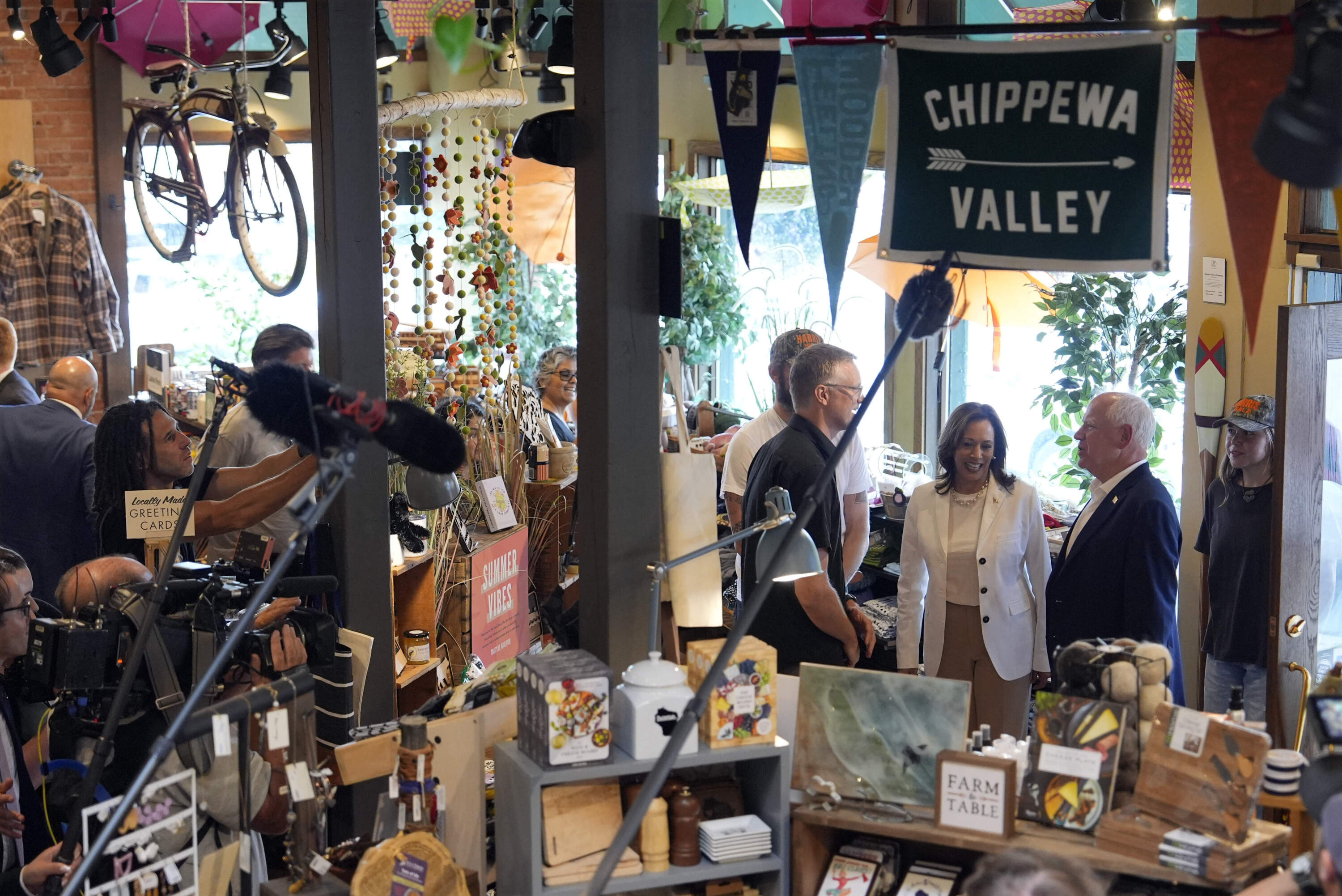
VP candidates JD Vance and Tim Walz hail from Midwestern states. Both use that identity to try and appeal to voters. Who will Midwesterners decide has it right?
Today, On Point: Midwestern identity on the 2024 campaign trail.
Guests
Jon K. Lauck, founder of the Midwestern History Association. Editor of the Middle West Review. Author of "The Good Country: A History of the American Midwest 1800-1900."
Kimberly Atkins Stohr, writer at The Boston Globe. Contributor at MSNBC.
Transcript
Part I
TIZIANA DEARING: Minnesota Governor Tim Walz is on the stage tonight at the Democratic National Convention to accept his party's nomination for Vice President. Coach Walz, as speakers have been calling him this week, will reportedly be flanked by former students and athletes from the town of Mankato, where he taught and coached football for a decade. The Dems are leaning into Walz's Midwest background hard as a core part of their campaign strategy. When fourth generation farmer Les Danielson took the stage at a rally in Eau Claire, Wisconsin earlier this month, he described his as a Wisconsin story.
LES DANIELSON: My wife Debora and I purchased 700 acres of our own land and now grow 500 acres of corn, soybeans and some hay. We built a grain setup and milk a small herd of cows.
DEARING: Danielson spoke about his family's history and land stewardship, and he spoke about his support of Tim Walz.
DANIELSON: And that's why I'm glad and excited that Vice President Harris's running mate is a lifelong Midwesterner.
DEARING: Walz then took the stage to the music of blue-collar icon Bruce Springsteen.
TIM WALZ: Thank you for articulating what we know it means to live out here in the Midwest. Care for your neighbors. Kindness. (CHEERS)
DEARING: Now that was a polite acknowledgement. And an anchor statement in the battle of the Midwesterners.
Yesterday, the Republican candidate for Vice President, JD Vance, declared at a rally in Kenosha, I basically live in Wisconsin now. Walz and Democratic presidential nominee Kamala Harris were in Milwaukee, 40 miles away. Both Vance and Walz are running on their biographies. Walz was born in West Point, Nebraska, before climbing the political ladder in Minnesota to the governor's office.
Vance, born and raised in Middletown, Ohio. He's been the state's junior senator for about 20 months. Both are on the ticket to offset presidential candidates often seen as coastal elites. But they offer different visions of who Midwesterners are and what they want. Walz hopes to appeal to community minded folks.
WALZ: Being a Midwesterner too, I know a little something about commitment to people. I was born in a small town in Nebraska where community meant everything.
DEARING: While Vance often talks about the hardships Midwesterners face.
JD VANCE: The most consistent complaint that I hear is that it is harder and harder for normal people to get by.
And I happen to think that if you work hard and play by the rules in this country, you ought to be entitled to a good life in the country that your grandparents built.
DEARING: Vance says there's really not much that unites the two except their region of origin.
WALZ: We're white guys from the Midwest. I guess there are similarities there, but what's different is the actual ideas about how best to serve people, white, Black, or anything else in the Midwest and everywhere else.
DEARING: So here's the question. Who's right about this idea of Midwestern identity? And which party has the winning message for a key political region in 2024? Jon K. Lauck is the founder of the Midwest History Association and editor of the journal, The Middle West Review. He's been an advisor to Republican South Dakota Senator John Thune.
Lauck studies Midwest history. He joins us now to help us get a grasp on this intersection of politics, Midwest identity. Jon Lauck, welcome to the show.
JON LAUCK: I'm here.
DEARING: Great to have you. Welcome. There's a lot of work to do, I think, just to start with what do we mean by Midwest and Midwestern. Now, this is an area of research for you.
What do you mean by Midwestern when you use it, Jon Lauck?
LAUCK: I think we should talk about the Actual region first, and that's 12 states, that stretch from Ohio out to Nebraska, Kansas, and the Dakotas and everything in between. About 70 million people, most of the states of the old Northwest ordinance, plus a few states to the West of there.
And I think what people mean when they talk about the Midwest is a place that was defined for generations by it. Small towns, farms, an industrial core that produce steel and automotive bills, et cetera.
DEARING: So I'm going to stop you there for just a second, Jon Lauck, because I was born and raised in the Midwest in Michigan, and you have these 12 states.
And I live in the Boston area now and you'll get beef from people just defining which neighborhoods are Boston, right? These 12 states. Do any of the states disagree with you? And even within states, right? Does southern Indiana or southern Ohio or parts of Missouri or Kansas consider themselves Midwest, versus South, versus West, Nebraska, for goodness sake?
How do you think about that?
LAUCK: This is a great debate. And at the Journal of Middle West Review, we've done a lot of polling on this and done a deep dive into particular states. For example, Ohio, since we're talking about Senator Vance, that southern southeastern tier of Ohio is extremely oriented toward Appalachia and West Virginia.
And we did a big poll of 2,000 people in Ohio earlier this year, and we found that 87% of people in Ohio identified as Midwestern. The major exception was that southern tier of counties, right up against Kentucky and West Virginia. And if this is, of course, the area where Vance's family comes from, they're former coal mining families that moved up into the industrial Midwest, you said you're from Detroit.
DEARING: No, I'm from Michigan, but I actually am from, I was born and raised in Battle Creek.
LAUCK: Okay. Anyway, in Michigan, there was a big industrial belt of cities and in industrial towns that drew in a lot of people, especially poor Appalachians, since they were so close to that part of the Midwest. And that's the backstory of Vance's family. So he's in this borderland. If you remember his book, he traveled back and forth from the traditional Midwest, Middletown, Ohio in particular. And then they would go back down into Kentucky on the Hillbilly Highway, which is what it was called. So they transcended regions.
DEARING: Okay so some contested areas on the outskirts. You've really looked at the history of the Midwest. And its formation in the 1800s and the 1900s, you've argued, has a lot to do with how we think of Midwest culture now. And a little later, we'll do the now part. But I do want you to give us a little bit of the then part.
Jon Lauck, in order to understand where we've come from in our understanding, to the extent that there ever is a sort of monolithic understanding of any group of people. What is the 'then' on the Midwest?
LAUCK: Big picture, we should just say this is a nation of regions. It's often forgot now when we have a national culture or mass culture, and we listen to all the same radio programs or TV programs. But in the 1800s, this country was deeply divided by regions and the Midwest was a very distinct place.
Very different from the American South, for example. And it was shaped by the rules set forth in the Northwest Ordinance of 1787. The Northwest Ordinance mandated that there would be a strong public education system in the Midwest, mandated that there would be a strong civil liberties system. It abolished slavery in the region.
So it made the place much different than other places in the country, especially in the South. People would write in their diaries about traveling down the Ohio River, and how they could see on the left, the slave society of the South and the more industrious, hardworking, entrepreneurial Midwest on the right side.
So these distinctions were very visible. And of course, ultimately this leads to a Civil War, and the Midwest provided hundreds of regiments to fight the South in the 1860s. And a lot of this was fought over regional differences. And in particular, the existence of slavery. South of the Ohio River, and it was a great annoyance to the South that so many slaves would escape into Ohio and into Michigan.
You mentioned Michigan. Michigan was one of the key stops on the Underground Railroad, as people fled North into places like Battle Creek, places like Detroit, Windsor, Ontario. And so there was a very deep divide between the regions. And this continues on into the late 19th century.
The Midwest is very proactive, passing Civil Rights laws, for example, and building strong education system. So that 95% of people in the Midwest are literate by the end of the 19th century. These are very high rates and there was a high degree of education for African Americans in the Midwest.
In fact, more African Americans in the Midwest were literate and educated than whites were in the American South. So these are very distinct regions.
DEARING: Let me jump in there for just a second, Jon Lauck, that is actually quite distinctive, and does give us a good sense. We're going to go to break in a minute.
Before we do, the other thing that I want to pull out is then you get into the 1900s and just very briefly, during what was known as the Great Migration. The Midwest did struggle and have the same kinds of racial tensions in a Joliet, Illinois or Springfield, for example, that we saw in a Tulsa race massacre, or other parts of the country that experiences racial tensions.
Just briefly. That is correct. Yes?
LAUCK: Yes, absolutely. When the great migration started, there were distinct trails that African Americans would follow out of the South and they desperately wanted to get out of the South. Because a lot of the racial restrictions that defined Southern life persisted after the Civil War.
And so there were these streams of migrants that would go up into particular cities. I think Detroit had a lot of African Americans from Mississippi and Alabama, that's true of Chicago too. But that led to racial tensions in the North. There's no question about it. And I think that just this week there was recognition of the racial tensions and race riot that took place in East St. Louis. I think that was recognized by President Biden. So that created a whole new era in places like Detroit, Chicago.
Part II
DEARING: Vice Presidential Candidate Tim Walz will take the stage at the DNC in Chicago tonight to officially get that nomination. Both he and Republican Vice Presidential Candidate JD Vance are from the Midwest and running on that nomination identity. But who is Midwestern? What is that? And who will have the winning message in 2024? We're joined by Jon Lauck, still with us. He is the founder of the Midwest History Association. He studies Midwest history. And we're going to add a guest here, Kimberly Atkins Stohr, a writer at the Boston Globe and contributor at MSNBC.
Kimberly, welcome to you as well. And I understand, as I know, you have your own Midwest credentials.
KIMBERLY ATKINS STOHR: I do. I am currently wearing my 'Detroit vs. everybody' t-shirt, because I was born and raised in the Detroit area, went to Wayne State University. So I understand that Midwestern life very well.
DEARING: Jon Lauck you were taking us through the history and the roots of the Midwest. Now I really want to bring us to today, Kimberly, I know you heard that. Your reactions to the strong public education system, the unique place that region held in the 1800s, the history of the 1900s and the Great Migration, to where we are today.
What is the Midwest now?
STOHR: Yeah, so it is the vestiges of all of that, right? Just the part that you were getting to with that Great Migration. That's really the story of my family. All three of my grandparents who lived past a very young age moved from the South to Detroit or actually one moved from Iowa to Detroit, to work in the automotive industry, to have a chance at a good middle-class, working-class life and to ensure that their children would get educated.
The education was a big virtue in my family and my grandparents and aunts went to higher education. I know in a lot of places in this country people in my generation, Gen X, are often the first college graduate in their families. I was not, because of that strong value in education that my family had and that desire to just build an American life.
But at the same time, I did feel the vestiges of racism too. Both that carried over from a lot of the people who came from the South, or who came from Appalachia, as Jon talked about. And also this sense that there was, we had, I grew up past the Civil Rights era and where there were a lot of tensions.
The first time I was called a racial slur was in Sterling Heights, Michigan. So all of those things are happening and it's all a part of what makes it the place that it is today, particularly for Black people and other marginalized communities.
DEARING: Jon Lauck what Kimberly was just saying makes me think to a moment just last night at the Democratic National Convention, when former President Barack Obama is on stage and he is talking about his own Midwestern roots.
He says wife Michelle Obama's mom reminds him of his own grandmother despite their differences.
BARACK OBAMA: One was a Black woman from right here, south side of Chicago, right down the way. (CHEERS) Went to Englewood High School. The other was a little old white lady born in a tiny town called Peru, Kansas. (CHEERS) Now, I know there aren't that many people from Peru. (LAUGHS)
And yet they shared a basic outlook on life. They were strong, smart, resourceful women, full of common sense. Who, regardless of the barriers they encountered and women growing up in the '40s and' 50s and '60s, they encountered barriers. They still went about their business without fuss or complaint and provided an unshakable foundation of love for their children and their grandchildren.
DEARING: And I'll note a little bit of political counter programming there, too, because Republican presidential candidate Donald Trump was in Michigan yesterday using a message of common sense, and then we hear Barack Obama talk about common sense as a Midwest value that his family owns.
The diversity, the growing diversity, Jon Lauck of the Midwest in the 20th century and into the 21st century. In your research, it has to be a piece that emerges.
LAUCK: Absolutely. Hearing Barack Obama talk about Kansas there reminds me of a piece of diversity in Midwestern history that we don't talk about very much.
And that is all the African Americans who moved into Kansas after the Civil War, and became farmers, the exodusters as they were called. So there are a lot of little towns in Kansas that were basically settled by African Americans. And Langston Hughes, the great African American author, comes out of this culture in Kansas.
So what Barack Obama is talking about there is an important slice of Midwestern history and a diverse slice of Midwestern history that people sometimes forget about. Of course, there's a Great Migration into the big cities of the Midwest, but there were also a lot of African Americans who came out of an agricultural tradition in the South, who set up small towns and farms throughout the Midwest, Michigan was a great home for these settlers too.
DEARING: So Kimberly Atkins Stohr, we're having this conversation about the Midwest, Midwestern identity, both who Midwesterners are and what they need. I want to stay on the who just a little bit longer. And we've talked about history. We've just been talking about the Great Migration. You talked about your own family.
The other thing, though, that I find myself thinking about is, you know, a Dearborn, Michigan, which is the first Arab majority city in the U.S.
Minnesota, where the population in Minnesota of the Hmong community exceeds 94,000 now. You've got Chicago where Cook County is now home for of over 15,000 people of Palestinian descent.
The Midwest is now an immigrant region too. When you look at a Tim Walz and a JD Vance, they are representing a white Midwest identity, but this is a diverse region, Kimberly Atkins Stohr.
STOHR: Yes, it really is. When I was going to school just outside of Detroit, it was incredibly diverse at a time.
Now it was sometimes difficult to maintain diversity in one particular community, because there was, it was beyond white flight. It would be cultural flight, right? It was a time when white Midwesterners would move outside of a suburban area, then that would be followed by a Jewish community.
And then that, when they moved out, then it would be a Black community. But I happened to be in a city called Oak Park when it was just at a blended, diverse point, where I had friends who were from the Middle East. I went to Bar and bat mitzvahs, along with birthday parties and Christmas parties.
One of my best friends was a Chinese immigrant. I learned of an America in my own classroom that looked like the melting pot, that Schoolhouse Rock talked about. And it was only afterwards, after I saw, finally, the neighborhood turned to almost completely Black and Latino. And then was confronted as I got older with the divisions between them, to understand a little bit more about what the country was like.
But it's a tremendous amount of diversity in the Midwest. And it has been for a long time, and certainly that has shaped the idea of what it is for a lot of people. But at the same time, when you're talking about, you have these two exemplars of white men, representing the Midwest, there was, and I can attest to it, also a fairly strong cultural push for what I call assimilation too. You get to the Midwest and it's okay that you're here, but you have to speak English. You have to live the American dream, work hard by standards that white people won't find you threatening and do all of those things at the same time while also trying to preserve your own identity, which can cause a lot of strife.
It can cause a lot of undercurrents of xenophobia and bigotry, that were also very palpable there.
DEARING: So there's so much in that Kimberly Atkins Stohr and you've laid out a lot of tensions in this Midwest. There is also a piece that seems like it could resonate in any other region of the United States right now.
And I find myself also thinking, as there is very clearly a battle for the Midwest happening with these vice-presidential candidates, with some of this messaging. The, I'm from Ohio, I'm from Minnesota. I'm the bootstraps guy. I'm the coach. The joke about Tim Walz is he's the dad who's gonna make sure you've got jumper cables in your trunk.
This exceptionalism for the Midwest is rooted in some political realities about how voting maps work, and it's probably the right time to remind us about that. Kimberly Atkins Stohr. That part of this is how the maps work.
STOHR: That's absolutely true. Gerrymandering is not something that just happens in the South.
People have always been very strategic with the way voting maps are drawn, in order to preserve political power to certain people. And I think that's why for so long, when we, political commentators have spoken about the Midwest and how politicians can appeal to Midwest voters. And even this term, which I don't like at all, but which is used frequently, everyday Americans.
That really is referring to a specific voter, which is usually white, usually suburban or ex urban in the Midwest. And that is, in part, because maps are drawn to give greater voter power to those parts of the Midwest, at the expense of people in more rural areas, at the expense, per capita, of people in the more urban areas, where the maps are really carved out to ensure more packing of political power, of people in more marginalized communities.
So that sort of perpetuates, I think, both culturally and politically, the thought, the way that campaigning is done in the Midwest and how that messaging is made and how it's received there.
DEARING: So let's use that as a transition to messaging and this sense of two parties fighting over what Midwesterners need.
Jon Lauck, and I'm gonna set us off with some sound from Michigan Representative Elissa Slotkin, a Democrat, who was speaking to PBS NewsHour from the DNC yesterday. Slotkin's running for the Senate and was talking about what Midwesterners need to hear from politicians.
ELISSA SLOTKIN: You can have all the highfalutin concepts, in a policy paper, that you want.
In Michigan, if you're not talking about people's pocketbooks and their kids, you're just not really talking to everybody. To me, that's a big lesson that Democrats should be using across the Midwest. And we're really excited that finally the Midwest is getting its recognition. We have a Midwesterner in VP Walz, or potential VP Walz, and we have a potential VP, JD Vance.
DEARING: That's political messaging. The research that you and your colleagues do in the Midwestern History Association, in the Middle West Review, there must be evidence based practices that show us what the needs are in this diverse Midwest region. What do we know about what the real needs are, Jon Lauck?
LAUCK: I think these pocketbook issues are first and foremost in people's minds, and this common sense that Barack Obama was talking about, is a way to win votes in the Midwest. I just wanted to elaborate on what something Kimberly said about the new immigrants to the region and how this fits into this question of common sense.
The Midwest has always been a region of immigrants from the very beginning, and people came from different directions. They came from New England. They came as Pennsylvania Quakers. They came from the upland South. And then there was this big foreign immigration, especially early on, the Irish, Irish Catholics in particular, and German immigrants were the first major groups to settle in the region.
And after that came the Scandinavians, et cetera. Why I bring this up is because Walz, I assume, is a German name out of Nebraska, a lot of German settlers in Nebraska. And, people forget this element of Midwestern history, the German immigrants did not have a very easy time, especially the ones who were Catholics.
There was a fair amount of anti-Catholicism in the region. And as Kimberly said, a pressure to assimilate. And of course, after World War I, there was very little tolerance for German culture. So people actually started passing laws saying you have to speak English, and you have to teach in your classes in English instead of German.
We've been down this road before and there is a certain pressure for assimilation. So it's not unique in our history. But it seemed to work. You may remember this political theorist, Horace Kallen, who developed and first imagined the theory of American democratic pluralism.
He did that after living in Wisconsin and seeing all these diverse groups working well together. And if we're talking about Wisconsin, of course, the Germans are a major ethnic group there, but they made it work. And they made it work by focusing on common sense themes, like trying to get ahead, working hard on the farm, trying to make a decent income, striving, embracing that Horatio Alger ethic that was very common in the Midwest, and not being extremely theoretical or radical or demanding too much.
I think that is a Midwestern tradition. That goes back a couple of hundred years. And that's what these people like Slotkin and others are tapping into, Slotkin and Barack Obama. And in terms of Vance, he's talking about the people who worked hard and strived and got ahead by working in these industrial plants in places like Ohio.
And that's what he's trying to emphasize with his life story. That he grew up in tough circumstances, in a poor household where there were drug problems, but he worked hard and got ahead. I think that's a very basic Midwestern message.
Part III
DEARING: I do want to now turn to not just 2024, but August 2024, September, October 2024, and then we're talking about the vice presidential candidates a lot.
And of course, there are presidential candidates as well who hail from the coasts, and it's a whole thing. But to what extent do messages for Midwestern voters play to non Midwestern voters right now, Kimberly?
STOHR: Yeah, Midwestern voters are concerned about a lot of things that everyone is concerned about.
Everybody is concerned about the economy. Everybody wants an immigration system that works. They want a strong education, but it comes from a place that is slightly different. My father was a union leader. So I grew up knowing the value of the labor union and the labor movement and people who want to fight for strong stable jobs that come with good benefits that allow someone to have a family comfortably.
That's very much, to me, what I think of when I think of Midwestern values. We talked about education, that being a really strong one. And related to that is this idea, when we talk about the everyman and kitchen table issues, and all people care about is what is the price of milk and they don't want to hear anything else.
That's a misstatement of Midwestern voters. Midwestern voters are incredibly savvy. They understand that if they have a business, then they do have to care about the broader economy. They have to care about how the stock market is performing. If they are talking about the grocery prices, that has to do with corporations and whether they are price gouging or whether they are buying up the mom-and-pop grocery stores that make it very difficult for people to not only shop local, but to keep those prices low. They understand the impact of the broader economy on farming, which is, a lot of farming towns in the Midwest. So they are very savvy, but they have a different experiential point of view when they're coming from it, they're starting small businesses.
They have main streets, not downtown's very often. And the economy of a main street is very different than the economy of a downtown in a big city. So it's the same issues, but it's from a different point of view, a different tangible experience.
DEARING: So there are a couple of things that I want to draw out in that are striking.
And one is you actually talked about unions, and this has been an interesting battle in this particular race for who unions will endorse. It was a little more up in the air when Joe Biden appeared to be the Democratic, likely Democratic nominee, running against Republican nominee, Donald Trump, then it is now, Shawn Fain of the United Auto Workers, at the DNC this week.
But that manufacturing history, right? You and I, again, born and raised in Michigan, where the UAW was like, I don't know, the Rotary Club somewhere else might be, right?
STOHR: (LAUGHS)
DEARING: That manufacturing history is a key piece of how the economy has changed in the Midwest, versus what you might see a loss and change be in a Georgia or a Delaware or even, let's say, a California or a Texas.
And yet the new manufacturing economy may play just as attractively in a Tennessee as it would in Illinois. So how to think about what the new investments will be and what candidates need to promise.
STOHR: Yeah. I think it's very important, within labor, an interesting thing was happening.
I remember when I was covering the 2016 DNC, and you had all the labor leaders there, and strongly backing Democrats, strongly backing Hillary Clinton. But what you began to hear and understand from the rank and file was that the populist message of Donald Trump began to really take hold and appeal, protecting the American workers.
This is what it means to be hardworking, and you should be rewarded for your efforts. And Donald Trump was able to speak to the rank and file in labor in a way that Democrats were caught flat footed on. And I think what you have seen in the ensuing years is Democrats through, people like Tim Walz, are able to make that case in a way that is attainable.
That is more understandable. That does make them feel heard. Talking to voters, no matter who they are, it's about making them feel heard. It's not about promising all these things that they probably don't think you can do. It's about making sure you understand them and their values.
And I think a Democrats have done a better job of it, but we've also seen the power of labor. We've seen major strikes from in recent years everyone from, automakers down to Starbucks workers. And that power of unionization has had a resurgence and it aligns more with the progressive, more Democratic populist message.
And so what I think you're going to see in this election is a swing back in that rank and file. Union leaders at the end of the day are always going to endorse the Democratic presidential candidate, I think in modern times, but I think getting their members to go along with it is something that Democrats are trying and doing a better job of doing, right now.
DEARING: So I want to pull on another policy thread here, Kimberly Atkins Stohr, as we look at messaging and policy promises from candidates heading into the November election. But I'm going to use Elissa Slotkin, the Democratic representative from Michigan who was at the DNC and spoke to PBS NewsHour yesterday, as a little bit of a foil.
Here she is comparing Walz and Vance.
ELISSA SLOTKIN: I think in Michigan and in the Midwest in general, we all know people like Tim Walz, and we all know people like JD Vance. We know the coach, the teacher that you love. The guy who's going to teach you how to drive and make you keep jumper cables in your car.
And we all know people like JD Vance, who are all about splitting people apart, dividing people, angry, that angry guy at the town meeting. So I think the vision that most of us want is a positive vision of Midwest values, and I think Tim Walz does a great job of embodying that.
DEARING: A very clear framing there.
We heard it again from former First Lady Michelle Obama last night. This hope and positive values. There are issues that come up for Midwesterners on the economy that are scary for Midwesterners. And one of the places that's interesting in that is this competition between energy policy and climate and how that plays out in Midwestern states.
Let's say the Dakotas in Jon Lauck, our guest from earlier in the show, they count in his list of the 12 Midwestern states. You've got Kamala Harris on fracking, for example. You've got Donald Trump literally using the phrase 'Drill, baby, drill.' And you've got what climate does in Midwestern terrain versus other parts of the country.
So what are the gnarly pieces that have to be pulled apart for the candidates and the parties in the inverse relationship between those two things?
STOHR: Yeah, it is hard because it's not as simplistic as political messaging sometimes likes to be, right? For a while, Donald Trump was able to have a winning, all this climate mumbo jumbo is bad for business.
It's bad for miners. It's bad for our industrial workers. And that resonated. But now, again, Midwesterners are savvy. They understand that climate is posing an existential threat. They're seeing the flooding and the drought and the other things that are harming industry, harming farms, harming a lot of things.
And they know that there needs to be a more nuanced solution. And I think what is much harder for Democrats to do is to try to pivot. And again, focus on the voters and make sure you hear them and try to bring them into the future, with a more climate positive, climate focused policy that does not leave manufacturing behind, doesn't leave workers behind, doesn't leave industry behind, and bring them into this new economy.
But that's a tougher pitch to make. And I think that's why Republicans, up to now, have had that advantage there because it's easier to make that simple pitch, even when it's not entirely in touch with reality, than it is to deal with the more complicated truth.
DEARING: So housing is another interesting issue.
When we look at the regions across the country, Kimberly Atkins Stohr, one in part because of the sort of the cyclical trajectory of housing falling apart, prices rising again, how interest rates have played out in Chicago. Let's say, or Detroit or a Kansas City versus a Las Vegas or Orlando, Florida, right?
And yet we know that affordability is an issue all the way across the country. Is there something different in housing policy that Midwestern states need, actually need, or need to hear, than other parts of the country in this housing crisis?
STOHR: I think what you are seeing in the Midwest is something that folks who live on the coasts have experienced for a long time, but the impact of the corporate real estate industry on housing, on housing for working class Americans, you see a place like Detroit. Detroit was built as an industrial town, a part of, it's Midwest, but it's also part of the steel of the Rust Belt, right?
Where that was built on industry that extends from the Midwest out East. And it was a place that you could buy a house. I think my parents bought their house in Oak Park for something like $40,000 when they bought it in the seventies, right? It was affordable, but now you saw Detroit decline and where housing prices really dropped through the floor.
But now that there is a renaissance of the city, you are seeing some of the houses go for hundreds of thousands of dollars and price out the people who live there. And this is a story that is happening throughout cities and suburbs in the Midwest at a really fast pace. And that has to do a lot with a lot of corporate investment that goes in and seems like a good idea in the beginning, but can really have some negative outcomes.
Leaders have to be able to come up with actual policy that will deal with that, that will protect the availability of housing for the people who built their lives there, and not see the kind of pricing out corporatization of neighborhoods the same way that you see it right now in, say, Washington, D.C., where I currently live, where it's extremely difficult for longtime Washingtonians to remain in the city.
That same thing is happening in the Midwest, and that is in desperate need of some attention and action.
DEARING: So we've set up a lot here, Kimberly Atkins Stohr, starting with sort of the history of how the Midwest evolved and developed at a time as, I guess Jon Lauck told us, when regions were the defining way you thought of the country, to the country we're in now in 2024 which is a growing, increasingly diverse certainly not monolithic country, nor any of the regions in it.
We've got a couple minutes left. Kimberly, and as a longtime political observer and analyst who's in D.C. now. Either, and it's dealer's choice for you, Kimberly, either what are you watching for in messages from the two parties over the next month or so, or if you're feeling frisky, what would you advise as the messages to the two parties in the month or two coming up?
You've got about 90 seconds for this.
STOHR: Yeah. I think in addition to what I said, is talking to voters so that they are heard and understand that you can show that you understand what they're feeling, what the issues they truly care about. But also, and I'm pro democracy. I'm not a registered member of either party, but I'm pro democracy, so a message for Democrats would be, yes, you still have to talk about rights and freedom and democracy, but you have to do that and understand that jobs is freedom.
That a strong economy is freedom, that racial equality is freedom. It's a difficult job. It's much easier just to say, Make America Great Again. But you have to talk about all those things at the same time, particularly to these savvy Midwesterners who understand, probably as well as, if not better than, I'm saying that as a biased Midwesterner, most just what that means on the campaign trail, what that means in their own daily lives.
These are the things that they're talking about at their kitchen tables.
DEARING: You were very efficient, which means I can ask you one last question.
STOHR: (LAUGHS)
DEARING: In D.C. in Congress, do they know that? Are those the messages they're carrying, too?
STOHR: I think in the House for sure, where you have a lot of representation.
But look, states like Michigan have shown, have been a great exemplar of what you can do when you talk in that way. They've implemented stronger voting protections. They have implemented protections for reproductive rights, which is probably the biggest issue in this election, listening to those voters in that state, which includes a lot of social conservatives, a lot of Catholics and a lot of others, but that still resonated as an important issue there. You have seen, even with some of the drawbacks on housing, the ability to rebuild industry and rebuild cities and communities like those, in and around Detroit.
So they have shown how to get it done, so they can really serve as an example and teach others too, just what that means.
This program aired on August 21, 2024.