Support WBUR
Can the Democrats win over voters in 2024?
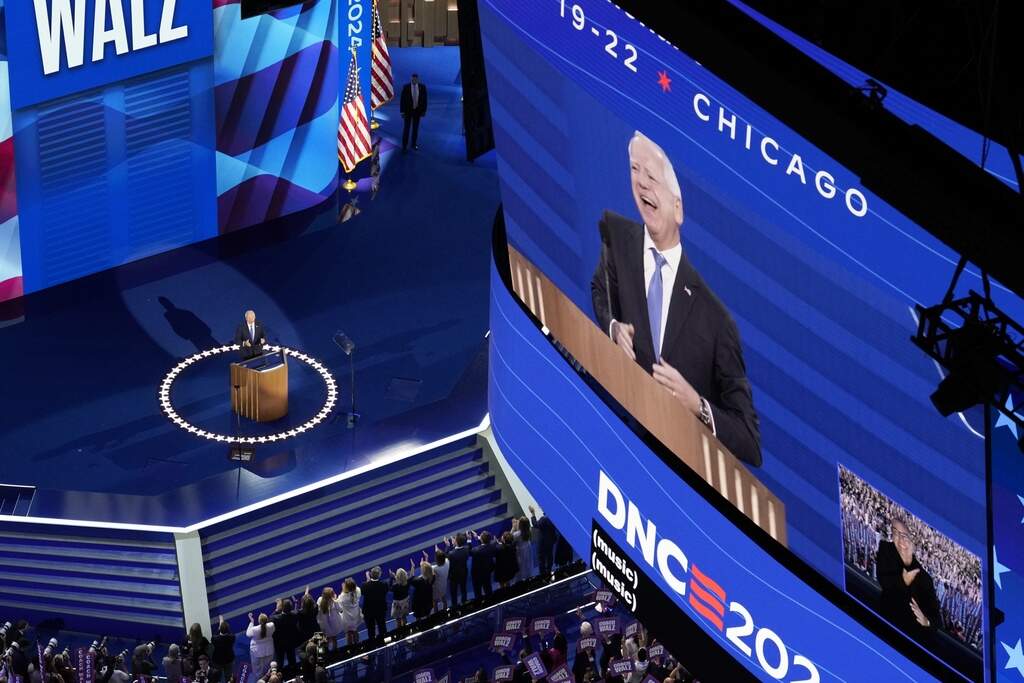
Democrats have a 2024 policy platform, covering topics like the economy and immigration. But they wrote it when Joe Biden was the nominee.
What do the Democrats stand for with Kamala Harris out front?
Today, On Point: What the Democrats stand for in 2024.
Guests
Elena Schneider, national political reporter at POLITICO, where she covers the 2024 presidential campaign.
Simon Rosenberg, longtime Democratic strategist. Author of a Substack newsletter called the Hopium Chronicles.
Also Featured
Evan Roth Smith, chief pollster at the Democratic public opinion research initiative Blueprint 2024.
Transcript
Part I
TIZIANA DEARING: Last night, the sounds of freedom rang through the halls of the United Center in Chicago as Democrats honed in on a new message in their campaign to keep the White House.
TIM WALZ: This is a big part about what this election is about, freedom. When Republicans use the word freedom, they mean that the government should be free to invade your doctor's office.
Corporations, free to pollute your air and water. And banks, free to take advantage of customers. But when we Democrats talk about freedom, we mean the freedom to make a better life for yourself and the people that you love. (CHEERS)
DEARING: That is Vice Presidential Candidate Tim Walz last night officially accepting the nomination.
But two days before:
All those in favor of approving the platform, please say aye. Aye. All opposed say no. Co-chairs, I am pleased to report for the record that with a majority of the delegates having voted in the affirmative, the platform has been adopted. (CHEERS)
DEARING: The party approved its official 2024 policy platform based on an old message.
Reelect Joe Biden, the 91-page document that outlines where the party stands on abortion, immigration, the economy, Israel, and other key policy issues this election season. The party drafted it in July before President Biden withdrew from the presidential race. It mentions him nearly 300 times. Trump appears by name 150 times.
Harris, just 32. Former New Orleans Mayor Mitch Landrieu served as DNC platform committee co-chair.
MITCH LANDRIEU: Our platform is grounded in our democratic values of hope, of progress, and love of our country. It makes a strong statement about the historic work that President Biden and Vice President Harris have accomplished hand in hand.
And it presents a bold vision for our future.
DEARING: Tonight, Vice President Kamala Harris officially takes the helm as the Democratic candidate. Just three days after they were approved, are those 91 pages still what the Democrats stand for? And what does the platform tell us about the Democratic Party today?
Elena Schneider of Politico joins us now. She's a national political reporter and is covering the 2024 presidential campaign. Elena, welcome to On Point.
ELENA SCHNEIDER: Thank you so much for having me.
DEARING: So a lot to happen in a few weeks and then a few days in sort of pivots in the Democratic party platform. What are the big headlines, we see those articles, Elena, the five key things in this platform for 2024.
SCHNEIDER: Look, you set it up really nicely, which is to say that so much of this party platform came together before we saw this dramatic and pretty drastic change in the trajectory of this campaign, which is to say that we went from Democrats putting forward an 81 year old sitting president looking for reelection and swapped him out with a 59 year old vice president, who is still broadly unknown by voters.
And I think that opens up some real possibilities and also some challenges and risks. But certainly, Democrats are feeling far more optimistic about what their situation looks like, given who their messenger is, on the platform that they passed. And you said it, as I said, you set up nicely because a lot of what was passed, as you said, came through in July before this switch was really officially made.
And so a lot of it still refers to what the Biden-Harris administration built and was going to build, a Biden reelection around, which is broadly popular policies for particularly Democrats, but which they also think will appeal to some swing voters. So this centers around things like trying to restore Roe vs. Wade.
So protections for reproductive health, but not going further than restoring Roe vs. Wade, restoring things like the child tax credit. Which happened in the first year after the COVID crisis, but was not able to extend it. Trying to do things around investing in infrastructure, raising the minimum wage.
These are all priorities that we have heard from Democrats for many years, some of which the Biden administration was able to move on, primarily around infrastructure and climate change, given their work with the Inflation Reduction Act and what they were able to do and invest on that front.
But look, this is again, this is still policies and topics that are broadly popular for Democrats, and ones that the Biden Harris administration has been, it's still basically in line with now that Harris has taken over the mantle. But there are some key areas where we sense that, or we can see that Vice President Harris is looking to push this further.
DEARING: So let's pick up. So before you do that and because I'm going to want to go deep on that part in a little bit, but there's something else that you said, Elena, that I want to make sure we flesh out a little more. At the beginning of your explanation, you said it presents some possibilities and some risks with this transition from Biden to Harris, in relation to this policy platform. And that feels like an important piece of the setup, right?
So if this platform, and when you look through the 91 pages, in every section, you can see the thing you just talked about, right? It starts with the Biden and Harris administration did this, and now the next step or the 2.0, right, or the steroids, are this. We should talk about what those assets and liabilities are. So lay those out for us, so that when we look at it, what Harris wants to do differently. We have that context.
SCHNEIDER: I think what I meant mostly in that in those opportunities and the risk with a new candidate is primarily that a lot was known about how Joe Biden wanted to govern and what his policy priorities and the way he would move through governing looked like, he was a moderate.
He was fundamentally somebody who was looking to always try to bring Republicans on board. That being said though, he did some really progressive things. So you've got some counterexamples and examples of how he operated as somebody who could govern. And I think far less is known about the way that Kamala Harris wants to do that, and we don't really have the details to flesh out some of what these policy proposals look like, because so far, her campaign has really resisted giving any further details.
It's much more trying to let voters project onto her what they hope to hear from her or what, be it a little more moderate, be a little more progressive, they've left a lot of details unknown. And I think that there, as I said, there's some risks to that, but there's also some advantages in letting people read into what they want out of what you're putting out so far so that you're not potentially alienating any voters.
So that's really what I meant by the opportunities and the risks that come from swapping in a new candidate.
DEARING: So you did then say, both, we've started to see a little bit of how they might differ and that's the big question and the Harris team has been reticent.
Interestingly, on the Friday before the DNC started, she did give a policy speech in one key area in Raleigh, North Carolina, and that was on economic policy. I'm going to play a little bit of sound from that. One area that she says she's focused on is lowering prices, including on prescription drugs and food.
KAMALA HARRIS: I will work to pass the first ever federal ban on price gauging on food. (CHEERS) My plan will include new penalties for opportunistic companies that exploit crises and break the rules, and we will support smaller food businesses that are trying to play by the rules and get ahead.
DEARING: Another key area was pledging to build thousands of new affordable housing units if she's elected president.
HARRIS: As president, I will work in partnership with industry to build the housing we need both to rent and to buy.
We will take down barriers and cut red tape, including at the state and local levels.
By the end of my first term, we will end America's housing shortage by building 3 million new homes and rentals.
DEARING: So both, what are the substantive differences on that piece? And why come out ahead of the DNC on economic policy in particular, Elena Schneider?
SCHNEIDER: I think a couple of things. Why focus on the economy?
We know that is still one of the most important issues for voters in this election. And so I think that in terms of how the Harris campaign is thinking about this election, they want to go with the issue that voters care about most, as they try to flesh out what their platform is going to be.
So that wasn't surprising, but what is notable is how she has focused on a more populist messaging lens to talk about those economic challenges that voters are facing right now. That is a real point of difference from President Biden. Biden was always a little more resistant to blame. Quote-unquote, big business, for some of the inflationary challenges that voters were dealing with right now, and Kamala Harris is going right after that.
And not only is she going after that by attacking them, she's also saying that she's looking to do work against price gouging, and look, this is an area where she has not really given a ton of details as to what a federal ban on price gouging would look like. And so that is delighting progressives, because that means that they can again, project what they'd like to hear onto that policy idea, but it's also opening her up to criticisms from Republicans who are saying that this would be socialist.
They're raising concerns about this being government enforced price controls, those are the sorts of things that the Republicans are going to want to use to recast the policy proposal that she's putting forward. But nonetheless, it certainly signals that she's willing to go down a sort of more populist route than what we had really heard from Joe Biden in what his plans had been for trying to jumpstart, keep the economy going strongly.
DEARING: Of course, her focus on price gouging, especially on food. In just a sentence or two, because we're going to go to break just momentarily here, Elena, the inflation piece of this, where does it fit?
SCHNEIDER: Look, the inflation piece is trying to bring down the cost of groceries, as you said. For so many people, that's still where they're really feeling the pinches, is when they go to the grocery store and the prices of milk and eggs is still far higher than it was a couple of years ago. And even though we've seen inflation cool, especially in the last few months, and in a sort of the macro trend outlook for inflation, looks far better than it did a year ago, that this, the feeling that inflation hasn't gone away is still being felt at the sort of micro level, as people go to the grocery store, and that's what she's trying to tackle. Even though that is really hard to do from the Oval Office.
Part II
DEARING: Now we'll welcome Simon Rosenberg.
He is a longtime Democratic strategist, also author of a Substack newsletter called Hopium Chronicles. Simon, welcome to On Point.
SIMON ROSENBERG: It's great to be here.
DEARING: So Simon, just before the break, we were just doing a quick compare and contrast on economic policy, because Vice President Kamala Harris did give a speech on that before the DNC.
But your two cents, pun intended, on that piece, before we move on.
ROSENBERG: Yeah. I think my general view, I listened to your conversation, is that the vice president will represent continuity and evolution from Joe Biden. I think that what we've seen this week is a very unified Democratic party.
We've seen our former presidential, our former president speaking. And I think that it needs to be, in terms of the economy, it's very important to recognize that Democrats have been wildly successful in our stewardship of the economy over the last three presidencies, all the last three Democratic presidents have all seen very robust job growth, very robust economic growth, rising wages, lower deficits.
We've seen that our modern policies towards the economy have been successful again and again. And I think there will be enormous continuity from our next president, Kamala Harris, as well as evolution. One of the things that I thought was most interesting about her North Carolina speech was the emphasis on housing.
This is, we've gotten a lot done under Joe Biden. But there are things that we still need to do. Housing may be one of the most important things that she focuses on.
DEARING: And yeah, and I know dissatisfied lots of people in America and polls have shown it dissatisfied about where the economy is.
And with Donald Trump fairly consistently polling higher in terms of people trusting him to handle the economy, at least going into, let's say, late July. So it presents this tricky moment. And actually, I don't want to spend too much time on the economy here, because there's some other things that I want to pick up, but I do want to push back on you with that, Simon Rosenberg, because that's a different picture also out there, about Democrats in the economy.
ROSENBERG: We have to distinguish between what's true and what people believe. And they're not always the same thing. What's true is that the economy is booming. Inflation is way down. The deficit is way down. Joe Biden's stewardship of the economy. We're doing better in America today than any other advanced economy in the world by huge margins.
We've seen the stock market booming, and I know that there are polls, last week, the FT had a poll showing Kamala Harris more trusted on the economy than Donald Trump. And I think the polling around this is changing and evolving. I think, look, there's a very dynamic race, but we have work to do.
There's no question we have work to do, but I think people are going to give Kamala Harris a fresh start and an opportunity to talk to them about what she's going to do, and she isn't necessarily going to carry all the baggage for Joe Biden. The second thing is that when you ask people questions about their own economic life and their life satisfaction, job satisfaction, income satisfaction, those are at historically high levels.
There isn't broad discontent about the economy in America. Otherwise, Democrats wouldn't be winning all these elections over the last two years. And we wouldn't be leading in this election either. And so I think the issues around the economy are complicated. And I think there's an understanding with many workers that we've made progress.
But the key is that she's going to be focusing on what we have to do now. ... And she began to do that on Friday.
DEARING: So a couple things there first to underscore one of your points, inflation at 2.9%, the lowest since March of 2021. You arguing that the economy is why Democrats have won in the last couple of elections.
There is another narrative out there, Elena Schneider, that abortion is actually part of, a big part of the reason that Democrats have won in the last couple of elections. And I pivot to that in particular because one of the threads I do want to pick up, that is intriguing in this moment, is the way a message of freedom, which that was last night's theme at the Democratic National Convention.
The pivoting that we're seeing to using it as a way to cover all kinds of policy issues that the Democrats care about. And you saw that in Vice President nominee Tim Walz's speech, where he talks about freedom in the context of freedom in the doctor's office, freedom with pollution and air and water, freedom from banks taking advantage of customers.
This link between a freedom message, but taking it in a new place. Are there legs for that in the actual Democratic policy platform, Elena?
SCHNEIDER: I absolutely think that there are legs for that in their platform. I think that's part of what they have been building on for a number of years, actually, is this sort of reframing the conversation around what they're offering to voters.
And it goes actually all the way back to, and I'm sure other Democrats have talked about it in different ways, but as it's been popularized in recent years. It started with Pete Buttigieg, during his presidential campaign, where he would often center and wrap the messaging that he'd talk about around this idea of freedom, the freedom to marry who you want, the freedom to have access to health care that actually covers your family.
He really leaned into that as a messaging frame. And then that was very much picked up in the reproductive rights space in Kansas, when they had a ballot measure put on after Roe vs. Wade was overturned, to try and eliminate abortion in their state. And Democrats once again took up that sort of scripture or that frame around freedom and privacy.
This idea that they were in favor of women and people holding on to their freedom of choice, but not using the word choice, but freedom to decide for themselves, and privacy to make those own decisions. And now we've seen that carry through all the way to the Democratic National Convention floor, as you said, with Tim Walz's speech last night.
I think that in conversations with pollsters like Simon, but others who are watching this, is that is proven to be an effective way to reframe some of these issues for voters to shake loose some of the language that maybe is a little bit more problematic or challenging, say the pro-life versus pro-choice set up that has been the traditional way to talk about reproductive freedom.
And now to try and reframe it around this context of freedom. At least in the minds of swing voters and particularly women, that they're trying to bring in here, that has proven to be very effective in congressional races across the country, since Roe vs. Wade was overturned.
DEARING: So we're here with Elena Schneider of Politico, Simon Rosenberg, longtime Democratic strategist.
We're looking under the hood of the Democratic platform, policy platform for 2024, which again is a reminder, written in July, drafted when Joe Biden is still thought to be the candidate, and now it's Kamala Harris. And part of the question is, how much holds, how much changes, and how much does it work in this campaign cycle?
Simon Rosenberg, tonight NBC is reporting that victims of gun violence are speaking at the DNC, and that'll include Gabby Giffords who was shot while serving in office in Arizona. One of the things that struck me in that Tim Walz speech last night, the second half, I talked about that first half with Republicans.
When he talked about a Democratic offering, one of the things he talked about, former public school teacher, was kids being free from being afraid of being shot in the halls of a school. Gun policy is a thing that has been a key differentiator in the past, not something we've heard a lot of conversation about.
Is it a piece that Democrats need to hit hard in this election season with their policies? Does it take a backseat now? You're a democratic strategist. What do you think?
ROSENBERG: Yeah, and just building on something Elena said, is that I do think that the themes that we're seeing now, because I do think the democratic language and our narrative, and our storytelling is evolving and changing.
I think we're in a very different place than we were six weeks ago, eight weeks ago, Kamala Harris and Tim Walz are starting to put their stamp on the party. And, to me, this emphasis on freedom and opportunity. On making sure that we go forward and not go back. These are really the foundational themes that we keep hearing throughout this convention, and they're powerful.
I feel like the democratic language and the storytelling is flowing very powerfully right now. And we feel like a party that knows where we want to go. On the question of gun violence, this is very central to our understanding of politics. Particularly since Uvalde and El Paso, the shootings that happened in recent years.
This idea that we want to have, we want to let kids be able to go to school. And as Tim Walz has often said, without the fear of their kids not coming home during that day, it's a central issue for parents. It's a legitimate and serious matter. In some polling, it's the single most important issue revolving around education in the United States. More so than I think the contrast between us trying to protect our kids and to make sure they come home safely, versus Republicans who are banning books, creates this very powerful contrast about our connection to families that are struggling to raise their kids.
And all the struggling of parents parenting. I'm becoming an empty nester this week. I just finished 24 years of being a parent and I can tell you that first of all, a joyous week, I know a joyous week for me, but the sad week, but joyous. But I think that this is part of the story that our party is telling, which is that we're on the side of people to have a better life and in every way that's imaginable. And I think it's real. It's in our guts. It's in our bones. It's really, I think what Kamala Harris is going to be all about. And this is a key part of it.
DEARING: So let's hold those two pieces in the frame for a moment, Elena Schneider, and ask explicitly, will we hear anything different policy wise from a Kamala Harris campaign than what is in the party platform now on abortion or guns?
SCHNEIDER: First of all, I have to echo also, I'm sending my kid off to pre-K this week.
We're all in our feelings right now as we start the school year again.
DEARING: I got you both. I hear you.
SCHNEIDER: That being said though, in terms of any marked difference from Joe Biden on abortion and on gun violence. Look, I think that the Harris campaign has intentionally stayed vague on what the details are going to be for their policy issues on a range of issues.
But I don't think, and I don't expect that there's going to be some dramatic difference, particularly on those two issues, two core issues that Kamala Harris and Joe Biden and broadly Democrats are pretty aligned on. I think on the reproductive freedom question. How she talks about that issue, I think is going to be where the difference comes, and certainly activists are interested in pushing her further on it.
So the language in the platform right now is to essentially restore Roe and the protections for women under Roe, which was being able to obtain an abortion up until the point of fetal viability at about 20 to 23 weeks. I think that certainly activists would like her to go further to push for even more access than what Roe offered.
But so far, we have not gotten any indication that she plans to go any further than that. And I think instead what she's going to do is to be able to speak about an issue that was deeply uncomfortable for the president. And it's somebody who is a devout Catholic and just generally didn't like even using the word abortion.
We're not going to see that discomfort from the vice president. And she can speak pretty authentically as a woman about what that experience is like in a way that a male politician just simply cannot do. So I think that, again, on those two issues and just generally on all the issues that we've seen the Harris campaign take on so far, that broadly speaking that they're going to stay in line with what we've seen coming out of the platform, and that rather the sort of the tone and the way that she talks about it is what's really going to be different here.
DEARING: Simon Rosenberg, one place where there has been pressure for Harris to depart is on Israel policy. Pro-Palestinian protesters have demonstrated outside the convention all week. Some of the protests have drawn thousands. Chicago has the largest Palestinian American population in the U.S. Here's a little bit of sound from outside the convention Wednesday.
(PROTEST)
Genocide Joe, you can't hide! Genocide Joe, you can't hide! We charge you with genocide! We charge you with genocide.
DEARING: This is an important one, a tricky one for Harris and one where people are standing right outside listening, right outside the building.
What do you anticipate? What do we know there?
ROSENBERG: Yeah, I think it is tricky, because she still is the vice president in an administration, and the president is still in charge of American foreign policy. And so I don't think we should anticipate her making any kind of dramatic break on this during the course of the campaign, what happens after the election or after she becomes president will depend on what happens between now and then, and what happens on the ground in Israel and in Gaza, but certainly she will inherit this enormous challenge, and we'll have to lead on it.
And I think it will depend to a great degree on what the circumstances are, what she inherits. And she's already signaled a sort of tonal difference and a greater emphasis on the struggle of the Palestinians, but it's really important to recognize that Joe Biden and Kamala Harris are for two state solution in the region, which is something that neither Netanyahu or Hamas are not for. That we, Joe Biden and Kamala Harris have been fighting really hard for a ceasefire from the very beginning. And Joe Biden actually negotiated one. And so I think that we've got work to do here.
This is a really hard problem. And I think this would be one of the most important early challenges of her presidency. But I don't think you should expect any kind of significant departure from current policy until she becomes president herself. And I'll note, two state solution and ceasefire, both explicit in the platform document, that was ratified, ceremonially ratified on Monday.
DEARING: Elena Schneider before we take a break, the other thing on my mind about the document that gets passed Monday when drafted under Biden, but now under Harris, is that also partly a way to preserve sort of some stability for down ticket races? Democrats are running for office for more than the presidency, and how do we think about that piece of this?
SCHNEIDER: Certainly, by having the platform remain the same. I think that helps as a broad priority list for down ballot candidates to run on and to talk about. But I don't think you could find a single down ballot candidate who isn't thrilled about the way that their fortunes have changed now that Joe Biden is no longer atop the ticket, but instead Kamala Harris is.
And there were some real realities far from policy, but really just the bare knuckles politics of the way that this campaign was going, that Joe Biden was really dragging not only himself down, but everyone across the Democratic party ticket, because of his concerns about his age.
And his ability to keep up a robust campaign that was affecting everybody down ballot. And we saw places, I'm thinking in particular of a place like Nevada, that Democrats were fearful that was just going to be entirely out of reach for them. And I think that Senator Jacky Rosen was pretty quiet about whether or not she wanted him to step aside.
But I think that ultimately the change has dramatically changed Democrats' chances and then that's not to say that they weren't also able. And since I called out Rosen specifically, she was running ahead of where Joe Biden was in the state. So it certainly was possible for her to outrun him and to still have won Nevada, even without Joe Biden winning it.
But the task to do that is far harder. And so the road to winning in those states has gotten, at least in public polling, gotten a little bit easier for these Democrats.
Part III
DEARING: There's a group of Republicans who've come out in support of Vice President Kamala Harris for president. That includes former Congressman Adam Kinzinger, who's speaking at the Democratic National Convention today. Kinzinger served on the committee investigating the January 6th U.S. Capitol attack. Here he is at a virtual event for a group called Republicans for Harris last week, which he helps lead.
ADAM KINZINGER: If I have two targets, one is far off and one is five meters from my trench, I'm going to focus on the five-meter target. The five-meter target is the threat to democracy. The 20, 30 meter off target is the differences we have in policies.
If we can eliminate this threat to democracy, proverbially, if we can seal up our democracy and restore faith in our election system, if we can defeat Donald Trump, then we can go back to the luxury of arguing about policy again. Cause that's what democracy is.
DEARING: about Trump skeptical Republicans who have yet to sign on for Harris and the coveted independence across the country?
What are those voters hoping to hear from Democrats? Evan Roth Smith has some ideas, he's chief pollster at the Democratic Public Opinion Research Initiative called Blueprint 2024.
EVAN ROTH SMITH: Talking about democracy, talking about Donald Trump as a threat to our democracy is not a particularly effective way to win over swing voters or to persuade Republicans who might have doubts about Donald Trump.
DEARING: Instead, Smith says Democrats should target the two biggest issues, immigration and the economy, especially reducing inflation.
SMITH: When we polled policies like prosecuting companies for price gouging and price fixing, 81% of voters, all voters, supported that. And you know what? It really wasn't all that different across the parties.
Independents were at about 84%. That's a huge number in American politics. It's very rare to find 81% of Americans who agree on a certain political action, and we also polled things like investing in supply chains, right? That has 66% right? That's 2 thirds of American voters in a country where our elections have been 51%, 49%.
It feels like for a generation, to hear that two thirds of Americans agree on something or that 81% of Americans agree on something means it's great politics.
DEARING: While some economists have expressed skepticism about Harris's price reducing policies, as we've mentioned, Smith says politically they're very popular.
And he says that Blueprint's polling shows tax policy might be a good place to try to reach Republicans, especially those who voted for Nikki Haley or Ron DeSantis in the primary.
SMITH: They're worried about Trump's tax cuts, that it'll blow a hole in the federal budget, that it's a giveaway to wealthy corporations and wealthy individuals, ultra wealthy individuals.
And so one of the best ways for the Democratic Party to win over Republicans who are skeptical about Trump isn't to talk about democracy, it's to talk about tax policy. And to talk about things like no tax increases on any household, making under $400,000, the Democratic nominee for Vice President, Tim Walz, when he was in Congress, had a pretty serious record as someone who took the deficit and the national debt very seriously and took cutting taxes quite seriously.
DEARING: And then there is the issue of immigration. Lawmakers negotiated a border bill in the spring that had broad bipartisan support, before Republicans killed the measure at Donald Trump's urging. Evan Roth Smith says the border bill polled well with voters at the time.
SMITH: About two thirds majority support. And in key voting groups like seniors, it was polling about 90%.
Voters of all types, but particularly among key voting groups like seniors, as I mentioned, and also independents, really want to hear, hey, we're going to serve some resources to the border patrol, right? We're going to try and clear some of these asylum courts so that we can adjudicate these cases.
And we need to reevaluate exactly who is applying for asylum and refugee status.
DEARING: Lastly, Smith says Harris has a big advantage with voters on the issue of abortion rights.
SMITH: We polled independents and said, who do you trust more on reproductive issues? And Kamala Harris has a 22-point advantage over Donald Trump.
It's her biggest advantage on any issue.
DEARING: Smith thinks Harris should talk about abortion rights more on the campaign trail to bring the issue back to the center of attention. And that's Evan Roth Smith, chief pollster at the Public Opinion Research Initiative Blueprint 2024. And we are talking about the Democratic Party's policy platform in this year's presidential election.
Elena Schneider is here, national political reporter at Politico, and Simon Rosenberg, longtime Democratic strategist. And now for the rest of the time, this is the question, right? The people who are not in the bag, as they say, for either Kamala Harris and Tim Walz yet, or Donald Trump and JD Vance yet, and this new Democratic policy platform for 2024 and whether it will draw them in.
Simon Rosenberg, Democratic strategist. I'm sure you have many thoughts on what you just heard. So let me just start by letting you unload a couple of them. Yeah.
ROSENBERG: No, quickly. And is that I do think the general argument we're making and the story we're telling, freedom, opportunity. Focusing on the future and not the past is very broadly appealing, not just to Democratic voters, but to independents and Republicans.
And I think that the thing that is going to be very important is we're now seeing very prominent Republicans come out at the convention in their own communications about the need for Republicans and independents to support Kamala Harris. And it's going to be a major part of the campaign.
We've seen it here in the convention. And the way we talk about it in politics is that those political leaders like Jeff Duncan from Georgia are giving a permission structure for other independents and Republicans to vote for Kamala Harris. He had a great line last night, which is, voting for Kamala Harris doesn't make you a Democrat.
It makes you a patriot. My fellow Republicans. It was a very, one of the most powerful lines to me of the convention so far. And that language is saying, look, it's okay to vote for her. You can stay a Republican and still vote for her. So I do think that the work the former Republicans are going to do in the next few months, the ads they'll cut, campaigning they're going to do.
This is going to really matter. It really mattered in 2022. It mattered in 2020, but it mattered much more in 2022. And I think this is now very central to the entire campaign, the Harris campaign. And so I'm optimistic that we can make inroads. Those Nikki Haley voters from Republican primary, I think are still loosened and available to us.
We've got to go work our butts off to get as many of them as possible on our side.
DEARING: Elena, let me play you a little sound from earlier in the week at the DNC. Kyle Sweetser works in construction in Alabama. He spoke on Tuesday. He told the crowd he had been a repeat Trump voter who came to realize the former president's tariff policies could hurt him economically.
Now he's saying he's voting for Harris.
SWEETSER: He told us he'd look out for blue collar workers. So I made my first ever political donation to Trump, and I donated to him many times throughout his presidency. But then I started to see Trump's tariff policy in action. Costs for construction workers like me were starting to soar.
I realized Trump wasn't for me. He was for lining his own pockets. Now I'm not left wing, period. But I believe our leaders should bring out the best in us. Not the worst.
DEARING: So you've got the patriotism message that Simon just talked about. We've got what Kyle Sweetser is saying here, and that is economy.
... I'm struck with a conversation I had with a congressperson from Massachusetts a couple of weeks ago, Jake Auchincloss, who said he thought the party's appeal to Haley voters, Nikki Haley voters. And that seems to be a proxy here, is faith, flag, family. To convince middle voters that's a thing Democrats still care about.
Is this a yep. Or, does there have to be a hierarchy here? And if so, how do you do that?
DEARING: Look, I think that they're going to try to maybe in some ways throw a bit of spaghetti at the wall and just see what sticks with these voters and throw a lot of this messaging at them.
But I should say this in a very targeted way. We also know that the campaign has kept a very close eye on where these Nikki voters, Nikki Haley voters are. And you're right. That's a proxy for these swing voters or these voters who lean Republican, but don't like Trump and have been a challenge for Trump and Republicans broadly ever since he was elected in 2016, we know that they've been keeping a close eye on them and throughout actually the primary.
As Nikki Haley dropped out herself, voters still voted for her. I think particularly of Pennsylvania, she had dropped out maybe a month before, but that primary there with thousands of voters, particularly in the collar counties around Philadelphia. Who nonetheless voted for her.
And then the campaign very quickly cut a digital ad that talked about Donald Trump attacking Nikki Haley and Nikki Haley voters targeting those voters. And I'm sure that they have tried to keep up that conversation with them, going after them on a host of issues that got laid out Here. As Simon said, on patriotism, on quote, unquote, decency, and then also trying to push an economic message. And I think I would also flag something that, from that clip, that you played from the DNC, something that he said was I'm not left wing. And I thought that was notable as giving people a permission structure,, in which to say, even though she may not fit everything or tick every box that I stand on policy wise.
That nonetheless, people like me are still supporting her. And the other side of that story is that we've seen Kamala Harris back off some of the more far left or super progressive positions that she held during the 2019-2020 Democratic presidential election. I'm thinking particularly of her stance on banning fracking, which is very popular in a place like Western Pennsylvania, where that's a real part of the economy.
She's now very much backed off of that entirely and said she's in effect, reversed positions on it entirely. So they're looking to try and bring these voters in both, in a sort of tonal message targeting around patriotism and decency. And also trying to build out a permission structure from those either former Republicans or current Republicans who are voting for Harris, to say, look, people like me feel this way and that gives you the space to vote for her too.
DEARING: So Simon Rosenberg, and listening to all of that, one of the things that is striking is this, I don't know, art, alchemy, challenge, you pick, of weaving together identity and policy. Which we're coming up with over and over again. And then of course, one cannot miss the fact that Kamala Harris is running to be the first woman president, the first woman of color president and this identity and policy intersection for undecided voters.
Talk about that.
ROSENBERG: Just building on what Elena said, I think that in addition to us using Republicans to speak to independents and Republicans. The other tool in our toolbox is going to be the vice president, our vice presidential candidate, Tim Walz, who comes from a small town, comes from a rural part of America.
And I think that the genius of that pick, and I was skeptical of the pick in the early days, because he wasn't well known and I was worried that bringing somebody who has not been on the national stage to be on the national stage, it's a big leap, right? And obviously he's done a great job. But Kamala Harris is telling people who live in rural areas in the United States that she considers them to be on their team, on her team, places in the country, parts of the country that have been hard for us to get to. And she's saying now to all those voters and those people that live in rural areas, I've now got as my vice president, one of you guys, somebody who grew up in a small town.
One of my favorite lines of this whole election is his line about how his high school graduating class was 25 people and he was related to 12 of them. It's one of, to me, it's one of the best political lines in modern times.
And he, and so I think that this is, I think we haven't really totally processed this part of his emergence either, in terms of her wanting to expand the coalition and grow our map and let people that perhaps felt the Democratic party wasn't for them to let them know that, Hey, we have an open door. We're welcome. Come check us out. We are not in opposition to you and we're trying to lessen that sense. I think, what I have heard, what I heard last night in particular. Is this enormous effort by the Democrats to try to bring everybody back together again as a country, to ground our campaign and love of country and love of neighbor, love of community, love of one another.
This is new language for our politics, and it is really the opposite of Trumpism, which is about division and about pushing us apart. And I think it's so welcome and necessary. I think it's the way that we really not just beat Trump, but that we beat MAGA. And which is something bigger than Trump.
And so I'm really deeply encouraged that we're not just talking about, as Adam Kinzinger said, just beating the Republican candidate. We're figuring out how to beat an ideology that has become dangerous for the country. And I think that we're getting, I think we've made enormous strides in the last few weeks in that regard.
DEARING: And I'll note we spent an hour yesterday talking about Midwestern identity, the battle between the two vice presidential candidates. If you missed it, you can check that hour of On Point out as well. And Elena. All right. So here's the last piece then. This is the battle for the independent voter, and we know these polls have been often, small differences between candidates within the margin of error.
How much fruit is there left to be plucked off the tree? When we look across the polls, is there a policy platform that could move enough people? Are there enough out there to be moved?
SCHNEIDER: Certainly, I think that there are people out there to be moved. It's just, as you said, at the margins. And we're dealing with very small numbers of people in a specific group of states where the electoral college is decided, thinking about places like Pennsylvania, Michigan, Wisconsin.
But arguably Kamala Harris has some path through some Sunbelt states. North Carolina has been newly put back on the map now with the new candidate at the top of the ticket. So that's where they're going to be looking for these voters to try and decide this election. And I think to your question about the identity of who she is and the fact that Democrats have nominated a woman for the top of their ticket.
I think the way that she's talked about her identity speaks to her effort to try and continue to connect with that very narrow group of voters. We talked to more than a dozen or more than two dozen women, a lot of them who represent first in their own political careers about how and what way she has talked about her identity, which is basically not much. She has not leaned into a lot of the history making aspects in an explicit way. And that's in direct contrast to Hillary Clinton, who certainly did talk about the highest, hardest glass ceiling. It wore white pantsuits, talked about the little girls watching her who wanted to be president one day.
Kamala Harris hasn't done that. And I think in part because she wants to center the swing voters that her campaign needs to win over and focus on their issues and how she can get it done for them. And it speaks to the focus of their campaign that they want to keep that front and center. That will be the thing to watch tonight.
This program aired on August 22, 2024.